American Electrical Services runs licensed commercial electrical work for businesses across Idaho's Treasure Valley and over the Oregon line — offices, retail, restaurants, shops, warehouses, clinics, churches, rentals and light industrial. Idaho Electrical Contractor LIC# 3671445. Call (208) 782-8268. What follows is the part a business owner actually needs before booking anything: how long your power goes off, who has to approve the work when you lease your space, what a commercial permit and inspection involve, and what moves the price.
What happens from your first call to the final inspection?
Commercial work runs on four steps, and we keep them separate on purpose.
1. The call, and the first question we ask. It is not what you want done — it is whether anything is unsafe right now. Burning smell, a hot panel, exposed wires, arcing, a scorched breaker: that is an emergency dispatch and it does not go through the estimate process. Everything else gets scheduled.
2. The walkthrough. For commercial work this is its own appointment, not a step tucked into the front of the repair visit. A licensed electrician comes to the building, opens the panel, reads the actual load against the actual service, looks at the circuits in question, and finds out what is really behind the wall or above the ceiling grid. We book it as a separate visit because a business needs a scope and a date before it can decide anything, and you cannot get either from a phone description.
3. The written scope, with the outage window in it. You get a flat price in writing, and alongside it the part most contractors leave out: which circuits go down, on what day, starting when, and for how long. If that window does not work for your operation, we move it before anyone commits, rather than discovering the conflict on the morning of.
4. The work, then the inspection if the job needs one. Permitted work is not finished when we drive away. It is finished when the state inspector signs it.
How long will our power be off?
This is the number businesses actually want, and it is not the same number as "how long is the job."
A repair or a troubleshooting call — a dead circuit, a failing breaker, a bad outlet, a light bank that stopped — usually takes only that circuit down, and the rest of the building keeps running. We diagnose and repair on the same visit whenever the part is on the truck; when it is not, you get told what we are waiting on and when it lands, rather than an open-ended second appointment.
A lighting changeover or a circuit addition takes down the area being worked on, in sections. Retail and restaurants normally get this done before open or after close; we would rather be finished before you unlock the doors than watch you turn customers away.
A panel replacement on the same service size takes the whole building's power down for a defined block on one day. We tell you the block before the day, and we plan the work so the block is as short as the job honestly allows — not as short as it sounds good to promise.
A service upgrade — moving the building to a larger electrical service than it has now — is the one that surprises people. The meter and the wires feeding your building are the utility's property — Idaho Power, for buildings on the Idaho side of the area we cover — so that date is not entirely ours to set. That coordination step is where these jobs most often pick up extra calendar, and it is why we raise it at the walkthrough instead of at the end. Replacing a panel without changing the size of the service skips that step entirely. A service upgrade never does.
Permits and inspections add calendar, not labor. Neither one is compressible by working harder, and anybody who tells you otherwise is guessing. What we can do is tell you at the walkthrough whether your job carries them.
Do we need a repair, new circuits, or a service upgrade?
Businesses tend to arrive asking for the biggest version of the fix. Often they do not need it, and it is worth being honest about which one you actually need before anyone quotes a price.
A repair is the right answer when one thing has failed and the rest of the system is sound. A breaker that trips on one circuit, a dead outlet, a fixture that quit. We chase the fault to wherever it actually lives and repair that.
Added circuits or a lighting changeover is right when the service and panel are fine but a specific area needs more capacity, better light, or its own circuit for a new piece of equipment. This is the usual answer in a suite that has changed use — laid out as an office, now running kitchen or shop equipment.
A service upgrade is right when the building's total demand has genuinely outgrown what the service was ever sized for. Two things make this different from the same job at a house. First, the load calculation — the arithmetic that adds up everything the building actually draws — has to account for a tenant mix rather than a household: what each suite is running today, what the last occupant left connected and nobody unplugged, and what the vacant unit will draw when it fills. Second, the utility does not deal with whoever called us — it deals with whoever holds the account, which in a leased building is usually the landlord. That is a phone call you may not be the one who gets to make, and it is better discovered at the walkthrough than once the work is under way. The shared mechanics of panel work are covered on our panel upgrades page.
If the building still has a Federal Pacific Stab-Lok or a Zinsco panel, we will put that in the written scope whether or not you asked about it. Both lines carry documented failure-to-trip histories, and in a commercial building the consequence is not only safety: it is the panel your insurer asks about, the panel a buyer’s inspector photographs, and the one item a landlord cannot claim not to have known about once it is in a written scope. Fitting a new breaker into one of them does not change any of that.
What usually goes wrong in an older commercial building?
Most of what we find in an older commercial building was installed correctly for a business that is no longer in it. Tenants change, equipment changes, and each remodel gets done by whoever was available that week. What accumulates is rarely dramatic and rarely flagged by anything until an inspection or an insurance review goes looking.
The recurring ones: a circuit extended during a previous tenant's buildout with no record of where it goes; a panel carrying more than it was listed for because each new tenant added one more thing and nobody re-checked the total; wiring sized for the equipment that used to be plugged into it rather than what is plugged in now; and missing shock protection at kitchens, restrooms and wet areas where current rules require it. We look for these on any commercial call, not only when a compliance review is what you asked for, and we tell you what we found even when fixing it is not this visit's job.
Depending on what kind of business you run — a restaurant, a clinic, a warehouse — local fire and building requirements can apply on top of the electrical rules. Sorting that out is part of what the walkthrough is for.
Who has to approve the work — you or your landlord?
This stalls more commercial electrical jobs than any technical problem, and it is worth settling before you call.
In a leased space the electrical system is usually split. The service, the main panel and everything feeding the building are typically the landlord's. Everything inside the leased suite — the sub-panel, the circuits, the outlets, the lighting — is typically the tenant's. Typically. Your lease is the authority, not the convention, and the split moves depending on how the lease was written.
What that means practically: a tenant can normally approve work inside their own space, but work at the main panel, at the meter, or anything that changes the building's service almost always needs the owner or property manager to sign off, because it affects every other suite in the building. We will do the walkthrough for whoever calls us, put the scope in writing, and hand you a document you can forward to your landlord — but we will not open a main panel on a tenant's say-so when the lease puts it on the owner. That is not caution for its own sake. It is how a job avoids turning into a dispute.
Does commercial electrical work need a permit in Idaho?
Many commercial jobs do. The thing to know first is where the permit comes from: not your city hall and not the county, but the state — the Idaho Division of Occupational and Professional Licenses, through its Electrical Board. If you have been chasing the wrong counter, that is why.
Three things are specific to a commercial job:
- The permit is pulled under our contractor license, not under your business name. You are not filing anything, and your business is not the party on the hook for the paperwork.
- In a leased building, the sign-off comes before the permit, not after. Anything touching the service needs the owner's approval first, and the landlord will usually want the closed inspection for the building file.
- The inspector looks at the whole circuit path the work touched, not only the piece we installed. That is why a previous tenant's shortcut sometimes surfaces at inspection on a job that had nothing to do with it — and why we flag what we find at the walkthrough rather than at the end.
Permit fees are set by the permitting authority rather than by us, so waiving them is not ours to offer. What we do instead is break them out on the quote — our labor on one line, the state's fee on another — rather than folding both into a single figure and letting you guess. For a commercial building the closed inspection is also the document your insurer, your landlord and any future buyer will ask to see.
Emergency electrical service for your business
Some things get scheduled. These get dispatched:
- Any smell of burning or hot plastic near a panel, an outlet, a light fixture or a piece of equipment
- A panel door, breaker or switch plate that is warm or hot when you touch it
- Browning, blistering or melted plastic anywhere on a device or a cover plate
- Buzzing, humming or a crackle you can hear standing next to the panel
- A breaker you have reset that will not stay on — it is protecting you, and whatever is wrong is still there
- Anyone on site getting a shock from a machine, a fixture, a sink or a switch
- Wiring left exposed or torn loose after a storm, a vehicle strike or a water leak
- A dead main while people are still in the building
Stop using that circuit and call (208) 782-8268. On an emergency call we prioritize by what is unsafe for your staff and your customers, not by ticket size — a scorched panel outranks a capacity project every time.
A genuine emergency is dispatched rather than scheduled. It does not go through the estimate process, it does not wait for the next open walkthrough slot, and same day is often possible. If we cannot get to you quickly, you will hear that on the phone along with what to shut off in the meantime — which breaker, which disconnect, or the main — rather than being left to guess while you wait.
What does a commercial electrician cost?
A flat price for the job, in writing, approved before anything starts — with the outage window written beside it. Both are fixed. The number does not climb because the job ran long, and the window does not slide because we found something interesting behind the wall. If real added scope turns up, you see the new number and approve it before we carry on. Nothing here is billed by the hour, so nobody is standing in your ceiling on your clock.
We will not put a number on commercial work we have not seen, and the reason is particular to this trade. Nearly everything that moves the price stays hidden until somebody opens a panel or lifts a ceiling tile:
- Whether we can reuse a circuit that is already there or have to pull a new one
- Whether the panel has room for more breakers, enough amps to carry them, both, or neither
- How far the wire has to run, and what it has to pass through — running above drop-ceiling tile you can lift out is a different job from cutting into drywall, block or concrete
- Whether Idaho Power has to be scheduled alongside us
- Whether the work has to happen before you open, after you close, or on a weekend to keep you open
- Whether a previous tenant's work has to be corrected before ours can pass
- Whether a permit and inspection apply
Every one of those is settled in a single walkthrough and unknowable over a phone call. That on-site estimate is free — the visit, the written scope, the flat price and the outage window cost you nothing, whether or not you go ahead with the work. That is why we will not quote a price over the phone, and it is exactly why the walkthrough exists.
Where we work, and what else we do for businesses
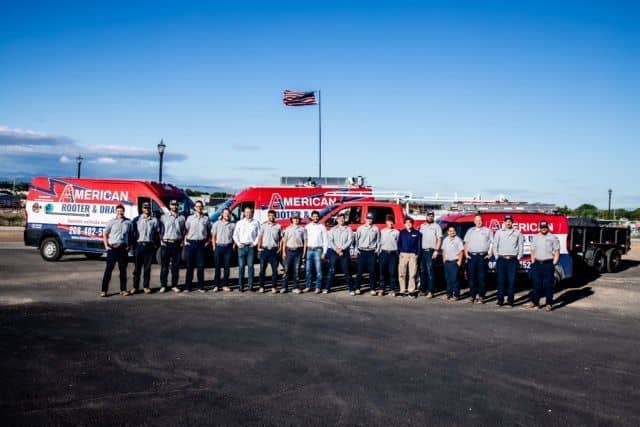
Across all our trades combined — plumbing, drain and sewer, septic, heating and air, and electrical — 210 businesses have had us out on 821 completed jobs since January 2025. That is the whole company’s commercial work rather than the electrical slice of it, but it is the same dispatch, the same service area and the same trucks. The work sits in the Treasure Valley and just over the Oregon line, and eleven towns carry 720 of those 821 jobs: Nampa, Boise, Ontario and Caldwell lead, followed by Nyssa, Weiser, Meridian, Payette, Kuna, Vale and Parma. If your building is in one of them, we are already working nearby most weeks.
- Panel upgrades and service capacity
- Electrical repair and troubleshooting
- EV charger installation — for staff and customer parking, sized for the stations you will add later, not only the ones you are adding now
- Generator installation with a proper transfer switch
- Lighting installation
- All residential and commercial electrical services
- For sewer and drain work at a commercial property or an HOA, see trenchless plumbing for commercial buildings
Service area by city: Boise · Nampa · Caldwell · Meridian · Ontario, OR
About American Electrical Services
The electrical brand of American Rooter & Drain is an Idaho DBA (ABN 0006889156). It carries Idaho Electrical Contractor License LIC# 3671445 in its own right, with its own electricians and its own direct line at (208) 782-8268. The parent company was established in Caldwell, Idaho and has served the greater Treasure Valley since 1945; both work out of 1005 Commercial Way in Caldwell, and the main American Rooter & Drain line is (208) 366-5771. Company background and residential electrical work live on the electrical services page.
Need a commercial electrician? Call (208) 782-8268 — you get a person, not a menu — or request service online for a free on-site walkthrough and a written price with the outage window in it.