

American Electrical Services installs home EV chargers across Idaho's Treasure Valley and out into eastern Oregon. The thing that decides your price is whether your electrical panel has room to spare — and that is a number we work out at the house, not a guess. Below is what that check involves, how the job changes between an attached garage, a carport, a driveway and a detached shop, whether you want the charger plugged in or wired in permanently, and how long each version actually takes.
Idaho Electrical Contractor License LIC# 3671445. Call (208) 782-8268 or request service online for a free on-site estimate.
How long does it take to install a home EV charger?
The estimate visit. An electrician looks at your panel, walks the path the wire has to take, and confirms where you want the charger. This is where we work out whether your service can carry it, and where you find out which of the installs below you are in. You get a written flat-rate number before anything is opened up.
A straightforward install — the panel has power to spare and an open space, and the charger goes on the garage wall near the panel. One appointment. We run the dedicated circuit, install the breaker, mount the charger and start it up, and we confirm the car is drawing power at the rate it should before we pack up.
A long run across the house, a detached shop, or a trenched driveway. Still usually one appointment, but a longer one, and the trenching depends on the weather and on the underground utility lines getting marked first. Anything that gets dug has to be called in to 811 — call before you dig — ahead of time, and that lead time is set by the line-marking service, not by us. We schedule around it rather than surprising you with it.
Charger plus a panel or service change. Two phases. The panel work comes first and carries its own permit and its own power shutoff — and if the size of the service itself is changing rather than just the panel, there is a coordination step with Idaho Power, because the meter and the wires feeding your house belong to the utility. Utility scheduling is outside our control, and it is a common reason a project runs longer than the homeowner expected. The charger circuit then goes in on top of a service that can actually carry it. We tell you which phase you are in before you commit to anything.
Permits and inspection run alongside all of it. Electrical permits in Idaho are issued through the Idaho Division of Occupational and Professional Licenses under the Idaho Electrical Board — not the city and not the county. When the job needs one, we pull it and we schedule the inspection.
Can your panel handle an EV charger?
This is the real question behind every quote, and it is the one a phone quote cannot answer. It has two halves that people collapse into one.
Does the panel have physical room? A charger breaker is a double-width breaker, so it needs two spaces side by side. A panel that looks full may still have a usable position, or it may genuinely have none. That part is easy to answer standing in front of it.
Does the service have power to spare? That is arithmetic, not a look. Electricians call it a load calculation: we add up everything the house is already wired to run — square footage, the lighting and outlet allowance, the built-in appliances, the range, the dryer, the water heater if it is electric, and the larger of heating or cooling — using the method in the National Electrical Code, then measure that total against the size of your service. Whatever is left over is what a car charger has to fit inside.
Then there is the rule that catches people who priced the charger online: charging a car counts as a continuous load, so the circuit has to be sized above the charger's rating, not equal to it. A 32-amp charger needs a 40-amp circuit. A 40-amp charger needs a 50-amp circuit. A 48-amp charger — about as fast as home charging goes — needs a 60-amp circuit. The number on the box is never the breaker number. That also cuts the other way: a charger whose output can be turned down is a real tool for making a tight panel work, and setting a 48-amp unit to 32 amps usually costs you nothing you would notice on an overnight charge.
There are three honest outcomes, and we will tell you which one you got.
- It fits. Houses built after 2000 — a lot of Meridian, Kuna, Star and Middleton — generally came with 200-amp service. The catch in those houses is usually space rather than power: the builder filled the panel, and now the charger is competing with a heat pump, a hot tub and a shop sub-panel that the builder never planned for.
- It fits if we manage it. The Code recognizes energy management. A charger, or a separate load-management device, that turns the charging circuit down or shuts it off when the rest of the house is drawing hard can let a big circuit live on a service that could not carry it otherwise. That is a legitimate engineered answer, not a workaround, and it is usually far cheaper than changing the service. It is also usually invisible to you, because the car is parked and charging overnight when little else is running.
- It does not fit. The service genuinely cannot carry it, or the panel is one of the old brands that are no longer considered safe — the ones still in service all over Caldwell, Nampa and the Boise Bench. Then the conversation moves to panel upgrades — and it is worth knowing that a sub-panel, or rearranging what is already in the panel, is sometimes the answer instead of a whole new service. Those are very different jobs, and they do not cost the same.
We do the arithmetic before we quote, and we show it to you. Nobody should be told "you need a service upgrade" without being shown why.
Where can the charger go — garage, carport, driveway or detached shop?
The charger is the predictable part. The wire between the panel and the charger is what actually separates two jobs that sounded identical on the phone.
Attached garage, panel on a shared wall. The best case. Short distance, and we can usually run the wire straight through the wall or in a conduit along the surface — no trenching, and nothing along that path has to be weather-rated.
Attached garage, panel on the opposite corner of the house. Now the wire has to cross the structure, and the path matters more than the distance. An accessible attic or crawlspace makes it routine; a finished basement ceiling, or plaster-and-lath walls in an older Boise North End or East End house, makes it real work. A long run also needs thicker wire, so the charger still gets full power at the far end.
Carport or an exterior wall. Everything outside gets weather-rated: an outdoor-rated enclosure, the correct conduit and fittings, and a properly sealed hole where the wire passes through the wall. A charger may well be rated for outdoor mounting, but the installation around it still has to be built for Idaho winters and Idaho sun. Mounting height and where the cable hangs matter more here than in a garage, because nothing is protecting it.
Driveway pedestal, detached garage or shop. This is the one that gets trenched: underground conduit at the proper depth, wire rated for wet conditions, and a call to 811 so the underground utility lines get marked before anyone digs. For a detached shop, the better answer is often not one long circuit but a small sub-panel out at the building — more up front, and you end up with a shop that can do more than charge a car. We will lay out both and let you pick.
Where you actually park matters more than people expect. Tell the electrician where the car sits, which side the charge port is on, and whether a second vehicle is coming. Cable length and mounting position get chosen around that, and moving a charger later is a second job.
Should the charger plug in, or be wired in permanently?
Both are correct installs. They are correct for different reasons, and the choice is genuinely yours once you know the trade-off.
Plugged in. We install a 240-volt outlet — the type is called a NEMA 14-50 — and the charger plugs into it. Swapping to a different unit later means unplugging one and plugging in the next, which suits anyone who expects to change vehicles or chargers. Two things to know going in. A plug-in charger is limited to 40 amps of continuous draw on a 50-amp circuit, so it cannot reach the fastest home charging speed. And a 240-volt outlet in a house has to have ground-fault protection, which means a GFCI breaker — the kind that cuts power the moment electricity starts leaking where it should not — rather than a standard one. It is also worth paying for an industrial-grade outlet; the cheap ones are a known heat problem under something that draws hard for hours every night.
Wired in permanently. The charger is wired straight to the circuit, with no plug and no outlet. This is the route to the full 48 amps, it removes the outlet as a failure point, and it is the cleaner-looking install. Some chargers have that protection built in, in which case no separate GFCI breaker is needed — it depends on the unit, and we check yours. The trade is that changing the unit later is an electrician visit, not a plug swap.
Rough guide: if you want the fastest charging, or the charger is going outdoors, wiring it in permanently is usually the better call. If you want flexibility, or you already own a plug-in unit, the outlet is a perfectly good answer. We install either one, and we will tell you plainly which one we would put on our own house and why.
What does it cost to install an EV charger?
We do not quote electrical work sight-unseen and we do not publish a price range, because a range would mislead you. What drives the number on an EV charger install is specific, and most of it is behind the wall:
- Whether the panel has power to spare and room for the breaker — one, both, or neither
- The distance and the path from the panel to the charger: attic, crawlspace, finished ceiling, plaster, trench
- Whether the wire runs indoors, outdoors, or underground
- Whether the charger is wired in or plugs into an outlet, and the breaker type that follows
- Whether a sub-panel, a load-management device, or a service change is involved
- Whether you are supplying the charger or we are
The estimate is free and it happens on site. You get a flat rate for the job in writing before any work starts — not hourly, so the number cannot climb while somebody is in your attic. The only thing that changes an approved number is additional scope you approve first. Here is why we will not quote a price over the phone.
Can I just plug my car into a regular garage outlet?
You can, and it is how a lot of people start. The problem is speed first and safety second. A car on an ordinary 120-volt household outlet gains range so slowly that somebody with a normal commute loses ground instead of catching up — that is the whole reason a home charger exists. The safety half matters too: a standard outlet, and the circuit behind it, were never designed for one appliance drawing hard for hours at a time, night after night, and a garage outlet that also feeds the freezer and the shop vac is a bad place to charge from. If your current arrangement involves an extension cord, that is the call to make today.
Worth getting a licensed electrician out if: you have bought an EV or have one on order; you are charging from a standard outlet and losing ground; the breaker feeding your current charging setup trips; a previous charger install was never permitted; or you simply do not know whether your panel has room and would like an actual answer.
Where we install home EV chargers
Idaho: Boise · Meridian · Nampa · Caldwell · Eagle · Star · Kuna · Middleton · Garden City · Hidden Springs · Mountain Home · Emmett · Marsing · Homedale · Parma · Wilder · Payette · Fruitland · Weiser
Related work: panel upgrades when the arithmetic says the service is the limit · electrical repair for a breaker that will not hold or a dead garage circuit · generator installation · the full electrical services overview.
Talk to a home EV charger installer
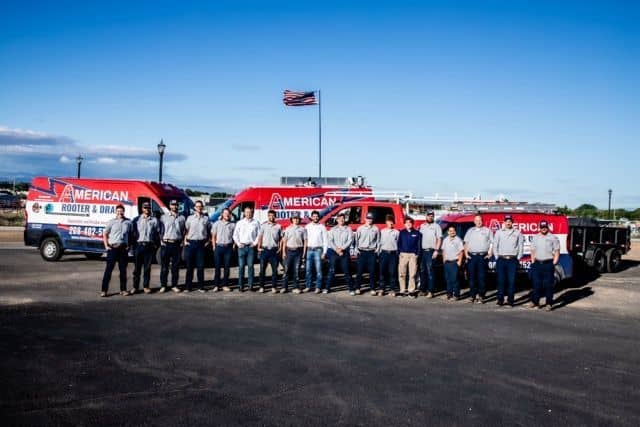
American Electrical Services is the electrical side of American Rooter & Drain — same company, same shop, its own license and its own phone line. American Rooter & Drain was established in Caldwell, Idaho in 1945, and has served the greater Treasure Valley since 1945. The electrical side holds Idaho Electrical Contractor License LIC# 3671445 in its own right.
Every job is run by a licensed electrician, permitted where a permit is required, and priced in writing before the work starts. Call (208) 782-8268 or request service online to schedule a free on-site estimate for your electric car charger.