Fruitland is the fastest-changing plumbing market in Payette County, and that drives nearly every call here. The town had 573 residents in 1950 and about 3,800 in 2000. Today it is past 6,000. That growth splits the housing stock in two: a small older core, and a large volume of construction from the last twenty-five years. Which half your house falls in decides what goes wrong.
What we handle in Fruitland
- Drain cleaning in Fruitland and hydro jetting in Fruitland — kitchen, bath and main lines
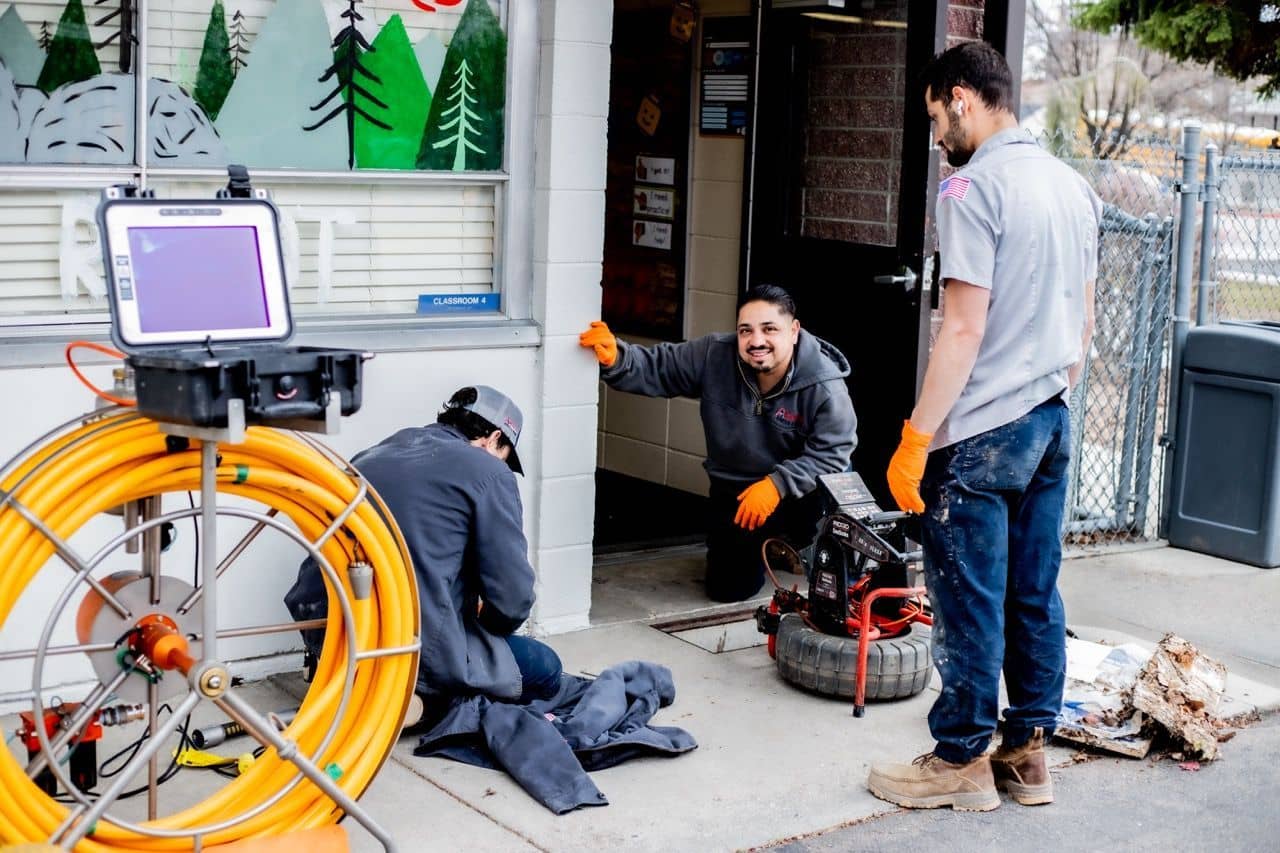
- Sewer camera inspection in Fruitland before anyone digs
- Sewer line repair in Fruitland and trenchless replacement
- Water line repair in Fruitland and water heater service, tank and tankless
- Septic pumping in Fruitland, septic inspection in Fruitland and drain field service
- Gas line installation in Fruitland and plumbing inspection in Fruitland
- Emergency plumber service in Fruitland
- Furnace repair in Fruitland, heat pumps, AC repair in Fruitland, and panel upgrades in Fruitland
If it's just one slow or clogged fixture, clogged drain repair in Fruitland is the faster fix. Everything else on the plumbing side — fixtures, valves, general repairs — is plumbing repair in Fruitland. On the septic side, our sister company covers septic pumping in Fruitland for properties on a tank.
Two Fruitlands, two sets of problems
The older core. The blocks around Fruitland Community Park on SW 3rd Street — the site of the town's first public school — and the streets near Fruitland High School on Iowa Avenue hold the pre-war and mid-century housing. These are the addresses where we still find galvanized steel supply and cast-iron drains. Both corrode from the inside, and the symptoms come on slowly enough that people adapt: pressure that quietly fell off over twenty years, a sink that has always been slow, discolored water on the first draw. Here we camera first, because the real fault is usually upstream of the call.
Everything built since the late 1990s. Fruitland's newer subdivisions are almost all PEX supply and PVC drains, which sidesteps corrosion entirely. The failure modes differ: builder-grade angle stops never meant for two decades of service, tankless units sized for the household that toured the model home rather than the one living there now, missing expansion tanks, and construction debris left in a drain line during framing that has been catching wipes ever since. New does not mean immune — the clock just started on different parts.
Fruitland water is treated and chlorinated, and you can taste it
This is the most distinctive thing about plumbing in Fruitland. The city's wells have been turned off and are held on active reserve for emergencies. Municipal water now comes through a microfiltration membrane treatment plant that fills the storage tanks automatically. Treated drinking water is required to be chlorinated, and the city says plainly there will be a constant chlorine residual in the supply.
That is a safe, well-run system, and it is why filtration comes up more here than in most Idaho towns. Chlorine taste and odor is the number one thing Fruitland customers ask us to fix — straightforward, once someone sizes the unit to actual household demand instead of selling a generic cartridge.
Backflow assemblies are the other Fruitland-specific item. Where a property draws irrigation water off the public supply, the city requires a backflow prevention device at that connection, tested annually. In an orchard valley where nearly every lot runs irrigation, those are exactly the fittings that crack over winter and fail their test in spring. If yours failed, or has never been tested, call before irrigation season, not after.
Out past the city limits
Fruitland sits between the Snake and Payette rivers along US-95 on the Oregon line, and the orchard ground around town is where the private wells and septic tanks are. On a well, test before choosing filtration. On a tank, chemical drain cleaners are hard on the bacteria it depends on. Our septic pump-out is $395 for 1,000 gallons; a routine drain clearing goes on our $59 drain-cleaning special.
How we decide what a line needs
One slow fixture gets cabled — quick and correct for a discrete clog. Repeat clogs, several drains slow at once, or any older line gets a camera first, because cabling a collapsed or root-invaded pipe only buys a few weeks. Heavy buildup on a sound pipe is what hydro jetting in Fruitland is for: it scours the full inside diameter rather than punching a hole through. A break, an offset joint, or a belly holding water means repair, and open-cut versus trenchless comes down to depth and whether the host pipe can carry a liner.
Most drain calls finish in under two hours. A camera inspection adds under an hour. A water heater swap is usually a half-day. A lateral replacement takes one to two days plus the permit inspection.
Clogged drain, toilet, sink or shower in Fruitland
Need a plumber for a clogged drain in Fruitland? Which fixture is backed up tells us where to start. A clogged toilet that will not clear with a plunger is usually blocked at the fixture itself. A clogged kitchen or bathroom sink or a clogged shower or tub drain is a single branch line, the kind of job our $59 drain cleaning special covers. When more than one fixture backs up at the same time, the blockage is in the main line, and that starts with clogged drain repair in Fruitland. Call (208) 366-5771, days, nights, weekends and holidays.
What it costs, and why we look first
We do not publish price ranges. A range is a low number you will remember and a high number you will resent, decided before anyone has seen your pipe. What moves the real number: access, pipe material and age, depth and run length on anything buried, how much diagnosis is needed, and permits on gas line or full sewer work. We look first, then hand you a written flat-rate price. Estimates are free.
Call if drains are slowing month over month, pressure has fallen off gradually, you see rust-colored water from the hot tap only, or several drains run slow at once. Any smell of gas: leave and call immediately.
Fruitland, ID 83619 and the surrounding Payette County orchard ground. Call (208) 366-5771, or our Weiser office at 536 State St. Suite 7, Weiser, ID 83672, (208) 618-3118. License PLB-C-13057 — licensed, bonded, insured, workmanship guaranteed.