This page answers that, and it deliberately does not answer your address. Which office issues your permit, what the water is doing on your street, how a tank gets down your basement stairs or through your crawlspace hatch — those are real questions, they change the job, and they are answered on the page for your town, linked at the bottom. What is here is the decision itself.
We have completed 642 water heater calls across the Treasure Valley and eastern Oregon. 239 of those were not a repair and not a replacement — they were a technician driving out to look at a unit and tell a homeowner what they actually had, at no charge. This page is meant to get you as far as reading can get you before that visit, and to make sure that when it happens you are the one asking the questions.
Should I repair my water heater or replace it?
Repair it if what failed is bolted to or threaded into a sound tank. Replace it if the tank itself has failed. That single distinction settles more of these calls than age, brand or price does, because nearly every part of a water heater is a serviceable component and exactly one part of it is not.
There are two axes to the decision, and most bad advice comes from somebody using only one of them. The first is what failed. The second is how much life the unit has left. A gas control valve on a young heater and the same valve on an old one are the identical repair and a completely different decision.
Three rows there deserve to be said out loud rather than left in a table.
A tank leaking through its own steel is not repairable at any age. Not with a patch, not with a weld, not with sealant, not with the stop-leak product somebody will sell you. It has corroded from the inside out and it is under household pressure every minute it stays connected. Anyone offering to fix it is selling you a delay. It is also the single most misdiagnosed failure in this trade, because five different things put water on that floor and four of them are cheap — which is why there is a whole section below on working out which one you have.
A reset button that keeps tripping is not the problem. It is the safety device doing its job. Pressing it a second time is answering a smoke alarm by taking the battery out. Something is driving the water past its limit — a shorted element, a stuck thermostat, a failed high-limit — and the reset is reporting it, not causing it.
The anode rod is the part nobody knows they own. It is a sacrificial metal rod hanging inside the tank whose entire job is to corrode so the steel does not. It is a consumable, like a brake pad. Once it is gone, the tank is the next thing in line to corrode, and the tank is the one item on that list that cannot be repaired. Replacing a rod that is half gone buys real years. Replacing one after the tank has already started rusting buys almost nothing, which is why the same part sits in two different columns of the table.
There is a third input, and it is yours rather than ours: what you are doing with the house. A heater you are handing to a buyer next spring is a different decision from one you intend to run for another decade — not because the plumbing changes, but because the payback window does. Say that part out loud to whoever is quoting you. It should change the recommendation, and if it does not, that tells you something too.
More than a quarter of the water heater jobs we finish are repairs rather than replacements, so this fork genuinely goes both ways. Where both options are live, the useful thing is not our opinion — it is two written numbers sitting next to each other, the repair and the replacement, so you are choosing between known figures instead of agreeing to a plan and learning the number afterward. Producing those two numbers is what the on-site estimate does, and it is free.
How long should a water heater last?
Longer than most of them get, and there is no honest fixed number of years to hand you — a company that quotes one without looking at your unit is reading you a brochure. The same model, installed in two houses on the same street in the same year, ends at different times. Three things decide which of those two yours is, and you can check two of them yourself in about ten minutes.
1. Has it ever been flushed? Our water leaves mineral behind on every heating cycle, and it settles on the floor of the tank. That layer insulates the steel from the heat, so the burner or the element runs longer for the same result, and the trapped heat works on the metal from the wrong side. Rumbling or popping when it fires is that layer announcing itself — steam bubbles forming underneath the crust and breaking through. A tank nobody has ever flushed can be finished years before an identical tank that was flushed annually.
2. Has the anode rod ever been replaced? For most houses the honest answer is no, because most homeowners have never been told the part exists. It only works if it is done while there is still rod left. Checking it is a hex head on the top of the tank and a look at what comes out.
3. What pressure has it lived under? If the house is on a closed system with no working expansion tank, every heating cycle spikes the pressure, and the heater absorbs that spike for its entire life. It shows up as a relief valve that drips for no obvious reason, and it quietly shortens everything upstream and downstream of it.
Before any of that helps you, you need the one fact most homeowners do not have: how old it actually is. The manufacture date is on the same label as the model and serial number, but there is no industry standard for how it is written. Some brands print the month and year in plain language. Others bury it in the first characters of the serial — a letter standing for the month, two digits for the year, or a week-of-the-year code that is meaningless unless you know that brand's scheme. It is not a puzzle you should have to solve in a dark garage. Photograph the whole label, brand name included, and read it to us over the phone. Dating a heater off its label takes about a minute for somebody who does it weekly.
If the label is gone, faded, or turned to face a wall, three fallbacks are worth knowing. The permit record for the house, because a legitimate previous replacement is permitted work and usually left a paper trail. A previous plumber's sticker, which most shops leave on the tank, on the wall behind it, or inside the access panel, often carrying the install date. And the age of the house, if you bought new and nobody has replaced it — that is a floor rather than an answer, but a floor is enough to tell you which column of the table above you are reading.
Here is the part that actually matters for your decision. A water heater replaced on purpose and a water heater replaced on the morning it lets go are not the same transaction. Planned, you choose the capacity, the fuel and sometimes a better location, on a schedule that suits you, with the floor dry. Unplanned, you choose from what is on the truck while somebody is running a wet vac. If yours is old but currently behaving, that gap is the entire argument for deciding now instead of being told later.
If the scale is showing up all over the house and not only at the heater — on the fixtures, in the kettle, on the glassware — the longer-term fix is upstream of the tank rather than inside it. See water softeners and filtration.
What size water heater do I need?
The size you need is set by your busiest hour, not by how many people live in the house — and the number on the label is not the number that answers it.
The gallon figure is storage, not delivery. A 50-gallon tank does not hand you 50 gallons of hot water. As you draw hot off the top, cold enters the bottom to replace it, and the temperature at the tap starts falling well before the tank is empty. Meanwhile the burner or the element is making more. So what you actually get is storage plus whatever the unit can reheat while you are still using it. Two heaters with the same number on the label can deliver noticeably different amounts of usable hot water, which is why comparing labels is not comparing capability.
That reframes the question entirely. It is not how many people live here. It is what is the worst hour of your week, and what runs at the same time inside it. Four people showering one after another across two hours is an easy problem. Two people showering simultaneously while the washing machine fills is a harder one, and no head count tells those two households apart.
Three things break sizing far more often than household size does:
- A large soaking tub. One fill can take most of a tank on its own. A household that is fine six days a week discovers this on the day somebody wants a bath. If a soaking tub is part of a larger bathroom overhaul, our bathroom remodel and upgrades guide covers what else is worth planning before the plumbing goes in.
- Simultaneous draws nobody counted. The dishwasher and the washing machine both pull hot water, and neither one cares what time you shower. If either runs on a schedule you set once and forgot, it is in your peak hour whether you meant it to be or not.
- Winter. The water arriving at your heater in January is far colder than it was in July, so the same unit has to lift it further to reach the same shower temperature. A heater that is marginal in August is inadequate in February, and that is why so many sizing complaints arrive in the same eight weeks of the year.
And there are two levers, not one. Capacity is the obvious one. Recovery rate is the one people miss — how fast the unit makes replacement hot water while you are drawing it. Often the correct answer is the same number of gallons with faster recovery rather than more gallons, and that is worth knowing before you shop, because going up in capacity is not free in a physical sense. A larger tank is taller or wider or both. It may not stand where the old one stood. The water lines, the gas line or the circuit and the vent all have to be re-run to meet it in its new position. Upsizing turns a straightforward swap into a genuinely different job, and it should be a decision rather than a default.
Oversizing has its own quiet cost: you pay to keep water hot that you never draw, every hour of every day, for the life of the unit. Bigger is not safer. Right is safer.
Sizing a tankless unit is not a larger version of this question. It is a different question with different units, and it is next.
Should I get a tankless water heater?
Get one if you run out of hot water no matter what tank you buy, if you want back the floor space a full-size tank is currently eating, or if you are staying in the house long enough for a longer service life to pay for a harder installation. Skip it if your hot water use is modest and predictable, if you need hot water back today rather than on a scheduled job, or if the infrastructure work the conversion requires will not pay back for your household. It is not a better tank. It is a different appliance, with a different sizing rule and a different maintenance obligation.
A tank is sized by gallons stored. A tankless is sized by flow — how many gallons per minute it can raise to temperature at once. It never runs out, which is the real selling point and it is a genuine one. What it has instead is a ceiling on how many fixtures it can serve simultaneously, and that ceiling drops as the incoming water gets colder, because raising colder water to the same output temperature takes more of the burner's capacity per gallon. Idaho groundwater is cold in winter. A tankless unit sized off a warm-weather brochure figure instead of a measured inlet temperature is the most common reason these installations disappoint people in February, and it is a sizing error rather than a product fault.
What turns a tankless install from a swap into a project, in the order it usually bites:
- Gas volume. The existing line was sized for a tank that sips fuel over hours. A whole-house tankless burner wants a great deal more, all at once, and the line has to be measured against that load rather than assumed adequate.
- A dedicated vent path. A tankless heater vents through its own sealed path. An existing chimney or B-vent that served a tank is not reusable for it, so a new route through a wall or roof has to exist.
- Condensate. A high-efficiency unit produces acidic condensate that has to drain somewhere legitimate, which is a drain line that did not previously need to be there.
- Power. The controls need a circuit. A gas tank with a standing pilot needed none.
There is also an ongoing obligation people are rarely told about at the point of sale: a tankless heat exchanger has to be descaled on a schedule, and hard water shortens that schedule. It is a straightforward service, but it is not optional, and a tankless unit that has never been descaled will lose output and eventually fault. If you are the kind of owner who would rather never think about the appliance, that is a real argument for a tank, and it is worth being honest with yourself about before you buy.
For the operating-cost comparison worked through properly, we wrote it up separately: tankless versus tank water heaters and what each really costs to run in Idaho. What a conversion means at your specific address — where the gas meter is, where the wall penetration can go, what the vent has to clear — is a standing-in-the-room answer, and the town pages below get into it for the housing stock in each place.
Why is my water heater leaking?
Because of one of five places, and only the last one means the heater is finished. Water on the floor tells you almost nothing on its own, because water runs down the outside of a tank and pools at the bottom no matter where it started. So the job is not to look at the puddle. It is to find the origin. If the wet ground is out in the yard rather than under the tank itself, that's a different problem — our outdoor water line leak page covers how to track that down.
1. The temperature and pressure relief valve, or its discharge tube. This is the valve near the top or upper side with a lever, and a pipe running from it down toward the floor. If it is wet at the valve or dripping out the end of that tube, the valve is either relieving for a reason or has failed to reseat. Both are repairable, but the order matters: test the house pressure and the water temperature before replacing the valve, because if the valve is doing its job you will fit a new one and watch it do the same thing next week.
2. The drain valve at the bottom. The original plastic ones are the ones that fail, and they very often start weeping right after somebody flushes the tank for the first time in years — the handle moves, debris gets under the seat, and it never quite closes again. Cheap, repairable, and not a sign the tank is dying.
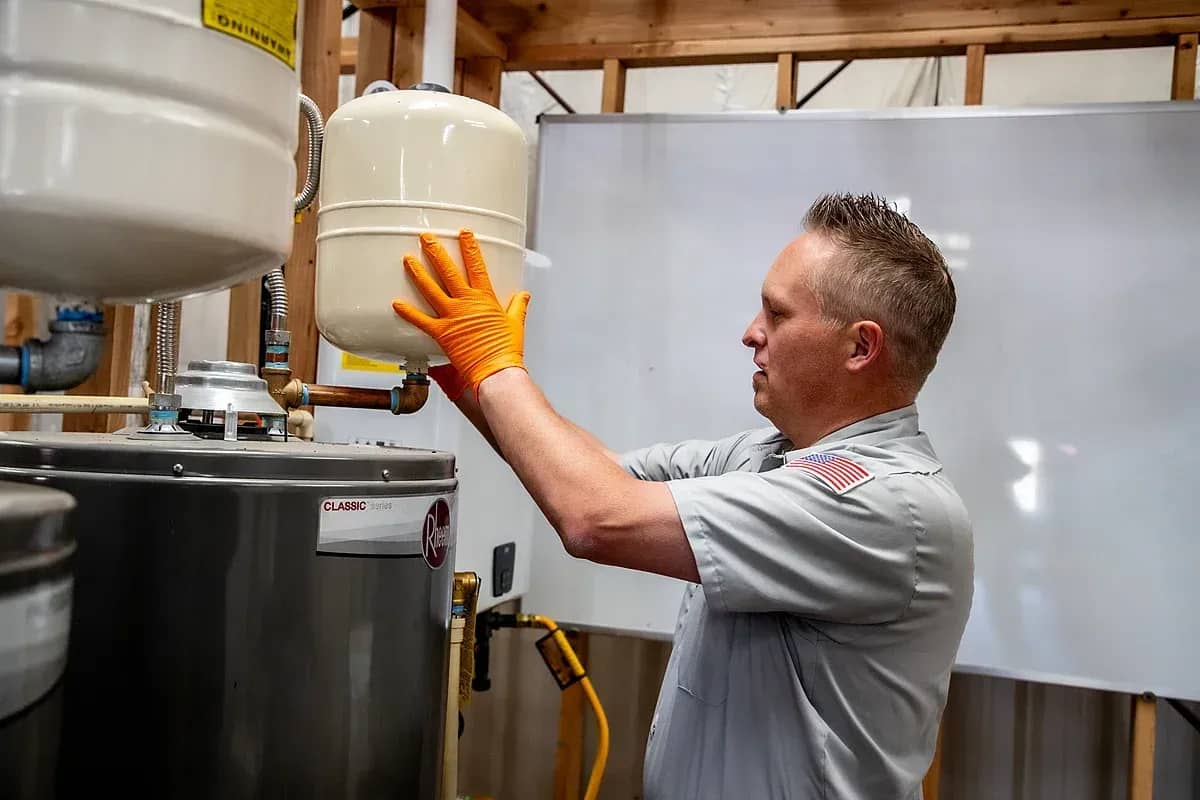
3. The connections on top. The hot and cold nipples, the unions, the flexible connectors, and on an electric unit the fitting where the conduit enters. A drip up there runs straight down the side of the tank and arrives at the floor looking exactly like a tank failure. Feel the connections with a dry hand before you conclude anything.
4. Condensation. A cold tank in a humid garage, or a tank that has just been refilled with cold water, will sweat, and a heavy sweat drips. It looks alarming and it is nothing. It resolves once the tank comes up to temperature and stays there.
5. The body of the tank itself. A seep at a seam, or water appearing from under the jacket with no fitting above it, means the steel has rusted through from the inside. This is the one that is not repairable at any age.
How to tell them apart without tools: dry everything completely — the top, the fittings, the sides, the floor — then lay dry paper towel or newspaper under and around the base and leave it alone for an hour or two. Come back and read the paper. Wet in a ring around the base with dry fittings above it points at the tank. Wet in one line running down one side points at whatever is directly above that line. Wet only at the end of the discharge tube points at the relief valve. That one test, done properly, is the difference between a part and an appliance, and it costs nothing but patience.
If it is running rather than seeping, do not wait to finish diagnosing. Close the cold water shutoff on top of the heater, turn a gas control to OFF or switch off the double-pole breaker for an electric unit, and call. Everything above still applies once the water has stopped moving.
Why do I keep running out of hot water?
Either the heater is too small or too slow for your busiest hour, or something inside it has failed and it is only pretending to be undersized. The fastest way to tell those apart is one question: did this change? A house that has always been tight on hot water has a sizing problem. A house that was fine last year and is not fine now has a failure, and buying a bigger tank to solve it means paying for an appliance to fix a part.
The failure patterns are distinctive enough to narrow down from your own shower.
- Hot for a short burst, then cold, on an electric unit. That is the lower element. It sits down in the sediment and it dies first, leaving the upper element heating only the top portion of the tank. You get what is above the upper thermostat and then nothing. It is the single most common no-hot-water call on electric heaters and it is a repair.
- Never properly hot, on an electric unit. More likely the upper element or its thermostat, and worth checking the breaker and the high-limit reset first.
- Hot water that turns lukewarm almost immediately, on either fuel. Suspect the dip tube — the plastic tube that carries incoming cold water down to the bottom of the tank. If it has broken or crumbled near the top, cold water is being introduced at the top and mixing straight into what you are drawing.
- Gradually less hot water than last year, with rumbling. Sediment. It occupies volume the water used to occupy and it insulates the burner from the water, so the tank both holds less and recovers slower.
- Hot at one fixture, disappointing at another. That is often not the heater at all. A failed mixing cartridge in a single shower valve can let cold cross into the hot line and rob the whole house, and a tempering or mixing valve set low on the outlet of the heater will cap every tap in the building regardless of how hot the tank is.
- Somebody turned it down. Worth ruling out before anything else, especially after a service visit, a house guest, or a new thermostat on a heater that has both.
If nothing changed and it has always been like this, it is a sizing conversation rather than a repair conversation, and the section above on size is where that goes — including the part where the correct answer is often faster recovery instead of more gallons.
What we do on that call, in order: measure the actual delivered temperature at a tap rather than trusting the dial, confirm what the household draws in its worst hour, check the elements or the burner and the thermostats, look at the dip tube and the sediment load, and only then talk about capacity. Doing it in that order is the difference between a part and a purchase, and it is why we would rather look than guess.
How much does a new water heater cost?
It is set by six things, and not one of them can be assessed down a phone line. In rough order of how much each moves the number:
- Repair or replacement. Not close, and it is the first fork for a reason. This one genuinely goes both ways rather than always landing on a new tank.
- Tank or tankless, and if tankless, whether it is a first conversion or a straight swap of an existing one.
- Capacity and fuel, and whether either is changing from what stands there now.
- What has to be corrected to pass inspection — venting, gas sizing, an expansion tank, a drain pan, a shutoff valve that will no longer shut off.
- Access. Getting the old unit out and the new one in is a different job in an open garage than through a crawlspace hatch or up a turning stairwell.
- The permit and inspection a full replacement requires.
You will not find a price range on this page, and that is deliberate. Everybody reads the bottom of a range and almost nobody's job is the bottom of it, so a range is a number engineered to be wrong. It also quietly rewards whoever publishes the lowest floor, which is not the same as whoever does the best work.
What you get instead is a technician looking at your actual unit, your actual connections and your actual access path, and a flat price in writing before any tool comes off the truck — a fixed number for the job, not an hourly meter running while you watch. Where repair and replacement are both on the table, you get both numbers side by side and you decide between them. The visit that produces those numbers is a free on-site estimate. And if somebody has already handed you a written quote, bring it out — we will read it with you and tell you honestly whether it is fair, at no charge and with no obligation to use us.
Do you work on water heaters in my town?
Almost certainly. Our completed water heater calls have landed in 31 different towns, and 98 of those calls were across the Oregon line in Ontario, Nyssa and Vale. We run out of the shop on Commercial Way in Caldwell, and unlike furnace work, water heaters have no season — a tank that has reached the end of its life does it in July as readily as in January, and these calls come year-round.
Your town's page carries what this one deliberately leaves out: which office issues the permit at your address, what the local water is doing inside tanks, what the housing stock means for getting a unit in and out, and how quickly we can be there.
Boise · Nampa · Caldwell · Meridian · Kuna · Eagle · Star · Middleton · Garden City · Emmett · Mountain Home · Hidden Springs · Payette · Fruitland · Weiser · Parma · Wilder · Marsing · Homedale · Ontario, OR · Nyssa, OR · Vale, OR
Everything on this page gets you far enough to have an informed conversation instead of a nervous one. The remainder — the real age off the label, what specifically failed, whether the tank is sound, and what the repair and the replacement each cost in writing — takes somebody with their hands on the unit. That visit is free, and it is quick to get: of the completed water heater estimate visits we can time from the call to the finish, 72 out of 91 happened on the same day the customer called.
Call (208) 366-5771 and a real person answers — days, nights, weekends and holidays, not a phone tree and not an out-of-state call center. Tell them what the unit is doing, and whether it is gas or electric if this page helped you work that out. If water is coming from the body of the tank right now, say that first, close the cold shutoff on top and turn the heater off, and we will sort the decision out once the water has stopped.
American Rooter & Drain has been doing licensed, bonded and insured plumbing work in the greater Treasure Valley since 1945. The price goes in writing before we pick up a tool, and if it is not right after we leave, we come back and make it right.