American Rooter & Drain has worked the greater Treasure Valley since 1945, out of the shop at 1005 Commercial Way in Caldwell. If you think you have a leak between the meter and the house, call (208) 366-5771.
The four signs that point at the buried service line
A soggy or green patch that outlasts the weather. Grass over a leak gets watered from underneath every hour of every day. Watch whether it holds a shape — a leak shows as a stripe or oval following the pipe run from the meter toward the house, not a random low spot.
A bill that climbed with nothing else changing. A pinhole you cannot hear still runs thousands of gallons a month. Compare usage in gallons or cubic feet across a few statements, not the dollar total, since rate changes muddy the dollars.
Pressure dropping at every fixture, not one. A single weak faucet is an aerator or a cartridge. When the whole house drops at once, or fades over a year, the restriction is upstream. Old galvanized steel in mid-century Caldwell and Boise homes does this without ever leaking — it rusts closed from the inside until the opening is the size of a pencil.
The meter creeping with everything off. Shut off every fixture, and more than the faucets: kill the ice maker, the furnace humidifier, and the irrigation timer, and make sure the softener is not regenerating. Most Treasure Valley meters carry a small triangle, star, or gear-shaped low-flow indicator that spins on even a trickle. If it turns with the house off, water is escaping somewhere. If it sits still, note the odometer-style reading, wait thirty to sixty minutes using no water, and read it again. Any change means flow.
Your side of the meter, or the city's
The line from the main in the street to the meter belongs to the city or water district. The line from the meter to your house — the service line, or water lateral — is the homeowner's, and so is the repair bill. The boundary is normally the meter itself or the curb stop beside it.
We close the curb stop, put a gauge on a hose bib, and pressurize the house side. If pressure holds with the supply shut, your pipe is sound and the leak is on the district's side. Then the right call is to the utility, not to us, and we will say so rather than sell you a replacement you do not need.
Before you dig: the wet yard that is not a water leak
A persistently green, soggy stripe is the textbook symptom of a leaking water service and equally the textbook symptom of a broken or offset sewer lateral. Sewage is nutrient-rich, so grass over a cracked clay joint grows greener and faster than anything around it. In older Caldwell and Boise neighborhoods, where laterals are vitrified clay or Orangeburg, the sewer is the more common of the two. Seasonal wet spots are worth ruling out as well — much of Nampa, Kuna, Meridian, and Star runs pressurized irrigation on a separate canal-fed line that is only charged from roughly April through October.
The meter separates them. If it sits dead still with the house off, you do not have a water line leak, and digging for one is money burned. What you likely have is a sewer line failing underground, and the right next step is a sewer camera inspection to see the pipe from the inside before anyone opens the ground. We run that diagnostic in Caldwell, Nampa, Boise, and Meridian.
The camera earns its keep even when the water line is the culprit: before pulling a new line across a yard we locate the sewer lateral so the new path does not cross it. Driving a bursting head through an old clay lateral creates a cross-bore nobody finds until the sewer backs up months later.
How we find the leak without trenching the whole yard
- Trace the pipe. Metal lines locate directly; plastic with a tracer wire locates off the wire; plastic without one — common on older poly runs out in the county — gets located acoustically or with an inserted sonde.
- Isolate and pressurize. We shut the curb stop, cap the line, and bring it up on air so the leak is the only thing moving.
- Listen. A ground microphone and correlator pick up the hiss of escaping water through soil. Depth, soil, and pipe material all change that sound, which is why this is a skill and not a rented gadget.
- Confirm with a test hole. One small hole verifies the spot before anything gets excavated.
A locate runs an hour or two and ends with a marked spot on the ground and a straight answer on whether this is one repairable failure or a line that is finished. It matters most along the Boise and Payette River bottoms, where the water table is high enough that a real leak vanishes into saturated ground and never surfaces.
Who performs trenchless water line replacement, and when it is the right call
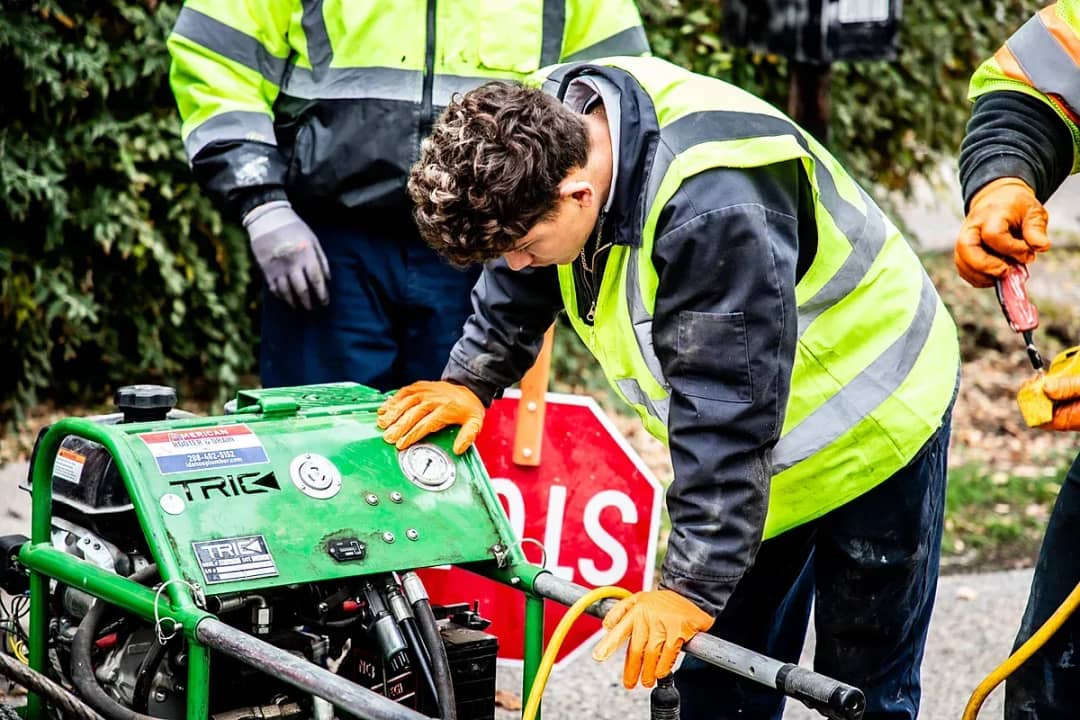
We do, and it is usually the better option. A pull-through uses two small pits instead of an open trench: one at the meter, one where the line enters the house. A continuous length of HDPE is fused into a single piece and pulled along the old line's path, bursting or displacing the failed pipe as it goes. Two pits the size of a wheelbarrow, and the driveway, sidewalk, patio, sprinkler heads, and root plate of a mature tree in between all stay put. The fused pipe matters as much as the method: no fittings buried in the run, and fittings are what fail — most leaks we find on poly lines are at the insert fittings where the stainless clamps corroded through, not in the pipe body.
We trench instead when the old path is collapsed hard enough that a head will not follow it, when the run turns sharply mid-yard, when depth or an obstruction makes a pull unsafe, or when one short accessible section is all that failed. We tell you which applies after the locate, not before.
A burst line is the loud version of the same job — water at the surface, a pressure drop you can feel, sometimes a section of yard heaving in a hard freeze. Shut the curb stop or main valve first, then call. A typical residential replacement is a one-day job with the water off for part of it. We pull the permit and hold the pits open for the inspection most Treasure Valley cities and water districts require, and backfill goes in compacted lifts so the yard does not sink over the run come spring.
What it costs
The variables decide it: length of the run from meter to house, depth, pipe size, what sits in the path — driveway, sidewalk, mature trees, a patio — whether the line can be pulled through or has to be trenched, the condition of the meter pit and curb stop, the permit your jurisdiction requires, and the restoration you want afterward. Anyone quoting a buried line over the phone is guessing, and guesses run one direction. We come out, run the diagnostic, and give you a written price on the actual job. The on-site estimate is free.
Book the diagnostic
If the meter moves with the house off, you have a water line leak and we will locate it. If the meter is still and the yard is still wet, the pipe failing under your lawn is the sewer, and the sewer camera inspection is the right first move. Either way the sequence is the same: find it, then fix it — never the reverse.