

This page is the map: everything we touch with furnaces, air conditioners, heat pumps and ductwork, plus how to work out which of those you actually need before you pick up the phone. Our dispatch records hold 4,049 completed heating and cooling jobs for 1,722 customers, July 2022 through the first week of September 2026. Almost everything below came out of that pile rather than out of a brochure.
Do you fix both heating and air conditioning, or only one of them?
Both, and in the Treasure Valley that matters more than it would in a place with one hard season.
Furnace failures and air conditioner failures both come through the same no-heat/no-cool and diagnostic call types in our records, and together they add up to 1,154 completed repair calls across 772 households. Same technicians, same trucks, whichever half of the system quit.
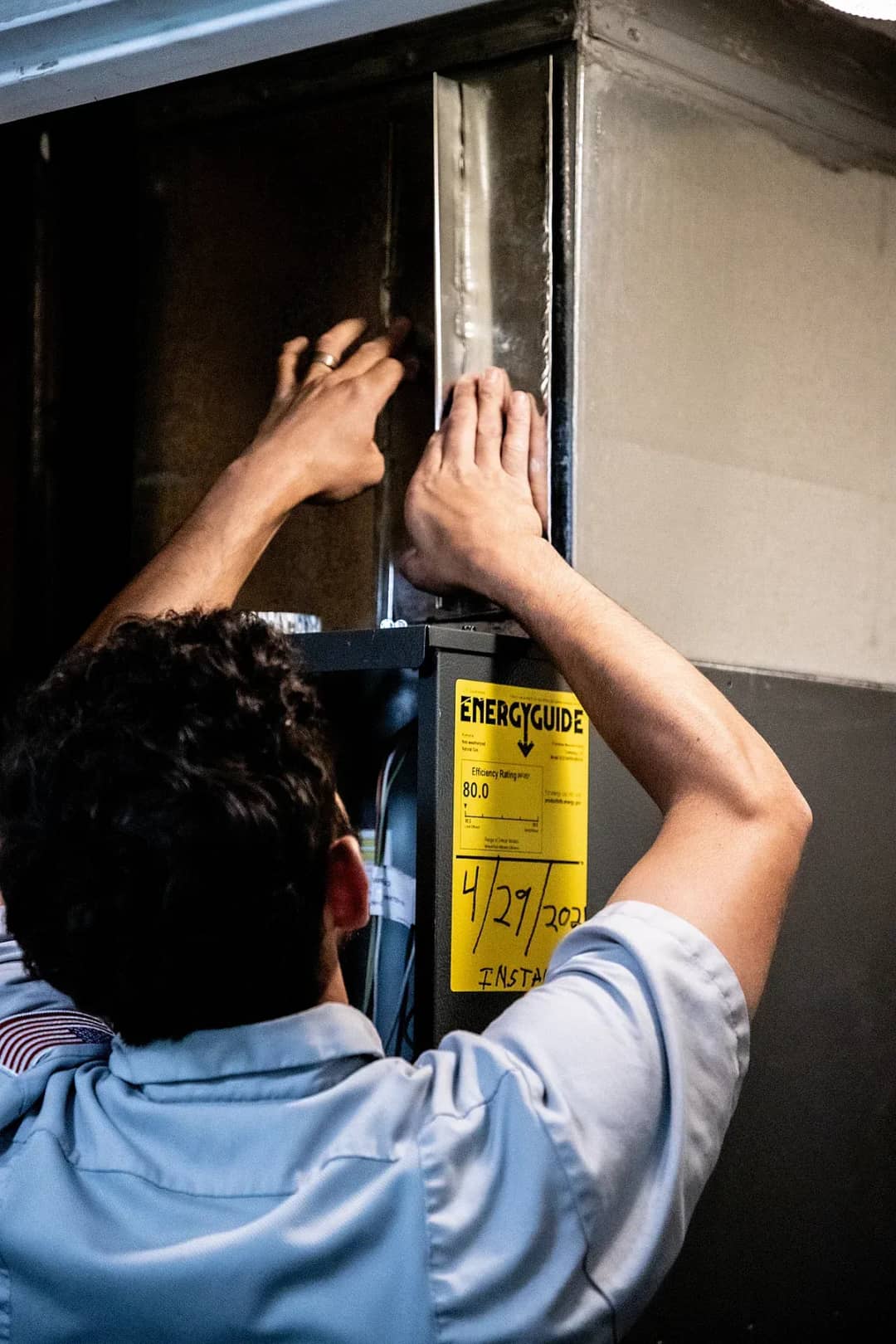
There is a mechanical reason those halves belong to one company. In a typical valley home the furnace and the air conditioner are not two systems — they are one system with two heat sources. The furnace cabinet holds the blower that moves your cold air in July, the evaporator coil sits in the plenum directly on top of that furnace, and the same filter and duct runs serve both. A cooling-only shop walks into a summer complaint, finds a blower or filter or duct problem, and is looking at somebody else's equipment.
Which problem do I have — the furnace, the air conditioner, or the ductwork?
Put your hand in front of a supply register while the system is running and answer these in order.
Is the air the wrong temperature? Heating that comes out room-temperature, or cooling that comes out barely different from the room, is an equipment problem. Burners are not lighting, the compressor is not making cold refrigerant, or nothing is running at all.
Is the air the right temperature but the house still is not? That is a delivery problem and a different service call. Good hot air at the register and a cold house means the heat is going somewhere other than your rooms: leaking duct joints in a crawlspace or attic, a disconnected run, a return too small for the blower, a filter so loaded the blower cannot pull through it, or a blower on the wrong speed tap.
Is it only some rooms? Almost always distribution — a closed or crushed run, a damper somebody moved years ago, or a room at the far end of a system that was marginal the day it went in. That is a design conversation rather than a repair.
Equipment problems route to furnace repair or AC repair.
My air conditioner is running but the house is not cooling. What is wrong?
This is the single most common summer complaint we log — 440 calls under it — and it has a short list of causes that come up over and over.
The order a technician works it: filter first, because a loaded filter starves the coil and can produce every symptom on this list; then the outdoor unit, checking the condenser coil for cottonwood, grass clippings or field dust and for real clearance around it; then the indoor coil for ice; then refrigerant pressures read against the outdoor temperature, which is how a leak gets confirmed rather than guessed; then the run capacitor and contactor; then blower speed and amp draw; then the thermostat and its wiring.
Three of those deserve a plain-language note, because they are where homeowners get talked into things.
Ice on the copper or the indoor coil is a symptom, not a diagnosis. Shut the cooling off, set the fan to run and let it thaw before anyone reads pressures — measuring a frozen system produces numbers that mean nothing. Then find out why it froze. Restricted airflow and low charge both do it, and they are fixed in completely different ways.
Low refrigerant is not a consumable. A sealed system does not use refrigerant the way an engine uses oil. If it is low, it leaked, and the leak has a location. Adding refrigerant without finding that location is buying the same repair again next summer.
A humming outdoor unit with a still fan is very often the run capacitor — a small part that rides on the truck.
How soon can someone come out when the AC quits in July?
Here is what the schedule actually did, rather than a promise.
Take all 440 cooling-failure calls: 135 got a slot on the same date the call landed, and 262 — just under six in ten — got one that day or the following one. That is the whole record, not a good month lifted out of it.
July is tighter, and it is fair to say so. 176 of those 440 calls arrived in July alone: forty percent of a year's cooling failures inside one month, because equipment does not fail while it idles in May, it fails the first week it is asked to run fourteen hours a day. Within July, 43 were scheduled the same day and 87 within a day. The valley's air conditioners break at the same time as each other and no shop schedules its way out of that. What we can do is tell you honestly where you sit in the day.
If somebody in the house is elderly, very young, or medically vulnerable to heat, say that when you call. It changes where the job sits.
Is this an emergency, or can it wait until morning?
Some of it cannot wait, and the list is short enough to memorize.
Get out of the house for a gas smell or a carbon monoxide alarm, and call from outside.
Shut the system off and call now for a burning or electrical smell that does not clear in the first minute of the heating season, a breaker that trips again after one reset, water running out of the air handler or down the wall below it, or scorching, melted insulation or soot around the equipment.
Shut it off and call in the morning for an air conditioner that starts and stops every few minutes on a hot afternoon. Short cycling is not a system trying harder — it is a system taking damage, and the compressor is the most expensive single part out there.
It can wait for a system that runs but underperforms, one noisy register, a thermostat reading a couple of degrees off, or the smell the first time the furnace ran in October that was gone by the second cycle. That last one is dust burning off the heat exchanger, and it is normal.
For the heating side symptom by symptom, our furnace not working page walks through each one in the order we check them.
What does the technician actually do on the first visit?
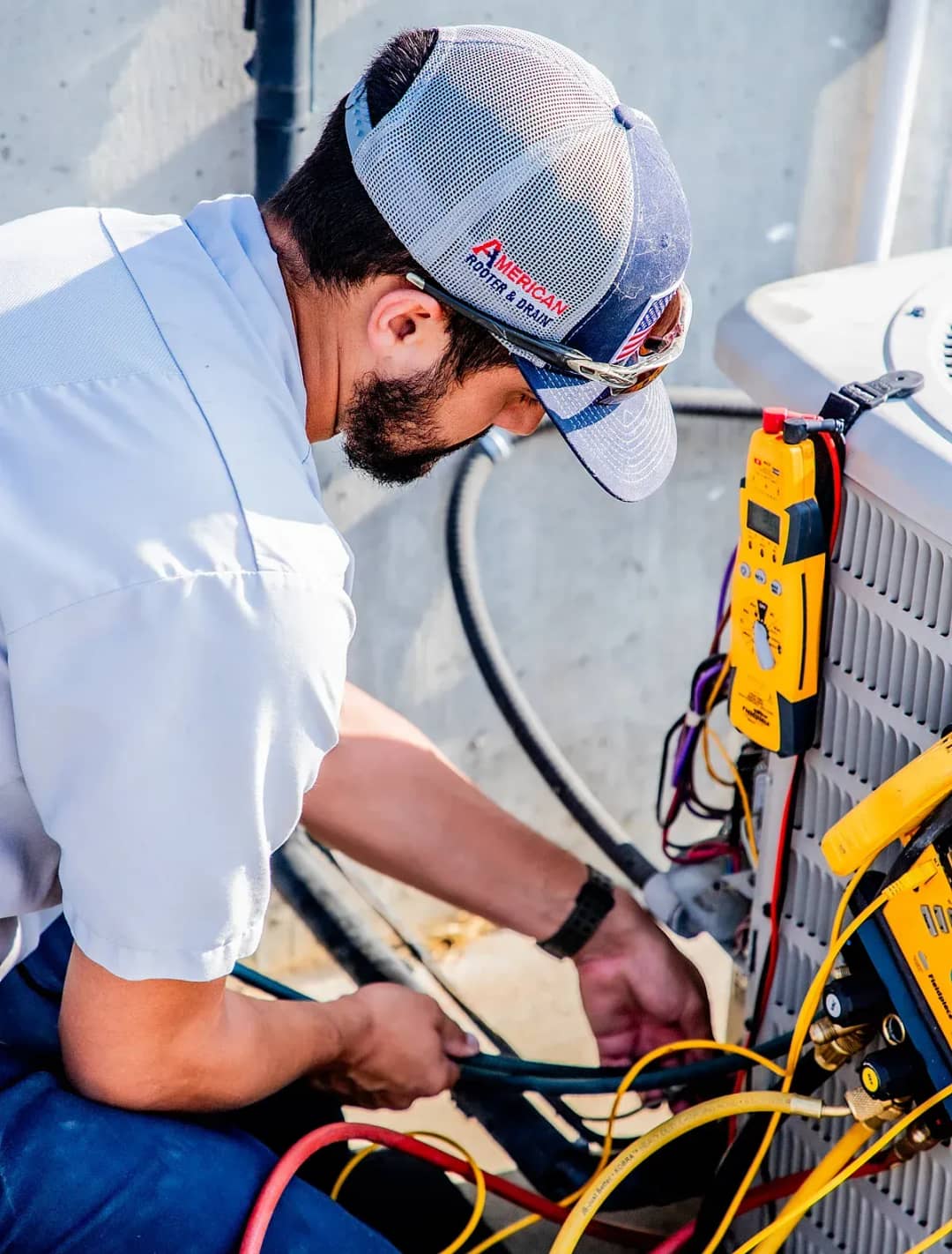
Whichever box is broken, the front of the visit is the same, because the fastest way to a wrong answer is to start replacing parts. The technician confirms the thermostat is genuinely calling, confirms power including the service switch and the low-voltage fuse on the board, and reads stored fault codes. Then the measurements: temperature difference between return and supply air against the equipment's own data plate; static pressure if the numbers point at airflow; amp draw on the compressor and blower; a microfarad reading on the capacitor against its printed rating, because capacitors drift out of tolerance long before they fail outright. Combustion gets an analyzer rather than an eyeball.
Then you are told what is wrong and what it costs, in writing, before anybody turns a wrench. Capacitors, contactors, igniters, flame sensors, thermostats, float switches and board fuses ride on the trucks, so those repairs usually finish on the visit that found them. Anything ordered means a second trip, and you hear that on the first visit.
Do I need a tune-up if nothing seems wrong?
The honest answer is that a tune-up is not magic. It is a set of measurements taken while the equipment is still healthy enough for the numbers to mean something.
We have logged 930 completed tune-up visits across 544 households — furnace tune-ups, air conditioner tune-ups, and combined furnace-and-AC visits together. What they find, over and over, are the things drifting rather than broken. A capacitor reading below its rated microfarads, which is a July failure with a date not yet attached. Pitted contactor points. A condenser coil packed solid with cottonwood — a genuinely local problem, because the valley's cottonwoods let go in June, right before the equipment is asked to work hardest. A condensate drain closing up, which is how ceilings get stained. A sooty flame sensor, the most common reason a furnace lights and drops out.
None of those are dramatic on the day. All of them are the reason somebody has no cooling on a Saturday. What gets checked is on the HVAC maintenance page.
What month should I book so I am not waiting behind everyone else?
This is the most useful thing on this page, and it comes straight out of the calendar our own dispatch keeps.
Failures are not spread evenly across the year. Bucket every no-heat and not-cooling repair call by calendar month and November comes out highest, at 135, with July (127) and January (124) close behind; September is the quietest month, at 43. That is real seasonal load spread across three peak months rather than one isolated week, driven by both the first hard freeze and the first stretch of real heat.
The maintenance calendar shows people already working around it. Combined furnace-and-air-conditioner tune-ups cluster in October (164) and September (141), tail through November (88), and bottom out in January (18).
So the shoulder months are the answer: March and April for cooling, September for heating. That is when the schedule is open, when a marginal part can be replaced on an ordinary weekday instead of during a heat wave, and when nobody is deciding about a system with the house hot and everybody unhappy.
Should I repair this system or replace it?
It depends on which part failed and how much service life is left in the rest of it, which is not answerable from a phone call. The heating-side decision is written out in full — how to read your furnace's real age off the rating plate, which failures are worth paying for and which end the argument — on should I repair or replace my furnace.
The cooling side follows different rules. An air conditioner is two halves that have to match: the condenser outside and the evaporator coil sitting on your furnace. Replace one, leave the other, and you get a mismatched pair that never delivers what either half is rated for. The compressor is the most expensive component out there, so a failed compressor on an older unit is usually the moment replacement wins on arithmetic alone. Equipment old enough to be charged with R-22 is its own conversation, because that refrigerant is no longer produced. And if the furnace is being replaced, the coil comes out of the plenum anyway, which makes that the one day a tired coil is cheap to deal with.
Will cleaning my ducts fix a room that never gets warm?
Usually not, and we would rather say so before taking the money.
Duct cleaning jobs are the exception on this page — unlike everything else here, they do not follow the season at all. That is because duct cleaning solves a contamination problem, not an airflow problem. A room that never gets warm is nearly always a leak, a crushed or disconnected run, a closed damper, or a run undersized when the house was built. Cleaning changes none of those.
Duct cleaning earns its keep when something is in the ducts that should not be: construction or remodel debris, drywall dust, rodent or bird activity in crawlspace ductwork, or a system run for a stretch with no filter. Those happen in this valley's older housing stock more than people expect, and they are what air duct cleaning is for. For fewer particles in the air generally, whole-home air filtration does more.
Do you work on heat pumps and ductless mini-splits?
Yes to both, and two things about heat pumps generate calls that are not actually problems.
Air from a heat pump register feels cooler than air from a gas furnace. That is not a fault — a heat pump delivers a larger volume of moderately warm air rather than a smaller volume of hot air, so the room lands at the same temperature while your hand says otherwise at the vent. And a heat pump that goes quiet, steams and blows cool for a few minutes in cold weather is running a defrost cycle, which is designed behavior. What is not designed is an outdoor unit encased in ice that never clears, or auxiliary heat strips running constantly — usually the defrost control or the reversing valve. Detail is on heat pump services and heat pumps.
Ductless mini-splits solve what ducted systems cannot: an addition, a converted garage, a finished shop, or an upstairs bedroom the original ductwork was never going to reach. See ductless mini-splits.
What is this going to cost?
We do not print a figure here, on purpose. Any number published on a page like this one is a number for somebody else's house.
What moves it, roughly in order: which component failed and whether it rides on the truck or has to be ordered; gas or electric equipment; the age of the system and whether its parts are still made; how the equipment is sized against the house rather than against whatever was there before; whether the ductwork and return can carry what you are putting in; venting and condensate on a high-efficiency install; electrical work and the permit; and what the working space is like, which around here runs from a hallway closet to an attic in August.
So we work it from the other end. A technician stands in front of your actual equipment and writes down both paths — fix it, or replace it — with no obligation attached to either. That estimate visit is free, and it ends without a sale often enough that we are comfortable calling it genuinely free. What an installation involves is on HVAC installation, furnace installation and AC installation.
Do you come to my town?
Those 4,049 completed jobs came out of our top 25 cities by completed heating and cooling volume: Ontario (550), Payette (501), Fruitland (421), Nampa (392), Boise (382), Caldwell (307), Weiser (285), Meridian (199), Nyssa (180), New Plymouth (145), Parma (134), Vale (119), Middleton (66), Emmett (38), Eagle (36), Kuna (33), Wilder (25), Homedale (24), Star (24), Mountain Home (17), Huntington (11), Adrian (10), Mesa (9), Midvale (9) and Melba (8).
Worth pointing out that at least 870 of those completed jobs were on the Oregon side of the river — Ontario, Nyssa, Vale, Adrian and Huntington combined. Plenty of valley companies stop at the state line. We do not.
American Rooter & Drain has served the greater Treasure Valley since 1945, out of the shop at 1005 Commercial Way in Caldwell. Local pages worth a look: AC repair in Boise and in Nampa, furnace repair in Payette and in Ontario, or the whole-service roundups for Boise, Nampa, Payette and Ontario.
Why is a heating and air company part of a plumbing company?
Because in a real house those trades keep running into each other, and having them under one roof settles arguments that otherwise get handed back to the homeowner.
American Rooter & Drain was established in Caldwell, Idaho in 1945 and is veteran-owned. American Heating & Air is its Idaho mechanical division, carrying its own HVAC Contractor License LIC# 029771 rather than working under somebody else's.
The overlap is not theoretical. The gas line feeding your furnace is plumbing work, and so is the one feeding the water heater next to it. A condensing furnace produces acidic condensate, which needs somewhere to go and frequently a pump to get it there. An air conditioner's condensate line ties into drainage. A crawlspace with wet ductwork usually has a plumbing reason for being wet.
If your heat is off or your house will not cool, call American Heating & Air at (208) 782-8267. Tell whoever answers what the air at the register is doing — right temperature, wrong temperature, or nothing at all. That one sentence decides what goes on the truck.