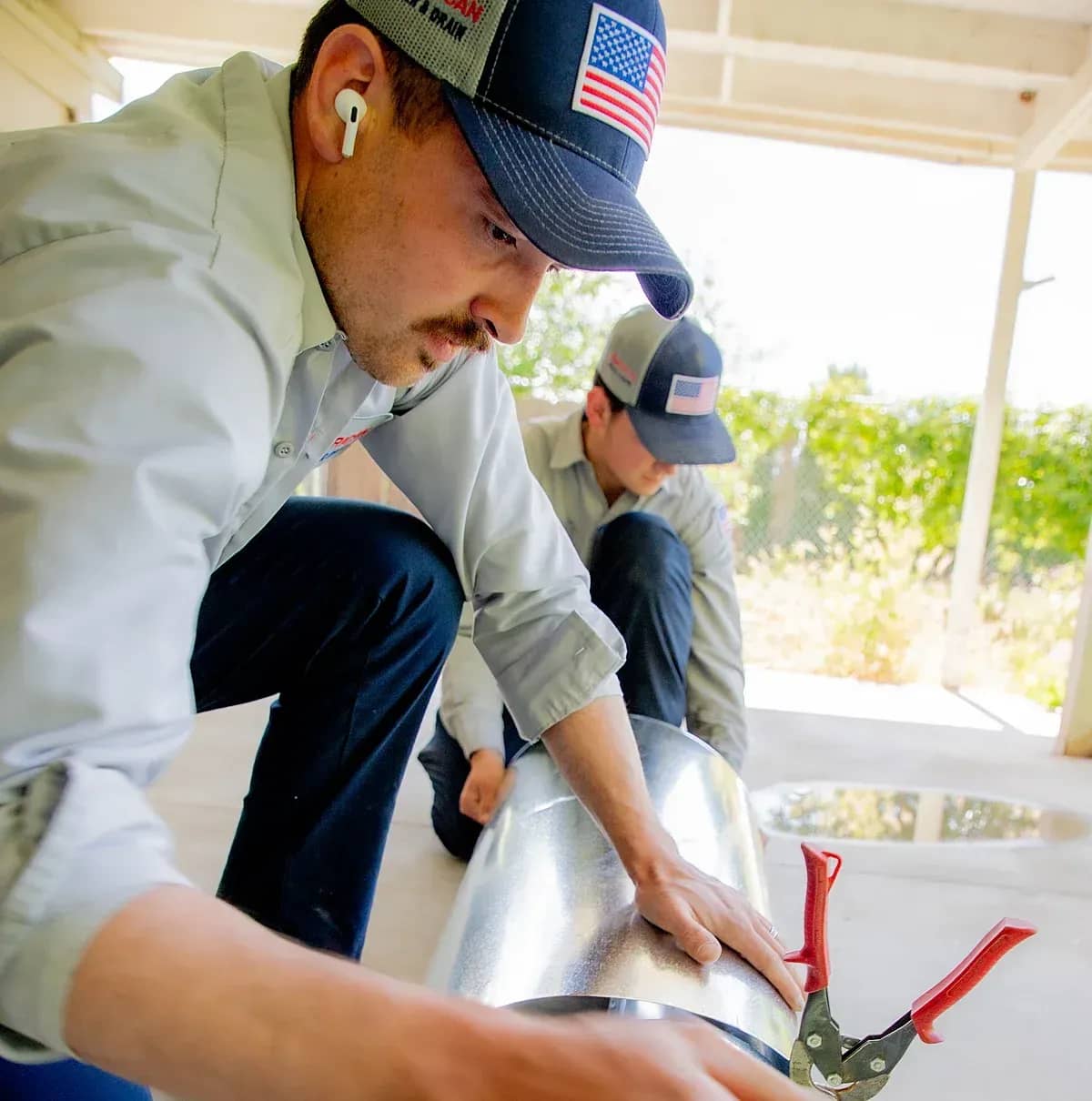

Cooling work here is done by American Heating & Air, part of American Rooter & Drain — established in Caldwell, Idaho in 1945, serving the greater Treasure Valley since, and holding Idaho HVAC license no. 029771. Our shop sits at 1005 Commercial Way in Caldwell, roughly 28 miles down I-84 from downtown Boise. Below is what actually happens when you call with a dead air conditioner.
My AC quit on a hot Boise afternoon — how fast can you get here?
Of the 127 completed Boise heating-and-cooling jobs — repairs, tune-ups, installs and inspections together — that carry both a booking date and a completion date, 102 were finished the same calendar day they were booked and 3 more the next day, which works out to 80.3% same-day and 2.4% next-day. Company-wide across every town we cover, the comparable figure for AC-specific repair calls alone comes out at 284 of 344 same-day and 328 of 344 within a day.
The honest caveat is that those odds are not identical in every week of summer. The first serious heat wave fills the board by nine in the morning, because every marginal capacitor in the valley fails on the same afternoon. In our Boise record for "A/C not cooling" calls, Wednesday is the most common completion day at 11 of 45 and Thursday next at 9 — a fair picture of what a Monday heat spike does to a schedule.
Two things help. Call in the morning rather than after work; a 7 a.m. call has options a 4 p.m. call does not. And tell whoever answers what the system is doing — outdoor fan spinning or still, vent air warm or nothing at all, ice visible or not. That detail decides which truck we send and what is on it. Boise is a short run from Caldwell, so distance is rarely the constraint. July board capacity is.
Which parts of Boise do you drive to?
All of it. Across every kind of job we've booked at Boise addresses, the ZIP codes break down like this: 83709 (1,034), 83705 (795), 83702 (739), 83704 (679), 83706 (583), 83713 (446), 83703 (388), 83714 (316), 83716 (256) and 83712 (189).
In plain geography that is southwest Boise around Five Mile and Overland, the central Bench near the airport, the North End and downtown, the west Bench toward Cole and Ustick, the Depot Bench and the university side, the Maple Grove corridor, Collister below the lower foothills, the Dry Creek and Hidden Springs side, southeast toward Harris Ranch, and the East End and Warm Springs. If your street is not obviously on that list, call anyway — it reflects where the calls came from, not a boundary we drew. Garden City, Eagle, Meridian, Star and Kuna ride on the same trucks, and the full in-town service list sits on our Boise page.
What does the technician check first, and in what order?
There is an order to this and it is not arbitrary. Electrical faults are both more common and cheaper to rule out than refrigerant faults, and every time gauges go onto the service ports a little refrigerant leaves the system. So we work from the cheap, non-invasive end inward.
First, confirm the system is actually being told to cool: thermostat in cool, setpoint well below room temperature, 24 volts reaching the outdoor unit. A dead thermostat battery and a tripped condensate float switch both look identical to a dead air conditioner from the hallway — and when a slimed-up 3/4-inch drain line backs up, that float switch shuts the system down and the complaint arrives as "it just stopped for no reason."
Second, indoor air. Is the blower moving air at the registers, and is the filter something you could read a newspaper through or one you could stand on?
Third, outdoors. Is the condenser fan turning? Is the compressor humming, straining, or silent? Pull the disconnect and check the fuses — a 20-amp dual element fuse is a cheap part that presents exactly like a failed compressor.
Fourth, the capacitor, which is where a great many Boise calls end. A dual run capacitor is stamped with its rating — 45/5 MFD, 40/5 or 35/5 at 440 volts on the units we see most — and we put a meter on it. One reading 31 MFD against a 45 MFD label is failed even though it looks new and shows no bulge. That is the point of metering rather than eyeballing.
Fifth, the contactor: its 24-volt coil either pulls in or it does not, and the contacts either pass current or are pitted and welded from years of arcing.
Only then do the gauges come out, for pressures, superheat and subcooling, plus an amp draw on the compressor under load. By then the diagnosis is usually already made.
A rough map before we get there: no air at all points indoors, at the blower or a control board; plenty of air at room temperature points outdoors, at the compressor circuit or the charge; water on the floor with the heat off is condensate, not a plumbing leak.
What breaks most often, and will the part be on the truck?
We looked at every air conditioning repair job across our whole service area that carried an itemised invoice — 58 of them. A run capacitor appeared on 20. A contactor appeared on 16. Refrigerant appeared on 14. A condenser fan or blower motor appeared on 7. A defrost or control board on 6, condenser coil cleaning on 6, condensate drain repair on 3, and a blown fuse on 2.
That is company-wide rather than Boise-only, but it explains what our trucks carry as standard: 35/5, 40/5 and 45/5 MFD 440-volt round dual run capacitors; 24-volt 30-to-40-amp contactors in 1½-pole and 2-pole; 20-amp dual element fuses; universal condenser fan motors, 1/5 to 1/2 horsepower; 240-volt universal blower motors, 1/6 to 1/2 horsepower at 1075 RPM; R-410A; nitrogen for pressure testing; bi-flow filter driers; Schrader valve cores and service valve caps; and 3/4-inch PVC with primer and cement.
What is not on the truck matters too. Manufacturer-specific control boards, compressors and evaporator coils get ordered. Where a universal board or motor is the right engineering answer we will say so; where it is not, we order the OEM part rather than fit something that half fits.
My AC has ice on it. Should I leave it running until you arrive?
No. Turn the cooling off at the thermostat and leave the fan set to ON. That stops the coil getting colder and pushes room-temperature air across it to thaw it.
Ice means the evaporator coil dropped below freezing, and there are only two families of cause. Either the coil is starved of air — loaded filter, failing blower, closed or blocked registers, a crushed flex duct run in a crawlspace — or the system is low on refrigerant, which drops coil pressure and therefore coil temperature. The ice then worsens the airflow, which is why it snowballs over a single afternoon.
Running a frozen system is how a bad afternoon becomes an expensive one: refrigerant that should boil off in the coil returns to the compressor as liquid, and compressors are not built to compress liquid. Give it an hour or more with the fan running, put a towel under the indoor unit, and do not attack it with hot water or a screwdriver. Thawing before we arrive matters for a second reason — nobody can read an accurate charge on an iced coil, so it saves you a return visit.
The system is low on refrigerant. Can't you just top it off?
A sealed system is not supposed to use refrigerant up. A low charge means a leak somewhere, and adding more without finding it means paying for the same refrigerant twice.
Finding it is real work and we treat it as such. We recover what is left, pressurise with nitrogen and watch whether it holds — the nitrogen line on our invoices is exactly this — then hunt with an electronic detector and, on awkward joints, soap. The usual suspects are formicary corrosion in the evaporator coil, a leaking Schrader core, missing service valve caps, a lineset rubbed through where it passes a joist, and old brazed joints. Once sealed, we pull a deep vacuum, break it with the correct charge by weight, and verify with superheat and subcooling rather than guessing off a gauge.
An injected sealant is a defensible answer on a very small leak in an older system the homeowner has already decided not to replace, and we carry it. More often it is not, and we will tell you which case you are in.
What if my air conditioner still uses the old refrigerant?
R-22 systems are still out there in Boise, mostly on equipment installed before about 2010. Production and import of new R-22 in the United States ended on January 1, 2020, so everything in circulation now is reclaimed stock. We still service those systems — R-22 line items still appear in our invoice history — but the arithmetic changes the moment there is a leak, because the refrigerant itself becomes the expensive part.
The newer rule causes more worry than it needs to. Under the AIM Act, new residential air conditioners and heat pumps manufactured from January 1, 2025 use lower-global-warming refrigerants such as R-454B in place of R-410A. That governs equipment being built, not equipment already bolted to your slab. If your system runs on R-410A it keeps running on R-410A, that refrigerant remains available for service, and nothing in the rule obliges you to replace anything.
Why do Boise air conditioners fail in the same few weeks every summer?
Because the failure was already there and the heat exposed it. The seasonal shape of all our completed Boise heating-and-cooling work — repairs, tune-ups, installs and inspections together — runs 37 in January, 18 in February, 37 in March, 42 in April, 45 in May, 37 in June, 43 in July, 16 in August, 23 in September, 43 in October, 17 in November and 24 in December. Company-wide the curve for AC-specific repair calls alone is steeper still — 130 in May, 176 in June, 271 in July, 127 in August.
Mechanically that is runtime. A capacitor that has drifted from 45 MFD down to the low thirties will start a compressor perfectly well on a 78-degree June evening when the unit runs twenty minutes an hour. Ask it to start that same compressor forty times on a 100-degree day, with high head pressure and a hot electrical cabinet, and it will not. The same goes for pitted contactor points, a fan motor with worn bearings, and a coil with three summers of cottonwood packed into the fins.
Which is the argument for looking at it in April, while the weather is mild and the schedule is open. Our Boise record holds 32 A/C tune-ups and 23 combined AC-and-furnace tune-ups completed, and April and May are where those belong. Seasonal HVAC maintenance in Boise covers that checklist.
Does my neighborhood change anything?
Not the diagnosis, but often the job. If your condenser is squeezed against a side fence on a narrow North End or East End lot, clearance is costing you real capacity. That unit rejects heat by pulling air through the coil on all sides and blowing it up out of the top. Fence panels, a hedge grown in over three seasons, or a deck built over it recirculate hot discharge straight back through the coil, and head pressure climbs until a safety trips. Two feet of clear air all round, with nothing overhead, is not a suggestion.
Up in the foothills and out toward Dry Creek and Hidden Springs, linesets tend to be longer and the insulation on the suction line takes a beating from sun and rodents; bare copper there costs capacity every foot of the way.
On the Bench and in southwest Boise, plenty of systems sit on ductwork sized for the house as originally built rather than as it stands now. That shows up as one room that never cools regardless of how good the equipment is — a duct conversation, not a repair, and duct cleaning and airflow work is the other half of it. In the newer subdivisions on the west and north edges, construction dust packs condenser fins and loads filters far faster than the manufacturer's schedule assumes.
What decides whether this is a cheap fix or an expensive one?
We will not quote an air conditioner over the phone, and anyone who does is guessing. What we can do is name the variables that move the number, so you can hear the diagnosis and judge it yourself.
Which component failed. A run capacitor is a part off the truck and a short visit. A compressor is a sealed-system job: recover the charge, cut and braze, replace the filter drier, pull a vacuum, recharge by weight, verify.
Whether the sealed system has to be opened. Everything electrical — capacitor, contactor, fuse, fan motor, control board — leaves the refrigerant circuit untouched. The coil, lineset and compressor do not.
Refrigerant type and quantity. A short R-410A charge after a repaired leak and an R-22 recharge on a 2006 system are not the same conversation.
Universal part or OEM. Universal motors and boards ride on the truck; manufacturer-specific boards, coils and compressors get ordered, which adds a return trip.
Access and collateral damage. A condenser you can walk up to is not a crawlspace air handler. And a compressor that burns out acidifies the oil, so a filter drier and acid neutraliser ride along with it.
Warranty. Many systems carry a manufacturer parts warranty running years from installation, and if yours is still in force that changes the parts line entirely. We check before we quote.
In practice: the technician diagnoses on site, puts a price in writing before any repair starts, and nothing happens until you approve it. If the answer is replacement rather than repair, the estimate for a new system is free.
Is this one worth fixing, or should I be pricing a new system?
Three questions decide it more reliably than age alone. Is the failure inside the sealed system — an electrical repair on a fifteen-year-old unit is usually money well spent, while a leaking evaporator coil or a dead compressor means rebuilding the expensive half of the machine. What refrigerant does it use, since R-22 on a system that has developed a leak is the clearest replace signal in the trade. And is this the second or third failure in two seasons, because small repairs that keep arriving are telling you something about the machine as a whole.
We keep repair and replacement separate so nobody has to decide standing in a hot hallway with a technician waiting — our Boise record shows 13 dedicated A/C estimate visits and 92 HVAC estimate visits. If replacement is genuinely on the table, look at HVAC installation in Boise and heat pump options.
How do I keep from going through this again next July?
Change the filter on a schedule that matches the filter. A 1-inch pleated filter in a house with pets and July runtime is a monthly item; a 4-inch media cabinet goes far longer. Write the date on the frame in marker.
Wash the condenser coil once a year, power off at the disconnect first, rinsing from the inside out so dirt leaves the way it came in — rinsing from outside in drives cottonwood deeper into the fins and makes it permanent. Keep two feet of clearance and stop landscaping into it. Leave the registers open, too: closing vents in unused rooms raises static pressure and starves the coil, which is one route to the ice above.
And have the capacitor and contactor measured every spring. Those two parts account for the largest share of repairs in our invoice data, they fail predictably, and they are exactly what a tune-up catches while the system still works.
Are your technicians licensed to work in Idaho?
Yes. American Heating & Air holds Idaho HVAC license no. 029771, and the technician who arrives at your Boise house is our employee driving our truck — we do not farm cooling calls out to whoever is available. Parts are invoiced by name and specification rather than as a lump of "materials". Our Boise history is not limited to air conditioning either: our records hold 5,434 jobs booked at Boise addresses, 4,799 of them completed, across 2,108 distinct customers, the earliest completed in October 2020.
What else can you take care of while you're already at the house?
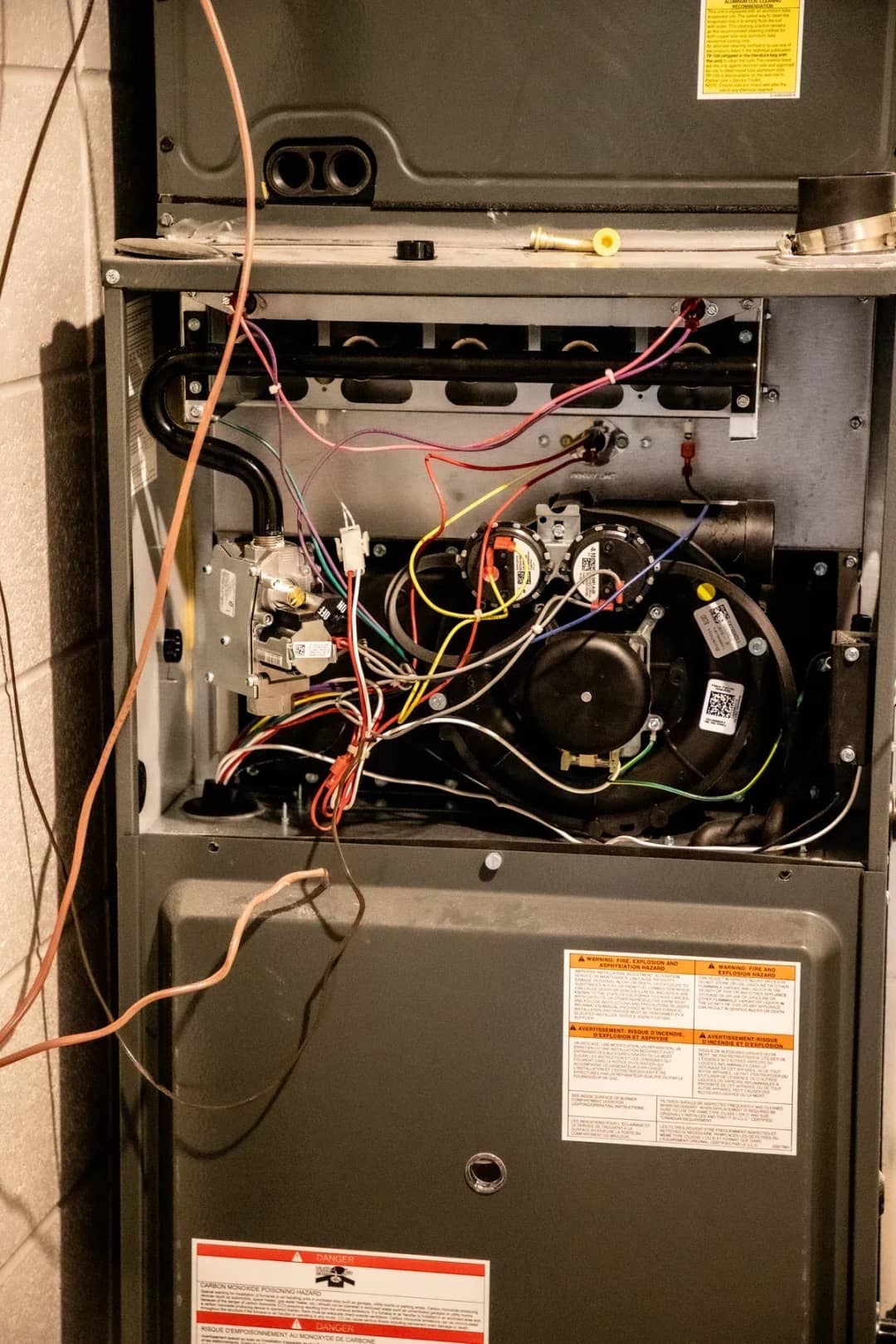
The furnace is the same box your evaporator coil sits in, so if the blower has been noisy or the heat was rough last winter, say so and we will look while the panel is already off — furnace repair in Boise covers that side. The same company handles drain cleaning in Boise and water heaters here too; for plumbing the number is (208) 366-5771, and electrical work runs through American Electrical Services at (208) 782-8268.
For anything cooling-related — blowing warm, icing up, tripping off, leaking water, or refusing to start at all — the cooling number is (208) 782-8267. Describe what the system is doing when you ring, and we will give you our best guess before we set out and the real answer at the unit.