If the house is already cold, call (208) 782-8267 now and read the rest while the truck is on its way. To match your symptom first, our furnace-not-working guide walks through the five ways a furnace fails.
Do you really send a furnace truck over to Ontario?
We do, and the dispatch log is the proof rather than a paragraph of promises. Since October 2020 our records hold 3,276 jobs at Ontario addresses across 833 households, 2,946 of them completed, all within ZIP 97914. Those records begin when the current dispatch system was switched on; the company itself was established in Caldwell, Idaho in 1945 and has worked the greater Treasure Valley since 1945. Our heating and cooling records for Ontario run from March 2023 and hold 617 jobs for 200 households — 232 of them furnace work across 127 households, and 105 of those an actual breakdown, what we book internally as a no-heat call or a furnace repair, for 77 households between September 2023 and April 2026.
On our dispatch map Ontario is its own zone, grouped with Vale and Huntington, and an Ontario address sits on average about 31 miles as the crow flies from the shop at 1005 Commercial Way in Caldwell. A technician finishing a call in Payette or Fruitland is one bridge away. Nyssa and Vale have their own pages.
The heat is out right now. Can someone be here today?
Of the 105 Ontario breakdown calls on our books, 52 were put on the schedule for the same day the call came in, and 81 within one day. Twelve different primary technicians have run those calls. Five of the 105 landed on a Saturday and none on a Sunday — worth knowing on a Sunday night, so say so when you call and get a straight answer about Monday morning.
Across the whole service area the picture is similar: of 718 breakdown calls since March 2023, 334 were scheduled the same day and 522 within one day. When an arctic front settles into the Snake River valley and the freezing fog does not lift for days, every marginal furnace from Weiser to Nyssa quits at once, and the day you call and the day we arrive are most likely to differ. Ringing early in the morning genuinely changes what is available.
One practical detail: you are on Mountain Time, the same clock as Caldwell and Boise, even though most of Oregon is not. Malheur County moved its clocks to match the Idaho side about a century ago, so when our dispatcher says between eight and ten, that is your clock too.
It clicks and never lights, or it lights and blows nothing. What broke?
Those are the two failures we have actually put parts on at Ontario addresses.
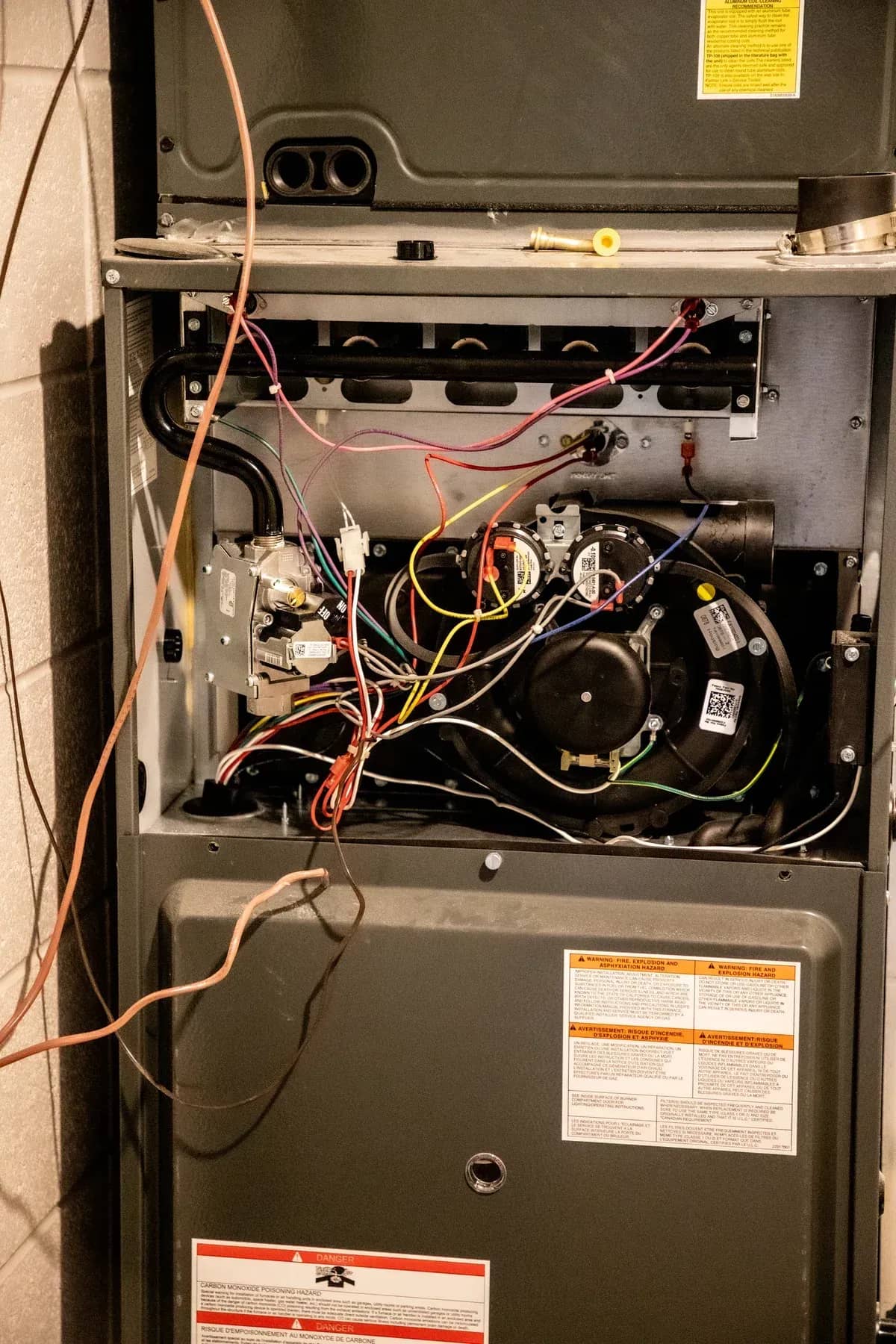
Clicks, hums, no flame. The thermostat calls, the inducer spins up, there is a click or two, then nothing; after a handful of retries the board locks itself out. Usually the hot surface igniter has failed — a small ceramic element that glows orange in front of the burners so the gas has something to light against, with only so many heat-ups in it before it cracks. The technician confirms it by watching the ignition sequence and measuring the igniter's resistance, then checks the gas valve opening on cue, the flame sensor proving the burn, and manifold pressure. Plain hot surface igniters and the smart-valve style igniter assembly fitted to some furnaces are both items we have invoiced on Ontario furnace calls, so neither is a special order.
Burners light, registers stay silent. The blower. The burners fire, no air arrives, and before long the high-limit switch cuts the gas and the whole thing repeats. Three things fail here: the run capacitor, which reads weak on a meter long before it dies; the motor — the common 115-volt universal frame in the 1/6 to 1/2 horsepower range is one we have replaced at an Ontario address, along with a multi-horsepower Mars motor; and the blower wheel, which packs up with dust on a furnace run for years without a filter change until it moves a fraction of its rated air — we have replaced one of those in Ontario too.
Why do you block two hours for a furnace call?
Of the appointments booked against Ontario breakdown calls, 77 of 118 were booked at a full two hours, because several common furnace faults cannot be confirmed in a few minutes. A flame sensor that reads marginal on one cycle and fine on the next, a limit switch that only trips after a long run, a pressure switch that closes until the wind shifts — these have to be watched through a complete heating cycle and then a second one.
What fills the block: power and the door switch, the filter, the thermostat's call, and the fault code stored on the control board. Then measurement — microamps at the flame sensor, microfarads on the capacitor, amp draw on blower and inducer, manifold gas pressure, temperature rise across the heat exchanger. Then combustion readings and a look at the heat exchanger itself, because a crack there ends the repair conversation. And finally: what killed the part that died? If you can safely open the front panel before we arrive, read the model and serial number off the rating plate; that decides which parts get loaded in Caldwell.
Is it done in one trip, or do you have to come back?
Usually one trip. Of the 97 completed breakdown calls at Ontario addresses, 86 were closed out inside a single appointment; nine took two visits and two took three. Across the whole service area the ratio holds — 599 of 660 completed breakdown calls finished in one appointment.
The parts that fail on cold nights are the ones we keep stocked, and the invoices across our service area read like a packing list: hot surface igniters, 80 percent and 90 percent induced draft motors, universal blower motors, blower wheels, dual run capacitors, universal pressure and high-limit switches, a universal ignition control board, single-stage gas valves and thermostats, and 30-amp cartridge fuses for electric furnaces.
What forces a second trip is anything built specifically for your cabinet — an OEM gas valve for a discontinued model, an inducer assembly that fits one brand, a control board nobody has stocked since the furnace was new. Thirty-one miles is a real drive, so if your furnace lands on that list you hear it before the technician leaves your house, not from a voicemail two days later.
Which month does the heat go out in Ontario?
December, by the count, not October. Sorting Ontario's 105 breakdown calls by month: 23 in December, 20 in November, 17 in January, 16 in February and 14 in October. Then it collapses — five in March, four in April, and a single call apiece in June, July and September.
That is a slightly different shape from the service area as a whole, where November and January lead, and one reason is the river. Ontario sits low on the Snake, and once an inversion sets in the valley floor can hold freezing fog for days while the benches above it see sun. A furnace that limped through the first cold week in October gets its real test in the long, gray, sub-freezing stretch of December, running for hours at a time instead of cycling gently. That is when a weak igniter finally cracks and a tired inducer bearing seizes. Ontario's tune-up bookings say homeowners here already know it — 22 in September, 20 in October and 15 in November, against a single one in January.
Does it matter that I am on the Oregon side?
For the furnace, no. For the gas and the paperwork, a little.
Gas. Inside the city limits you are almost certainly on Cascade Natural Gas; their Ontario office is on Southwest 19th Street. If a whole block loses gas pressure on a cold night that is a Cascade call rather than a furnace call, and it happens — low inlet pressure looks exactly like a failing gas valve until the technician puts a manometer on it. Out on the acreages along Oregon 201, Hyline Road and the roads north of town, propane is common; a propane furnace gets its own section below.
Permits. A repair does not need one. A replacement does, and in Ontario it is pulled on the Oregon side under Oregon's code, not Idaho's. Same crew, different rulebook, and we handle the paperwork.
Is there anything about Ontario houses that makes furnace repair harder?
Ontario's houses fall into two eras, and they fail differently.
The old core. The blocks off South Oregon Street and the numbered streets — Southwest 2nd, Southwest 4th, Northwest 3rd, Southwest 1st — appear more often on our Ontario list than almost anywhere else in town, and many of those houses predate forced-air heat. What we walk into is often a basement furnace that replaced a gravity system decades ago, bolted to trunk lines built for different physics, with a return path that was an afterthought. Those furnaces short-cycle on the limit switch no matter how many parts get replaced, because the problem is air, not ignition. Some still share a masonry chimney with a gas water heater, which becomes a real venting question the moment anyone proposes a high-efficiency replacement.
The newer subdivisions and the acreages. North and west of town — Sunset Drive, North Dorian Drive, South Verde Drive, Foothill Drive, Lauren Drive — the equipment is younger and lives in a garage or a closet. The failures are builder-grade thermostats, condensate drains that freeze in an unheated garage, and the twin white PVC pipes of a high-efficiency furnace ending on a windward wall where freezing fog glazes them shut. On the acreages, add rodents: a pack rat chews low-voltage wire in the crawl space, and the symptom looks exactly like a dead thermostat until somebody follows the wire.
Farm country adds dust everywhere. Ontario is onion and sugar-beet ground, and between field work, harvest and August smoke a one-inch filter loads up far faster than the box suggests. A starved furnace runs hot, trips its limit and cooks igniters years early. Where the cabinet has room for a four-inch media filter, it is the cheapest upgrade on this page.
How much should I expect to pay?
No number here, and that is a decision rather than an omission. A price quoted before anyone has opened the cabinet is a price for a furnace nobody has looked at, and it can only move once the panel comes off.
What actually builds the figure: which component failed, and whether it is a stocked universal part or a manufacturer-specific assembly from a supplier. Whether the furnace burns natural gas, burns propane, or is electric — three different parts lists. How reachable the unit is, because a basement furnace with room on all sides and one at the back of a low crawl space are not the same hour of labor. And whether the visit turns up a safety condition, which turns it into a replacement conversation.
What you get is a fixed price in writing before anything is taken apart, and the right to say no to it. If the honest answer is replacement, the on-site visit that lays repair and replacement side by side is free; we have run 82 of those heating estimate visits at Ontario addresses for 68 households.
If it cannot be fixed, how fast can a new furnace go in?
Faster than most people expect, and there is a record of it. Eighteen Ontario households on our books had a replacement job opened within ninety days of a breakdown call, and seventeen of those installs were completed.
Two recent ones show the pace. On 5 February 2026 an Ontario homeowner called with a furnace repair; the visit closed the same day, the installed-equipment job (job type HVAC (INS), sold off an estimate) was written the same day, scheduled for the 6th, and completed on the 6th — cold house to new furnace in about a day. What went in was a Ruud R801T 80 percent upflow gas furnace (model R801T0754A21UHSNAS), a new plenum, a rebuilt flue with a new high-wind cap, a T6 Pro thermostat, and a battery carbon monoxide alarm left on the wall on the way out. The second, in January 2026: a no-heat call on 20 January, technician there on the 21st, the installed-equipment job (job type HVAC (INS), sold off an estimate) written on the 28th and finished on the 30th — a Ruud R951T 95 percent multi-position gas furnace (model R951T0603A17M4SNAS) with a matched 2-ton air conditioner and coil, new 2-inch PVC sidewall venting, a condensate pump with a safety switch, and two carbon monoxide detectors.
Neither was a hard sell; the call is yours. Our repair-or-replace walkthrough shows how the math gets done, and HVAC installation in Ontario covers sizing, venting and install day.
Would a fall tune-up have caught it?
Sometimes, and we would rather give you the honest count than a slogan. Of the Ontario households with a breakdown call on our books, 18 had booked a furnace tune-up with us at some earlier point. A tune-up is a snapshot, not a warranty.
What it reliably buys is timing. The visibly cracked igniter, the flame sensor reading low, the inducer bearing that has started to whine — those get caught in October with a warm house and an open schedule instead of at night with the nearest truck on the wrong side of the river. Ontario homeowners have booked 59 furnace tune-ups and another 39 combined furnace-and-air-conditioner tune-ups with us, nearly as many planned visits as breakdowns. HVAC maintenance in Ontario lays out what one includes; if the furnace is still healthy, furnace tune-ups is where to start.
I am outside town on propane. Is that a problem?
No, but say so when you call. Propane and natural gas furnaces are the same machine with different plumbing at the gas end — smaller orifices, higher manifold pressure, and on a converted unit the correct conversion kit with a pressure check afterward. Propane also has a failure natural gas does not: the tank. A long cold stretch in December pulls a tank down faster than the delivery schedule assumed, and low tank pressure imitates a failing gas valve convincingly. Check the gauge before you call.
Electric furnaces are a different animal: no burners, no flame sensor, no flue, no heat exchanger to crack. What they have is resistance elements staged in by sequencers, a contactor, and cartridge fuses in the disconnect that leave the unit dead with nothing visibly wrong; electric heat kits and contactors both appear on our invoices across the service area. If your backup heat is electric strips on a heat pump, start at heat pump services in Ontario.
Can you look at the water heater or a slow drain on the same trip?
Yes, and in Ontario it is the norm. This company started as a plumbing and drain outfit, and 129 Ontario households on our books have had both heating-and-cooling work and work in another trade — plumbing, drain, or electrical — from us. The Ontario zone on our dispatch map is also where our $59 drain-cleaning special applies. A furnace and a gas water heater sharing one flue is one conversation, not two, and a wet spot by the furnace is either condensate or a plumbing leak — one visit says which.
With the heat out overnight, open the cabinet doors under sinks on exterior walls and let a pencil-thin stream run at the farthest fixture; the burst-pipe call the next morning is the one we least want to take from you. Common pairings on the Oregon side: water heater repair in Ontario, gas line work, and duct cleaning in Ontario. Everything we do in town is listed on our Ontario services page.
Who actually shows up, and how do I reach you?
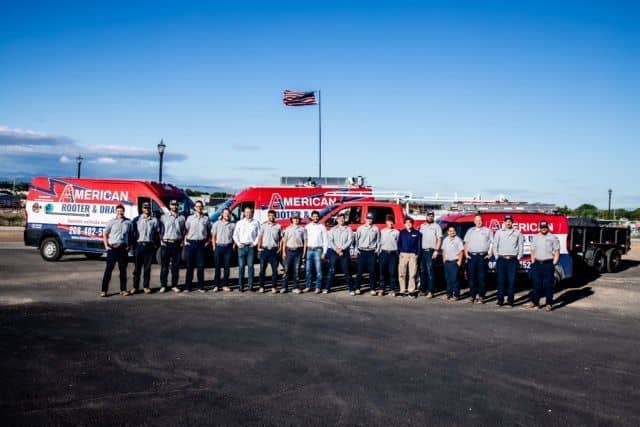
American Heating & Air is the heating and cooling division of American Rooter & Drain, established in Caldwell, Idaho in 1945 and working the greater Treasure Valley since 1945. The trucks run out of 1005 Commercial Way in Caldwell, and mechanical work is performed under Idaho HVAC Contractor License 029771. Nineteen different primary technicians have run a furnace call at an Ontario address, and 82 have worked an Ontario job of some kind. Two of the 105 Ontario breakdown calls carry a recall reference, meaning a return trip on the same complaint.
If the heat is off, call (208) 782-8267 and tell whoever answers what the furnace is doing — clicking without lighting, lighting without blowing, blowing cold, cycling on and off, or nothing at all. That one sentence, plus the model number off the rating plate if you can reach it, decides what gets loaded in Caldwell before the truck heads for the bridge.