
Cold house right now? Call (208) 782-8267 and finish reading later. To match the symptom first, our guide to what a furnace is telling you goes through them one by one.
Do you send furnace technicians to Fruitland, or is that too far from Caldwell?
We do, and the record is long enough to trust. Since October 2020 we have run 1,347 jobs at Fruitland addresses for 397 customers at 364 addresses, 1,201 of them completed, and 1,344 of those jobs sit inside ZIP 83619. The dispatch database only reaches back to October 2020, when the current dispatch system was adopted; the company itself was established in Caldwell, Idaho in 1945 and has worked the greater Treasure Valley since 1945.
Heating and cooling came to us later than plumbing did. Our furnace records at Fruitland addresses begin in March 2023. Since then, Fruitland addresses account for 150 completed furnace-and-air-conditioner no-heat, repair, service and not-cooling calls at 87 addresses; 83 completed tune-ups at 44 addresses; 4 completed system installations and 41 completed installed-equipment/sold-work jobs (component replacements included) at 32 addresses combined; 19 completed sold repair-and-replace visits at 16 addresses; 13 completed duct jobs at 11 addresses; and 111 completed estimate, inspection and other visits at 78 addresses — 421 completed heating and cooling jobs altogether (480 booked), for 158 customers, run by 19 different primary technicians.
Fruitland is about 27 miles from the shop at 1005 Commercial Way, Caldwell, as the crow flies — west on I-84, then north on U.S. 95. On our dispatch map it shares a service zone with Payette, New Plymouth and Weiser, so a van bound for any of those is already on your road.
The heat is out right now. Will someone be here today?
Here is the scheduling record for Fruitland furnace-and-air-conditioner no-heat, repair, service and not-cooling calls: 168 booked since March 2023, 150 of them completed. Looking at same-day performance across all of our Fruitland furnace and air-conditioning work — not just no-heat calls — 149 of the 421 completed jobs carry both a booking timestamp and a completion timestamp: 139 were completed on the same calendar day they were booked, 5 exactly one calendar day later, and 5 fall into neither count. Booked_at is not always a scheduling timestamp in this data — on some jobs it reflects when an earlier estimate was sold rather than when the visit was set up, which can make the gap meaningless as a duration — so we won't guess what happened on any one of those five jobs. A cold house is still scheduled ahead of a tune-up on our dispatch board.
The arrival window we book is four hours wide — 87 of the 94 furnace appointments at Fruitland addresses were booked that way, the other seven at two hours. We do run furnace calls on a Saturday when the weather demands it; Sunday coverage is rare. Saturday evening? Say so, and you will get a plain answer about Monday rather than a maybe.
The honest caveat is weather. When a cold front settles onto the Snake River valley, every marginal furnace between Ontario and Emmett quits inside the same couple of days, and that is exactly when a same-day slot becomes a next-morning slot. Calling first thing in the morning genuinely changes what is available.
Why did my furnace make it through November and quit in January?
Because January is when a furnace here stops resting. Counting every furnace and air-conditioning job at Fruitland addresses, June (54) and July (49) are the busiest months of the year — summer tune-up and air-conditioning season — but January (42) is the busiest winter month and the third-busiest month overall. November (39), December (38) and October (32) fill out the rest of the cold season, and February (15) is the quietest month of the year.
What January does that October does not is length of run. In October a furnace fires briefly and rests for most of the hour. When the inversion sits over the river bottom and the daytime high stays below freezing, the same furnace runs most of the hour, and the merely tired parts give out: the igniter that had been taking a few tries, the blower motor whose bearings only get hot on a long cycle, the run capacitor drifting under its rating. A furnace that worked fine last month was simply not being asked to work.
The other January problem belongs to the rivers. Freezing fog off the Snake and the Payette glazes the pair of white plastic pipes on the side of a high-efficiency furnace; ice over the intake means the pressure switch will not close, and the furnace refuses to light for a reason that has nothing to do with the furnace. If yours vents through the wall, check those pipes first.
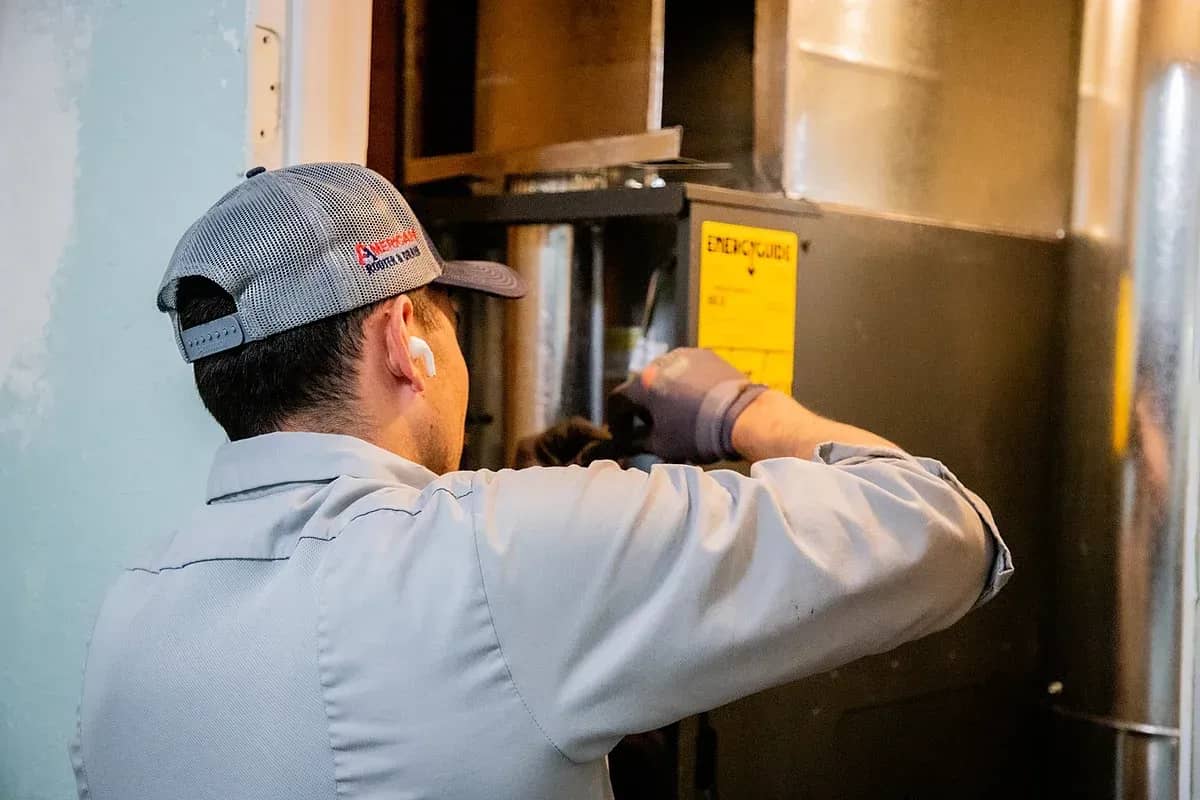
What does the technician actually do in front of my furnace?
Three questions, in order: is the furnace being allowed to run, is it trying to run, and can it prove it is running safely. The order matters because the cheap answers sit at the front.
Allowed to run: the breaker, the switch on the cabinet that looks like a light switch, and the blower door — a door not fully seated presses a safety plunger that kills the whole unit, and it is easy to leave it that way after a filter change. Then the filter, the thermostat's call for heat, and the control board, which stores the last fault as a blink code.
Trying to run: the inducer motor should start first and pull a draft through the vent; the pressure switch has to agree the draft is real; the igniter should glow; the gas valve should click open; the burners should light in sequence. Where the chain stops tells the technician which part to test, and he tests it with a meter rather than replacing it on suspicion — microamps at the flame sensor, microfarads on the capacitor, amp draw on the motors, gas pressure at the manifold.
Proving it is safe: temperature rise across the heat exchanger, compared with the span the manufacturer prints on the rating plate, which exposes an airflow problem disguised as an ignition problem, and a proper look at the exchanger itself. A crack there, and the repair conversation is over. Then the question that separates a repair from a return visit: why did this part fail in this house? An igniter that dies every second winter is not an igniter problem.
Which furnace parts fail most, and do you carry them?
Looking only at parts invoiced on furnace jobs across our service area, the list is what you would expect a January to produce: induced-draft motors for 80 and 90 percent furnaces, dual run capacitors, universal 115-volt blower motors in the 1/6 to 1/2 horsepower sizes, hot-surface igniters, universal electronic-ignition gas valves, blower wheels, pressure switches, high-limit switches, control boards, angled flame sensors, 30-amp cartridge fuses and single-stage thermostats. Those are the parts we make a point of carrying. At Fruitland addresses specifically, a universal 1075 RPM blower motor, a hot-surface igniter, a single-stage thermostat and a gas connection rebuilt to code — new shutoff valve, flex connector and sediment trap — have all come off a van and gone into a furnace.
Single visits are the figure to care about with a cold house: most of our completed furnace and air-conditioning visits at Fruitland addresses close in a single appointment; a handful need a second visit, and a very few need a third or fourth. Two of these jobs carry a recall reference, meaning we came back on the same complaint. What pushes a job to a second visit is nearly always a part made for one furnace and no other, and if that is where yours lands, the technician says so before he leaves.
Which Fruitland houses are hardest on a furnace?
Fruitland named itself after its orchards, and the housing still reads that way. The older farm places along Elmore Road, Custer Road and the highway frontage are where we find the furnace fitted into a crawl space or a lean-to utility room long after the house was built, with ducting added a run at a time. A crawl-space furnace on the river bottom lives in damp air, and damp air rusts cabinet bottoms, flame-sensor mounts and heat exchangers from the outside in.
The newer subdivisions — Syringa Springs, Crimson Circle, Bayberry, the Whitley Drive loops — put the furnace in the garage or a closet off the hallway, run flex duct through an unconditioned attic and finish with a builder-grade thermostat. A garage furnace breathes garage air, which in Fruitland means field dust in spring, harvest dust in fall and truck dust off U.S. 95 all year. Thin filters here choke faster than the box suggests; a thick media filter, if the cabinet can take one, is the cheapest thing you can do for a furnace's life. Slab ranch houses and manufactured homes add the downflow furnace to the mix — same parts, stacked in the other order, filter often at the top.
Can you tell me what the repair will cost before you come out?
No, and be suspicious of any furnace page that says otherwise. A figure given before anyone has opened the cabinet is a figure for a different furnace. What actually moves the number:
- Which part failed, and whether it is one we carry or one that ships from a supplier.
- Gas or electric, because those are two different parts lists and two different diagnoses.
- Where the furnace lives. A garage unit with clear floor around it and one buried at the back of a crawl space are different afternoons.
- Whether the part that died is the root problem or a casualty of one. A new pressure switch on a furnace with an iced-over intake means fixing it twice.
- Whether the visit uncovers a safety problem, which turns it into a replacement conversation.
What you receive is a fixed figure in writing before any work begins, and usually more than one figure. On furnace visits at Fruitland addresses our technicians have written 588 separate estimates for 73 households, and 186 of those were accepted (31.6 percent). You are shown options, and declining one is ordinary. When the honest answer is replacement, the on-site assessment that puts repair and replacement side by side is free and commits you to nothing.
When does a furnace stop being worth repairing?
When it starts repeating itself, mostly. Forty-seven Fruitland households have had a completed no-heat or furnace repair visit from us; two of those went on to a completed heating installation within ninety days. The other 45 had the furnace fixed and kept it. That proportion is smaller than a sales pitch would have you believe. Two Fruitland households show the two ways it goes.
The first called on a Sunday, 11 January 2026, with no heat. A technician was there Monday afternoon inside a one-to-five window and the visit closed that day. Two days later the furnace was out again; the technician came back the same afternoon, returned the next morning, replaced the blower motor and the hot-surface igniter, rebuilt the gas connection to code, and wrote the replacement estimate before he left, because a furnace losing a motor and an igniter in the same week is telling you something. The homeowner chose replacement. On 20 January — nine days after the Sunday call — the crew installed a Ruud 80 percent downflow gas furnace (model R801T0753A17DZSNAS) with a matched three-ton coil and air conditioner, a T6 Pro thermostat and a battery carbon monoxide alarm, and finished the same day.
The second household took the long road: a no-heat call in January 2024, furnace repairs on 31 January and 16 February, another that August, and two more in early December 2025. The estimate was written on the second of those December visits, the installation was completed on 19 December, and the final inspection was signed off on 14 January 2026. Nobody pushed. The furnace made the argument itself over 23 months.
If you are weighing it now, how we call repair versus replacement walks through the reasoning, and HVAC installation in Fruitland covers sizing and how install day runs.
Does an inspector come out after a furnace replacement?
Yes, and we book that visit ourselves — twelve final HVAC inspection visits at Fruitland addresses are on our books, for ten households. A replacement gets a mechanical permit; a like-for-like part swap on an existing furnace does not.
What the inspector looks at, so nothing about the visit surprises you: a gas shutoff within reach of the furnace, a sediment trap below the valve, and a flex connector that does not pass through the cabinet wall; a flue of the right diameter, pitched and supported, clear of anything that burns; combustion air provided on purpose; a condensate line with a trap that drains somewhere legal; a service switch and a working receptacle at the unit; the clearances printed on the furnace's own label; and a carbon monoxide alarm. The alarm in the January install above is not decoration. It is on that list.
Does it matter if my furnace burns propane or runs on electricity?
It matters to what goes in the van, so say which you have when you call. A propane furnace beyond the gas mains is the same machine with a different gas train — smaller orifices, higher manifold pressure, a conversion kit that has to be genuinely installed and set with a gauge — plus one failure natural gas never has: an empty tank. Long January runs drain a tank sooner than the delivery route expects, and low tank pressure imitates a dead furnace convincingly. Glance at the gauge before you call.
An electric furnace is a different diagnosis entirely: no burners, no igniter, no flame sensor, no flue. Heat comes from resistance elements staged in by sequencers, and the usual failures are an element, a sequencer, a contactor, or the cartridge fuses in the disconnect, which leave the furnace stone dead with nothing visibly wrong. If yours is a heat pump with electric strips, start at heat pump services in Fruitland.
While you are here, can you fix the slow drain too?
Yes, and you should ask, because the drive from Caldwell is already spent once the van is in your driveway. Fifty-four Fruitland households have had both heating-and-cooling work and plumbing work from us. Drain, sewer, camera and jetting calls at Fruitland addresses run to 266 jobs for 179 households, and water heater calls to 24 jobs for 18 households. ZIP 83619 is inside our $59 drain clean zone.
In real houses the problems braid together anyway: a bedroom that stays cold is often a loose duct in the crawl space, found while somebody is under there for a leak. Frequent pairings here are water heater work and drain cleaning in Fruitland; if the furnace conversation turns into a gas piping conversation, gas line work is the same crew. The full list is on our Fruitland services page.
Is a fall tune-up worth it, or is that just an upsell?
Twenty-six of the 80 Fruitland households on our furnace list met us first on a tune-up; 31 met us first on a no-heat call. September is when the planned visits cluster — 25 furnace and air-conditioning jobs at Fruitland addresses in September — and it is the right month, because the schedule is open and the house is warm.
We will not sell a tune-up as insurance, so here is the plain count: exactly one Fruitland household that had a completed tune-up from us later called in a no-heat. That is a count, not a promise. What the visit reliably buys is timing — the weak igniter and the drifting capacitor found in September rather than late on a January night with the nearest van in Weiser. Details at furnace tune-ups and HVAC maintenance in Fruitland; duct cleaning in Fruitland and AC repair in Fruitland ride the same schedule.
Who is going to be in my house, and what should I have ready?
American Heating & Air is the heating arm of American Rooter & Drain. The company was established in Caldwell, Idaho in 1945 and has worked the greater Treasure Valley since 1945; the Idaho HVAC contractor license is number 029771, and the vans leave from 1005 Commercial Way in Caldwell. Eighteen of our primary technicians have run furnace calls at Fruitland addresses; 69 have been to a Fruitland address for some trade; 36 have run furnace calls somewhere across our service area. Whoever comes diagnoses first, explains what failed in plain words, and hands you the price in writing before any part is disturbed.
Before you call (208) 782-8267, note the brand, model and serial number from the rating plate if you can safely reach it, and be ready to say what the furnace is doing — dead quiet, blowing cool air, lighting then shutting down, running all day without the house warming, or short-cycling. That description decides what goes into the van in Caldwell.
Same run, neighboring towns: furnace repair in Payette, furnace repair in Weiser and, across the river, furnace repair in Ontario.