If the house is already cold, skip ahead and call (208) 366-5771. If you would rather work out what your furnace is doing first, our symptom-by-symptom guide sorts it by what you are seeing.
What actually breaks on a furnace?
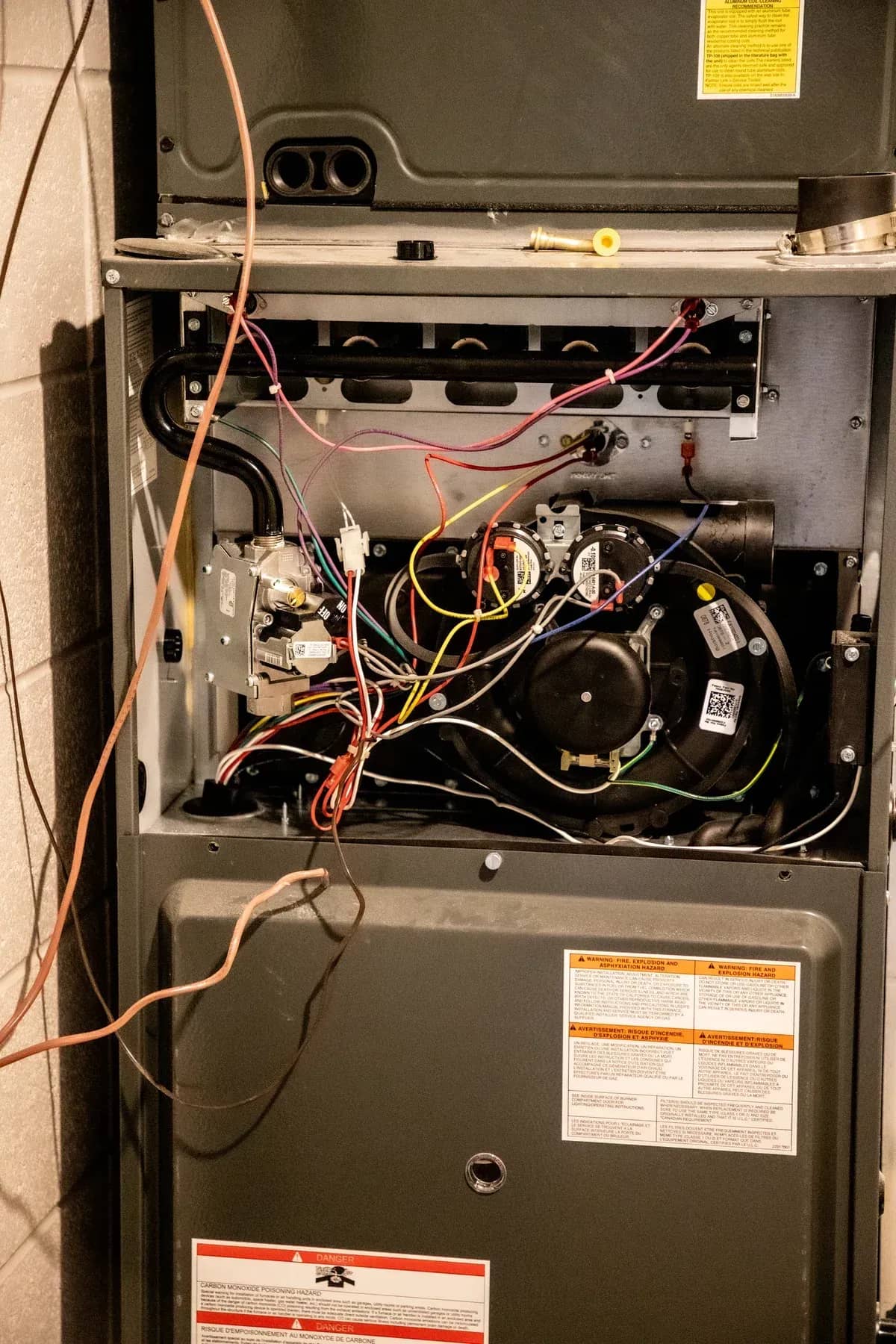
A gas furnace is a relay race, not a box that makes heat, and a failure is a handoff that did not happen. The thermostat closes a circuit. The control board wakes and runs a self-check. The inducer motor spins first and pulls a draft through the heat exchanger and out the flue. A pressure switch senses that draft and closes, which is the board's proof that the exhaust path is genuinely open. Only then does the igniter get power. The gas valve opens. Within seconds the flame sensor has to prove there is a real flame at the burners, or the board shuts the gas back off. The blower waits out a delay so it is not pushing cold air into the house, then starts. Limit switches watch cabinet temperature throughout and will stop everything if it climbs too far.
Now the failures, in that order.
The igniter. On anything built in recent decades this is a hot surface igniter, a small brittle element that glows orange at well over a thousand degrees. It dies from thermal cycling, and it dies from being handled — skin oil left on the element burns through it on the next call for heat. When it fails you get every step up to ignition and then nothing. We carry them on the truck.
The flame sensor. This is nothing but a steel rod sitting in the burner flame, and what it does is stranger than it looks. Flame conducts a tiny current, measured in microamps, and the board reads that current as proof of a burn. A film of oxide on the rod cuts the signal, so the board decides the burner is not lit and closes the gas valve to be safe. The symptom is unmistakable once you know it: the furnace lights, runs, and under a minute later drops out and starts over. Cleaning the rod takes minutes; if the microamp reading will not hold afterward, the rod gets replaced.
The pressure switch. The switch itself is rarely the villain. It is a diaphragm on a rubber hose whose only job is to confirm the inducer is really moving air. When it will not close, the answer is usually elsewhere — a flue or intake blocked by snow, ice or a nest, a cracked hose, or on a high-efficiency furnace a condensate trap full of water backing pressure up the line. Replacing the switch without finding what tripped it is how a furnace gets fixed twice.
The inducer and the gas valve. The induced draft motor has bearings, and it usually announces itself before it quits: a whine or a grind at the start of every cycle, weeks ahead of the morning nothing happens at all. Standard-efficiency and high-efficiency cabinets take different assemblies and they are not interchangeable. Downstream of it, the gas valve is sometimes a straightforward electronic ignition valve and sometimes an integrated assembly with the igniter built in, which changes both the part and the diagnosis. Valves get tested rather than guessed at, and every joint is sealed and leak-checked on the way back together.
The blower motor and its run capacitor. A capacitor that has lost capacitance leaves the motor humming and not turning, and a motor that sits and hums is cooking itself. Capacitors are stocked and cheap; motors are neither, so a capacitor caught early is a genuine save. While the blower is out the wheel gets inspected too — a squirrel cage packed with dust moves less air than the furnace was designed around, and that shortage surfaces as an overheat trip somewhere else in the sequence.
Limits, boards, fuses and thermostats. A high-limit switch opens on rising temperature, and one that keeps opening is pointing at airflow rather than at itself. Control boards fail, and so do the low-voltage transformers behind them; on most boards there is a small automotive-style fuse that one pinched thermostat wire will blow, and fitting a fresh fuse without finding the short buys about ten seconds. Thermostats themselves do fail, and they get blamed far more than they fail — a wiring fault upstream of one looks exactly like a dead one.
The failed part is rarely the whole story. The second question is the one that keeps you from doing this again: this igniter failed, so what in this house is chewing through igniters?
Will you fix it on the first visit?
Usually, and there is a number behind that rather than a slogan. From March 2023 through August 2026 our schedule carried 307 jobs booked as a furnace repair. Of those, 287 were completed, 18 were canceled and 2 were still open when we pulled this. Of the 287 completed repairs, 259 were finished inside a single appointment. Twenty-two needed a second visit, four needed a third, one needed four and one needed seven.
What decides which side of that line you land on is almost always parts. Igniters, flame sensors, run capacitors, board fuses, universal pressure switches, high-limit switches, dual-element cartridge fuses and thermostats live on the truck, because those are the parts that fail on a January night. What has to be ordered is anything brand-specific or physically particular: an OEM gas valve, an inducer assembly sized to one manufacturer's cabinet, a blower motor in an unusual frame, a control board for a model long out of production. When that happens you hear it on the first visit, along with what we can do to keep the house livable in the meantime.
Twenty-one different technicians have run those 307 calls. Two of the 307 came back on our books as a recall, meaning a return trip on the same complaint. That is a more useful number than any adjective.
How soon can someone come out?
Of the 307 furnace repair jobs, 103 went onto the schedule for the same day the call came in, and 185 were scheduled within one day. A house with no working heat moves ahead of routine work on our board — a dispatch rule, not a favor.
Two honest caveats. The first is the cold snap: when the valley drops hard, every marginal furnace in three counties fails inside the same forty-eight hours, and that is the week when the day you call and the day we can be there are most likely to differ. Calling early in the morning genuinely helps. The second is the weekend — 10 of those 307 were scheduled on a Saturday, and furnace repairs do not go on the Sunday board. If it is Saturday evening and you are cold, say so when you call and you will get a straight answer about Monday.
What does a furnace repair cost?
You will not find a repair number here, and that is on purpose. Anybody who gives you one over the phone is pricing a furnace nobody has looked at, and that figure has to change the moment the cabinet comes open.
Here is what the number is built from. Which component failed, and whether it is a stocked consumable or an ordered assembly. Whether the furnace is gas or electric, because those are two different repair lists. How hard the unit is to reach, since a basement furnace with three feet of clearance and an attic unit at the end of a plank walk are not the same labor. Whether the failure is a symptom of something upstream, because a blocked flue is not a pressure switch job no matter what the board recorded. And whether what we find is a safety condition that turns the visit into a replacement decision instead of a repair.
What you do get is a fixed price in writing before anything is taken apart, and the standing option to say no. If replacement turns out to be the better buy, the assessment visit that puts both options side by side is free and carries no obligation. Our repair-or-replace walkthrough covers how that call gets made.
Why did my furnace break in the first place?
Furnaces in this valley fail for local reasons, and a technician who only swaps the dead part will be back.
Filters. Start here. Farm ground works all spring and all fall, August fills the valley with smoke often enough to matter, and a one-inch filter loads up faster than the box implies. A starved furnace overheats, trips its limit, cycles short, and burns through igniters and board relays years early. A four-inch media cabinet holds far more dust before it chokes, if there is room for one.
Airflow the house is fighting. Closed registers in unused rooms, furniture over a return, a filter grille smaller than the blower needs, a duct run that came loose in the crawl space. Every one presents as a furnace problem and none of them is.
Where things are mounted. A thermostat in afternoon sun, in the draft off a front door, or a few feet from a supply register reads a temperature nobody in the house is experiencing and shuts the furnace down early, over and over. A furnace living in an unconditioned crawl space or a detached garage works harder and corrodes sooner than the same model in a finished basement — and out here, chewed low-voltage wire is a real cause of a dead furnace, not a punchline.
The vent terminations. On a high-efficiency furnace the white PVC intake and exhaust exit through a wall or the roof, and in this valley they collect drifted snow, freeze shut in an ice fog, and occasionally house a bird. Knowing where yours come out, and walking past them after a storm, prevents a service call.
An annual furnace tune-up is where a technician finds this while you still have a choice about the timing.
What should I do while I'm waiting for the technician?
Getting through the wait safely is its own skill.
Stop resetting the furnace. Cycling the breaker or relighting a pilot over and over fixes nothing and puts unburned gas into the cabinet. If it locked itself out, leave it locked out.
Space heaters, carefully. One per circuit, plugged straight into a wall outlet and never into an extension cord or power strip, three feet of clear space all around, off when you sleep and off when you leave. A space heater deserves more caution than the furnace does. And do not heat with the oven — that is a carbon monoxide risk, not a thrifty workaround.
Protect the plumbing before you protect your comfort. If it is heading below freezing and the furnace will be down overnight, open the cabinet doors under sinks on exterior walls, let a thin stream run at the fixture farthest from the meter, and find your main water shutoff now, while the lights are on and you are calm. If you have a well house, keep whatever heat is out there running. We are a plumbing company as well as a heating one, and the frozen-line call the morning after a furnace failure is one we would rather you never make.
Shrink the house, and leave the thermostat alone. Close doors to rooms nobody is using, and open the blinds on the south side while the sun is on them. Set the thermostat to heat at a normal temperature: cranking it to ninety does not make heat arrive faster, and on a system misbehaving intermittently it makes the fault harder to reproduce while the technician is standing in front of it. Then clear a path, because storage stacked around the furnace or a crawl space hatch under a bed turns a short job into a long one.
Do you work on electric furnaces too?
Yes, and it is a different animal. An electric furnace has no burners, no flame sensor, no gas valve, no flue and no heat exchanger to crack, which removes the single most serious failure a gas furnace can have. What it has instead is a bank of resistance heating elements brought on in stages by sequencers, a contactor, and its own protective fuses, including the dual-element cartridge fuses in the disconnect. Diagnosis is largely electrical: amp draw on each element, whether the sequencers stage in order, and what the breaker and disconnect are doing. The blower motor and run capacitor are shared with the gas world and fail the same way there. Heat pumps are a third case again — if yours has electric backup heat, our heat pump page is the better starting point, because the diagnosis begins outdoors.
How far do you drive for a furnace repair?
Farther west than people expect. Sorting those 307 furnace repair calls by the town they came from: Ontario 50, Payette 35, Fruitland 33, Nampa 27, Weiser 26, Parma 24, Caldwell 20, New Plymouth 17, Vale 16, Boise 16, Meridian 12, Nyssa 11 and Emmett 6, with the remainder spread across Middleton, Homedale, Greenleaf, Kuna, Eagle and a few others.
Seventy-nine of those calls were on the Oregon side of the Snake River, worth saying plainly because plenty of Ontario, Vale and Nyssa homeowners assume an Idaho company stops at the bridge. We do not. The shop sits at 1005 Commercial Way in Caldwell, which puts the western end of the valley closer to us than a Boise-centered map makes it look.
City pages with local detail: Ontario, Payette, Fruitland, Nampa, Caldwell, Meridian and Boise, plus everything we cover near you in Ontario and near you in Boise.
Is my furnace still under warranty?
Worth checking before you approve anything, because two separate clocks are running. The manufacturer covers parts, and that coverage starts at installation rather than at purchase, which is why the install date matters more than any receipt. Some brands shorten the term unless the equipment was registered inside a window after it went in, and that registration is the step homeowners most often discover they never took. Labor is a separate agreement, normally with whoever installed the system, and it runs on its own term.
To check it we need three things off the rating plate inside the front panel: brand, model number and serial number. Photograph all three in one frame with your phone and you have removed an entire phone call from the process. If the part is covered you still pay labor, and sometimes freight, and a warranty part comes through a specific supplier — which can turn a same-visit repair into a two-visit one. That trade is yours to make.
At what point am I throwing money at it?
A fair question, and the record does not dodge it. Of those 307 furnace repair calls, some were later followed by a completed system installation or an installed-equipment/sold-work job at the same address — company-wide our records show 44 completed system installations and another 420 installed-equipment or sold-work jobs from estimates (component replacements included) over the same period, though we do not cleanly isolate which of those trace back to one specific earlier repair call. Among the 237 customers with a furnace repair on our books, 53 have had more than one furnace repair: 42 have had two, seven have had three, two have had four and two have had five.
Repetition is the signal worth watching. One failed part is one failed part. A third failure in a third different section of the same furnace inside one heating season is a system telling you something. When we think you have reached that point we say so during the visit rather than quietly selling you another component, and the repair-or-replace page lays out the whole decision, including how to read the true age off the serial number. If the answer is a new system, furnace installation covers sizing and install day.
One honest note on prevention: a tune-up is not insurance. 55 of the customers in that repair set had one on our books before the repair call came in. What a tune-up buys is timing — finding the tired igniter or the weak capacitor in October, with a warm house and an open schedule, rather than at ten o'clock on a January night.
Who is going to show up at my house?
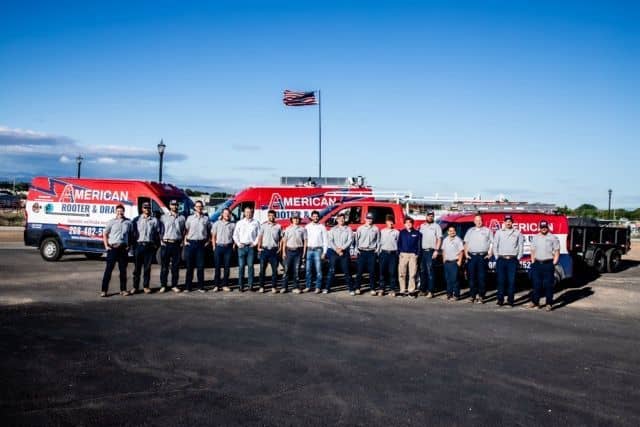
American Heating & Air is the heating and cooling division of American Rooter & Drain, an Idaho company established in Caldwell in 1945 and founded by a Marine veteran. We are licensed and insured in Idaho under HVAC Contractor License LIC# 029771, work out of the shop at 1005 Commercial Way in Caldwell, and have served the greater Treasure Valley since 1945.
On the day, a licensed technician diagnoses the system before touching a repair, explains what failed in language that does not require a trade background, and tells you straight whether the part is on the truck or on order. You can say no at any point in that sequence.
If your heat is off, call (208) 366-5771. If you can safely get to the rating plate, have the brand and model in front of you, and be ready to say roughly how old it is and whether anything has been repaired lately. Those three answers shape the visit before anyone leaves the shop.