
We work both sides of the river. Call (208) 366-5771 and an Ontario address goes on the board the same way a Caldwell one does.
Do you work in Oregon, or just Idaho?
Both, and Ontario is not an exception we make. It is a town we run in.
Here is why the question is a fair one to ask, though. Licensing does not cross the bridge on its own. Oregon licenses the contractors who do construction work in Oregon through its own Construction Contractors Board, and it licenses the plumbing trade separately from that. Idaho runs its own version of both for Idaho. Neither state's paperwork carries into the other. So a shop sitting a short drive east of you, closer to your kitchen than to half the customers it will see this week, can have no standing whatsoever to pull a permit at your address — and a water heater replacement is permitted, licensed work.
That reaches homeowners in three recognisable shapes, and it is worth being able to name them:
- The appointment that evaporates. Somebody answers, prices the job off your description, sounds keen, and then the confirmation call never comes once the address goes into their system.
- The offer to let you pull the permit. Presented as a way to save you money. It is not that. It is a company telling you it cannot pull the permit itself, which is a different sentence entirely.
- The claim that a water heater needs no paperwork at all. That one deserves a second question, and then a second company.
None of it is bad faith. It is the river. What settles it for us is that we carry the standing to do the work on the Oregon side, so an Ontario call is a scheduling question rather than a licensing one.
For what it is worth in plain numbers: at Ontario addresses we have completed 41 water heater jobs. Those are jobs that were finished. The 37 estimate visits and everything that was booked and then cancelled are left out of the count, because counting an appointment nobody kept is how a number stops meaning anything. We work Nyssa and Vale on the same footing.
Is the permit different on the Oregon side?
Yes. Different authority issues it, a different rulebook is behind it, and the record it leaves on your house is an Oregon record rather than an Idaho one.
The structural piece is the one most people have never been told, and it works in your favour. Oregon writes its plumbing code as a statewide specialty code. Cities and counties in Oregon administer that code and inspect against it; they are not each publishing their own amended edition of it. So what is required at your Ontario address is what is required in Nyssa, in Vale and in Baker City. There is no looser jurisdiction a block over to go hunting for, and equally no stricter one to dread.
What does vary by address is administrative rather than substantive: which office actually issues and inspects the permit where you live. That is a question about your address, not about which rules you fall under, and it is exactly the sort of detail that gets reassigned quietly. We confirm it on the Oregon side before the truck is loaded rather than quoting it to you from memory, and you never stand in a line or make a call about it.
Two more things follow from the state line, and both are worth holding on to:
Oregon revises on its own schedule. Its code cycle is not Idaho's, and the two do not have to change in the same year. That is why what sailed through on your brother-in-law's install in Fruitland last spring is not automatically the rule at your address this month, and why we check rather than assume.
The signature at the end is an Oregon inspector's. The permit is opened, the work is done against the Oregon requirement, and an Oregon inspector finals it. What ends up attached to the property is a closed Oregon permit — the thing that matters later, and the reason the section further down on selling exists at all.
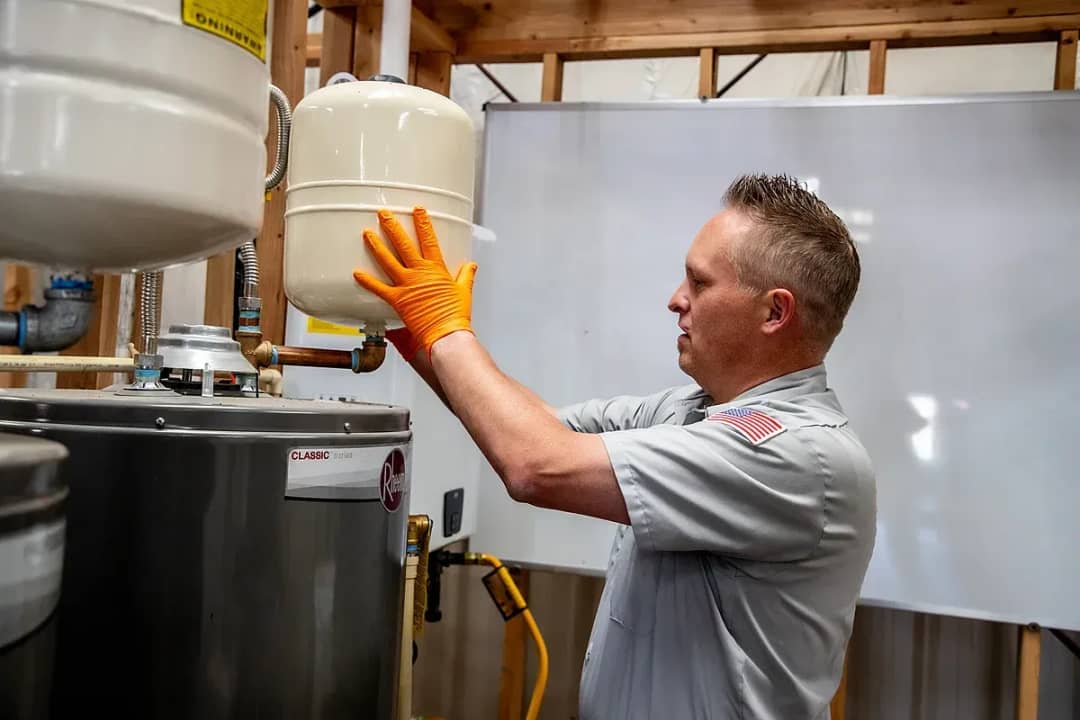
What the state line does not change is the line between a repair and a replacement. Swapping a thermocouple, an element, a thermostat or a drain valve is service to an appliance that is staying put. Taking the old heater out and setting a different one in is the permitted event, on either bank, because the water connections, the fuel connection, the venting and the safety devices all come apart and get remade. The reasoning behind repair against replacement is worked through properly on our water heater repair and replacement page.
How fast can you get to Ontario?
Usually the same day, and the honest answer comes on the phone rather than after we have looked at the board and let you wait.
Ontario sits on our regular run west, not on some out-of-area exception list, so getting a truck there is the ordinary kind of scheduling problem rather than a special trip somebody has to be talked into. What actually decides today against tomorrow morning is what is already on the board, which direction the crew nearest you is pointed, and — most of all — what your heater is doing. A tank putting water on the floor moves up. No hot water at all moves up. A pilot that needs relighting and a slow weep at a fitting are real problems, but they are not the same problem, and we would rather tell you that than book everybody into the same slot and disappoint two of them.
So the call goes faster if you have four answers ready:
1. Gas or electric. If a metal pipe rises off the top of the tank and disappears into the ceiling or a wall, it burns gas. No pipe like that anywhere on it means electric.
2. What the label says. The capacity and the serial number are both on it. Read them to us and we can place roughly where your unit is in its life before anybody turns a wheel.
3. Where it stands, and what a tank would have to come out through — a garage, a utility room, a closet, down a stair.
4. Whether there is water on the floor, and whether it is a drip at a fitting or coming from the body of the tank.
If water is running right now, two moves buy you time before anyone arrives: close the cold water valve on the pipe entering the top of the tank, then cut the heat — the gas control knob to off, or the breaker for an electric unit. After hours it is the same crew and the same number, through emergency plumbing in Ontario.
The one part of an Ontario job we genuinely cannot compress is the inspector's calendar, because it is not ours. It also sits after the work rather than before it, which is the next-but-one section.
Will you have the right water heater on the truck?
If what you describe on the phone points at a replacement, yes — the unit is loaded in Caldwell before the truck leaves, and it is loaded deliberately rather than hopefully.
The reason to be strict about this is specific to your side of the river. Our stock and our supply accounts are on the Idaho side. On an Idaho job, a fitting nobody packed is a short run to a counter and a mildly annoying half hour. On an Ontario job it is the bridge twice, with your morning attached to it, and it can turn a finished install into a return trip. So the loading list for an Ontario call is longer than for a job ten minutes from the shop, and that is on purpose: we would rather carry three things we do not use than come back for one we did.
What rides along, beyond the heater itself:
- The connection parts that decide whether the job finishes, rather than the ones we hope are already there — an appliance shutoff that will actually close, unions, a full-port brass drain valve to replace a plastic one, the right connector for the fuel.
- The items we would otherwise be crossing back for, restraint hardware and correctly rated discharge material among them, whether or not the last three Ontario jobs happened to need them.
- A drain pan and pan routing where the heater sits anywhere a leak would reach finished space.
- Haul-away for the old tank, so it leaves with us rather than living in your garage until somebody deals with it.
The four answers in the section above are what make that list right. Capacity and fuel decide the unit. Where it stands decides whether it goes in on a dolly or comes apart to get through a doorway. The label decides whether we arrive expecting a repair or a replacement.
And we will tell you plainly when the honest answer is that today is not it. A capacity or configuration outside what we stock, a conversion from tank to tankless, or a job where the gas or the electrical has to change to suit the new unit are all real reasons a first visit ends in a written price rather than a finished install. Saying so while you are still on the phone is worth more than a cheerful yes and a wasted afternoon.
Can you replace a water heater the same day in Ontario?
Yes — and the part people brace for, the inspection, is not what stands between you and a hot shower. It happens afterward.
The sequence on the day runs like this, and each step is worth naming because the order is what makes it work:
1. The permit is opened on the Oregon side first. Before anything is disconnected.
2. The old unit comes off. Fuel and water isolated, the tank drained down, the vent and connections broken, the old heater out of the room.
3. The new one is set and connected. Water remade, fuel remade, vent remade, everything checked against the Oregon requirement for that address as it goes rather than at the end.
4. The tank is filled and purged of air at an open hot tap before a single thing is lit or energised. This step gets skipped by people in a hurry, and on an electric unit it is how an element gets destroyed within seconds of the breaker going on.
5. It is fired and run through a full heating cycle, with the draft proven on a gas unit and the temperature checked at a fixture, before anybody packs up.
6. The old tank goes with us.
You have hot water that evening. The inspection is then scheduled on the Oregon inspector's calendar, we meet them at the house, we open the access, and we answer for the work. Nothing about that costs you a shower.
If something does get written up, the correction is our trip back across the river and our cost — not a change order, and not a conversation you have to have with an inspection office on your own. That is genuinely the largest thing the permit buys you. On a permitted job a defect is a phone call and a return visit. The identical defect on an unpermitted job is something you find out about years later, usually with a buyer's lender waiting.
What's different about an Oregon water heater install?
Mechanically, almost nothing. A tank behaves identically on both banks of the Snake, and January inlet water is cold on both banks too. What changes is the book the work is measured against, the person who signs it off, and the record that is left behind.
We work the Oregon requirement item by item instead of from Idaho habit. Restraint, vent material and clearance, discharge routing, thermal expansion control and combustion air are confirmed against what applies at that address before the truck loads — not recalled from the job we finished in Caldwell on Tuesday. That sounds like a small distinction and it is the entire distinction. A crew that only ever works one state does the thing it always does, and the thing it always does is right up until it is not.
The record is an Oregon record, and that is when it comes due. Sell the house, and the buyer, the buyer's inspector and both agents are working an Oregon transaction. What they go looking for is an Oregon permit, closed out on the Oregon side. A perfectly tidy Idaho permit is the wrong document for a house in Ontario, and in one respect it is worse than nothing at all, because it reads as handled right up until somebody checks which state issued it. The insurance side runs on the same logic after a water loss or a call involving combustion gases: the question is who did the work and whether anyone inspected it, and the answer is either a record or an argument. The record costs less.
One scope difference is worth planning around. Converting from a tank to a tankless unit pulls gas capacity and a new vent penetration into the job, which puts more of the work inside the permit and the inspection than a straight tank-for-tank swap does. That is an argument for deciding on a conversion in a month when you still have hot water, rather than on the morning the old tank finally lets go. The fuel side of that work is covered on gas line installation in Ontario.
How much does a new water heater cost in Ontario?
We will not quote it down the phone, and we do not publish a range. Everybody reads the bottom of a range, almost nobody's job lands at the bottom of it, and all a range achieves is making an honest number feel like a bait and switch when it arrives.
What genuinely moves the number at an Ontario address:
- Whether this is a targeted repair or a full replacement
- The capacity your household actually needs, and gas against electric
- Tank against tankless, and if tankless, whether it is a first conversion or a swap
- Whether the vent, the gas line or the circuit has to change to suit the new unit
- Whether anything on the existing installation has to be brought current for an Oregon final
- How hard the old tank is to get out of the room it is in
- The Oregon permit and inspection, and the trip back across the river to meet the inspector
- Haul-away of the old unit
So somebody comes out, looks at the actual heater in the actual room, and hands you one flat price in writing. The on-site estimate is free. Nothing starts until you approve that number, and the number does not move afterward. If a competing quote is already on your kitchen table, get it out — we will read it against the list above and tell you honestly which of those items it covers and which it is silent about.
Call (208) 366-5771 for water heater repair or replacement in Ontario, Oregon, with the Oregon permit pulled and the Oregon inspection met as part of the work. American Rooter & Drain was established in Caldwell, Idaho in 1945.
More at your address: everything we do in Ontario, OR · plumbing repair in Ontario · water line repair in Ontario · drain cleaning in Ontario. Other Oregon-side towns we permit the same way: Nyssa · Vale. Across the bridge: Payette · Fruitland.