What's the Difference Between a Clogged Drain and a Sewer Line Problem?
The symptoms overlap enough to fool almost anyone, which is why so many sewer line problems get treated as ordinary clogs for months before the real cause shows up. A single slow fixture — one sink, one shower — is usually local, cleared with a standard cable or a jetting pass. A sewer line problem tends to announce itself differently: more than one drain acting up at once, a toilet that gurgles when the washing machine drains, a backup at the lowest drain in the house, or standing water that won't clear no matter how many times a line gets cabled. Those point at the shared line downstream of every fixture, not any single one. Multiple drains backing up together is one of the clearest signals we look for. So is a pattern — a drain that clears, runs fine for a few weeks, then backs up again on something close to a schedule. A recurring drain backup almost always means the line has a structural issue creating the same bottleneck every time, not a fresh clog forming from scratch.
A sewage smell that lingers indoors or in the yard is worth taking just as seriously. Sometimes it's a dried-out trap or a venting issue with nothing wrong underground; sometimes it's gas escaping from a line that's cracked or separated at a joint. If that's what you're smelling, our page on sewer smell in the house walks through how to tell the difference.
Why We Always Run a Camera Before Talking About Repair
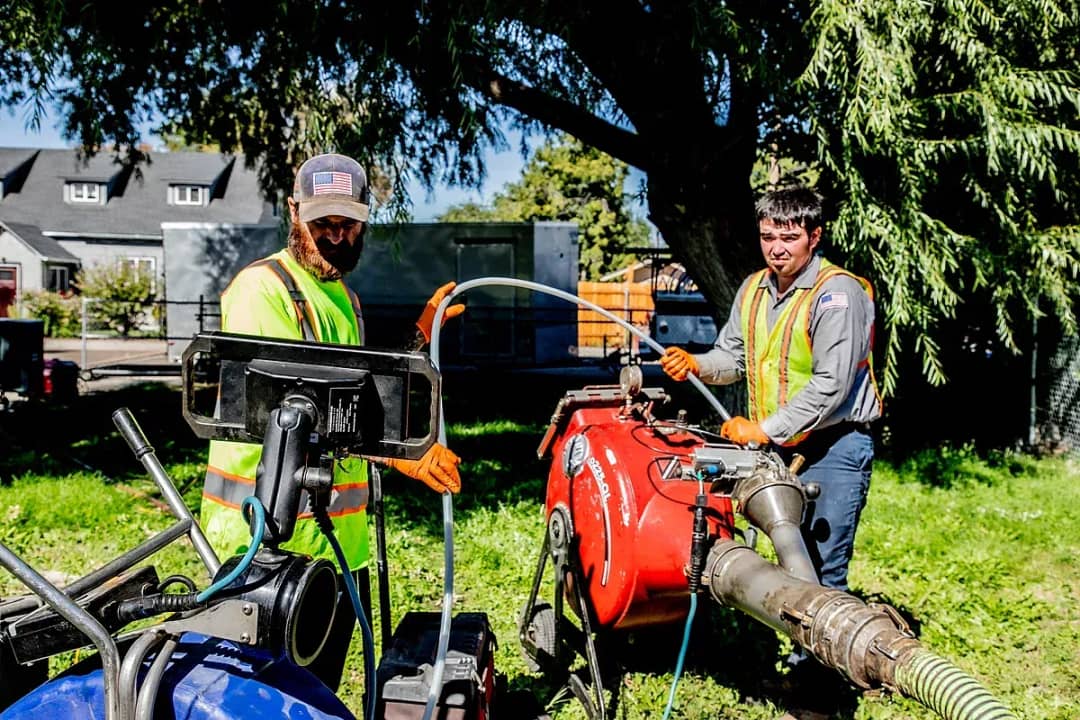
Every sewer line repair we quote across the valley starts with a camera, no exceptions. A technician feeds a waterproof camera into the line through an existing cleanout or access point and watches, in real time, what's actually happening inside the pipe instead of guessing from symptoms at the surface. That footage tells us:
- Where the problem sits — how far from the house, how deep, and how long a section is affected.
- What kind of damage it is — a clean break, a belly (a low spot where the pipe has settled and traps standing water instead of draining it), root intrusion working through a joint, or a joint that's separated and shifted out of alignment.
- How the surrounding pipe looks — whether the rest of the run is sound clay, cast iron, or PVC, or whether the same failure shows up in more than one spot.
- What diameter and condition the existing pipe is in, which determines whether a trenchless method can even work on it.
Skipping this and quoting off a phone description means either padding the number to cover the unknown, or underquoting and renegotiating once the ground is open. Neither is fair to you. A standalone sewer camera inspection is available if all you need right now is a look at the line's condition — a pre-purchase check, a landlord's peace of mind, or confirming a suspicion before committing to a repair.
How Do You Decide Between Lining and Digging Up My Yard?
Once the camera shows what's wrong, the method follows from the pipe's condition, not a sales pitch. Four realistic paths, and the criteria that separates them:
Spot repair. A single cracked joint, one short root-intruded section, or a localized break in an otherwise sound run doesn't justify touching the rest of the line. We access that one section, cut out and replace the bad stretch, and reconnect — the least invasive option that still involves opening the ground, because the disturbance is confined to a few feet.
Cured-in-place lining (trenchless). When the pipe is structurally sound along its length but cracked, root-intruded at multiple joints, or corroded from the inside — nothing collapsed or badly deformed — a resin-saturated liner threads into the existing pipe and cures in place, forming a new, jointless pipe inside the old one. It reinforces rather than replaces, usually with no continuous trench at all. For the deeper look at how lining and pipe bursting actually work, and more on how we choose between them, see our dedicated trenchless sewer repair page.
Pipe bursting (trenchless). When the line has failed along more of its length, or the existing diameter is too small or too degraded to simply reinforce, pipe bursting pulls a new pipe through the old one's path while a bursting head fractures the old pipe outward ahead of it — a full physical replacement through two small access pits instead of a continuous trench. It needs a pipe still roughly in its original alignment; bursting follows the old path rather than correcting a badly misaligned one.
Full open-cut excavation. The option nobody wants, and the one that's genuinely necessary sometimes. A severe belly, a total collapse, a line shifted so far out of grade a burst head can't follow it, or a pipe whose diameter or material can't support a liner all point toward digging the line up and replacing it directly. It's more disruptive to the yard, but forcing a trenchless method onto a pipe that can't support it just wastes money on a repair that won't hold.
When Trenchless Simply Isn't Viable
Trenchless isn't the default because it's gentler on the yard — it's the default when the pipe supports it. A handful of conditions rule it out regardless of preference: a severe belly, where the low spot itself is the problem and neither a liner nor a burst pull corrects the pipe's grade; a total or near-total collapse, with no intact pipe left to line or pull through; a run whose diameter is too small, too degraded, or too misaligned to support a bursting head; and multiple failure points spread across a long run, where a spot repair just means coming back for the next failure. In any of those cases, we'll say so plainly and explain what the camera showed — not push a method that won't hold up.
What Each Repair Path Actually Looks Like On Site
Spot repair starts with the camera pinpointing the exact location and depth of the problem, then a technician opens a single access point over that section. The damaged length is cut out, a new section fitted and connected, and the ground backfilled and compacted once the connection is confirmed sound.
Lining begins the same way — camera locates and confirms the extent of the damage — then a resin-saturated liner is inserted through an access point and pulled or inverted into place along the affected run. The resin cures in place, typically with heat or UV light, forming a new pipe wall bonded to the inside of the old one. No trench runs along the pipe's path; the disturbance is limited to the access points.
Pipe bursting uses two access pits, one at each end of the section being replaced. A cable connects a bursting head to the new pipe behind it and is winched through the old line, fracturing the old pipe outward into the surrounding soil while towing the new pipe into the space it leaves. The new line comes out the far end connected and ready to backfill.
Full excavation opens a trench along the length of the damaged run, deep enough to expose the pipe fully. The damaged section is removed, new pipe is laid at the correct depth and slope, connections are made at both ends, and the trench is backfilled and compacted in stages rather than all at once, so the new pipe isn't left sitting under loosely settled soil.
How Long Does Sewer Line Repair Actually Take?
Every path starts the same way — the camera inspection and quote visit is typically a single appointment, and you'll know which of the four paths applies before it ends. What happens after that varies by method and by what's actually involved in your repair.
A spot repair is generally the fastest once scheduled — a single access point and a short section of pipe mean less time on site than a longer run would need. Trenchless work, whether lining or bursting, tends to run longer than a spot repair but meaningfully less than a comparable open trench, since the crew isn't excavating the pipe's entire path — the time goes into set-up at the access points, the lining or bursting process itself, and confirming the result on camera before closing up. Full open-cut excavation is the most time-on-site of the four, since it involves digging, laying, and backfilling along the entire affected length rather than working through one or two access points.
Where a job requires a permit — which excavation or a full lateral replacement generally does in Treasure Valley jurisdictions — that adds a scheduling step ahead of physical work starting, separate from how long the repair itself takes once crews are on site. We handle that coordination as part of the job. We won't put a specific day count on any of this here, because the honest answer depends on what the camera finds at your property — a free on-site estimate is where you get a real timeline instead of a guess.
What Happens After the Repair Is Finished
The repair isn't done the moment the new section, liner, or burst pull is in place. For any job that involved opening the ground, backfilling happens in stages with compaction along the way, not soil shoveled back in loosely — uneven settling later is exactly what creates the next belly, so we don't rush that step. Surface restoration — sod, landscaping, driveway or hardscape repair — gets addressed as part of closing out the job wherever the work disturbed it.
Before we call any sewer line repair complete, we run the camera through the repaired section again to confirm the fix looks the way it should — solid connections, correct slope, no obstruction left behind. We don't tell you it's fixed; we show you. If anything about the repair needs a warranty-style follow-up down the line, that's part of the conversation before you approve the job, not something you have to chase down afterward.
Sewer Line Repair Across the Treasure Valley
This page covers how we diagnose and decide on a sewer line repair valley-wide — the same camera-first approach and the same four repair paths apply whether the line runs under a driveway in Caldwell or a backyard in Eagle. For how this plays out city by city, including the pipe materials and neighborhood patterns we see most often, see our pages for sewer line repair in Boise, sewer line repair in Nampa, sewer line repair in Meridian, and sewer line repair in Caldwell.
If tree roots working into an aging joint are part of what you're already dealing with, that page goes deeper on how roots find a line and what it takes to keep them from coming back after a repair.
American Rooter & Drain is licensed under Plumbing License PLB-C-13057, serving the greater Treasure Valley since 1945. Call (208) 366-5771 and a real person answers — no phone tree, no call center — for a free on-site estimate and camera inspection before anything gets decided about your line.