
Water Softener Installation Across the Treasure Valley
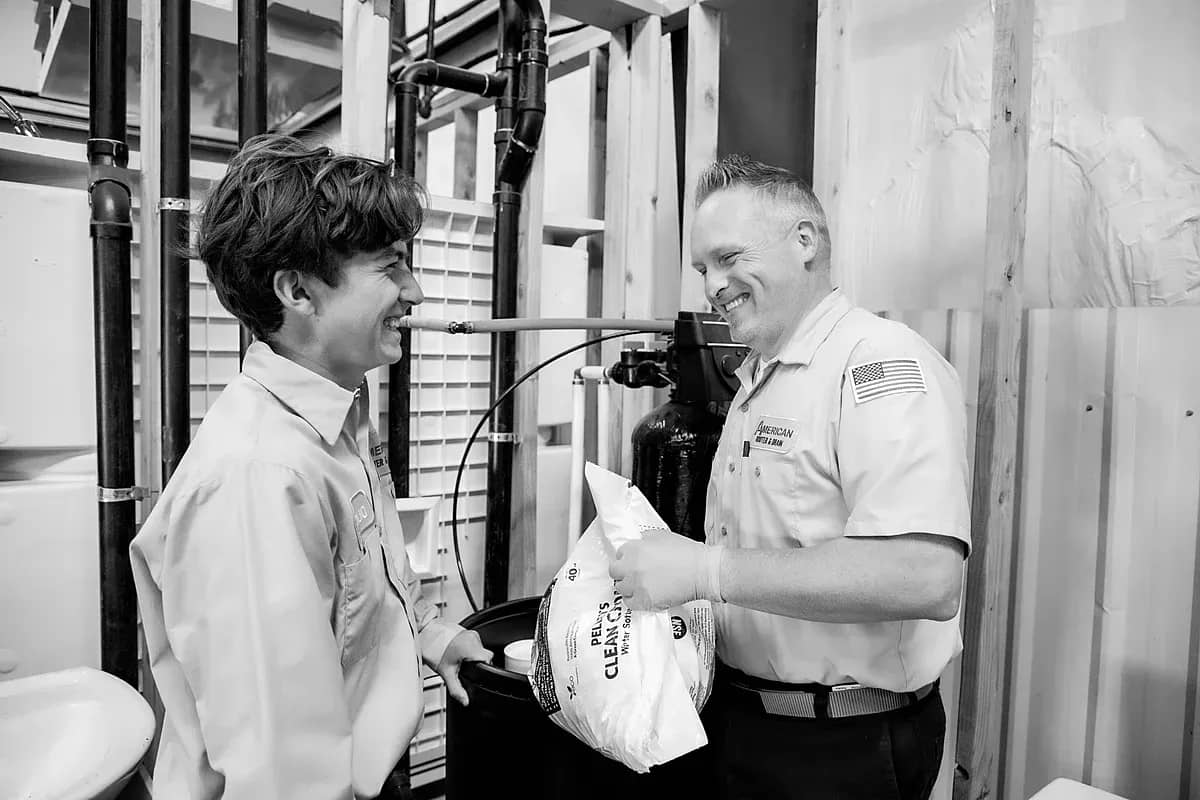
If you are comparing soft water systems, the job comes down to matching the system to your water and your plumbing. We test the water, size the system, install it, and set it up so it drains and regenerates correctly. That includes the bypass valve, the drain connection, and an air gap where the drain requires one, so the installation is done properly rather than just plumbed in. Most homes are straightforward; a few need extra work at the main line or the drain, and we point that out before we start.
What Is a Water Softener and What Does It Do
A water softener is a whole-house treatment system that deals with hard water — water carrying dissolved calcium, magnesium, and other minerals picked up as it moves through rock and soil. Left alone, those minerals build up as scale inside pipes, water heaters, and appliances, and leave the chalky film you see on faucets, shower glass, and dishes.
Traditional (salt-based) softeners remove the hardness minerals outright, swapping them for sodium through a process called ion exchange. Salt-free conditioners take a different approach: they don't remove the minerals, they change their structure so the minerals can't stick to surfaces and form scale. Either way, the goal is the same — protect your plumbing and appliances, and give you water that lathers better and doesn't leave mineral spots behind.
How Water Softener Regeneration Works
Inside a salt-based softener is a tank of resin beads that grab hardness minerals out of the water as it flows through. That resin has a limited capacity, so on a set schedule (usually overnight, based on water usage) the system runs a regeneration cycle: it flushes the resin bed with a concentrated salt brine, which strips the accumulated calcium and magnesium off the beads and carries it down the drain. The resin comes out of the cycle recharged with fresh sodium ions and ready to soften water again. Most residential units handle this automatically — you keep the brine tank filled with salt, and the system does the rest.
Salt-Based vs. Salt-Free Water Softeners
- Salt-based (ion exchange) — Actually removes hardness minerals from the water. Most effective option for genuinely hard water, which describes much of the Treasure Valley. Requires periodic salt refills, produces a small amount of wastewater during each regeneration cycle, and adds a small amount of sodium to treated water.
- Salt-free conditioners (like the AR-PRO system we carry) — Don't remove minerals; condition them with technology such as template-assisted crystallization so they can't form scale. No salt to buy or haul, no regeneration discharge, no added sodium — but no water-softener "slick" feel either, and mineral spots on glass and fixtures can still occur since the minerals stay in the water.
Neither option is universally better — it depends on how hard your water is, whether sodium intake is a concern, and how much maintenance you want to deal with. Worried about the discharge? Our guide on whether softener salt kills grass, plants, or weeds explains where to route it.
Choosing the Right Water Softener for Your Home
The right system depends on a few things we walk through during a free water test:
- How hard your water actually is. A test tells you your hardness in grains per gallon — the number that determines whether a compact unit or a larger-capacity system makes sense.
- Household size and water usage. More people and more water-using fixtures mean more regeneration cycles or a bigger resin tank.
- Well water vs. municipal water. Well water can carry iron, sediment, or other issues alongside hardness that change which system fits.
- Sodium sensitivity. Households managing sodium intake often lean salt-free, or add a reverse osmosis system at the kitchen sink for drinking water.
- Maintenance tolerance. Salt-based systems need regular salt refills; salt-free units are closer to install-and-forget.
We start every consultation with a free water test so the recommendation is based on your actual water, not a guess.
Water Softener Replacement
Softeners do not last forever. Common reasons people call us to replace one are a resin bed that no longer softens, a control head that has failed, a tank that is cracked or leaking, or a unit that was undersized for the household from the start. If your water has gone back to leaving spots and scale even though you are adding salt, the system may be due for service or replacement. We look at the existing unit and the plumbing around it, tell you honestly whether it is worth repairing, and if it is time for a new one, we size the replacement to your actual water rather than copying the old unit.
Water Softener Repair and Service
Not every problem means a new system. Softener service calls usually come down to a handful of things:
- Hard water coming through even though the unit is running, which can point to exhausted resin, a salt bridge, or a control problem
- A brine tank that is not drawing or refilling properly
- A drain line that is clogged, kinked, or discharging in the wrong place
- A unit that cycles at the wrong time or runs continuously
- Leaks at the fittings, valve, or tank connections
We diagnose which of these is going on and fix it, or tell you plainly if the repair no longer makes sense. If a drain problem is involved, our plumbing repair team handles that as part of the same visit.
Whole-House Water Filtration
A softener deals with hardness, but it is not a filter for everything in your water. Whole-house filtration is a separate system that treats the water as it enters the home, usually to deal with sediment, chlorine taste and odor, or other issues a water test turns up. Many homes end up with a softener and a filter working together: the filter handles particles and taste, and the softener protects the plumbing from scale. We recommend based on what your water test shows, not on adding equipment for its own sake.
Reverse Osmosis Drinking Water
A reverse osmosis system treats the water at one tap, usually the kitchen sink, and is built for drinking and cooking water rather than the whole house. It is a common pairing with a salt-based softener for households that want to limit the sodium in what they drink. We can install an under-sink reverse osmosis system with its own faucet and make sure the drain connection is done correctly.
Well Water Treatment
Homes on private wells often have water that is different from city water, and often harder. Well water can carry iron, sediment, or other minerals that a basic softener alone will not fully handle, and the right answer may be pretreatment ahead of the softener. We start with a water test and build the system around what is actually in your well, which is why a well water setup can look different from a home on city water.
Hard Water in the Treasure Valley
The Treasure Valley draws heavily on the same regional aquifers, and hardness shows up across the area. Meridian's own water reporting puts local hardness around 7 grains per gallon — squarely in the "hard" range — and homes on private wells throughout the valley often test even higher. That mineral load is what drives the scale buildup we see in water heaters, fixtures, and pipes on service calls across Caldwell, Meridian, Boise, and Nampa. It's also why protecting a water heater from scale is one of the most common reasons homeowners call us about softeners in the first place. For more on what hard water does to a home here, read our hard water in Idaho guide.
What Affects the Cost of a Softener or Filter
Pricing depends on the system, not a standard number. The things that drive it are the type of system, the capacity needed for your household and hardness level, whether you are on a well or city water, how far the equipment sits from the main line and drain, and whether anything needs to be replumbed. We give you a free on-site estimate and a flat price in writing before any work starts.
Caldwell-Based, Valley-Wide
From our shop on Commercial Way in Caldwell, we install and service water softeners and filtration systems across the whole Treasure Valley. We offer free water tests, straightforward comparisons between salt-based and salt-free options, and a flat price in writing before any work starts. Find your city: Boise, Meridian, Nampa, or Caldwell. Want more detail on what softened water changes day to day? See our water softener benefits guide. Curious what else we check on a visit? A plumbing inspection covers the rest of the house.
Call (208) 366-5771 and a real person answers — no phone tree, no call center. Family-owned, veteran-owned, and Caldwell-based since day one.