American Rooter & Drain has cleared and repaired sewer laterals across the greater Treasure Valley since 1945, out of our shop at 1005 Commercial Way in Caldwell. Call (208) 366-5771 and we will put a camera in the line instead of guessing at it.
Roots find the joint, not the pipe wall
Tree roots do not chew through sound pipe. They do not have to. A vitrified clay lateral is built from short sections, often two to four feet each, pushed together bell and spigot and sealed with oakum and mortar. On a sixty-foot run to the main that is fifteen to thirty joints, and every one is a seam.
When a joint loosens from ground settling, freeze-thaw, or eighty years of service, it weeps water, warmth and nutrients into the soil. A root hair the width of thread works into that seam, finds constant moisture, and thickens. Then it fans out into the classic tail: a mat of hair roots hanging in the flow, catching paper and grease and wipes until the line stops.
The damage is at the joint, and the joint is on the outside of the pipe. Nothing you do inside the pipe changes it.
Why the older Caldwell, Boise and Nampa laterals fail
Newer construction in Kuna, Star and the Meridian subdivisions runs PVC with welded or gasketed joints, and roots rarely get into those yet. The trouble sits in established neighborhoods, in three materials.
- Vitrified clay. Standard here from the 1920s into the 1960s. Chemically bulletproof and full of joints. The number one root pipe in the valley.
- Orangeburg. Tar-impregnated fiber conduit, used heavily from the late 1940s into the early 1970s. It softens, delaminates and deforms into an oval, so roots come through the wall itself. Orangeburg does not get repaired. It gets replaced.
- Cast iron. Common on the house side. Roots enter at hub joints and where the pipe bottom has scaled and channeled out.
Then the trees. Older streets in Caldwell, the Boise North End and central Nampa are lined with silver maple, cottonwood, willow and Siberian elm, all shallow and water-seeking. Roots spread well past the canopy and ignore property lines, so the tree causing your backup is often your neighbor's.
Timing is not random either. While the irrigation is on, roots stay up in wet topsoil. When it shuts off in October and the ground dries, the only reliable water left is what weeps from your sewer joint four to six feet down. That is why so many valley root backups land in late fall and winter.
How to tell it is roots
- The backup repeats on a schedule, the same stretch of the year, every year.
- The toilet gurgles when the washer drains, or the tub backs up before the toilet. The restriction is downstream of every fixture, out in the lateral.
- A strip of lawn over the sewer line is greener than the rest of the yard.
Who should I hire when tree roots invade a sewer line?
Hire the company that owns the camera and does the repair, not the one that only owns a cable machine. Three questions sort it out on the phone: do you carry a push camera and a locator on the truck, do I keep the footage, and do you do the repair yourselves? A company that only cables will only ever sell you cabling, once a year, forever.
We answer yes to all three. Camera and locator ride on every sewer truck, the video goes to the homeowner, and our own crews do the repair.
Why the backup came back after the last cable job
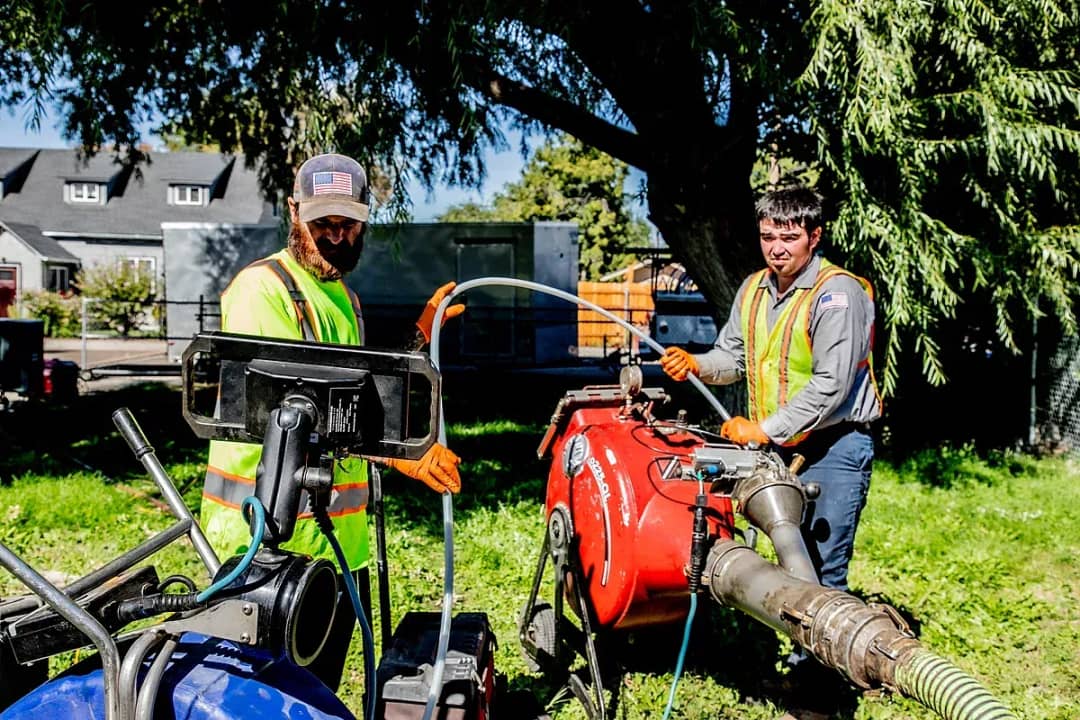
Cabling works and it works fast. A cutter head spins a blade through the mass, cuts it back to the pipe wall, and ninety minutes later the line flows. With sewage on a basement floor that is the right first move.
But cutting a root is pruning it. The part outside the pipe is untouched and the joint is exactly as open as it was that morning, so regrowth restarts at the same entry point, denser than before. You generally get six to eighteen months before the same phone call.
The honest ladder: cut, jet, camera, then repair
1. Cut and clear. Cutter head sized to the pipe, run to the main, flow restored. Usually one to two hours, same visit.
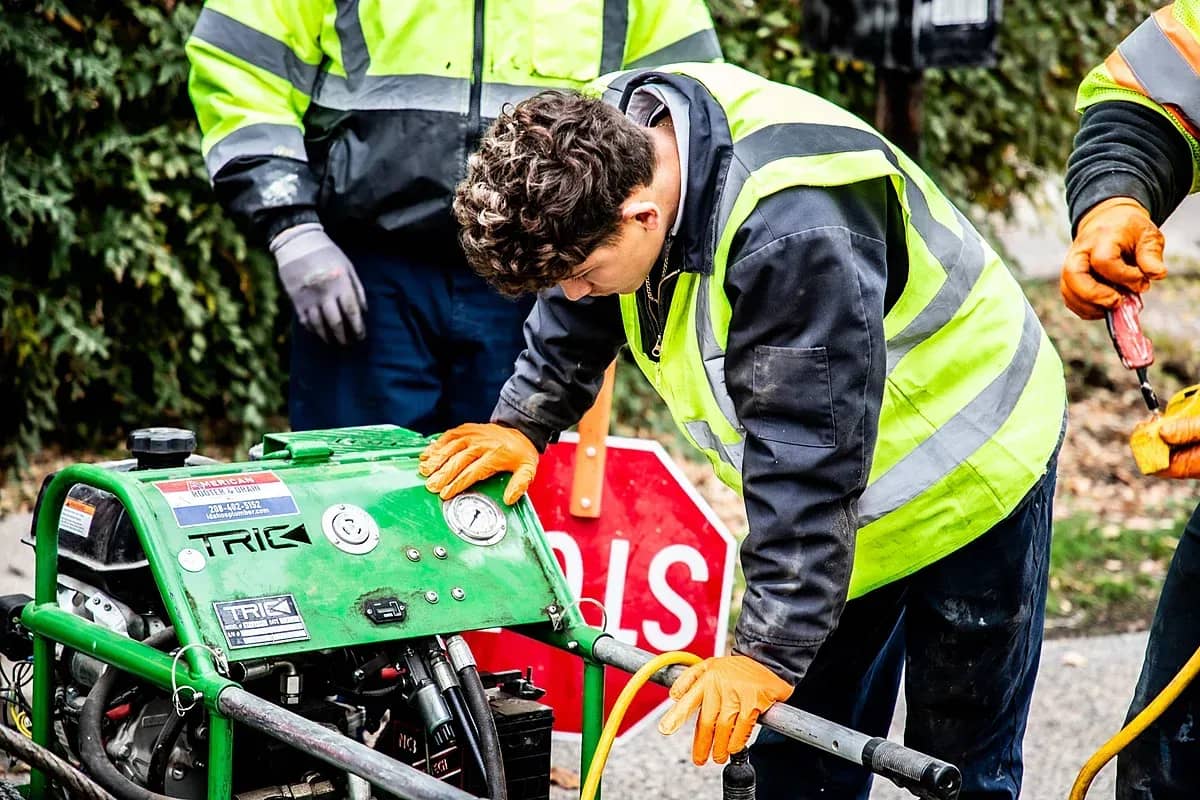
2. Hydro jet. A cable cuts a hole through the root ball; it does not clean the pipe. A rotating nozzle scours the wall back to bare clay, takes the hair roots the cutter left, and flushes the debris out to the main. You cannot grade a joint through a mud line, and a liner will not bond to a dirty pipe.
3. Camera and grade the joint. Now the camera earns its keep. A self-leveling head runs the full length and reads the real condition: one bad joint or six, a cracked bell, an offset or collapsed section, a belly holding water. A sonde in the head and a locator on the surface put a paint mark on the lawn over the defect and give us the depth before anyone touches a shovel. Book the sewer camera inspection and every decision after it is a measurement instead of a guess.
4. Repair the joint, or accept that you are renting the line.
What we do once we can see the defect
- Point liner, or spot repair. One or two bad joints with the rest sound. A short resin-saturated sleeve goes in on a packer bladder, inflates against the host pipe and cures, sealing the joint from the inside. No trench, usually half a day.
- Full-length cured-in-place liner. Many bad joints on the same run. A resin-saturated tube is inverted through the whole lateral and cured into one seamless pipe inside the old one. This is the permanent answer to roots for one plain reason: a liner has no joints, so there is no seam left to grow into. Typically one day, cured with hot water or steam in cold Idaho ground.
- Pipe bursting. For Orangeburg, or clay already collapsed. A liner needs a host pipe to hold shape against, and deformed Orangeburg cannot provide one. A bursting head splits the old pipe outward and pulls fused HDPE in behind it: two small pits instead of a trench.
- Open cut. A belly is a grade problem, and lining a belly just gives you a smooth belly. Those get dug, re-bedded and re-graded. We say so up front.
We do not quote any of it before seeing the line, and neither should anybody else. Price follows what the camera finds: the length and depth of the lateral, how many joints are genuinely compromised, the pipe material, and whether there is a usable cleanout. On-site estimates are free, and routine drain cleaning runs on our $59 special.
Get eyes in the pipe
If your line has backed up more than once, another cable job is not information. It is a subscription. Get a camera in it and find the joint.