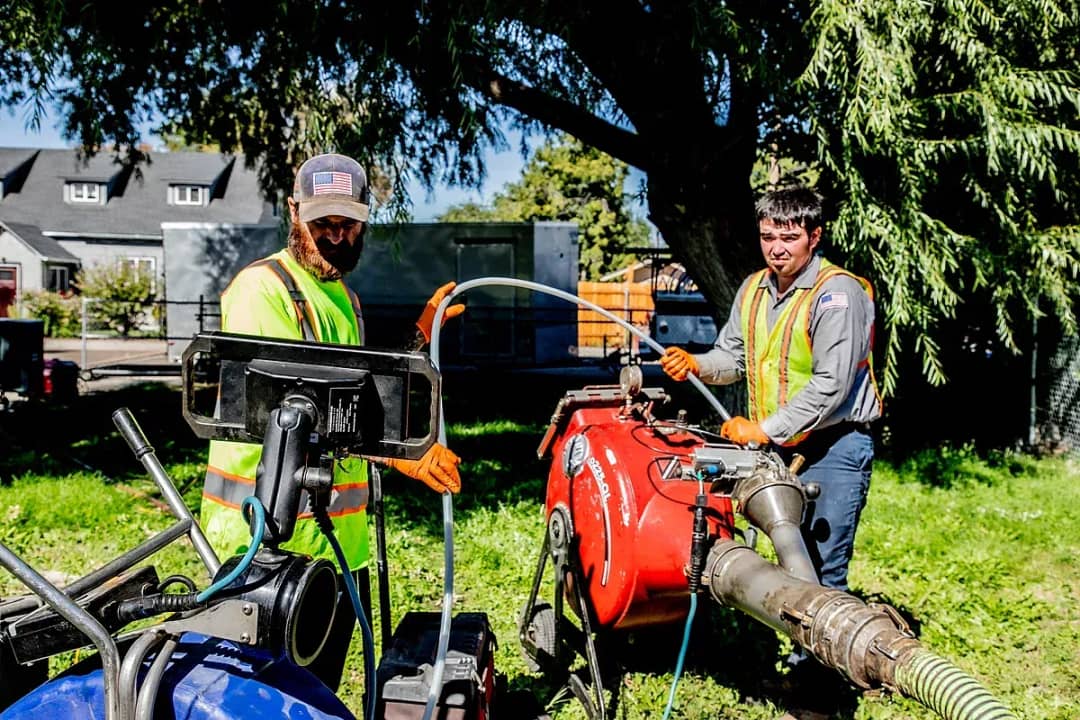
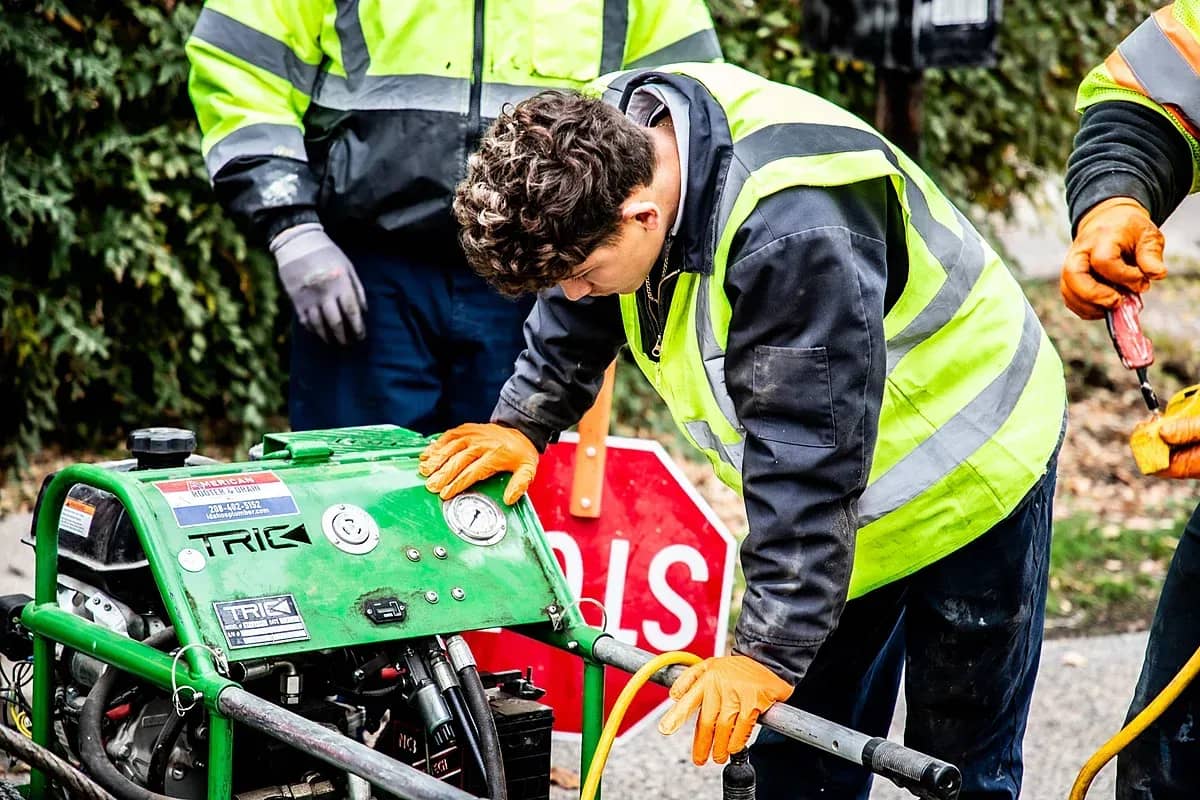
Why the North End and East End are their own kind of job
The run itself is different up there. A large share of older Boise homes drain out the back of the lot to a main in the alley rather than out the front to the street, so the camera work and the topside locate both happen where nobody expects them to. Depth changes too, and so does length — some of those alley runs are longer than a modern suburban lateral by half. Before we push a camera we want to know which direction the line actually leaves the house, because guessing wrong wastes an hour and tells you nothing.
Inside the foundation you are usually looking at cast iron, and it fails in a way clay does not. Cast iron rots from the invert up: the bottom of the pipe scales, then channels, then disappears, so the camera crawls through a rough trough that grabs paper and wipes on every flush. Outside the foundation the material changes to clay, and that transition point — where two pipes of different eras and different diameters were mortared together by somebody in 1922 — is one of the first places we slow the camera down and look hard.
Root timing is worth understanding because it explains a pattern homeowners describe to us constantly. Roots go where the reliable water is. In the older gravity-irrigated parts of Boise, the ditch water shuts off in the fall, the lawns dry down, and the warmest, wettest, most nutrient-dense thing left in that yard is the sewer lateral. If your line backs up in September and behaves itself all spring, that is almost never grease. That is a root mass that has been growing all summer and finally became a filter. If that pattern sounds familiar, it is worth reading what we see with tree roots in a sewer line and why drain backups that keep coming back are usually structural rather than a cleaning problem.
Orangeburg: the pipe you identify before you touch it
Scattered through Boise, mostly in post-war infill and in stretches replaced between the late 1940s and the early 1970s, there is bituminized fibre conduit — Orangeburg. It is wood pulp impregnated with coal tar pitch. It was cheap, it was light, a two-man crew could cut it with a handsaw, and it was sold with a fifty-year life. A great deal of it did not see thirty.
On camera it is unmistakable once you have seen it. The pipe reads oval rather than round, deflected down from the top, so the picture looks squashed. The wall is fibrous and matte instead of glazed, and where it has started to come apart it delaminates in layers that look like the inside of the pipe is peeling toward the camera. Advanced sections blister inward.
The reason this matters before anything else touches the line: an aggressive cutter head or a chain knocker will tear fibre conduit open, and high-pressure jetting can blow straight through a delaminated wall. A line that was merely restricted at nine in the morning can be an excavation by noon. That is why we scope first on any Boise house of that vintage where the material is unknown. If the camera shows fibre, we change tools or we stop and have an honest conversation about replacement, because cleaning a pipe that has already gone oval buys days, not years.
The Bench and the southeast are a different picture entirely
Drop off the North End and the story changes with the decade. The Bench — the Vista, Orchard and Franklin corridors, the Depot Bench, the 1950s and 60s tracts — is a mix: late clay, cast iron, and the earliest plastics. Southeast Boise, Columbia Village, Barber Valley and Harris Ranch are PVC, glued or gasketed, from the 1990s forward.
Roots essentially cannot enter a properly glued PVC joint, so out there we are hunting something else:
- Bellies, where trench backfill settled and left a low spot that holds standing water. Barber Valley river-bottom ground is the classic — an inch of water sitting in a sag catches solids every single time you flush.
- Offsets and separations at a coupling, usually from settlement or from something heavy parked over the run.
- Construction debris that has been in the line since the house was framed: grout, mortar, drywall mud, chunks of lumber. It never caused a problem alone, and then twenty years of wipes built a dam on it.
- Foothills lots add slope. A long steep run can scour perfectly clean at the top and pile everything up where the grade flattens near the street, which is why the symptom and the defect are often forty feet apart.
Whatever we find, you get the same four things on paper: the exact distance in feet from the access point to the defect, the material and rough era of the pipe, whether the problem is one spot or the entire run, and the video.
Locating the line, not just looking down it
The camera head carries a sonde, and we walk the line topside with a receiver to mark its path and depth on the ground. That is a separate deliverable from the video and it is frequently the more useful one. It tells you where not to set a fence post, plant a replacement tree, pour a patio, or trench a sprinkler main. In the North End it settles the alley-versus-street question in ten minutes. And it tells you how much of the run is on your side of the property line, which is the difference between your bill and somebody else's.
Before you buy an old house in Boise
A standard home inspection stops at the fixtures. It will not tell you the lateral is clay, that eleven joints already have root hair in them, or that the pipe has gone oval thirty-two feet out under the parkstrip. Replacing a lateral on a North End lot — narrow, mature landscaping, a big tree over the run, sometimes an alley approach — is the kind of number that changes an offer. Scope it inside the inspection period. It is the cheapest information you will buy in the whole transaction.
What a camera inspection costs in Boise
We quote the inspection flat, before we start, and there is no hourly meter on it. What moves the number is access and condition, not your zip code: whether there is a usable cleanout or we have to pull a toilet, whether the line is blocked so badly the camera cannot see past the obstruction and has to be opened first, how long the run is, and whether we need more than one access point to cover it. Our $59 drain cleaning special covers a standard cleanout-accessible drain when clearing has to come before the camera. If the footage turns up a repair, we price the repair flat and in writing after the camera has confirmed the scope — never off a guess from symptoms. On-site estimates are free, and nothing gets dug, cut or lined without your signature on it.
If the smell is what brought you here rather than a backup, that is a different diagnostic path — see sewer smell in the house. If the line is actively backing up into the house, call before you run more water through it.
American Rooter & Drain has served the greater Treasure Valley since 1945. Call (208) 366-5771, or see everything we do in Boise and the rest of our sewer camera inspection coverage across the valley.