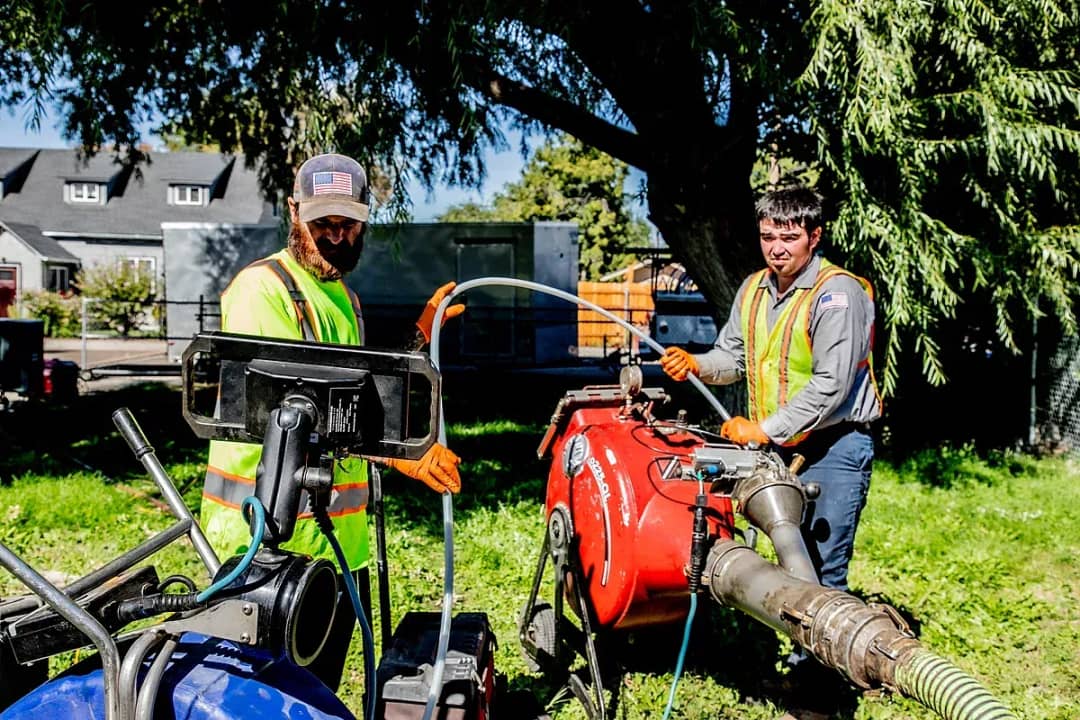
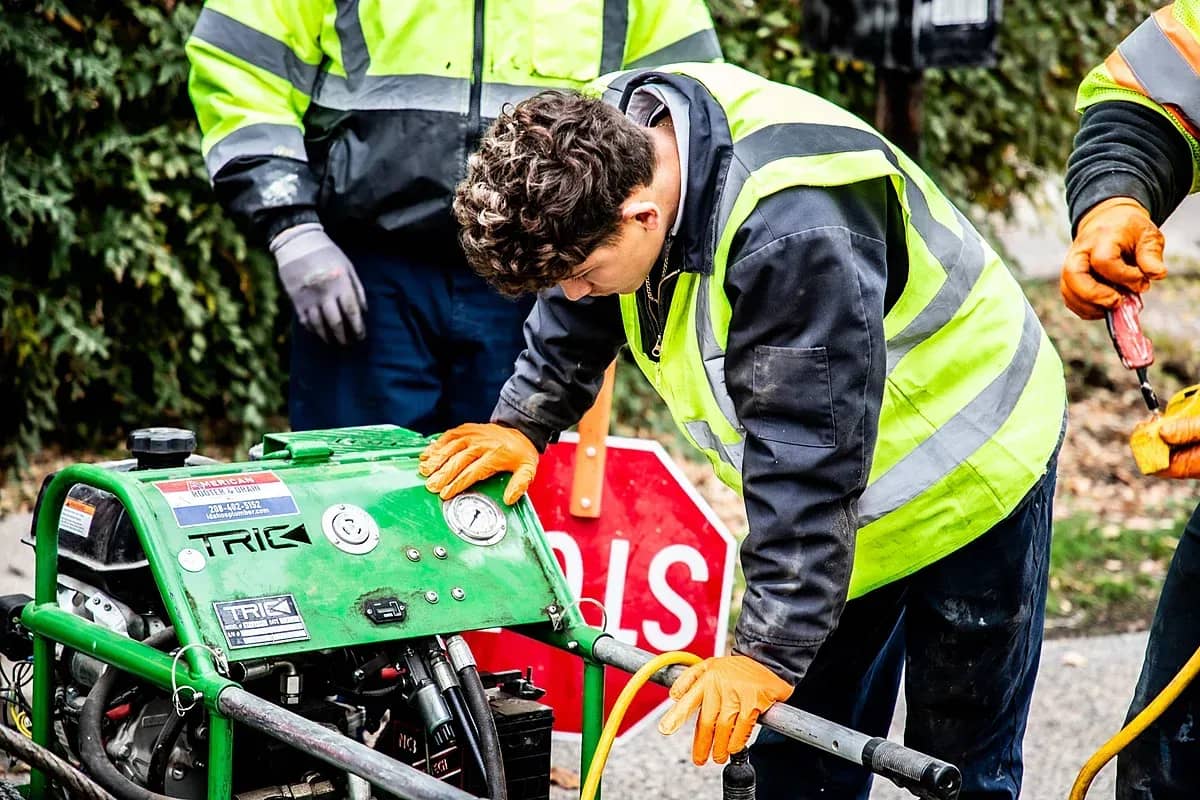
American Rooter & Drain runs out of a shop at 1005 Commercial Way in Caldwell and has worked the greater Treasure Valley since 1945. Payette is a standing part of our route, not a favor we do on a slow afternoon. Call (208) 366-5771.
What river ground does to a lateral
A sewer lateral needs exactly one thing to work: continuous fall from the house to the city main, roughly a quarter inch of drop per foot of run. River-deposited soil is the natural enemy of that. Fine sand and silt consolidate at a different rate than the gravel under them, so a line that was pitched correctly when it went in can develop a low spot — a belly — where waste slows down, solids drop out of suspension, and grease films the pipe wall. On camera a belly is unmistakable. The picture goes half underwater and stays that way hours after the last flush, with a tidemark of grease above the waterline. That is not a clog. Cabling it buys a week of relief and then the same phone call.
The same ground movement pulls bell-and-spigot joints apart. In an old clay line, an eighth of an inch of separation is enough for fine silt to wash in from outside every time the groundwater comes up, and silt collecting along the bottom of the pipe is the single most common reason people here tell us "we have it snaked every spring." That distinction is the whole point of the inspection: a pipe full of grease can be cleaned, and a pipe slowly filling with dirt from a hole cannot. One is a service call, the other is a repair, and only the camera tells you which one you own.
Shallow lines and a hard freeze
Laterals in the older blocks were frequently buried shallow. Fall toward the main was the priority and depth was whatever was left over after the grade worked out. Two things follow from that.
First, the top of a shallow run takes frost movement every winter. Repeated freeze and thaw at two to two and a half feet of cover works hairline cracks open in clay, lifts joints out of alignment, and finishes off pipe that was already tired. If a line backed up in January two years running and behaved itself all summer, put the camera in it in January. That is when an offset joint is at its worst and easiest to document, and documentation is what you need if the failure sits between your house and the property line.
Second, shallow means a shovel finds it. Before you set a fence post, plant a shade tree, or trench in a new irrigation line, we can put a sonde in the camera head and paint the path and the depth right on the ground. Fifteen minutes of that has saved more than one Payette homeowner a ruined Saturday and a sewage repair he caused himself.
Getting into the line: cleanout conventions in older Payette houses
Newer construction on the edges of town has a two-way cleanout near the foundation or out at the property line, and those jobs are simple. Houses near the core often have nothing outside at all. What we actually find:
- A cast-iron cleanout plug set in the basement floor, usually under the stairs or behind the furnace, and frequently painted over or carpeted across so the homeowner has never seen it.
- A house trap just inside the foundation wall — a U-shaped fitting with two plugs, standard practice for decades and still in the ground here. Those plugs seize. We bring the right wrench and heat them loose rather than cracking a sixty-year-old fitting to save five minutes.
- No access at all, in which case we pull a toilet, run the camera through the closet flange, and reset it on a fresh wax ring when we are done. In this part of the valley that is a routine part of the job, not a surprise line item.
We carry more than one camera head for exactly this reason. A push head sized for a four-inch lateral will not turn the corner out of a three-inch stack, and forcing it is how people wreck old cast iron.
Irrigation season changes what the camera sees
Payette runs on canal water, and when the ditches come on in spring the shallow water table under much of this town comes up with them. If your lateral has an open joint or a crack sitting below that new water level, groundwater pushes in. That is infiltration, and it gives you a line that runs high, drains slow, and smells, without one thing being stuck in it. Come fall, when the water goes off, the same line behaves itself.
We read footage with that in mind. Standing water in a line that has no belly, during irrigation season, is a strong tell for infiltration, and we will say so on the video instead of selling you a clearing you do not need. If your trouble follows the calendar rather than the holidays, mention it when you call — it changes what we look for. Where the pattern is year-round instead, the recurring drain backups page covers the other likely causes.
Cottonwoods, shelterbelts, and roots on the farm edge
The older streets here are lined with mature trees, and lots that back onto ag ground usually have a windbreak somebody planted a long time ago — cottonwood, poplar, Russian olive, all of them thirsty and all of them aggressive. Roots do not attack sound pipe. They follow moisture to a joint that is already weeping, then thicken inside the pipe until they hold back everything else that comes down it. The camera tells you which joint, how far out from the house it sits, and whether the pipe around the intrusion is still round. That last detail is what decides whether cutting the roots buys you five years or five weeks. If you already know roots are the story, tree roots in a sewer line walks through what comes next.
Not every wet spot is the sewer
Half the emergencies we get called to in this town turn out to be the water side, not the waste side. Shallow burial cuts both ways, and an old galvanized or poly service line running from the meter to the house fails in the same ground for the same reasons. If the wet spot in the yard is clean, the sound in the wall is a hiss rather than a gurgle, or the meter creeps with every fixture shut off, that is an outdoor water line leak and it wants leak detection equipment, not a sewer camera. We would rather tell you that on the phone than sell you the wrong inspection.
Response and scheduling, which is half the value out here
Payette is about forty minutes from our Caldwell shop, out I-84 and up US-95, and that distance is the honest reason this page exists. There is not a deep bench of camera equipment inside the city limits, and outfits working out of Boise treat a Payette address as most of a day and would rather put you on next week's board. When the only toilet in the house is backing up, next week is not an answer.
We run this direction regularly. The camera, the locator, and the cable machine ride on the same truck, and that is what actually saves you time here: if the camera finds a soft blockage, we clear it on that visit. If it finds a broken pipe, we locate it and mark it on that visit, so the repair conversation starts with facts instead of another appointment two weeks out. One trip, not three. If the line is already backing up into the house, say so when you call — that moves you up the board. Start with sewer line backing up if you need to know what to shut off before we get there.
Before you buy an older place here
A standard home inspection stops at the fixture. It will not tell you the lateral is clay, that it is offset eleven feet past the foundation, or that the previous owner has had it cabled every March for six years. A pre-purchase camera run tells you the material, the joint condition, whether roots are already in it, and whether the fall is intact — before the paperwork closes rather than after. On parcels out toward the ag ground, it also settles the question of whether the house is actually on city sewer or still running to a tank somebody stopped talking about, which is not a discovery you want to make in your first month.
What you have when we leave
- Video of the whole run, from the access point out to the main, with distances called out as we go
- The location and depth of anything worth knowing about, marked on the ground if you want it marked
- A plain explanation of whether you are looking at a cleaning, a spot repair, or a replacement, and why
- A written, flat price for whatever comes next, given before any of it starts
What an inspection costs in Payette
The honest answer is that it depends on what we find when we get there: whether there is a usable cleanout or we have to pull a fixture to get in, the diameter and length of the run, and whether the line has to be cleared before a camera can see anything at all. So we do not quote sewer work over the phone off a description of symptoms, and we do not hand you a spread and then land at the top of it. We come out, look at the actual house, and give you a firm number before anything starts. The on-site estimate is free.
Two things worth knowing. Our $59 drain cleaning special covers a standard drain clearing through an existing cleanout. And if a line is packed badly enough that the camera cannot see past the blockage, the clearing comes first and the camera follows it down the same hole on the same visit — you should not be paying for two trips to answer one question.
Ready to stop guessing? Call (208) 366-5771. See everything we do in Payette, or compare coverage across the valley on the main sewer camera inspection page.