
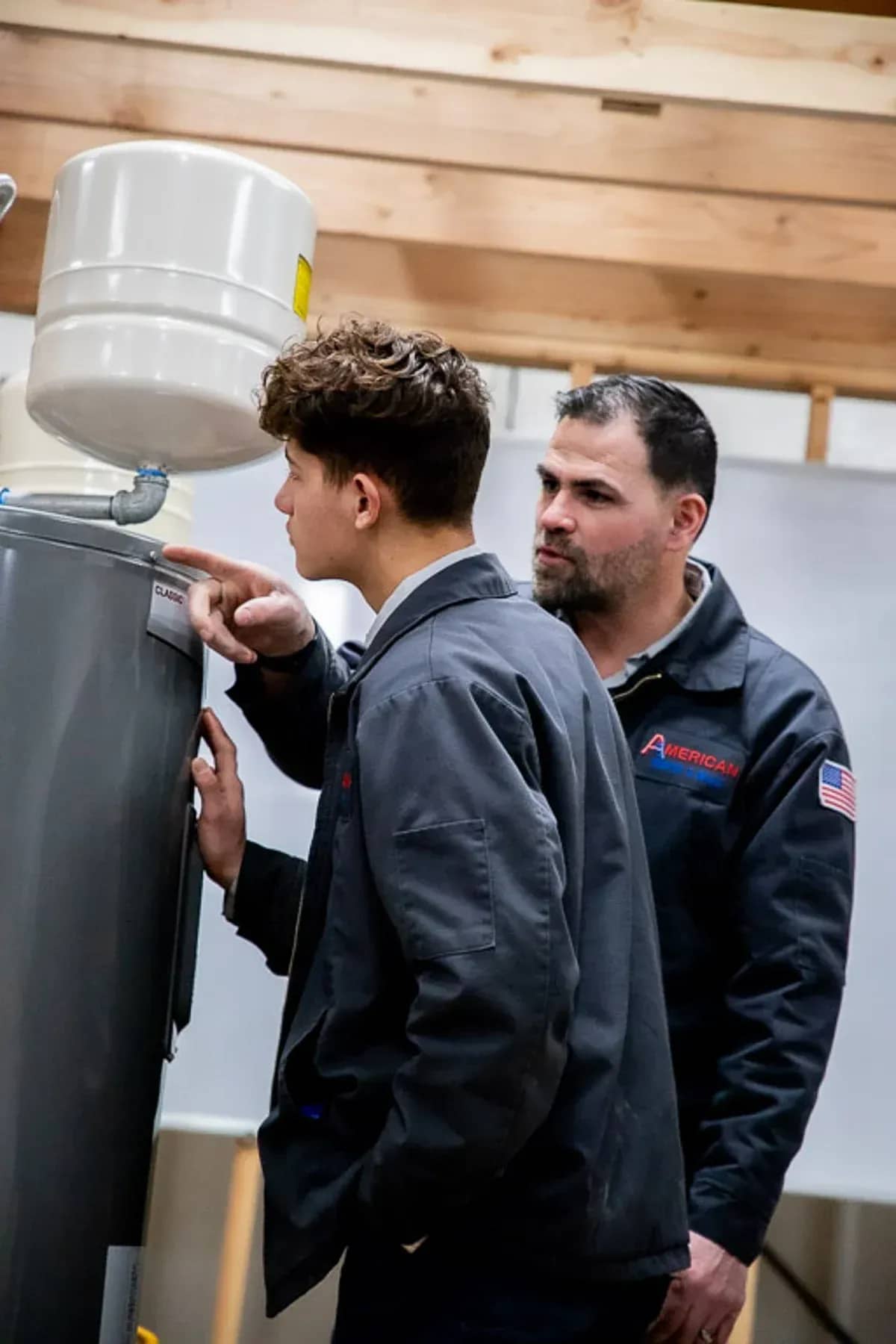
No hot water, not enough hot water, or water on the floor
Almost everyone who calls us about a water heater — or a hot water heater, which is what most people actually say — is describing one of four things. Which one you have is most of the diagnosis.
No hot water at all. On a gas unit that usually points at the pilot or igniter, the thermocouple, or the gas valve. On an electric unit it is most often a tripped high-limit reset button, a burned-out upper element, or a failed thermostat. Every one of those is a repair, and every one of those is a part we carry on the truck.
Not enough hot water, or it runs out too fast. The unit still lights and still heats; it is just not keeping up. That is either a sizing problem for how the house gets used now, a broken dip tube letting cold water short-circuit straight to the hot outlet, or sediment sitting on the bottom of the tank where the burner is trying to heat through it. Worth diagnosing properly before anyone sells you a bigger unit you may not need.
Rust in the hot water. If the cold side runs clear and only the hot side is rusty, the sacrificial anode that protects the tank is spent and the tank's own steel is what is corroding now. That is the tank talking, and it is a replacement conversation rather than a repair one.
Water on the floor. Where the water is actually coming from decides everything. A drip at the drain valve, at the temperature-and-pressure relief valve, or at a threaded connection is a repair. Water seeping out of the tank shell itself is not repairable at any price. If you find water pooling around the base, shut the water off to the heater if that valve still turns, and call us.
Will you just swap it out, or does something have to change?
Almost every Payette replacement lands in one of two buckets, and which one you have decides the price, the schedule, and whether a single visit finishes it.
A straight swap — what we call a like-for-like replacement — means the new unit matches the old one on fuel type, capacity, and location. The old tank drains and comes out, the new one goes in the same spot, and the existing gas line or circuit, venting, and water connections get reused after we inspect them. This is the common case, and it is a same-visit job.
Something outside the water heater has to change — what we call a conversion — means electric to gas, gas to electric or heat pump, tank to tankless, or a unit moving from an interior closet out to the garage. Now the job touches systems the old heater never depended on: a gas line sized for the burner, a dedicated 240-volt circuit with panel capacity behind it, a new venting path, or a condensate drain. These are worth doing when the reasons are real, and they are the reason a replacement occasionally needs a second visit.
We sort your job into one of those two buckets during the on-site look, before anything is ordered. That is the single most useful thing that happens on the estimate visit.
What size water heater do I need?
Homeowners usually ask for "the same size we had." Sometimes that is right. Often the number on the old label was chosen by whoever built the house, for a household that no longer lives in it.
What actually matters is first-hour delivery — how much hot water the unit can put out during your worst hour, not how much it stores. A gas tank recovers far faster than an electric one, so a smaller gas tank frequently delivers more usable hot water in that first hour than a larger electric one does. That is why changing fuel types is never a straight gallon-for-gallon trade.
So we count the real demand instead: how many bathrooms get used at once on a weekday morning, whether laundry and the dishwasher overlap with showers, whether anyone is filling a soaking tub, and how many people live there now versus when the last heater went in.
Then we check whether a larger unit physically fits. This one surprises people: a new tank is usually taller and wider than the old tank of the same capacity it replaces, because insulation requirements have tightened and that foam has to go somewhere. In a Payette utility closet framed around a smaller, older unit, the upgrade you want may not clear the door, the ceiling, or the required combustion-air and service clearances. We measure the space and the path into it before we promise a size.
Gas, electric, propane or heat pump — which one should I get?
Fuel type decides more of this job than the brand on the box does.
Natural gas. Wants a correctly sized gas line for the burner's BTU load, an intact vent connector with proper rise and slope, and adequate combustion air in the room. Atmospheric-vent units rely on a chimney or B-vent; power-vent units use a fan and PVC out a sidewall, and they need a nearby outlet — a detail that catches people replacing an old atmospheric unit in a closet that has no power in it.
Propane. Everything above, plus the unit has to be configured for propane rather than natural gas, and the regulator and tank have to keep up with the demand. If your property sits outside the city's gas service area, this is likely the lane you are in, and it matters most when someone is considering tankless — a tankless burner is a far bigger draw on a propane supply than a tank is.
Standard electric. No venting and no combustion air, which keeps the install simple. It heats with resistance elements, so it needs a dedicated 240-volt circuit with the right breaker and wire size, and a panel with both room and capacity for it. Recovery is slower than gas, so the sizing math has to account for that.
Heat pump (hybrid electric). The most efficient tank option, with three real requirements: enough air volume around it to pull heat from, a condensate drain going somewhere it can actually go, and an honest conversation about the fact that it cools and dehumidifies the space it lives in. That is a bonus in a garage in July and a nuisance in a small interior closet in January.
Should I switch to a tankless water heater?
- Tank to tankless. The gas line is the usual blocker, because a tankless burner fires far harder than a tank does even though it fires far less often. Add a new venting path, since tankless units do not vent like tanks, a condensate drain on condensing models, and a decision about where the unit hangs. This is the change most often worth making for a household that keeps running out of hot water — and the one most often oversold to a household that does not.
- Electric to gas. A gas line run and sized to the unit, plus a code-compliant vent path. When the gas supply is the blocker, that is its own scope of work — see gas line installation in Payette.
- Gas to electric or heat pump. Panel capacity and a dedicated circuit are the gate. An older panel that is already full is a real obstacle, not a formality — see panel upgrades in Payette.
- Moving the unit. Going from an interior closet out to the garage frees up living space, but it means new water lines, new venting, usually a new gas or electrical run, and elevating a gas unit off the garage floor.
You hear which of these applies to you during the estimate, with the reason attached — not on install day with the truck already in the driveway.
If you are on a well or have a water softener
Plenty of Payette-area properties sit outside city limits on a private well and a septic system, and that changes a water heater install in ways that have nothing to do with the heater itself.
Sediment and iron. Well water can carry fine sediment and iron that a municipal supply has already filtered out. That material settles to the bottom of a tank, insulates the burner from the water it is trying to heat, and shortens the unit's life. A sediment filter ahead of the heater — and a flush schedule that actually gets kept — does more for tank longevity out here than any brand choice on the box.
Pressure and thermal expansion. A well system cycles between the pressure tank's cut-in and cut-out points rather than holding one steady city pressure. We put a gauge on the system before we finish, because a heater installed on a closed system — anything with a check valve or a pressure-reducing valve upstream — needs somewhere for heated water to expand. Without a working expansion tank, that pressure lifts the temperature-and-pressure relief valve, and the homeowner ends up calling about a "leaking" valve that is in fact doing exactly its job.
Softened water. A softener protects the tank from scale, which is good. It also makes the water more aggressive toward the sacrificial anode that protects the tank's steel lining, which means that anode is worth checking earlier than it would be on unsoftened water, and worth choosing deliberately instead of accepting whatever shipped in the box. If you have a softener, say so — it changes what we recommend.
Will an older home make the job harder?
Often, yes — and what changes is usually the work around the water heater, not the heater itself. Around Payette's older core we routinely open a utility closet that was framed around a smaller unit and never revisited since. What that means on the day:
- Galvanized nipples and supply lines decades into service sometimes do not survive being unthreaded. We arrive prepared to rebuild those connections rather than discovering the problem halfway through.
- No drain pan and no floor drain under a unit sitting on a finished floor. A replacement is the moment to fix that, because the next failure is otherwise a water-damage claim instead of a service call.
- Tight combustion-air and clearance conditions in a closet that has since had a door swapped or shelving built in around the heater.
- Garage installs on newer builds need a gas unit's ignition source elevated off the floor and physical protection where a vehicle parks close to it.
- Crawlspace and hard-access units, where the honest constraint is getting the old tank out and the new one in — and that path is part of the estimate, not a surprise on install day.
How long does it take to replace a water heater?
The question worth answering is one day or two, and we can answer that one from our own completed work rather than from a brochure. Of the 205 water heater installs we have finished across our service area, 178 were done in a single day on site. When a job does need a second day, it is because something outside the water heater has to change first — a gas line run, a dedicated circuit added, a new vent path built, and sometimes an inspection in between.
We do not put an hour count on your install before we have seen it, because the hours are set by the conditions at your house rather than by the heater itself. What pushes a job toward the long end, and occasionally into a second day:
- Corroded or galvanized connections that do not survive being unthreaded and have to be rebuilt.
- A hard path in and out — a tank coming out through finished living space, up a tight stair, or from a crawlspace.
- A fuel-type change, which pulls a gas line or an electrical circuit into the scope.
- Tank to tankless, where the venting and the gas supply usually both have to move.
- Code items the old install never had — a drain pan, an expansion tank, a relocated relief-valve discharge.
The water is off for part of the visit, not the whole time — we tell you that window before we start so you can plan around it.
A water heater replacement is permitted and inspected work in Idaho. We pull the permit and schedule the inspection as part of a full replacement, so you end up with a documented, code-compliant install on the record — which matters at resale and on any future insurance claim.
Should I repair it or replace it?
We do not replace a heater that does not need replacing, and a good share of our water heater repair work in Payette finishes in one visit with a part off the truck. Thermostats, upper and lower elements, gas valves, thermocouples and igniters, temperature-and-pressure relief valves, drain valves, dip tubes and anodes are all real repairs on a unit with life left in it.
The way we think about it: if the tank itself is sound and still well inside its service life, and the failure is a component, repair it. If water is coming from the tank shell, that is not repairable at any price and no one should sell you a repair. And when a repair on an aging unit starts approaching what a new one would cost, we say so plainly, even though the repair is the smaller invoice today.
What do you need from me before you come out?
This is the single biggest factor in whether your replacement finishes in one visit:
- A photo of the data plate on the side of the existing unit — gallons, fuel type, model and serial all live there.
- Whether you are on city gas, a propane tank, or electric, as best you know it.
- Where the unit sits — garage, interior closet, crawlspace — and what the path to it looks like from the door.
- Whether you are on city water or a well, and whether there is a softener in line.
- Whether the shutoff at the heater still turns, and where the main shutoff is.
- A clear path to the unit on the day, because the old tank still holds water on the way out.
What does it cost to replace a water heater?
We do not put a number on a water heater over the phone, and we do not publish one, because the honest answer depends on things nobody can see from a phone call: whether you are repairing or replacing, the capacity and recovery rate you actually need, your fuel type, whether the new unit drops straight into the old one's place or something has to change, the condition of the existing connections and venting, and whether bringing the install up to current code adds a pan, an expansion tank, or a relocated relief-valve discharge. The on-site estimate is free, the price is flat-rate and goes in writing before any work starts, and what we quote is what you pay.
What you get on every Payette job
- Licensed, bonded and insured — every technician, every visit.
- The flat-rate price in writing before a wrench comes out of the truck.
- Common tank parts on the truck, so a repairable unit often gets repaired on the same visit.
- The permit pulled and the inspection scheduled on a full replacement, so the install goes on the record.
- A full heating cycle run, the relief valve checked and the venting verified before we call the job done — not just "it is installed."
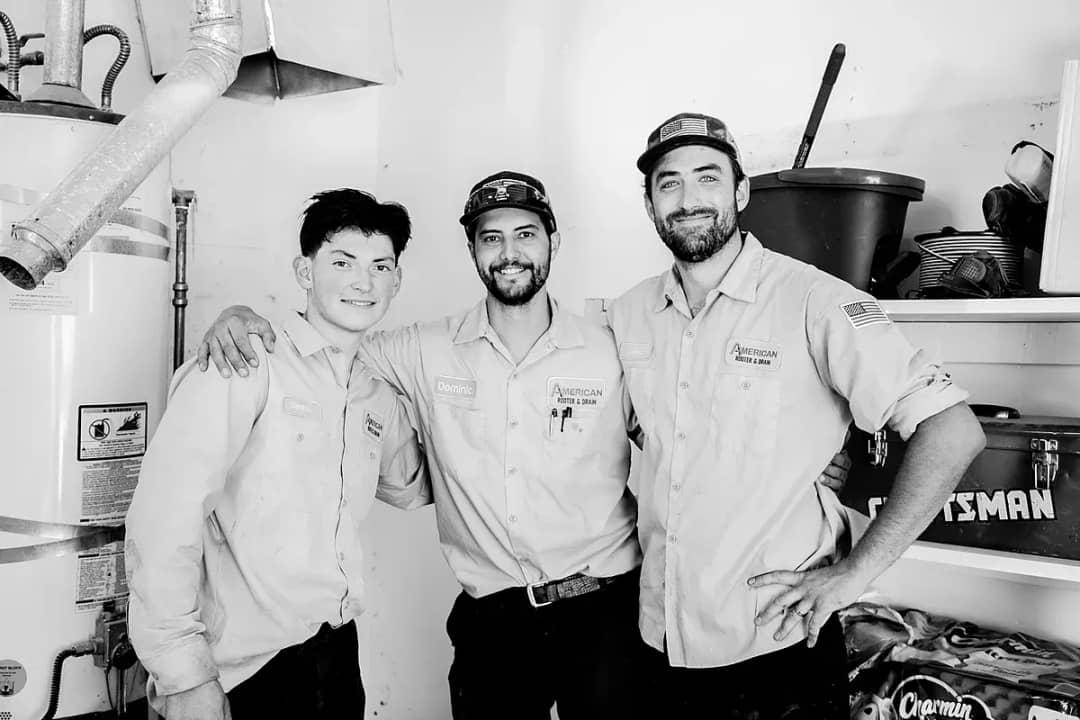
- American Rooter & Drain has worked across the greater Treasure Valley since 1945, and we run the Payette route out of our Caldwell shop.
Ready to schedule?
If you have no hot water, a water heater leaking onto the floor around its base, or rust showing up in the hot water at the tap, call (208) 366-5771 and we will tell you honestly what today's schedule looks like for your address. If you are planning ahead — the unit still works, but you know it is old — that is the better call to make, because a planned replacement lets you choose the size and the fuel type on your terms instead of on the tank's.