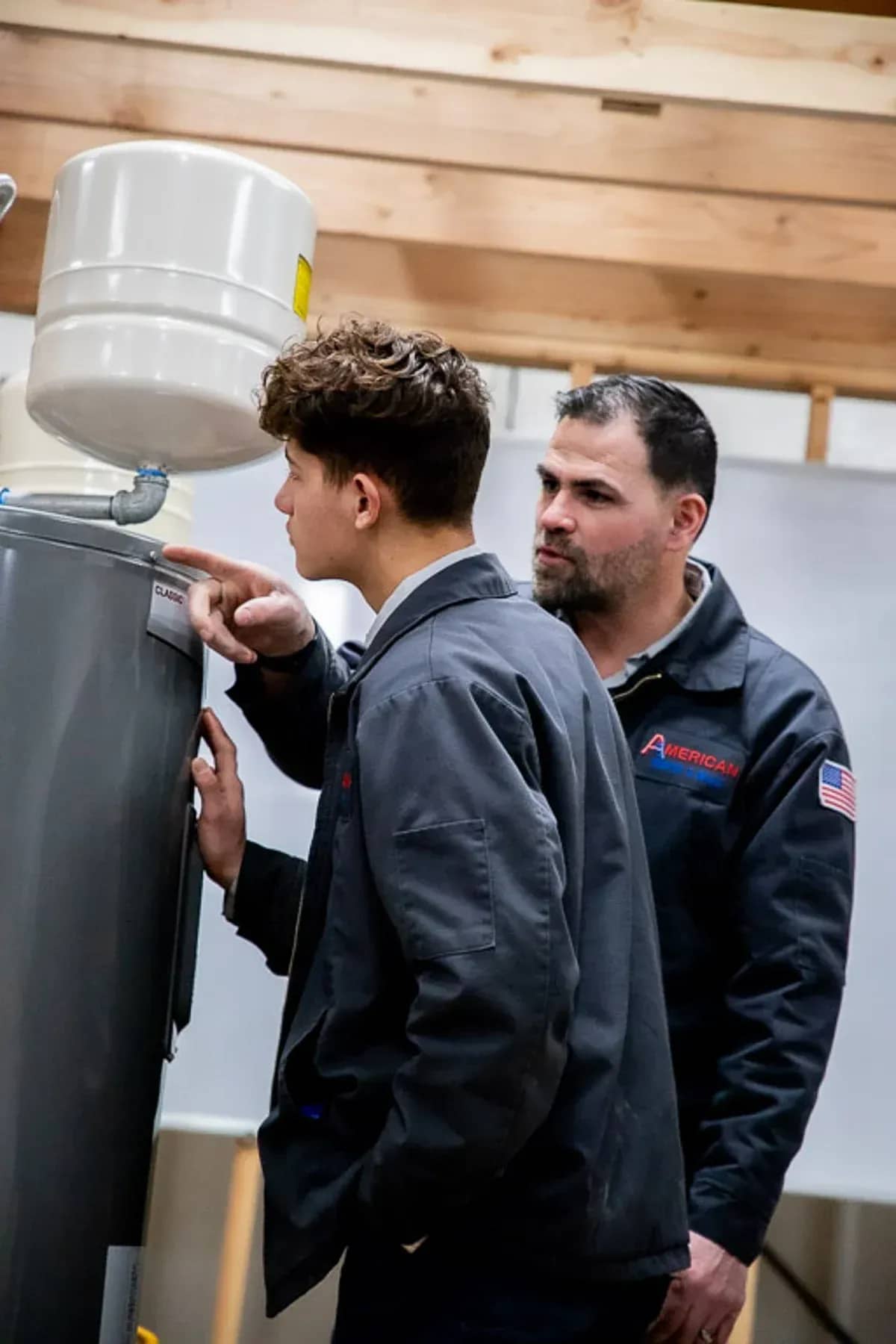

That is the entire value of him. It is also why the cheapest water heater quote in Nampa is very often the one with no permit inside it. That is not a discount. It is a line somebody left out, and the cost of leaving it out does not land this week — it lands years from now, at a closing table, or on the phone with an adjuster.
This page is about that half of the job: who is supposed to pull the paperwork at a Nampa address, what the inspector actually walks up and looks at, the three items that fail more replacements than everything else combined, and what any of it does to the day you get hot water back. If your water is cold right now, that part is simpler — call (208) 366-5771.
Do I need a permit to replace a water heater in Nampa?
Replacing it, yes. Repairing it, no — and the line between those two is cleaner than most people expect.
Not permitted work. Swapping a heating element or a thermostat on an electric tank. A thermocouple, a pilot assembly or a gas control valve on a gas one. Replacing the temperature and pressure relief valve itself, the drain valve, the anode rod, or a flexible supply connector. Flushing the tank. These are repairs to an appliance that is staying exactly where it is, and nobody needs a permit to keep a working water heater working.
Permitted work. Taking the old heater out and putting a different one in. That is the event, and it is the event regardless of what the heater cost, whether it burns gas or runs on elements, or whether the new one is the same make and size as the old one. The reason is mechanical rather than financial: every water joint on the unit, the fuel connection, the vent and every safety device come apart and get remade. A permit follows the connections, not the price tag.
Bigger than a water heater permit. Moving the unit to a different wall or a different room. Converting between gas and electric. Going up in capacity far enough that the vent or the gas line has to be resized to feed it. Each of those is gas piping, venting or electrical work in its own right, which means its own permit and its own inspection, and it should be quoted that way rather than folded quietly into a swap.
Two administrative wrinkles are worth knowing about, mostly so that you can recognise them if somebody tries to hand them to you as your problem. The first is that the plumbing side of a water heater and the gas or mechanical side are not always issued by the same desk, so one job can carry more than one piece of paper. The second is that a Nampa mailing address does not by itself settle which office covers the property — that is decided by where the house physically sits, and it changes which inspector you get and when he is available.
Neither of those is a question you have to answer. We work out which permits your specific job actually needs and pull them before the truck loads. You do not call anybody and you do not stand in a line.
Who pulls the permit — me or you?
We do. That is the plain answer, and it is not a courtesy — it is what the document is for. A permit attaches to a licence, and the licence is the thing with something to lose.
Idaho does allow a homeowner to permit work on their own residence, and on the surface that looks like a small saving. Here is what it actually moves. You become the responsible party for code compliance. The correction notice comes to you. If the inspector finds something, correcting it is your problem and your invoice, and the contractor who created it is standing off to one side of that conversation. And nobody's licence is behind the installation — which is precisely the question that gets asked later, on a seller's disclosure or in a claim file. "The homeowner pulled the permit" and "a licensed plumbing contractor pulled the permit" are two very different sentences on that record.
So the useful tell is this: if a contractor asks you to pull the permit for work they are doing, that is information. It means the licence that would otherwise go on the paperwork is not one they want attached to your job. A company that pulls its own permits has told you something real about itself before you have paid it anything.
If you are comparing bids, there are two questions that sort this out in about fifteen seconds on the phone. Whose licence goes on the permit? And will somebody from your company be at the house to meet the inspector? A shop that intends to do this properly answers both without hesitating, and the permit number ends up on your paperwork where you can see it.
What does the inspector actually look at?
He is not there to admire the tank. He works a short list, and he works it in roughly the order the failures come in.
Whether the appliance is what the permit says it is. The listing label legible and intact, and the model on the tank matching the model on the paperwork.
How it is standing. This is the item that is waved off more than any other in Idaho, because people file anchoring under California problems. Idaho's plumbing code is built on the Uniform Plumbing Code, and the UPC requires a water heater to be secured against horizontal movement. There is no local exemption for a tank that looks heavy enough to stay where it is.
What correct looks like: two straps, one across the upper third of the tank and one across the lower third, with the lower strap kept clear of the controls and the burner access so nobody has to cut it off to service the unit. The strap wraps the tank and anchors into framing or a masonry anchor — not into drywall, and not a length of plumber's tape and two screws, which is the version we find most often. Expect the inspector to put a hand on the tank and push it. He is not checking that the strap exists; he is checking that it does anything.
And the reason it matters is not really the tank tipping over. It is what tears when it moves. A tank that shifts a few inches takes its flexible gas connector and its water connections with it, and a torn gas connector in a closed garage is the actual hazard sitting behind the rule.
The water connections. A cold-side shutoff you can reach and actually turn, and proper dielectric separation where copper meets the steel nipples on top of the tank, so the joint does not quietly corrode itself apart from the inside out.
The relief valve and where its discharge goes. The temperature and pressure relief valve is the last thing standing between a failed thermostat and a tank full of superheated water, and it opens on either temperature or pressure. Every rule about its discharge line exists so that when it opens, it does so somewhere harmless and somewhere you will notice.
- Full size the whole way. A three-quarter-inch valve outlet gets a three-quarter-inch line. Reducing it throttles the one device you are counting on.
- No valve, no cap, no plug anywhere in the run. Nothing may be able to shut it.
- No threads on the far end. This sounds pedantic until you see why: a threaded end is an open invitation for somebody to cap a valve that has started dripping. A plain end removes the temptation.
- Downhill the whole way, with no traps. A dip that holds water collects scale, and a discharge line that has silted up is a discharge line that is not there.
- Terminating low and out of the way, near the floor and not where a person stands. What comes out of it is scalding water and steam, not a drip.
- Piped in material rated for that temperature. Ordinary PVC is not, and it is the single most common wrong material we find on a swap done in a hurry.
- Discharging through an air gap, never hard-piped into a drain, so that a valve which is relieving is visible instead of disappearing silently into the plumbing.
Thermal expansion control, which is the third of the three big ones and gets its own section below.
The gas side, on a gas unit. Rigid pipe up to an appliance shutoff within sight of the heater. An approved connector that does not pass through a wall or a cabinet panel. And a sediment trap — the short capped drop ahead of the gas valve that lets scale and moisture fall out of the gas stream before they reach the control.
The vent, and whether it draws. Material, diameter, rise per foot, connector length and clearance to combustibles, and then the draft actually proven rather than assumed. A vent that does not carry exhaust out of the room is a carbon monoxide problem wearing a paperwork costume.
Combustion air, wherever the heater lives in a closet or any other confined space. This is the requirement a physically larger replacement quietly breaks.
A pan and a pan drain, anywhere a leak would reach finished space, with the pan line ending somewhere a discharge would actually be seen.
Worth saying what is not on the list, because it surprises people. He is not grading the brand you bought, the price you paid, how tidy the joints look, or whether we were pleasant to deal with. He is checking a finished installation against a code. That narrowness is the point — it is what makes the sign-off mean something.
How much longer does the inspection make the job take?
On the day, none. On the calendar, some. It is the second half people are really asking about, so here is the whole sequence.
Before the truck loads, the permit is pulled. On a straightforward like-for-like replacement this is paperwork on our side rather than a wait you sit through, and it does not push the appointment.
On the day, the old unit comes out, the new one goes in, water, fuel and vent get remade, the tank is filled and purged of air, and then it is lit and run through a complete heating cycle before anybody leaves your house. You have hot water that day. Nothing about the permit changes that, because the inspection is not a permission slip you wait on — it is a review of finished work.
Afterward, the inspection gets scheduled, on the inspector's calendar rather than ours. That is the one part of the job we genuinely cannot compress, because it is not ours to compress. Somebody from our crew meets him at the house, opens the access and answers for the work. If the heater is somewhere reachable, you generally do not need to take time off for it.
If it fails, the inspector writes a correction notice naming the specific item. We correct it and call for a re-inspection. That is our cost and our scheduling problem, not a change order. This is the part of the permit that most repays what it costs. On a permitted job a defect turns into a phone call and a return trip. The same defect on an unpermitted job simply sits in your garage, and you meet it later — during a sale, after a water loss, or on the day somebody smells gas.
The job is not finished until the final is signed. We chase that, because a permit that is pulled and never closed out is its own problem — see the next section.
The one version where the inspection genuinely does stretch the timeline is when the job is bigger than a swap. Relocating the heater, converting fuels, or resizing a gas line or a vent to suit a larger unit can bring a rough-in inspection with it — an inspection that has to happen before anything gets covered up. That is the only case where an inspector sits in the middle of the work instead of at the end of it, and it is the best argument there is for deciding on that kind of change while the old heater is still working, instead of in a week where the schedule belongs to the water on the floor.
What is an expansion tank and do I need one?
An expansion tank is a small steel tank, usually a couple of gallons, mounted near the water heater with a rubber bladder inside it and a cushion of compressed air behind the bladder. Water cannot be squeezed. Air can. So when the burner or the element fires and the water in your tank expands, the extra volume pushes into the expansion tank and compresses that air, instead of driving the pressure up through every fixture in the house.
Whether you need one is not really a question about your water heater. It is a question about whether your plumbing is a closed system, and that is the first thing the inspector establishes.
A pressure-reducing valve, a check valve or a backflow preventer sitting between the meter and the house closes it: expanding water can no longer push back toward the street. That is the condition the code cares about, and it is what makes thermal expansion control mandatory rather than a good idea.
His route through it is short. He looks at the service side for the device that closes the system. Then for an expansion tank. Then at how that tank is installed — on the cold side, and carried on its own support rather than hanging its full weight off the pipe it is threaded into, which is how you end up with a stressed joint above a finished ceiling.
The part that gets missed even when a tank is sitting right there: an expansion tank has a pre-charge, and it has to be set to your house's actual static pressure, measured with a gauge at a hose bib. Out of the box it carries a generic factory pressure. Fitted without anybody checking, it can be doing nothing whatsoever from the first day, and from the outside it looks identical to one that is working perfectly.
There is a loop here worth seeing whole, because it is where people end up paying twice. If static pressure at the house runs above eighty pounds, a pressure-reducing valve belongs on the service line. Installing one is also what closes the system — which is what then requires the expansion tank. Those two decisions arrive together, and discovering the second one after the first is already in the wall is an avoidable second trip.
What happens if my old water heater wasn't installed to code?
Nothing today. It becomes a live question on exactly two days: the day the heater gets replaced, and the day you sell the house.
The replacement day is the one worth understanding, because it is where a written number can move on you if nobody looked first. The inspector is signing off on the new installation — but a new installation sits on top of the old one's infrastructure, so pre-existing conditions get pulled into the scope of the job whether anyone planned for them or not.
What we actually find, in rough order of how often we find it:
- No expansion tank on a house that gained a pressure-reducing valve at some point after the original heater went in.
- A relief valve discharge line reduced in size, capped, run uphill, or piped in the wrong material.
- No anchoring of any kind, or plumber's tape into drywall.
- A flexible gas connector run through the wall or the panel of a closet.
- A flue left oversized for a single appliance after the furnace that used to share it got changed out.
- A cold-side shutoff that will not shut off, which nobody discovers until somebody tries to close it.
That is exactly why we look at the actual installation before we quote it rather than after. A price built from a phone description is a price with all of that hiding behind it.
Then there is the version where a previous swap was done with no paperwork at all. Common, and not a crisis. There are two situations inside it and the point is to find out which one you have while it is still cheap. If the installation is sound, the fix is administrative — a permit pulled now against the work that exists, and an inspection of what is there. If it is not sound, you would far rather know today than during a sale, when a buyer's lender is waiting and you have neither leverage nor time.
One distinction inside that, because they are not the same thing. No permit at all leaves no record. A permit that was pulled and never finaled leaves an open permit, which is worse than no permit — a written record that work was started on your house and never signed off. That is the version that stops a closing. The final is not a formality; it is the thing that closes the record.
We will look at an existing installation and tell you plainly which of those you are holding. That look does not cost you anything.
How much does a new water heater cost in Nampa?
No number from a web page, and no range. A range is a figure designed to be read from its bottom, which makes it a figure designed to be wrong, and all it really buys anyone is an argument at the end of the job.
What this page can do instead is tell you which things move it, because most of them are already written above. Repair or full replacement. The capacity the household genuinely needs, and the fuel it runs on. Whether the vent, the gas run or the circuit has to be changed to feed the new unit. Whether anchoring, thermal expansion control, a drain pan, a shutoff that shuts off, or a compliant discharge line have to be brought current before a final can be signed. How awkward the space is to carry a tank out of and a new one into. The permit or permits the job actually needs, the inspection, and the return trip to meet the inspector. And hauling the old unit away.
The on-site estimate is free, and it is done standing in front of your heater. You get one flat price in writing, agreed before the old tank is disconnected, and it does not move afterward. Already holding somebody else's written quote? Have it out when we get there and we will walk it line by line at no charge — specifically, whether it accounts for the permit, the expansion tank, the pan and the discharge line, since those four are what an installation quietly leaves out when nobody is coming to look at it. That is where most of the distance between two quotes turns out to be hiding.
At Nampa addresses we have completed 24 full water heater replacements — 21 tank and 3 tankless. A replacement is the job that carries the permit; the repairs, tune-ups and no-hot-water calls we run here do not.
Call (208) 366-5771. No hot water moves up the list, and you will get a straight answer about what is genuinely open today rather than a booking somebody is hoping to keep. Tell whoever answers whether the unit is gas or electric, and whether there is water on the floor around it. If there is: close the cold water valve on top of the tank, then shut the breaker on an electric unit or turn the gas control to off on a gas one. That holds the damage where it is until a truck gets there.
American Rooter & Drain was established in Caldwell, Idaho in 1945 and has served the greater Treasure Valley since. Licensed, bonded and insured, and the permit and the inspection are handled as part of the work rather than sold to you as an extra.
Need something else looked at while we are out? See everything we do in Nampa, ID, or plumbing repair in Nampa, gas line installation in Nampa and water line repair in Nampa. Nights, weekends and holidays run through this same number and this same crew — emergency plumbing in Nampa. The division page for the whole service area is water heater repair and replacement.