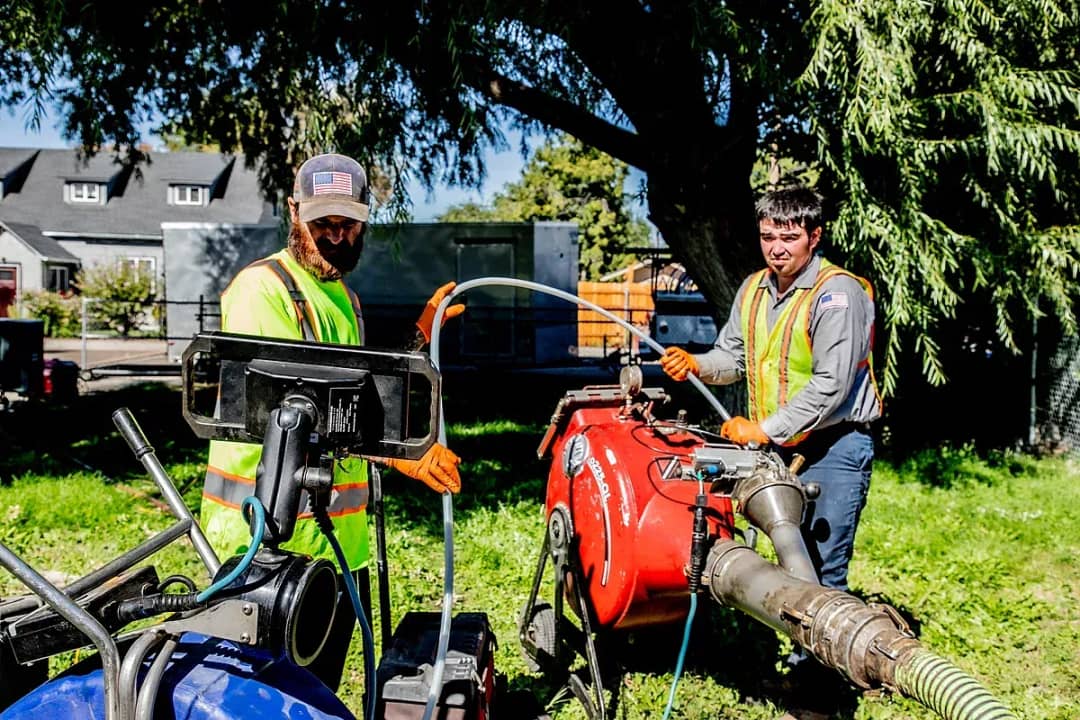
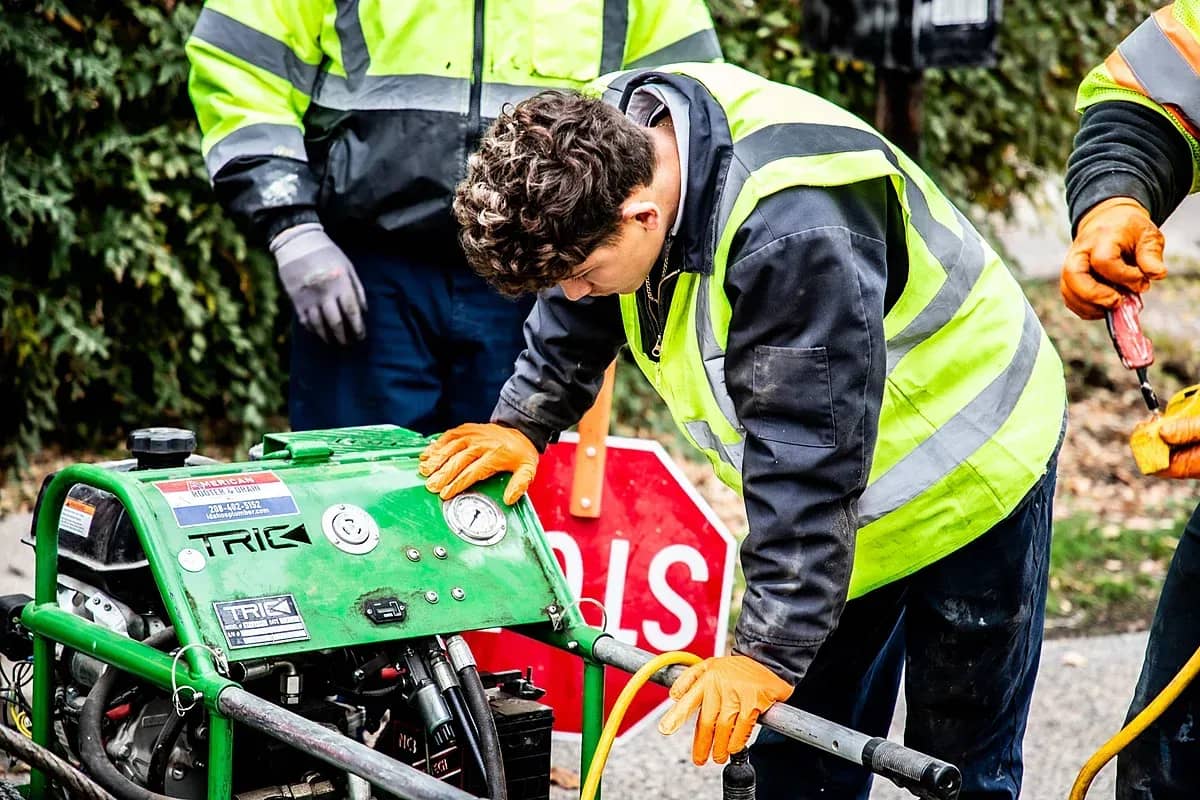
We inspect both, and the principle doesn't change: the camera goes down the line, you watch the screen with us, and the recommendation comes off the footage instead of a hunch.
Downtown: cast iron, alleys, and lines nobody has mapped
Buildings around SW 1st Street and Oregon Street were plumbed when cast iron was the only serious option, and cast iron doesn't fail the way people expect it to. It doesn't spring a leak. It rots from the inside along the bottom — scale builds on the walls, the invert thins, and eventually the bottom third of the pipe is gone while the arch overhead still looks like pipe. From up in the building everything is fine until the day it isn't. On camera you see it in the first ten feet: a rough, rust-scaled channel where a smooth pipe wall ought to be.
The other downtown reality is access. A lot of the old core drains out the back of the building into an alley main. Those runs cross under asphalt that has been overlaid three times, past a dumpster pad, sometimes under a delivery lane where loaded trucks have been rolling over a shallow clay or cast lateral for fifty years. Crushed pipe under a wheel path is common here, and it is almost never where the owner assumed the line ran. We use a sonde in the camera head and a locator up top to mark the real path and depth in paint before anybody talks about cutting asphalt. On a downtown building that locate is frequently worth more than the inspection itself.
Grease lines are the commercial job in Ontario
Ontario has restaurants, cafeterias, care facilities, hotel kitchens, school and college kitchens, and the motel-and-diner strip out by the interchange. Every one of them is running a grease-bearing line, and grease does not behave like a clog.
It doesn't sit in a lump you can punch a hole through. It plates onto the pipe wall in a layer that builds evenly for years. A 4-inch line coated three-quarters of an inch all the way around is a 2.5-inch line, and it will run acceptably right up until the night it doesn't — which is always a Friday. What a camera does that a cable cannot is measure what's left: remaining diameter, whether the deposit is a soft fresh layer or hardened and set, and which stretch is worst.
Sequence matters on a commercial line. Jet first, camera second. Trying to grade a greasy line wastes the trip — the lens fogs, the wall is coated, and every foot looks like sludge. Jet it, then run the camera, and that post-jet video becomes your baseline. Next year's footage tells you exactly how fast the line is re-coating and whether the interceptor is doing its job or getting bypassed.
The segment worth watching is the one from the interceptor outlet to the tie-in at the main. When a kitchen is on a service schedule and still backing up, the answer is nearly always in there. See recurring drain backups for that pattern, or a kitchen sink that keeps clogging if it hasn't progressed past the fixture yet.
Bigger pipe wants different equipment
Residential work is a 3- or 4-inch line and a standard camera head. Commercial in Ontario means 4-inch and 6-inch laterals, and older buildings with 6- and 8-inch runs out to the main. That changes the gear on the truck:
- A self-leveling camera head, so the picture stays upright and you can read the invert instead of watching the horizon roll every few feet.
- A skid or centering guide sized to the pipe. Without one the lens drags through whatever is lying in the bottom and you inspect three inches of sludge for ninety feet.
- Enough reel to make the full run. A downtown lateral out to an alley main is longer than most owners guess.
- A sonde the locator can pick up through asphalt, an overlay and a slab.
In larger pipe we're also reading the tap itself — whether the building was connected with a proper wye or a hammer tap knocked into the side of the main, and whether that tap protrudes into the main and catches everything going past it. That finding can change who pays for the repair, so you want it on video rather than in somebody's recollection.
Low ground, high water, and open joints
Ontario sits low, and the ground here holds water in a way the drier benchland does not. Irrigation season and seasonal groundwater both bring the water table up around a buried lateral, and that shows up on camera two ways.
The first is infiltration. When you're driving a camera down a line on a dry day and clear water is running in at a joint, that joint is open — and it is open in both directions. Groundwater coming in means sewage can go out. That's a repair conversation, and it also explains properties where the line only "acts up" on a seasonal schedule.
The second is settlement. Saturated fine-grained soil supports pipe poorly. Joints pull apart, sections drop, and you're left with offsets and bellies that hold water permanently. Put grease in a belly and it goes anaerobic and starts pushing odor back up through the building, which is why a sewer smell in the house so often traces back to a section of line nobody has ever looked at.
Residential Ontario
The older in-town streets have vitrified clay tile and cast iron with the failure modes any pre-war lateral has: a joint every few feet, root intrusion from the elm, locust and cottonwood that line the older blocks and the canal banks, and offsets where the ground has moved under the pipe. Newer neighborhoods on the edges of town are PVC and generally sound, though a camera run still turns up construction debris and bad bedding often enough to pay for itself.
Pre-purchase is the highest-value residential inspection we run. A home inspector will not camera a sewer line, and the lateral is the single most expensive thing on a residential property that a buyer cannot see. Footage in hand beats a surprise the first winter you own the place. If the line is already misbehaving, a sewer line that's backing up covers what happens next.
Before you sign a lease or buy the building
If you're taking a downtown space and changing what it does — retail becoming a restaurant is the classic version — the existing lateral was never asked to carry grease, and nobody else in the transaction is going to tell you what's in it. Camera it before you sign, not after the tenant-improvement budget is committed and the fryer is on order. Same goes for buying a commercial building outright: get the run from the building to the main on video and find out whether you're inheriting a working lateral or a replacement project.
What it costs on a commercial line versus a house
We quote a flat price up front, and the variables are honest ones: residential or commercial diameter, whether there's a usable cleanout or we have to make access, whether the line has to be jetted before it can be read at all, the length of the run, and whether you want the path and depth located and marked in paint. A grease line with a locate is a different job than a straightforward residential run, so we come look at it first. That estimate is free.
Scheduling on the Oregon side
We work the Oregon side of the valley regularly, and Ontario is a straight shot down I-84 from the shop. American Rooter & Drain was established in Caldwell, Idaho in 1945; the shop is at 1005 Commercial Way, Caldwell. Call (208) 366-5771 and describe what the line is doing — residential or commercial, we'll bring the right head for the pipe.
For the rest of what we do in town, see our Ontario service page. For sewer camera inspection everywhere else we cover, the main sewer camera inspection page lists every city.