Locating comes first out here
A camera inspection is two instruments doing two different jobs. The camera reports the condition of the pipe. A transmitter in the camera head, tracked from above ground with a receiver, reports exactly where that pipe is and how deep it lies.
The second half is what changes an Eagle job. Instead of "the line runs somewhere between the house and the street," we walk the yard, paint the actual path, and call a depth at each mark. That difference matters when the answer turns out to be seven feet off the northeast corner of the patio at fifty-one inches down, in the strip between the spruce and the pump vault. Now you know things before you commit to anything: whether the repair can be reached without taking the tree, whether the trench misses the irrigation mainline, whether equipment can physically get to it, and whether trenchless is worth pricing because the two access pits happen to land on open lawn instead of hardscape.
We mark it, we photograph the marks, and the marks are still there when the excavator arrives.
Long runs fail in ways short runs do not
A lateral in a tight subdivision might be thirty-five feet. In Eagle, with houses set back off Floating Feather, Beacon Light and the other roads where lots got platted deep, the run to the main is often several times that. Length changes the math three ways.
More joints. Every joint is a candidate for root entry, for an offset, and for groundwater to work its way in. Twice the pipe means twice the openings.
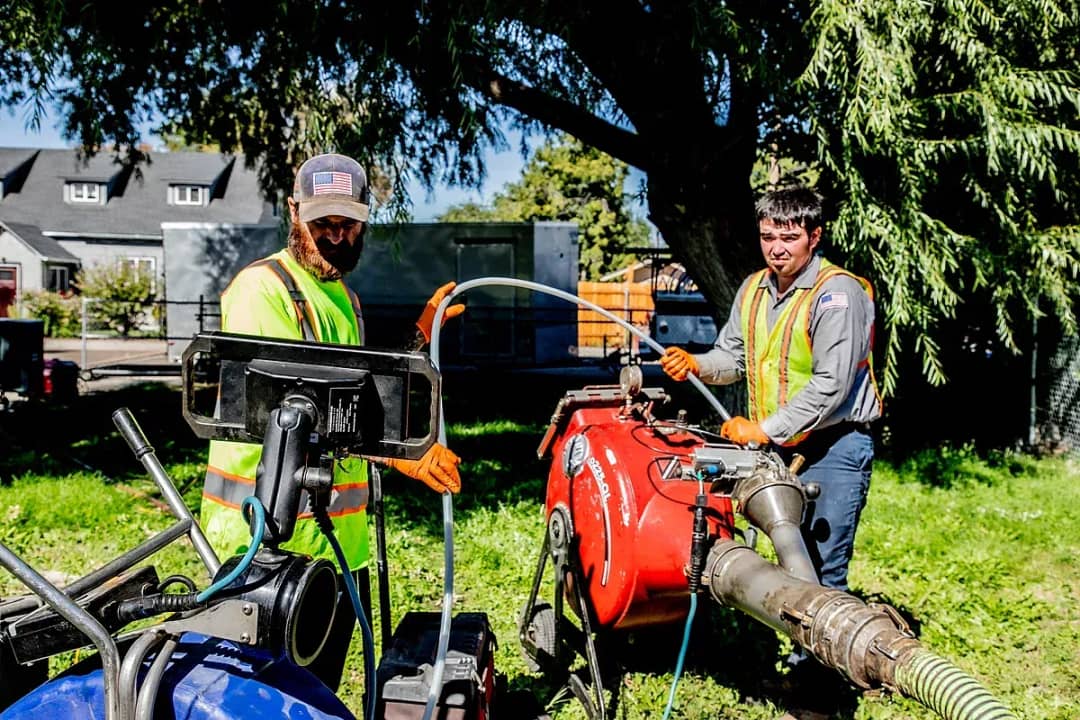
More grade to lose. A sewer line survives on a small, consistent fall. Over a long run there is more distance for a section to settle out of pitch, and a shallow low spot that would be harmless in fifteen feet of pipe becomes the place where solids stop and build in seventy. The footage counter on our reel puts a hard number on where that starts, and that number is what decides where anybody digs.
More distance to the access point. Cable and camera both have to reach. When the cleanout is at the house and the trouble is out by the sidewalk, you are working at the far end of the run, which is one more reason to establish length and layout before quoting a repair.
River-bottom ground and a spring water table
Eagle sits low and close to water. Between the main channel of the Boise River, the north channel around Eagle Island, Dry Creek, and an irrigation ditch network that predates most of the houses, much of this ground carries a seasonal water table that rises hard in spring runoff and drops back by August.
That does things to a lateral that a camera catches and a symptom never will. Groundwater finds joints and gets in, which is infiltration. On screen it reads as clean water trickling into the pipe at a joint while nothing in the house is running, often with a fine fan of silt below it. It rarely announces itself as a backup. It just quietly adds volume, and over years it washes bedding out from under the pipe, which is exactly how a line that was laid correctly ends up sagging. In sandy river-bottom fill that same washing action is what pulls joints apart into an offset.
Spring is also when we get called about a soft, wet patch in the lawn that is not sewer at all. If the ground is saturated and the smell is clean, it is more often a pressurized service line or irrigation than a lateral, and that is a different tool entirely. See water leak detection and an outdoor water line leak for how we tell those apart before anything gets opened up.
The landscaping is both the reason and the risk
Eagle plants big. Cottonwood and willow near the water, silver maple, poplar windrows left over from old farm boundaries, blue spruce, and lawns watered hard all summer on pressurized irrigation.
Roots rarely break a pipe outright. They find a joint or an existing crack, follow the moisture in, and grow into a mass that catches paper and grease until the run stops passing. On camera that progression is obvious and gradeable, and a few white hairs at a joint is a very different job from a plug you cannot see through. It also tells us which tree, because the footage plus the locate puts the intrusion at a measured distance and a painted spot on the ground, and often that spot sits directly under a canopy nobody wants to lose. There is more on tree roots in a sewer line and how far cutting them actually gets you.
Pressurized irrigation adds a second buried system in the same corridor. Sprinkler mainlines, valve boxes, drip zones and the pump vault all occupy the yard the trench has to cross. Locating the sewer accurately is half of protecting them. Planning the dig around the zones instead of through them is the other half, and it is a conversation worth having before the day of the work rather than during it.
What you get out of the visit
We record the run and go through it with you at the truck. What the pipe is made of, where each defect sits by footage from the entry point, whether the pipe is structurally sound or finished, and what the honest options are. Roots in a line that is otherwise healthy get cleared and put on a sensible interval, and we will tell you plainly that they come back. One failed section gets a spot repair. If the run is sagging or the joints have pulled apart along its length, lining does not fix geometry, and we will say so rather than sell it to you.
If what brought you here is a sewer line backing up, we normally clear it first so the camera has clean pipe to travel through. Our $59 drain cleaning special covers a standard clear through an accessible cleanout, and the camera goes in behind it to find out why the backup happened in the first place.
Cost, and what actually moves it
There is no honest single number for a repair nobody has looked at yet. On an Eagle property the variables are specific: total length of the run, depth, whether a usable cleanout exists or one has to be cut in, whether the pipe has to be cleared before the camera can pass, and what sits over the top of the work, whether that is open lawn, mature planting, hardscape, or irrigation that has to be cut and restored. Two houses on the same street can land in genuinely different places on that list.
So we come out, look, locate, and price the job flat and in writing before anything is opened up. The estimate visit costs you nothing.
Get it located before you dig
American Rooter & Drain has served the greater Treasure Valley since 1945, working out of 1005 Commercial Way in Caldwell, Idaho. Call (208) 366-5771 to get a camera and a locator on your Eagle line before a shovel goes anywhere near that yard.
Everything else we do in town is on the Eagle service page, and the rest of the valley is on the main sewer camera inspection page.