Need a plumber for a clogged toilet? We run toilet calls across Boise, Nampa, Caldwell, Meridian and the rest of the Treasure Valley, days, nights, weekends and holidays. You get a flat price in writing before any work starts.
The two tools that clear most toilet clogs
A flat cup plunger is for a sink. A toilet needs a flange plunger — the one with a rubber sleeve that folds out of the cup and seats into the throat of the bowl. Without that sleeve you are not making a seal, you are splashing water, and people decide the clog is "too bad to plunge" when they never built any pressure.
- Run hot tap water over the rubber first. Cold rubber is stiff and will not seal.
- Press slowly on the first stroke to push the air out, then pump hard for fifteen to twenty strokes without breaking the seal. The pull stroke is what moves the clog.
- Keep enough water in the bowl to cover the plunger head. Plunging air accomplishes nothing.
Do not flush again to see if it worked. If the trap is still packed, a second flush sends another gallon and a quarter into a bowl with nowhere to put it. Watch the water level instead: if it drops on its own inside a minute, the line took it. Skip the chemical drain cleaner — the trap holds standing water, so it dilutes before reaching the clog, then sits in the bowl as a hazard for whoever has to pull the toilet. On septic it goes to the tank and kills bacteria you need working.
If plunging fails, the second tool is a closet auger: a three-foot cable in a rigid tube, bent at the end, with a vinyl sleeve over the elbow so it cannot chip the porcelain. Do not substitute a drum snake — no sleeve, no fixed bend, and enough loose cable to kink sideways in the trap and crack the bowl. Feed the head into the throat, crank clockwise while pushing gently, and stop pushing the moment you feel resistance. Three feet covers the trap and a little past the closet flange, where the large majority of genuine toilet clogs sit. Objects and rope-formers — toys, floss, cotton swabs, tampons, paper towels and "flushable" wipes — usually have to be hooked and pulled back, or the toilet lifted, cleared from the outlet side, and reset on a new wax ring.
If the auger runs its full length without touching anything, that is information. An empty trap plus a toilet that still will not drain means the blockage is downstream of the fixture. Stop and read the next section.
When the toilet is not the problem at all
This is the part worth reading twice. A toilet dumps roughly a gallon and a quarter in about four seconds — the largest single slug of water any fixture in your house sends into the drain line. Nothing else comes close. So when a branch line, main line, or vent is partly blocked, the toilet is where it shows up first, and it looks exactly like a toilet clog.
Any one of these means stop plunging.
The toilet clears, but the tub or shower gurgles. That gurgle is air pushed ahead of backing-up water, escaping through the nearest trap it can reach — usually the tub, because a tub trap holds the least water in the bathroom. A healthy system does not make the tub talk when you flush.
Two or more fixtures act up at once. One slow fixture is a fixture problem. A slow toilet plus a slow tub is a branch problem. Add a floor drain or laundry standpipe that overflows and it is a main line problem.
Water rises in the tub or shower when you flush. That is a branch or main blockage — the water is looking for the lowest opening in the system and it found one. Do not run anything else in the house.
Running the washing machine sets the toilet off. A washer pump pushes fifteen to twenty gallons out fast, and a line that just barely keeps up with normal use cannot take that surge.
The bowl rises after a flush, sits, then drains slowly on its own. A fully blocked trap does not drain at all. Slow self-clearing means water is getting past, just not fast enough — roots at a joint, a belly holding water, or scale. This is the dangerous one: it looks like it fixed itself, so people live with it for months while the line narrows.
It is the only toilet on that branch and the clog keeps coming back. In older Caldwell, Nampa and Boise houses with one bathroom on a short branch to the main, nothing else on that branch makes enough flow to expose the real restriction, so the toilet takes the blame every time.
More than one toilet is affected. Two toilets do not fail the same week by coincidence. What they share is the line.
What is usually behind it around here
Roots in clay laterals. Older Caldwell and Boise neighborhoods still run vitrified clay to the city main, jointed every few feet. Roots find the moisture at those joints and build a mat that catches paper and grease, so the line works fine right up until it does not, then comes back a month after cabling.
Orangeburg. Tar-impregnated wood fiber pipe from post-war construction is long past service life; it ovals and delaminates. Finding it on camera is a replacement conversation, not a cleaning one, and better learned before paying to cable the same pipe three more times.
Cast iron that has scaled down. Interior corrosion narrows a nominal four-inch line until it effectively passes three, with a rough wall that grabs everything going by. Cabling opens a channel; jetting scours the wall.
Bellies. Ground movement and the high water table in low ground near the Boise and Snake rivers let a section settle into a low spot that permanently holds water. Solids drop out and build a dam there. A belly cannot be cleaned out for good, only relieved — a repair decision, not a cleaning one.
Hard water scale in the fixture itself. Treasure Valley water is hard, and mineral builds inside the rim jet holes and siphon jet. A toilet with plugged rim holes flushes weakly because it is delivering a fraction of the water it should, not because the drain is blocked. Lazy swirl instead of a hard pull? Hold a mirror under the rim before blaming the line.
A full septic tank. Outside city sewer, an unpumped tank backs up at the lowest fixture, often a first-floor toilet, and cabling into a full tank accomplishes nothing. Check the tank level first — our 1,000-gallon pump-out is a flat $395.
The camera is how we stop guessing
Every symptom above has more than one possible cause, and those causes have very different fixes. Roots, a belly, a cracked section, an object lodged out in the lateral, scale, and a full septic tank can all produce "the toilet backs up and the tub gurgles." Guessing between them means cabling the same pipe over and over and hoping.
A sewer camera inspection ends the argument. The camera goes in through a cleanout and we watch the actual pipe on a monitor, so we come out knowing the material, the condition, the depth, the distance to the problem, and what kind of problem it is. The head carries a locating transmitter, so we can mark the path and depth of the line on the surface before anyone digs. You watch the same video we do.
It matters most on a clog that has already come back once, and in any house where nobody knows the age or material of the lateral. Cabling a line clear only to find scaled cast iron with a belly at forty-two feet is a very different next twelve months than clean PVC that caught a wad of wipes. Book one in Caldwell, Nampa, Boise or Meridian.
What the call looks like, and how long it takes
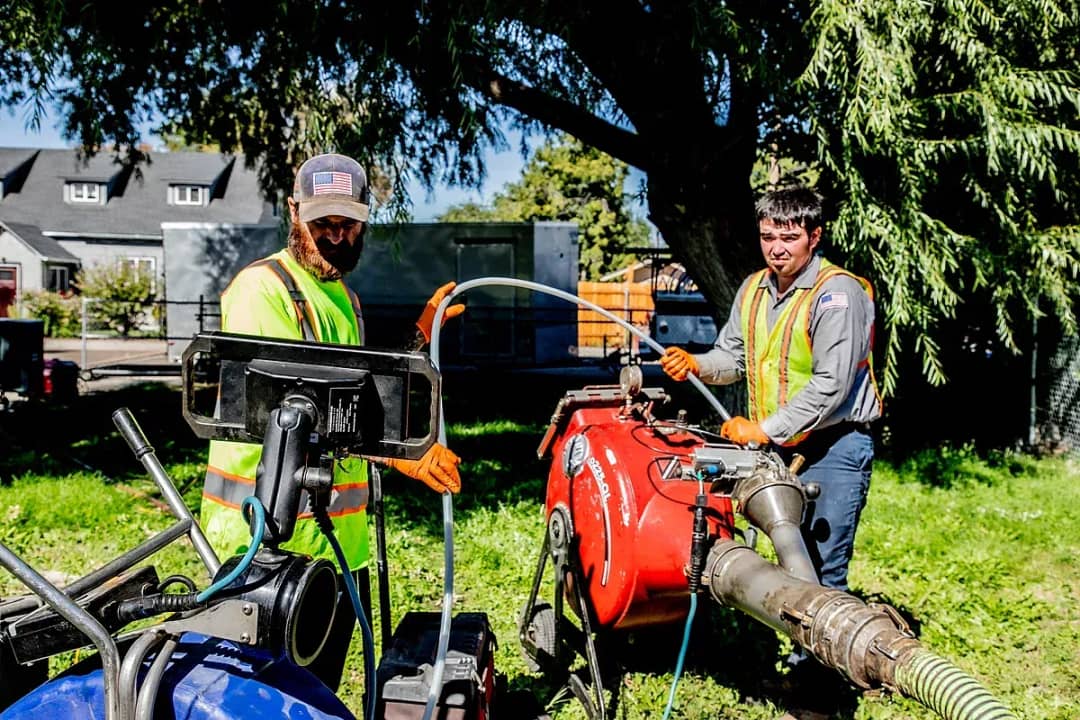
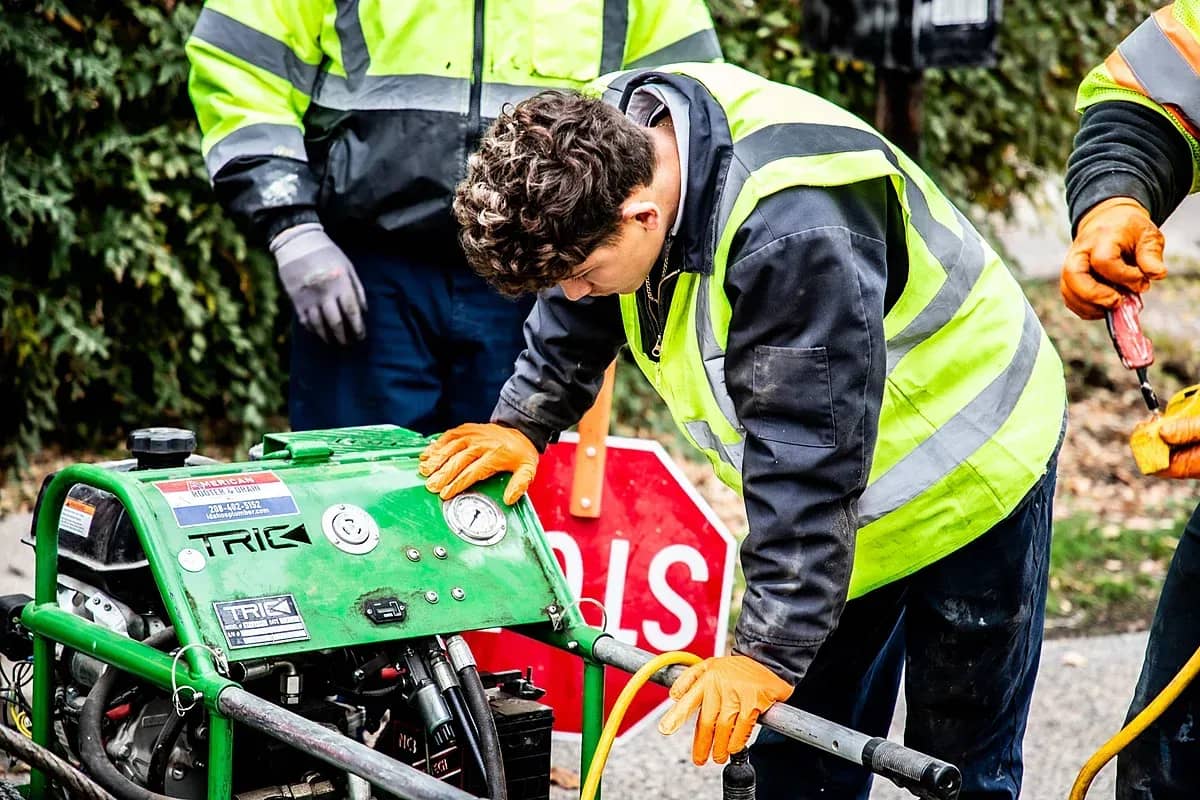
Before touching the toilet we run other fixtures to establish whether this is one fixture or the whole system. Five minutes, and it decides everything after. An auger pass at the fixture is quick; lifting and resetting a toilet to retrieve an object is typically under an hour. If the blockage is downstream we work from the cleanout — most Treasure Valley homes have an exterior one near the foundation on the sewer side, older houses sometimes only a crawlspace one, and a few have none, in which case we pull a toilet for access. Cabling a main line usually runs one to two hours depending on the length of the run. Cabling cuts a channel and hooks debris; hydro jetting scours the full inside wall and is the right call for grease, scale, and any line with a repeat history. A camera inspection is a single visit, and repairs it turns up get scheduled separately so you decide with footage in front of you.
What it costs
We do not publish a number for a clogged toilet, because the honest answer depends on what is wrong. What moves it: whether the clog is at the fixture or out in the line, whether the toilet has to come off the floor, whether a usable cleanout exists or has to be created, how far out the blockage sits, cable versus jetting, and city sewer versus septic. Our drain cleaning special is $59 and a 1,000-gallon septic pump-out is a flat $395. Everything else is quoted on site, in writing, after we look. Estimates are free.
Right now, while you wait
- Stop flushing. Every flush that does not clear adds another gallon to a full bowl.
- Shut the supply valve at the wall, or prop the flapper closed, so nobody else flushes it.
- Hold off on the washing machine, dishwasher and showers, especially if water has already come up in a tub. A blocked main will put that water on your lowest floor.
- If sewage has surfaced, keep people and pets off it and call.
Call (208) 366-5771 — a real person answers, and we run emergency plumbing when it will not wait. American Rooter & Drain was established in Caldwell, Idaho in 1945 and works the greater Treasure Valley from our shop at 1005 Commercial Way, across Boise, Nampa, Caldwell, Meridian, Kuna, Eagle, Star, Middleton and the rest of the valley, plus Ontario, Nyssa and Vale in Eastern Oregon.
Related: clogged sink · clogged shower or tub drain · toilet, faucet and sink repair · clogged drain repair · sewer repair · sewer line repair · trenchless sewer repair · plumbing repair · plumbers in Caldwell and Nampa.