Hydro jetting vs. snaking — what's the difference?
A cable auger — the standard snake — pushes a spinning cable down the line until it finds the clog, then bores a hole through it. That's often exactly what a single fixture clog needs: the blockage breaks up, water starts moving again, done. But a cable only opens a path through the center of whatever's blocking the pipe. It doesn't touch what's stuck to the walls on either side of that path.
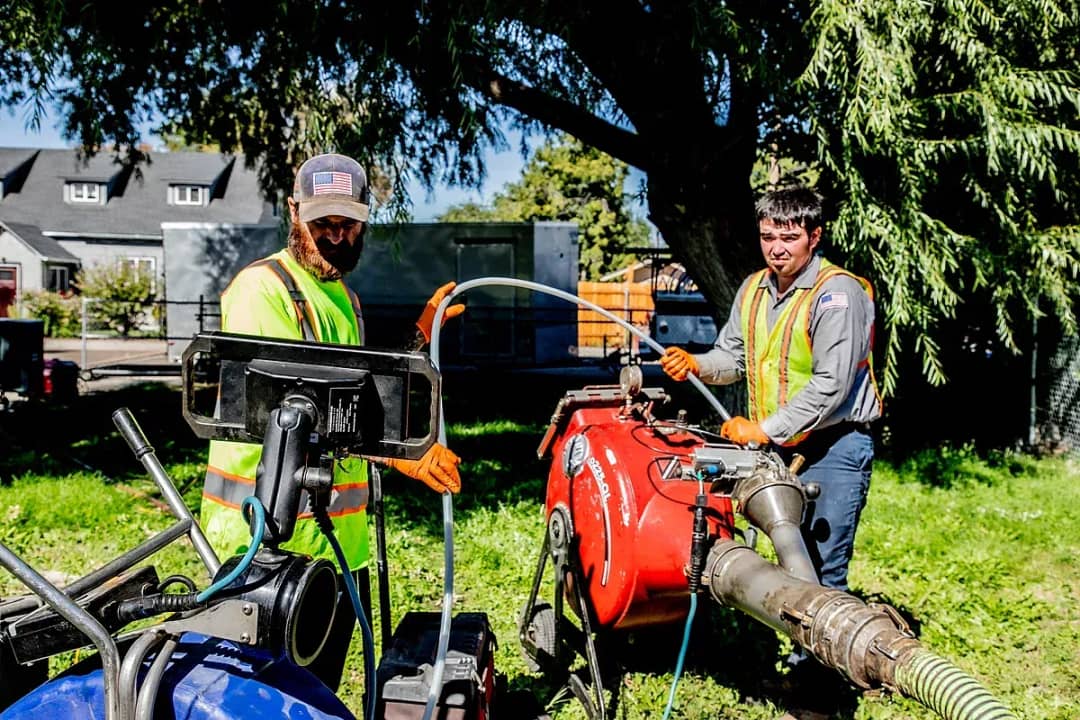
Hydro jetting works differently. High-pressure water sprays outward from a rotating nozzle as the hose feeds down the line, scouring grease, scale, and root hair off the entire circumference of the pipe — not just clearing a channel through it. For a one-off clog from something that fell down a drain, that's overkill. For a line coated in grease, narrowed by mineral scale, or laced with fine root hair working through a joint, it's the only method that actually removes the material instead of just pushing it aside. A cabled line with a grease or scale problem usually reclogs within weeks or months, because the cable left most of what caused the clog still stuck to the pipe wall.
How we determine hydro jetting is the right call
A technician doesn't default to jetting — it's decided by what's actually inside the line, not by habit. On a repeat or stubborn clog, that usually starts with a sewer camera inspection before anything else happens. The camera shows what's really going on: a slick coating of grease along a kitchen line, fine white root hair reaching in through a cracked joint, a buildup of hard-water scale narrowing the pipe's diameter, or sludge and sediment settled along the bottom of a mainline. Those are the four signatures that point to jetting.
The camera also does something just as important: it rules jetting out when it isn't a good idea. A line that's already fragile — badly corroded cast iron, deteriorated clay, a section with hairline cracks or separated joints — can be made worse by full-pressure water, not better. Jetting an already-compromised pipe risks turning a manageable problem into a collapsed one. That's why we look before we jet, not after.
When jetting is the right tool — and when it isn't
Not every clog needs jetting, and we'd rather tell you that up front than sell you more than the line actually requires.
- Jetting is clearly the right call for: grease-heavy kitchen or restaurant lines where fat and oil have coated the pipe wall; a line with a documented history of recurring clogs that keep coming back after repeated snaking; mineral scale narrowing an older pipe from years of the Treasure Valley's hard water; and fine root hair intrusion that's worked through a joint and is spreading across the pipe wall rather than blocking it in one spot.
- A standard cable is usually enough for: a single, simple clog — something flushed or dropped down a drain, a first-time backup with no history, a localized blockage the camera confirms is isolated rather than a wall-wide coating. Jetting that line doesn't get you a better result, just a bigger bill. Our drain cleaning service, which most calls start with, handles that case in one visit.
- We camera the line first, before jetting, when: the pipe is older, the material is clay, cast iron, or unknown, or there's any sign the line has already had structural trouble — a belly, a partial collapse, separated joints. Jetting a sound older pipe is routine. Jetting a fragile one without looking first is how a clog turns into a repair job.
Is hydro jetting safe for old pipes?
Usually, yes — age by itself isn't the disqualifier, condition is. Plenty of older clay and cast-iron lines are structurally sound and jet just fine; the water pressure that strips grease and scale off a healthy pipe wall doesn't damage pipe that's still intact. The risk shows up when a line is already thin, cracked, or separated at the joints — pressure that a sound pipe shrugs off can push a weak spot further. That's the entire reason the camera inspection comes first on anything older or with an unclear history: it tells us which situation we're actually in before the jetting hose ever goes downhole. If the camera turns up real structural damage instead of just buildup, that's a different conversation — see clogged drain repair for how we handle a line that needs more than cleaning.
What a hydro jetting visit actually looks like
1. We find or open an access point. That's usually an existing cleanout; if the line doesn't have one in a useful spot, we'll identify the best access before starting rather than force the hose through a fixture it wasn't meant for.
2. Camera first, if it hasn't already happened. On any line with a history of recurring problems, older pipe, or unclear condition, we run the camera before the jetting hose goes in, for the reasons above.
3. The jetting hose feeds down the line. The nozzle sprays high-pressure water both forward and backward as it travels, so it's cutting through blockage ahead and scouring the walls behind it at the same time, rather than just punching straight through to the far end.
4. We work the hose the full length of the line, not just to the point where water starts flowing again. Flow returning doesn't mean the pipe is clean — it means the water found a path. The technician keeps working the line until the walls are actually scoured, checking resistance and flow as they go.
5. What comes back out tells its own story. Grease, scale, root hair, and sediment get pushed back toward the access point as the jetting head works — a heavier and dirtier return usually means the buildup was worse than expected, which is useful information for whether the line needs a repeat pass or ongoing maintenance.
6. A confirmation camera pass, when warranted. For a line that had a history of trouble, or where we jetted based on what an earlier inspection showed, running the camera again afterward confirms the pipe is actually clear along its full diameter rather than just moving water again.
How long does hydro jetting take?
A straightforward residential line — a kitchen branch or a single-family mainline with easy cleanout access — is typically a same-visit job alongside the initial inspection. What extends it is fairly predictable: a longer mainline run, a cleanout that's hard to reach or buried, buildup heavy enough to need more than one pass with the jetting head, or a line where the first pass shows the material is worse than the camera suggested going in. Commercial lines — grease traps, restaurant mainlines — tend to run longer simply because there's more line and usually more buildup. We won't promise a specific number of hours before we've actually seen the line; what we can tell you honestly is that most single-line residential jobs don't turn into multi-day projects, and if a job is going to run longer than expected, that becomes clear early, not after the truck's already gone.
If the plan is jetting as a step up from a standard visit rather than a separate call, most jobs still start the same way ours always do — with the $59 drain cleaning special covering the diagnostic look, and jetting scoped in from there once we know what the line actually needs. Either way, you get a real number before work starts, not a guess. Call (208) 366-5771 or ask for a free on-site estimate if you want that number before committing to anything.
After the jetting — how do you know it actually worked?
The line should drain the way a healthy pipe drains: fast, quiet, no gurgling from other fixtures, no repeat slow-down within the next several uses. That's the practical test — not just "does water go down," but does it stay that way.
If the same line backs up again within a short stretch of time, that's worth paying attention to rather than just scheduling another cleaning. A line that reclogs quickly after a proper jetting job, rather than after months of gradual buildup, is usually telling you something structural is going on underneath the clean pipe wall — a belly holding water and debris, a joint that's letting roots back in, a section that's cracked enough to keep catching material no matter how clean the rest of the line is. That's a different problem than the one jetting solves, and it's exactly what a recurring drain backup usually turns out to be once we look closer.
The honest next step in that situation is the same one we'd take before jetting an older pipe in the first place: run the camera, see what's actually there, and go from that instead of guessing. If it turns out to be root intrusion working back in from outside the pipe, or the beginning of a bigger structural issue, that's a conversation about repair, not another round of cleaning — and it's one we'd rather have with you honestly, in writing, before any work starts.
We run hydro jetting crews across the whole valley, not just from one shop. See our dedicated pages for hydro jetting in Boise, Nampa, Meridian, and Caldwell — or call (208) 366-5771 and a real person will help you figure out whether your line needs jetting, a standard cleaning, or a closer look with a camera before anyone commits to either one.