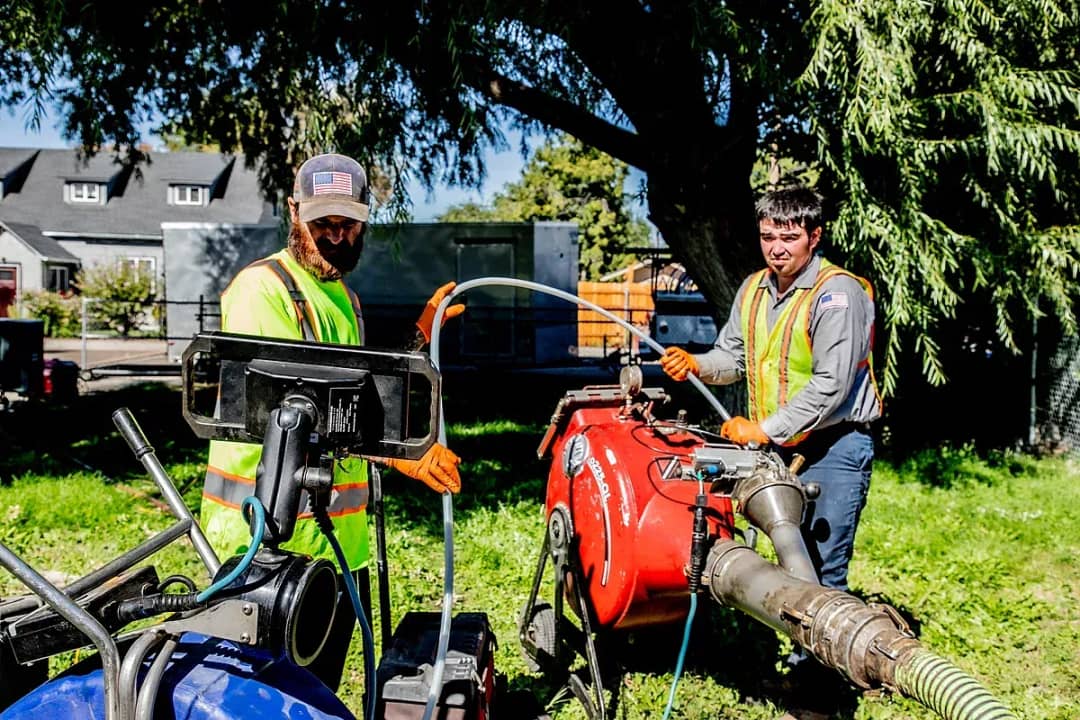
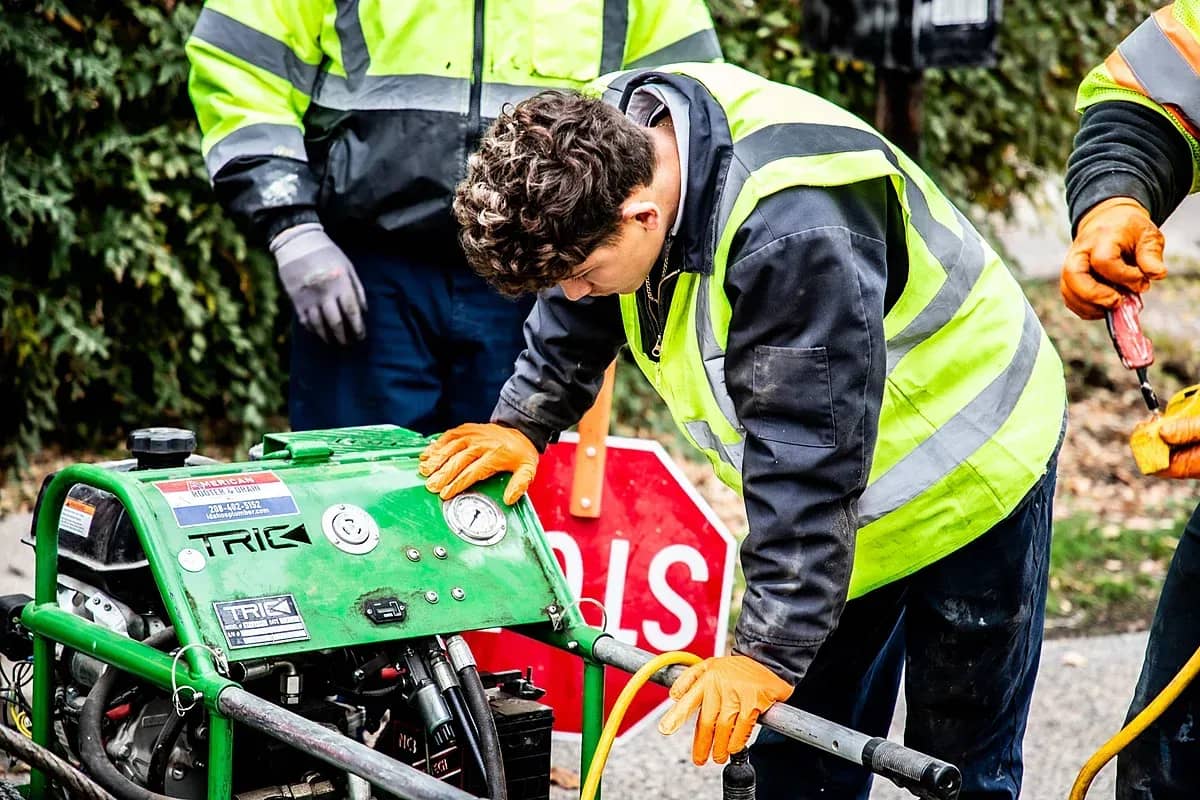
We work out of the shop at 1005 Commercial Way in Caldwell. For everyday clogs that don't need the full jetting treatment, our clogged drain repair page walks through simpler fixes first. American Rooter & Drain has served the greater Treasure Valley since 1945. Call (208) 366-5771 and we will get a camera in the line before anyone quotes you a number.
Why do the river-corridor lots keep backing up at the same spot?
Along the Boise River corridor and out on Eagle Island, the cottonwoods are old enough to have root systems that reach well past the drip line hunting for a steady source of water, and a sewer lateral sitting a couple of feet down, full of warm moisture, is exactly what a root goes looking for. It cannot get through sound pipe wall. What it can get through is a joint — older clay laterals in this part of Eagle were laid in short sections with a mortared or packed seal rather than one continuous gasketed run, and that seam is the only place along the whole line where a root actually has an opening. A single hair-root finds the gap, and once it is in, it thickens every season nobody disturbs it, filling the bore from the inside as a mat rather than sitting there as one obstruction to remove.
A cable does not know the difference between cutting through that mat and cutting through anything else soft enough to spin past. The auger bores a channel straight through the middle, water starts moving again, and the call feels closed. Nothing actually came out of the pipe. Within a matter of weeks the root mat has regrown around the hole the cable left, because the roots were never removed — only pushed aside long enough for the cable to pass through. That is why the same river-corridor address calls back for the same line every few months: the fix never touched what was actually causing the problem in the first place.
What does jetting remove that a cable leaves behind?
A root-cutting head is built to shear growth off the wall, not bore through the middle of it. It works the full circumference of the pipe rather than just the center, catching root mass at the joint and cutting it back to bare pipe instead of mowing a narrow path through the densest part of it. Follow that cut with the jetting nozzle's flushing action and the severed root material actually leaves the line, instead of settling a few feet downstream to take root again from whatever fragments got left behind. That is the entire difference between a line that holds through a season and one that has to be reopened every few months: whether the growth was cut away from the wall, or just punched through the center and left in place.
Is the foothills problem actually a different pipe?
Completely. Sound gasketed PVC in Eagle's newer subdivisions does not corrode into the nodules that narrow old cast iron, and it has no mortared joint for a root to walk through — it runs as one continuous length with no seam for anything outside the pipe to exploit. If a ten-year-old foothills line is backing up, the pipe itself is not the story. The story is what has gone down it since the house was framed: grease off the stove, soap film from every load of laundry and every shower, and whatever the water itself leaves behind on a warm pipe wall over years of ordinary use. None of that is a defect in the house. It is the same accumulation that happens in a new house anywhere in the valley, and it has nothing to do with the pipe material being wrong.
What is actually building up inside a newer kitchen line?
Warm grease goes down a drain as a liquid and does not stay one for long. A few feet past the trap it has cooled to the temperature of the surrounding pipe, and cooled grease does not keep flowing — it plates onto whatever surface it touches and stays there, thickening with every sink full of dishes. Soap does the same thing in slower motion, leaving a thin film that gives the next layer of grease something to grip rather than sliding past it. A cable run through a line coated this way opens a channel down the middle and does nothing about the film lining the rest of the pipe, which is exactly why a foothills homeowner can have a line cabled and be back on the schedule six months later, having done nothing wrong in between. Jetting sprays outward against the full wall as the hose comes back through the line, which is the only way to actually take that film off rather than route a path around it.
Does the same equipment handle a root mat and a grease film the same way?
No, and this is where the nozzle choice matters more than the pressure setting on the machine. A root-cutting or chain-style head belongs on the river-corridor lines, where there is something physically growing into the pipe that needs to be sheared off the wall. Running that head down a clean foothills PVC line accomplishes nothing useful, since there is nothing there for it to cut, and it risks scoring a plastic wall that never needed cutting in the first place. On the foothills side the choice is between a penetrating head, which opens a plug if enough grease has actually formed a soft blockage, and a flushing head, which moves a settled film back toward the cleanout without cutting anything at all. Which head goes on the hose is a decision made after the camera runs, not a default carried over from the last job.
When does an Eagle line need more than jetting?
The camera settles this, and we stop and show you the footage rather than run a pass that cannot fix what is actually wrong. Years of root pressure at a clay joint can eventually shift the joint itself out of alignment rather than just grow through it, and a jetting pass on an offset joint cleans the pipe without correcting the offset — the same low spot or bottleneck is still sitting there under a clean surface. That conversation moves to sewer line repair in Eagle or, for a section that needs replacing without opening a full trench through mature landscaping, pipe bursting in Eagle. A single soft grease clog close to a fixture on the foothills side, with no history of coming back, is the opposite situation: that is a job for a $59 drain cleaning in Eagle cable pass, and we would rather tell you that than sell a jetting visit a simple clog does not need. If that fixture is a kitchen sink specifically, our guide to clearing a clogged kitchen sink walks through what usually causes it before you call anyone out.
What happens once the crew is actually on site, in order?
1. Questions about history first — when it started, whether it has happened before, and whether the property sits along the river corridor or up in the foothills, since that already narrows the likely cause before a tool touches the line.
2. Locating and opening the cleanout. Some of Eagle's older river-corridor lots do not have one readily accessible, and establishing it is its own small piece of work we will flag before starting anything else.
3. A camera pass to confirm pipe material, whether the line is sound enough to jet, and exactly what is built up and where — on its own, that is a sewer camera inspection in Eagle.
4. One flat price in writing, based on what the camera actually found, before the jetter runs.
5. The pass itself, nozzle chosen for what is in the line — a cutting head for root mass, a penetrating or flushing head for a grease film — worked through in stages rather than run once to the far end and reeled back.
6. A second camera pass through the same line, cleaned, so you see the result instead of taking our word for it.
Is a repeat backup on the river-corridor side the same clog or a new one?
Almost always the same one, and it is worth asking directly rather than assuming a fresh problem every time a fixture backs up. An obstruction that was genuinely removed stays removed. If a river-corridor line was cabled six months ago and is slow again at the same fixture now, either the root mass was never actually taken out or the joint is still open and something has already grown back into it — a cable pass cannot tell you which, because it never looked at the wall to begin with. A jetted line that comes back slow is a different signal entirely: it usually means the joint itself has room to keep admitting roots no matter how clean the pipe gets, which is a repair question rather than a cleaning one, and it is why a second opinion after jetting still starts with the camera rather than another pass.
What determines the price of a hydro jetting job in Eagle?
There is no set number for this, because the two Eagle problems genuinely cost different amounts to fix. A root-cutting pass on a river-corridor clay lateral takes longer than a flushing pass on a sound foothills PVC line, and a line with no accessible cleanout adds a step that a line with one already in place does not need. What actually moves the price is the run length from the cleanout to the main, the pipe material and its condition, how many passes the deposit takes to clear, and whether it is a residential branch or a longer building sewer. We look at the line first and hand you one flat number in writing before any jetting starts, and that number holds even if the pass runs long — that is ours to absorb, not an added line on the invoice. The on-site estimate is free, and if the camera shows a single soft clog that a cable will handle just as well, we say so instead of running the jetter anyway.
If an Eagle line keeps backing up at the same fixture, or a newer line has gone slow for no obvious reason, get the camera in first and let the pipe tell you which problem you actually have. See everything we do around Eagle at our Eagle hub, check tree root intrusion if that is the visible symptom on your property, or see every city we serve on the hydro jetting overview. Call (208) 366-5771 for a free on-site camera inspection.