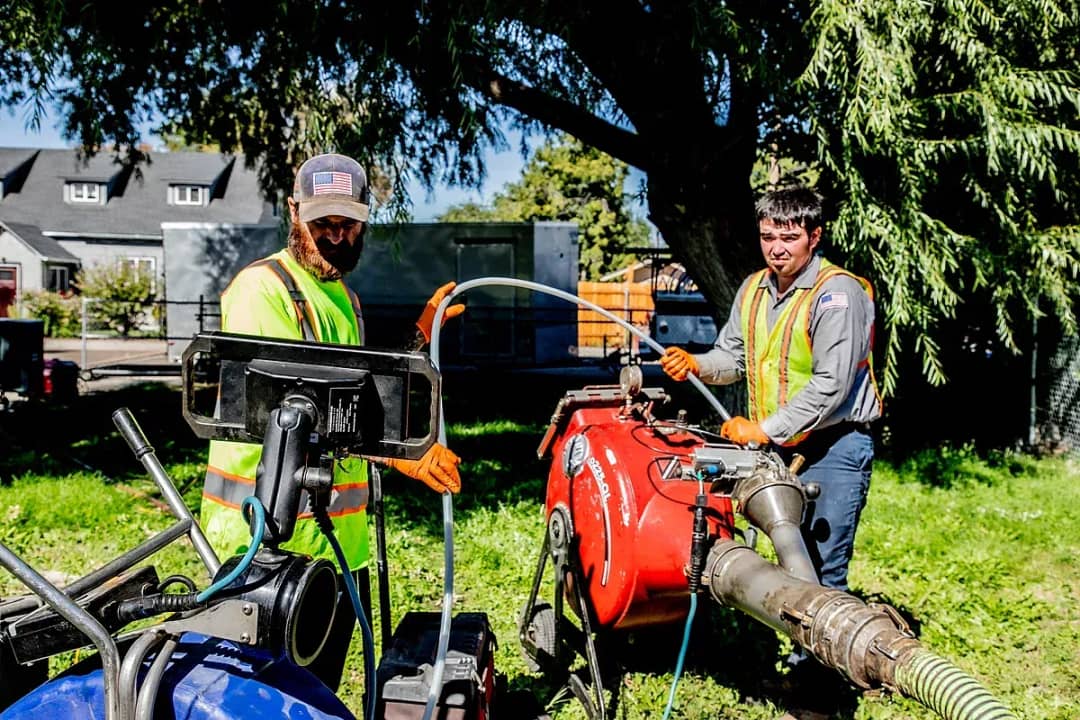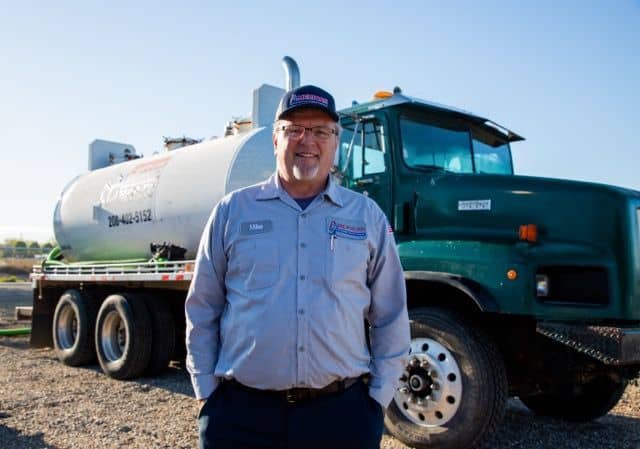
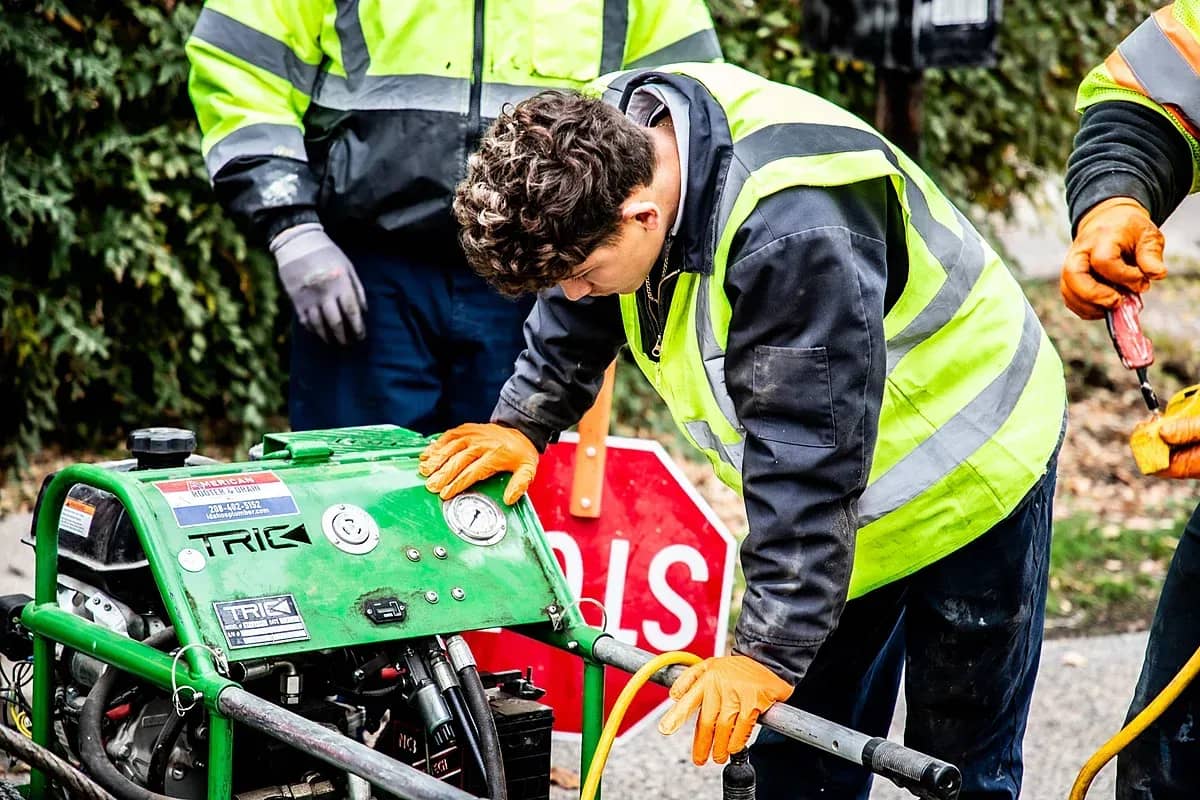
Caldwell is our home base — our shop is on Commercial Way — so these are the lines we know best. Call (208) 366-5771.
Where the roots get in, and why Caldwell's old blocks are the worst of it
Caldwell was platted in 1882 by railroad promoter Robert Strahorn, and the North Caldwell Historic District along 9th Avenue between Albany and Belmont still holds Queen Anne houses put up in the 1880s and 1890s — the same neighborhood where the College of Idaho held its first class in 1891. That's the original townsite, and the trees standing over it have had well over a century to work.
The laterals under those blocks are typically vitrified clay, laid in short lengths with a joint every few feet. Clay is chemically tough — it doesn't rust, it doesn't scale badly — but the joints were never watertight the way a modern gasketed or solvent-welded connection is. A root doesn't need a crack. It needs a seam and a source of moisture, and a leaking clay joint gives it both. Once a hair-thin root is through, it thickens inside the pipe where there's nothing to stop it, and it catches everything that flows past: paper, lint, grease, grit. The clog people call about is usually not the roots themselves but the mat that the roots collected.
Newer construction west and south of town, and out toward the fairgrounds, is a different animal — solvent-welded PVC with no joints for roots to exploit. Those lines back up for other reasons entirely.
The ground here moves, and pipe joints feel it
The heavier clay-loam ground around Caldwell swells when it's wet and shrinks when it dries, and our springs and summers give it a full cycle every year. Over decades that movement works on old bell-and-spigot clay joints, opening seams a fraction at a time. It's part of why the same forty-foot section of a lateral can be the section that slows down again after a cleaning while the rest of the run stays fine — the ground has been pulling on that particular stretch for eighty years.
It also means downtown's underground has been rebuilt in layers. Indian Creek ran open through the middle of town until the city entombed it under concrete in the early 1950s; after a car wash collapsed into the forgotten channel in 2001, the city began daylighting it in 2003, and the work finished with Indian Creek Plaza opening in July 2018. Utilities in that corridor have been cut, rerouted and re-bedded across several eras. When we're working a line near the plaza we don't assume anything about what's down there — we look.
Jetting versus a spot repair: how we decide
This is the decision that actually matters, and it comes down to what the camera shows.
Jetting is the answer when the pipe is structurally sound and the problem is what's inside it — root mass, grit, grease, mineral film. For a plain-English rundown of what causes a clog and when a simpler fix is enough, see our clogged drain repair guide. A cutting nozzle shears the roots out to the pipe wall and a flushing head brings the debris back to the cleanout. You get the full original diameter back, not a channel through the middle of it.
A spot repair is the answer when the camera finds an offset joint, a cracked hub, a crushed section, or a belly holding standing water. Cleaning those doesn't fix them. A belly will keep collecting solids no matter how clean the wall is, and an open joint will keep admitting roots on the same schedule it always has. On a defect confined to one section, digging or lining that section is often the end of the problem instead of the start of a subscription. That's sewer line repair in Caldwell, or trenchless sewer repair in Caldwell where the run allows it.
Often it's both, in order. Jet the line so the camera can actually see the pipe wall, then decide about the repair with real information. You cannot assess a pipe you can't see, and you can't see through a root mat.
What "the roots come back" actually looks like on a timeline
Nobody can give you an exact date, and we won't pretend to. What we can tell you is the pattern we see across Caldwell's older neighborhoods:
- Immediately after a proper jetting, the line is at full bore and the root mass is gone back to the pipe wall.
- Regrowth starts at the same entry point, because the joint is unchanged. How fast depends on the species, how close the trunk is, and how much moisture is available elsewhere on the lot.
- A homeowner on a clay lateral with a healthy tree over it usually settles into a recurring cleaning interval. Finding that interval takes two visits: the first cleaning establishes the baseline, and the condition of the line at the next backup tells us the real cycle.
- The interval doesn't have to be permanent. Repairing or lining the one joint the roots use ends the cycle. Whether that's worth doing depends on how short your interval turns out to be, and that's a conversation we'd rather have with camera footage in hand than in the abstract.
Rural and acreage lines out past town
Canyon County's farm ground runs right up to the edge of Caldwell, and lines on acreages behave differently from lines in town. More grit and fine sediment work in and settle on the bottom of the pipe, where a cable rides straight over the top of it. Longer runs from house to tank or main mean more places to hold a low spot. And a great many of these properties are on private septic rather than city sewer, which changes how we handle a jetting job — pushing a heavy slug of solids into a tank isn't good for the tank, so we plan around it and tell you before we start. If your property is on a system, septic services in Caldwell covers what that involves.
Timing: what a Caldwell jetting call takes
Being headquartered here means a Caldwell address isn't a detour, and same-day scheduling is realistic more often than not. On site, a typical residential job runs about two hours: locating and opening the cleanout, an initial camera pass to identify the material and find the blockage, the jetting itself, and a second camera pass to confirm what the line looks like clean. A long rural run, a heavily root-packed lateral, or a property with no accessible cleanout takes longer, and we'll tell you that after the first camera pass rather than at the end.
If the camera turns up a structural defect partway through, we stop and show you. Continuing to clean a pipe that needs a repair is not work we're willing to bill for.
What hydro jetting costs in Caldwell
There's no range on this page on purpose. Ranges read as promises of the low number, and then the actual job lands wherever it lands and the customer feels misled — that's not how we want to start. The variables that genuinely set the price are the length of the run, the pipe material and its condition, how packed the line is, whether roots require a cutting pass before a flushing pass, whether a usable cleanout exists, and whether the line serves city sewer or a septic system.
So we come out, put a camera down the line, and show you what's actually in there. Then you get one exact flat price in writing before any jetting starts. It's not an hourly meter — if the work runs long, that's ours to absorb — and the only thing that changes the number is additional scope you approve separately. If you already have a written quote from somebody else, bring it; a second opinion costs you nothing.
Ready to schedule?
Downtown near the plaza, out by the fairgrounds, or on an acreage past the edge of town — call (208) 366-5771 and we'll look at the line before we quote it.
Frequently asked questions
If roots always grow back, is jetting even worth it?
Yes, for two reasons. It restores full flow now, which a cable pass doesn't, and it lets the camera actually see the pipe wall so you can find out whether one bad joint is causing the whole problem. Plenty of Caldwell homeowners jet once, discover a single offset joint, repair that section, and never deal with it again.
How is jetting different from having the line snaked for roots?
A cable with a cutting head bores through the root mat and reopens a channel. A jetting nozzle shears the roots back to the pipe wall around the full circumference and flushes the debris out of the line. The difference shows up in how long it holds — a channel closes back up much faster than a cleaned pipe refills.
Will jetting break an old clay lateral in one of the historic blocks?
Sound clay handles jetting fine, and clay is durable material. The risk isn't the clay, it's a joint that has already failed or a section that's already cracked. That's exactly what we're checking for on the camera pass before anything gets pressurized — and if we find it, we recommend a repair instead.
You're based in Caldwell — does that actually mean faster service?
It genuinely does. Our shop is here, so a Caldwell call isn't a drive across the valley, and same-day scheduling is available more often than not. It also means we've worked a lot of these specific streets before.
My line runs to a septic tank. Can you still jet it?
Yes, with planning. The lateral can be jetted; what needs care is where the loosened material ends up, since a heavy load of solids into a tank isn't ideal. We'll talk through the approach before we start rather than after.
What if the camera shows the pipe is bad, not just dirty?
Then we stop and show you the footage. Cleaning a failed pipe doesn't fix it, and we're not going to charge you for a jetting pass that can't solve your problem. The conversation moves to repair options, including trenchless where the run allows it.
See everything we do in Caldwell, ID, and for routine line maintenance rather than a jetting job, drain cleaning in Caldwell. If it's just one stubborn fixture rather than the whole line, our clogged sink page covers that narrower repair.
Looking for hydro jetting in another part of the Treasure Valley? See every city we cover on the main Hydro Jetting page.