

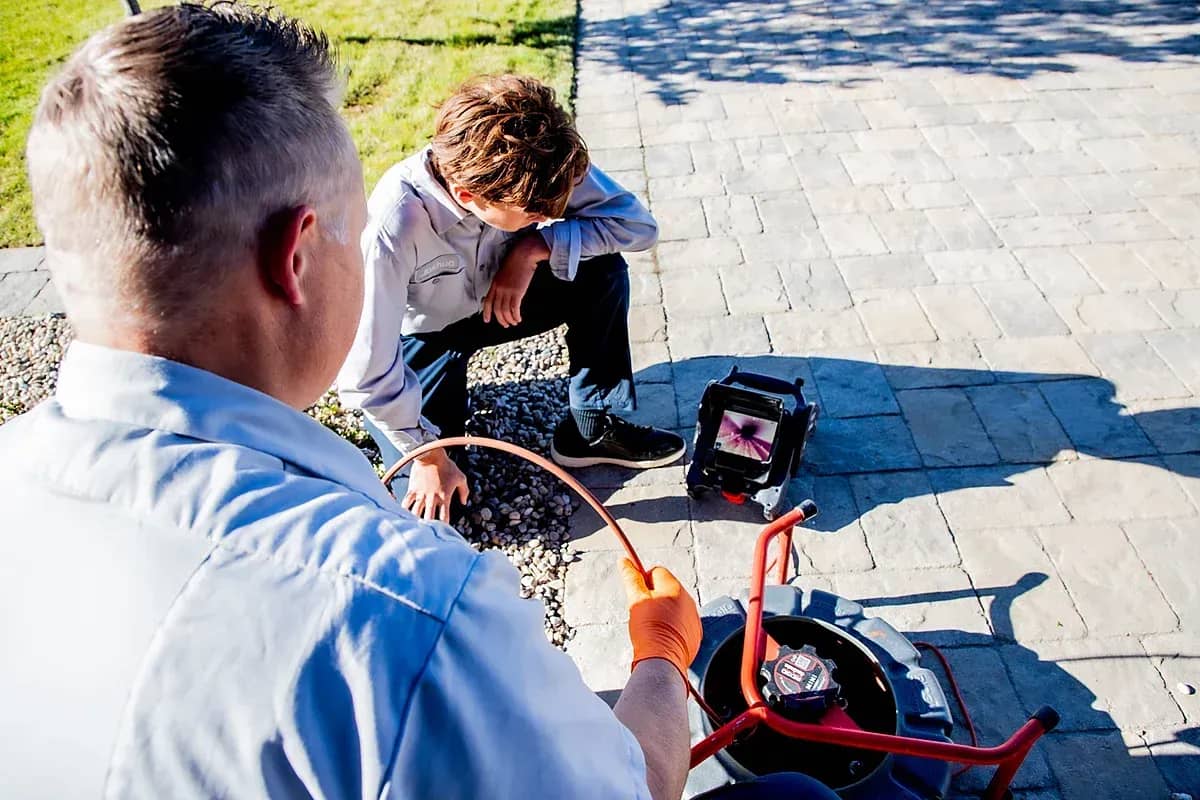
What routine drain cleaning actually covers
A standard cleaning visit clears buildup inside a branch or fixture line — the pipe running from a sink, tub, or washing machine out to the main. Kitchen lines pick up grease and soap scum that cools and hardens against the pipe wall every time hot dishwater runs through it; laundry lines collect lint and detergent film the same way. Left alone, that buildup narrows the pipe gradually until a fast-draining sink turns into a slow one, and a slow one turns into a Sunday-afternoon clog. Cleaning that line on a schedule — instead of waiting for the backup — is cheaper, faster, and a lot less disruptive than an emergency call.
That's separate from a main line clog, which usually means something further down the system, and separate again from a sewer lateral that's cracked, bellied, or offset at a joint. If a line keeps clogging no matter how often it's cleaned, that's not a maintenance problem anymore — see recurring drain backups for what that usually means and what we check next.
Why do Caldwell's older neighborhoods need drain cleaning more than newer ones?
Caldwell's plumbing age runs on a spectrum block by block, and that spectrum is the single biggest factor in how often a line needs attention. Downtown and the Indian Creek core are the oldest ground in the city — original cast-iron drain lines are still common there, a lot of the housing stock is rental property under heavier day-to-day use than it was built for, and cast iron corrodes and roughens from the inside over decades, which gives grease and debris something to grab onto instead of flushing through clean.
The Steunenberg Residential Historic District, between downtown and the College of Idaho, is one of the most intact historic neighborhoods in the state — more than 330 residential properties, most of them early-20th-century construction with original lateral lines and mature street trees planted long before anyone thought about where their roots would end up. Around the College of Idaho itself and up into Canyon Hill, old and new sit on the same block: a house built in the 1920s next to one built in the 1980s, decades apart in pipe material even though they share a street. Newer subdivisions west of downtown, north toward Purple Sage, and south past the interstate are a different story entirely — those run PEX or PVC, and when something clogs there it's almost always a builder-grade fitting or leftover construction debris, not corrosion or age.
Are tree roots actually getting into my drain line?
In Caldwell's older tree-canopy neighborhoods, yes — root intrusion is one of the most consistent reasons we get called out. Roots don't punch through solid pipe; they find a joint, a hairline crack, or a spot where clay pipe has shifted slightly, and they grow toward the moisture and nutrients inside. Once a root gets a foothold in a joint, it thickens year over year and starts catching everything else moving through the line — paper, grease, hair — until the pipe is effectively blocked.
Cabling a root mass out clears the immediate clog, but it doesn't fix the joint the root found in the first place. Unless that entry point gets sealed or the pipe section gets addressed, the same root regrows into the same opening, often within a year or two. If a drain in one of Caldwell's older neighborhoods clogs on roughly the same schedule every time, or a toilet is suddenly slow to clear with no obvious cause, that's usually a sign the problem is further down the line than a branch cleaning can solve — see tree roots in a sewer line for how we find and handle root intrusion, and clogged toilet if that's the symptom that sent you looking. For a line with a real repeat history rather than a one-time slowdown, we'd rather look at it with a camera than guess — see sewer camera inspection in Caldwell.
Does Canyon County's clay soil affect drain lines too?
It does, on both old pipe and new. Canyon County clay swells when it's saturated through a wet spring and shrinks again through a dry Idaho summer, and that cycle repeats every year. On an old clay lateral, that seasonal movement works at joints that are already decades old, nudging them apart just enough for roots or soil to find a way in. On newer PVC or PEX lines, the same soil movement works on the bedding underneath the pipe rather than the pipe material itself — over years, that can create low spots where waste and water sit instead of draining, which is exactly the kind of thing that turns an occasional slow drain into a recurring one even in a newer home.
Does Caldwell's irrigation and canal system have anything to do with my house drains?
No, and it's worth saying plainly because the two get confused. Caldwell sits inside an irrigation and canal network that's watered this part of the valley since 1904, and a lot of older lots have a ditch, lateral, or canal easement running through or near the property. Homes on pressurized irrigation service actually run two separate water systems — treated house water and untreated yard water — connected only through a backflow assembly, never through the household drain lines. An irrigation or canal issue on your property is a separate system from the pipe that carries wastewater out of your house, and one doesn't cause problems in the other. If your drains are backing up, the canal isn't why.
Cabling or hydro-jetting — which one does your line need?
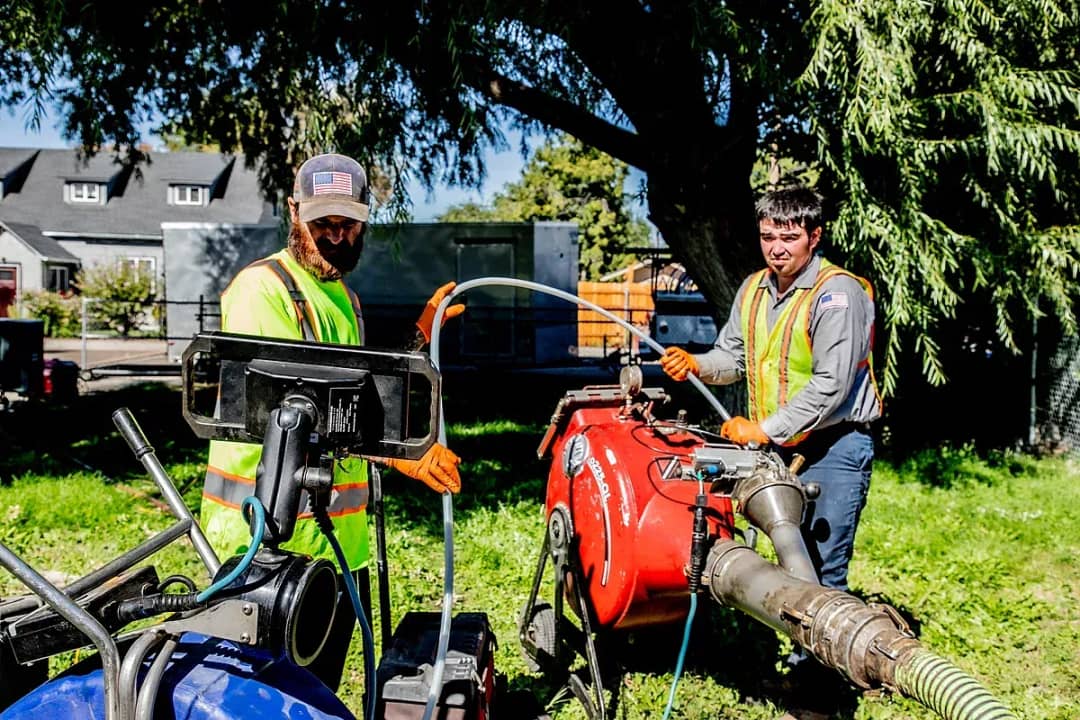
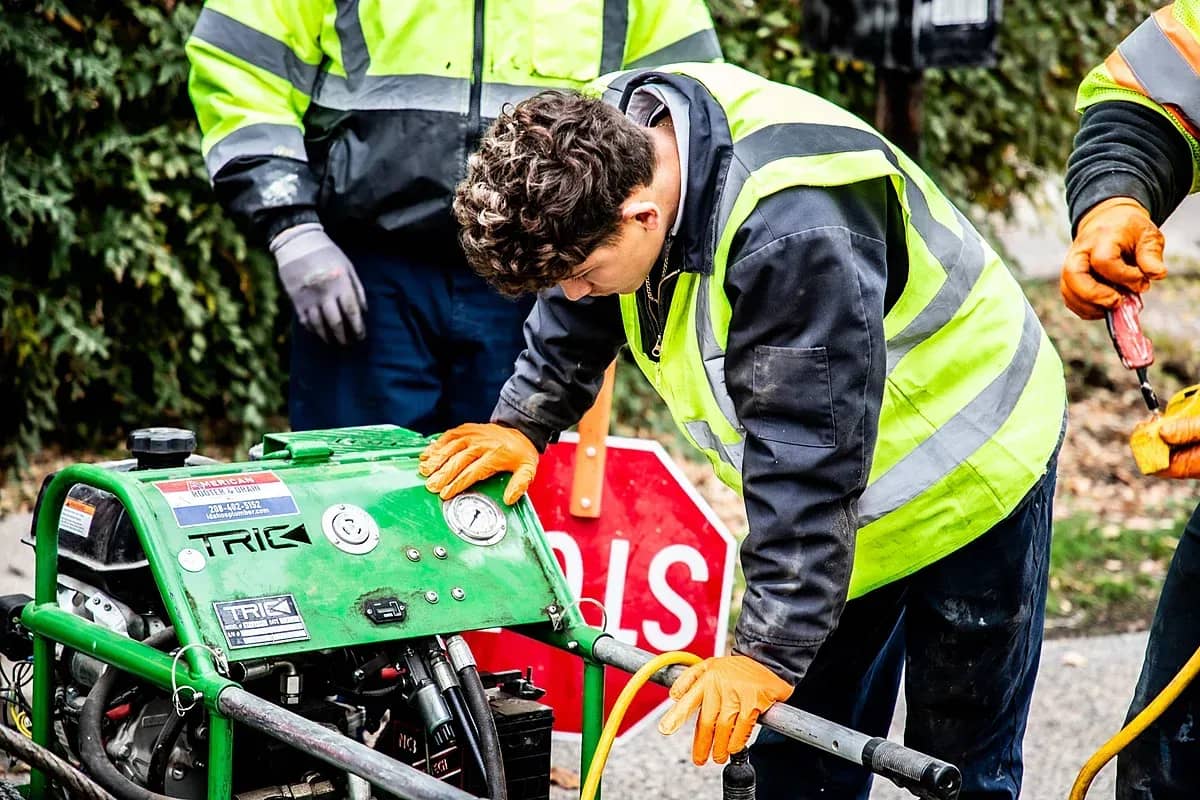
Both clear a blocked line, but they solve different problems. A cable — a rotating steel snake with a cutting head — is the right tool for a defined blockage: a root mass, a solid clog, an object caught in the line. It punches through and reopens the pipe. Hydro-jetting uses high-pressure water to scour the entire inside diameter of the pipe, not just cut a channel through the clog, which is what actually clears years of grease film off a kitchen or laundry line wall rather than just poking a hole through the middle of it. For a line with heavy grease buildup, or one that's clogged repeatedly with cabling alone, jetting is usually the visit that resets the pipe instead of just buying a few more months. We'll tell you which one your line actually needs once we've had a look — not which one happens to be already on the truck.
What a maintenance drain cleaning costs
A single branch or fixture line — one kitchen line, one laundry line, one bathroom drain — cleans for a flat $59 as our standard drain-cleaning special. That price covers one straightforward line and does not cover a main line clog, which involves different equipment, different access, and usually a different root cause. If what you're dealing with turns out to be bigger than a single branch line, or the camera shows something structural, we'll walk you through exactly what we're seeing and give you a written flat-rate quote before any of that work starts — no surprise number at the end.
Scheduling in Caldwell
We're licensed under Plumbing License PLB-C-13057, and every Caldwell call gets a free on-site estimate before anything beyond diagnosis gets billed. Our Caldwell office line is (208) 402-8033, or call (208) 366-5771 directly. We're open Monday through Friday, 7am to 7pm, and Saturday 8am to 5pm, with emergency service available outside those hours if a line backs up on you at the wrong time. For more on how we cover the rest of the city, see our Caldwell service hub.