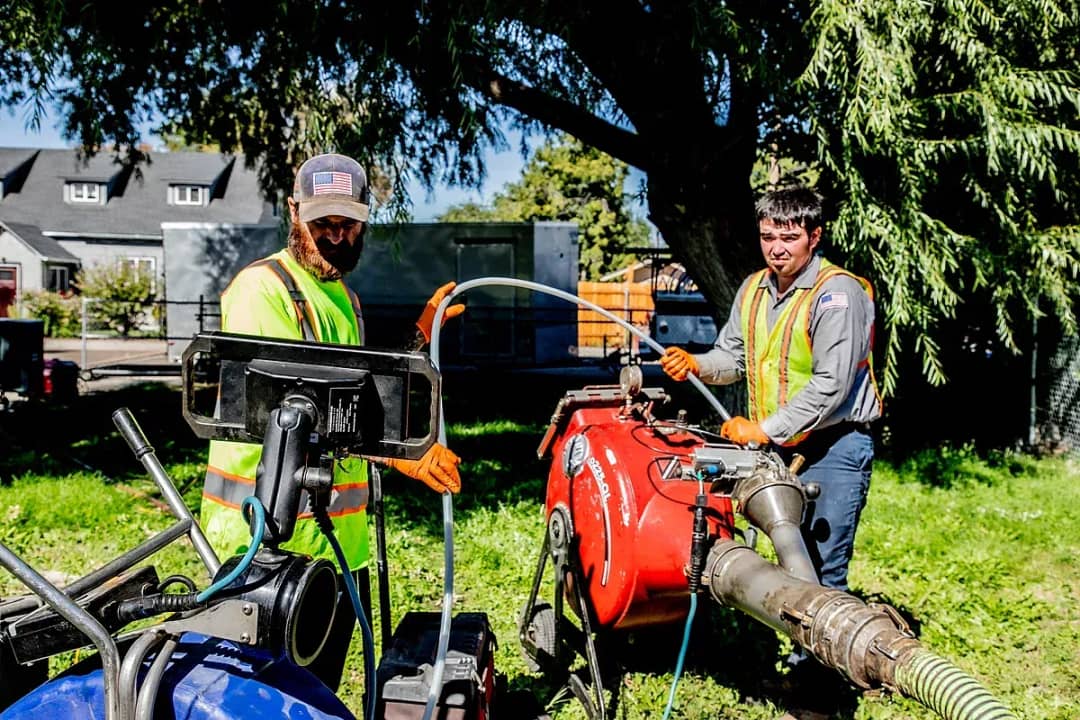
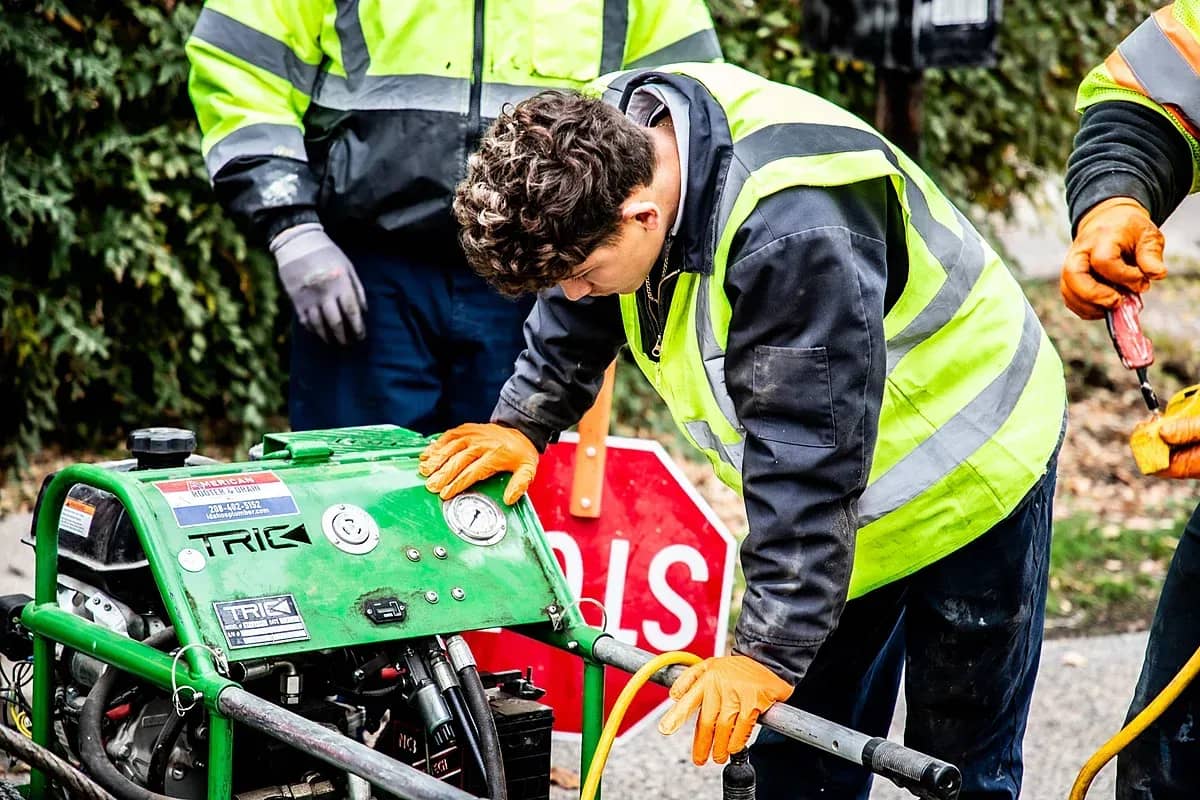
We run out of the shop at 1005 Commercial Way in Caldwell. American Rooter & Drain has served the greater Treasure Valley since 1945. Call (208) 366-5771, and we'll put a camera on the pipe wall itself, not just the water moving through it.
Why does this feel like a clog when nothing is actually blocking the pipe?
Because the effect on the drain is the same — slower flow, more gurgling, eventually a backup — but the cause is completely different from an obstruction. Scale builds as a layer bonded to the interior surface of the pipe, and it builds evenly around the circumference rather than piling up in one spot. The working diameter shrinks a little at a time, from a four-inch pipe down toward three, then toward two, and the water keeps moving the whole time, just more slowly with each passing season. There's no single moment where something \"blocks\" the line the way a root mass or a wad of debris would. By the time it's obviously a problem, the scale has usually been building for years.
Where does the mineral actually come from, and why does it stick to the pipe instead of washing through?
Vale's geothermal groundwater carries a heavier mineral load than most of the region, and that mineral doesn't stay dissolved once conditions change. Warm water moving through a warm pipe is exactly the condition that lets dissolved mineral come out of solution and plate onto a surface — the same basic chemistry that scales a water heater, applied to the inside of a drain line instead. Once a thin layer has bonded to the pipe wall, it isn't smooth anymore, and a rough surface gives the next layer something to grip that a bare wall wouldn't offer. The buildup accelerates the longer it's left alone, which is part of why a Vale line that's gone unaddressed for a long stretch tends to need more aggressive descaling than one caught earlier.
Can a cable or a store-bought cleaner do anything about scale like this?
Not really, and it's worth knowing why before spending money on either. A cable auger cuts through something in the way of the water; scale bonded to the pipe wall isn't in the way of the water, it is the wall, as far as a rotating blade is concerned, and a cable head passes down the center of a scaled pipe without touching most of the buildup. A chemical drain cleaner is even less suited to it — those products are formulated to soften organic material like grease or hair, not to dissolve mineral deposits bonded to plastic, clay, or cast iron. High-pressure water is the only tool of the three that actually scours the bonded layer off the wall rather than working around it, and even then, the nozzle has to match the pipe: a rotary descaling head built to strip scale off cast iron is too aggressive for PVC and has no business running down a plastic lateral just because it's on the truck.
Why can heavy scale hide a joint failure underneath it?
This is the part of a Vale job that changes everything else about how carefully the camera pass has to be done. A joint that has separated or shifted looks, from the inside, like an irregularity in the pipe wall — a step, a gap, a shadow the camera lens catches at a particular angle. Heavy scale can bury that irregularity under a layer of buildup thick enough to smooth it over visually, so a quick look down a heavily scaled Vale line can miss a joint that has already failed underneath the coating. That's a real risk here in a way it isn't on a cleaner line elsewhere in the valley, and it's the specific reason the camera pass carries more weight in Vale than in almost any other town we work: reading past the scale to what the joint is actually doing is a slower, more deliberate inspection than a routine buildup check, and it isn't optional.
The tell is usually in how the scale sits rather than in the scale itself. A layer that's uniformly thick around the full circumference, holding roughly the same profile as it moves past a joint, is consistent with straightforward mineral buildup on a sound pipe. A layer that thickens, dips, or changes texture right at a joint is worth a longer look before anyone runs a jetter through it, because that's often the buildup masking movement underneath rather than just more of the same deposit.
Does the pipe material change how bad the scale gets, or how it's removed?
Somewhat, though not in the direction people usually guess. Scale doesn't care what the pipe is made of — it forms because of what's in the water and how warm the pipe wall is, not because of a defect in clay, cast iron, or PVC. What changes by material is what's underneath the scale and how aggressively it can be removed. Cast iron corrodes on its own over time, and that corrosion roughens the interior surface even before mineral gets involved, so cast iron in Vale often carries the thickest buildup because corrosion and scale are compounding each other. It can also tolerate a more aggressive rotary descaling head built to strip metal clean. Clay tolerates a firm pass well too, but the joints are the weak point, which loops back to why the camera has to read them carefully. PVC scales the slowest of the three because it starts smooth and stays smooth longer, but it's also the least tolerant of an aggressive cast-iron-style head — on PVC, the nozzle is a standard flushing or penetrating head at a pressure matched to plastic, not the same descaling tool used on an older cast iron stack.
How often does a Vale line actually need this?
There's no single interval that fits every property, because it depends on how much mineral the specific water serving that address carries and how warm the line runs. A line that's been descaled once and camera-checked again at the next visit gives us a real answer — if the wall still looks close to bare a year or two later, the interval can stretch; if a visible film has already returned, it can't. Setting a schedule from a guess wastes money in one direction or invites a slow backup in the other, so we'd rather look at your specific pipe on a return visit than quote a default number that has nothing to do with your water.
What happens if you jet a line whose joint has already failed underneath the scale?
Water takes the path that costs it the least resistance, and a jetting pass runs at real pressure. Aimed down a line with a sound joint, that pressure does its job against the scale and pushes debris toward the cleanout. Aimed down a line where the joint underneath the scale has already opened, the water finds that gap before it finishes scouring the pipe wall above it, and pressure that should be moving debris toward the cleanout instead pushes into the soil around the failed joint — enlarging a void that was already there rather than fixing anything. That's the reason we won't run a full jetting pass on a heavily scaled Vale line until the camera has specifically ruled out a hidden joint failure, even when the surface symptom looks like ordinary scale buildup. If the joint has failed, the honest next step is pipe bursting in Vale or [sewer line repair](/sewer-line-repair/vale-or/), not a cleaning pass that can't reach the actual problem and may make the void around it worse.
What happens during the visit, and what does it cost?
1. We start with the pattern, not the symptom — how gradually the drain slowed, whether other fixtures in the house show hard-water symptoms too, and whether the line has ever been cleaned before.
2. A careful camera pass, read specifically for a joint hidden underneath any scale rather than a quick pass-through — this is our sewer camera inspection in Vale done with that in mind.
3. One flat price in writing, based on how much scale is present and whether the joint checks out sound, before any jetting starts.
4. The descaling pass itself, nozzle matched to the pipe material, working the full circumference rather than just opening a channel.
5. A second camera pass to confirm the wall is actually clear and the joint underneath still reads sound.
What moves the price: how thick the scale actually is, how many passes it takes to strip it back, the pipe material — clay and cast iron scale differently than PVC, and cast iron needs its own nozzle entirely — and whether the joint needs a second look partway through. We look at the line first and hand you one flat number in writing before starting, and if the camera turns up a hidden joint failure instead of straightforward scale, we stop and show you rather than run a pass that can't fix it. The on-site estimate is free either way. If the line the camera finds is sound and the scale is only light, a standard jetting visit clears it without turning into a bigger job — we won't recommend more work than the footage actually supports.
Gradual is the tell. A drain that's gotten slowly worse over a long stretch, in a town sitting on mineral-heavy geothermal groundwater, is a scale question before it's anything else — camera first, always. For the rest of what's available in town, our Vale hub has the full list, and the hydro jetting page covers every city on our route. Call (208) 366-5771.