Call (208) 366-5771 and we'll get a technician out to look before anyone quotes you anything.
Boise drain lines come in about four vintages
Most of what determines a jetting job in Boise was decided by whoever built the house, and when.
Cast iron, roughly 1890 through the 1960s. The North End Historic District and the East End were built out heavily between about 1890 and 1940 — Craftsman bungalows, Queen Annes and Tudor Revivals along Harrison Boulevard, Hays Street and Resseguie, with the Hyde Park commercial blocks on North 13th anchoring the middle of it. A great many of those homes still drain through their original cast iron. Cast iron doesn't fail the way people expect; it corrodes from the inside outward, growing rust nodules off the interior wall that narrow the bore and give grease and paper something to catch on. By the time the kitchen line is noticeably slow, the effective diameter can be a fraction of what the pipe started with. That interior scale is exactly what a cable auger cannot remove and what jetting is built to strip.
Vitrified clay laterals under the older streets. The run from the house to the city main in Boise's older blocks is frequently clay, laid in short sections with a joint every few feet. Clay itself is nearly inert — it doesn't rust and it doesn't scale much — but every one of those joints is a door, and mature tree roots find them. In neighborhoods with full street canopy this is the single most common reason a line that was "cleared" six months ago is slow again.
Post-war and mid-century transitional work. The Boise Bench, Collister, Depot Bench and the Veterans Park area sit in the middle, and their plumbing has usually been touched at least once by a previous owner. We also keep an eye out for bituminous fiber conduit — the tar-paper pipe sold nationally from the mid-1940s into the early 1970s. It deforms rather than cracks, and it is one of the few materials we will not put a high-pressure nozzle into.
ABS and PVC, 1970s to today. The Foothills, Barber Valley, Harris Ranch, Quail Ridge, West Cloverdale and the newer West Boise subdivisions are almost entirely modern plastic. These lines handle jetting well. What they get instead is grease from ordinary daily use, wipes that shouldn't have been flushed, and occasionally construction debris that has been sitting in the line since the house was framed.
What the pressure actually does, material by material
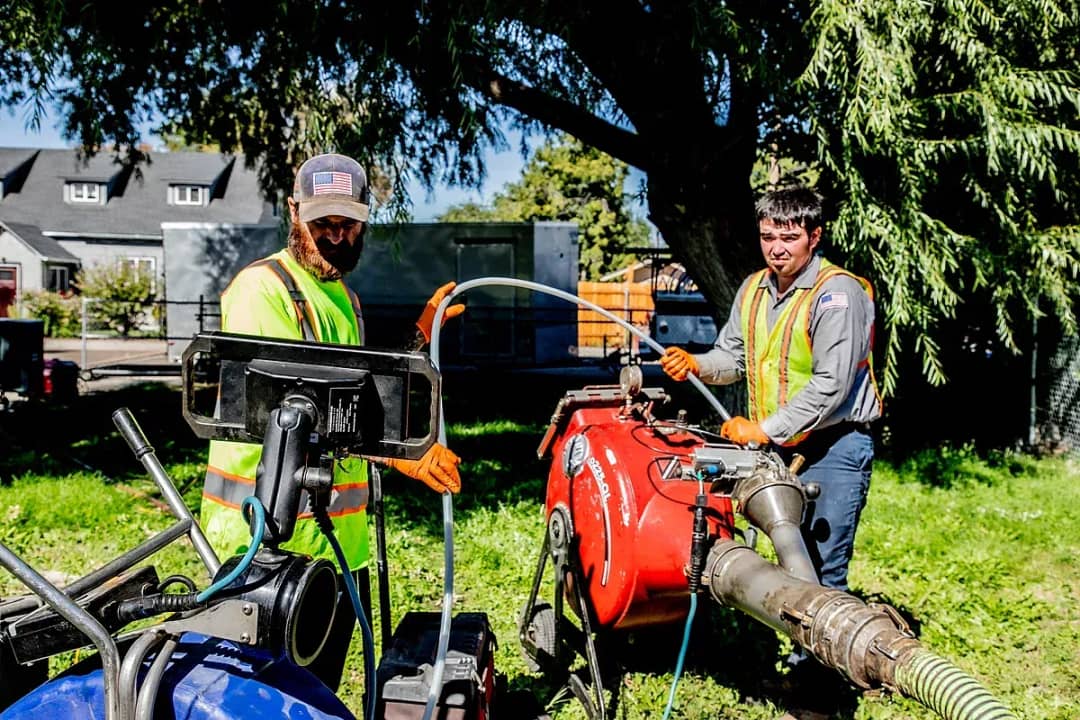
A jetter isn't a bigger snake. A cable bores a channel through an obstruction; a jetting nozzle drives water backward against the pipe wall and scours the full circumference, then drags the debris back toward the cleanout. That distinction is why the pipe material matters so much.
- Sound cast iron takes jetting well, and it is where jetting earns its keep — stripping decades of tuberculation and grease back toward the original bore is something no cable can do.
- Sound clay also handles it, but the camera pass matters more here. We're looking for offset joints and hairline fractures before we start, not after.
- PVC and ABS are the easiest case. Smooth wall, no scale to remove, so the pass is usually about grease and debris rather than descaling.
- Deteriorated pipe of any material — a cracked hub, a section that has lost its bottom, a belly holding standing water — gets a different recommendation entirely. Jetting a failed pipe doesn't fix it and can make the failure worse.
We adjust pressure and swap nozzles for the pipe in front of us rather than running one setting on everything. A descaling head working old cast iron and a penetrating head opening a grease plug are not the same tool.
Why the camera goes down before the jetter comes out
On a Boise call the camera is not an upsell, it's the thing that keeps us from making an expensive mistake. It tells us four things we cannot know from the outside: what the pipe is made of, whether it's structurally sound, where the blockage actually sits, and whether there's a defect — a belly, an offset, a crushed section — that is causing the problem and will keep causing it after any cleaning.
That last one is the reason so many Boise homeowners have paid to clear the same line more than once. If a lateral has dropped into a low spot, it will keep collecting solids no matter how clean the pipe wall is. Jetting a line like that buys a few months. Knowing about it lets you decide what you actually want to do. We run the camera again after the pass, too, so you can see the same footage of the same pipe cleaned rather than take our word for it.
Want the inspection on its own first? That's our sewer camera inspection in Boise.
When we tell Boise homeowners not to jet
Being straight about this is cheaper for everyone. We'll steer you away from jetting when:
- The camera shows a collapsed or severely cracked section — that's a repair, and often a candidate for trenchless sewer repair in Boise rather than an open trench.
- The line is bituminous fiber conduit, which deforms under pressure.
- The problem is a single soft clog close to the fixture with no history behind it. That's a cable job, and pricing it as anything else would be dishonest.
- There's a belly holding water. Cleaning the pipe doesn't change the grade.
If a straightforward clearing is all your line needs, drain cleaning in Boise is the page you want.
How long a Boise jetting job takes
Most residential jetting calls run about two to three hours on site, front to back. That breaks down roughly as: fifteen to thirty minutes to locate and open the cleanout and set up, twenty to forty minutes for the initial camera pass, thirty to ninety minutes of actual jetting depending on line length and how much scale is on the wall, and a final camera pass to confirm the result. Older North End and East End laterals with heavy tuberculation sit at the long end of that; a modern Foothills line with a grease problem sits at the short end.
If the camera turns up a defect, we stop and show you rather than continuing to clean a pipe that needs a repair. That conversation happens on site, before more of your money is spent.
Hard water is doing something specific to your drain lines
Veolia Water Idaho supplies most of Boise from a mix of Boise River surface water and a network of wells drawing the aquifer, and hardness varies noticeably depending on which wells feed your pressure zone. On the supply side that shows up as spotting on glassware and scale on fixtures. On the drain side it does something less obvious: dissolved mineral comes out of solution on the interior wall of a warm drain line, and once there's a rough mineral film, grease and soap have something to bind to. That's the compounding mechanism behind a kitchen line that has been getting a little slower every year for a decade — it isn't one clog, it's a slowly shrinking pipe.
What hydro jetting costs in Boise
We don't publish a range, and there's a reason for that. The honest drivers on a Boise jetting job are line length from the cleanout to the main, the pipe material and its condition, how much scale is actually on the wall, whether the line needs one pass or several, and whether a usable cleanout exists or has to be established first. A century-old lateral running eighty feet under a mature canopy and a fifteen-year-old line in a newer subdivision are genuinely different jobs, and quoting either one sight-unseen would mean either padding the number to cover the unknown or coming back to you mid-job to renegotiate. We won't do either.
What we will do: come out, put the camera down the line, show you what's in there, and hand you one flat price in writing before any jetting starts. That number holds. If we find additional scope, that's a separate quote you approve first.
Ready to schedule?
Whether it's original cast iron under a North End bungalow or a modern line in the Foothills, call (208) 366-5771. We'll look at the pipe before we quote the work.
Frequently asked questions
Will hydro jetting damage old cast iron pipe in a North End home?
Sound cast iron handles jetting well — that's precisely the case jetting was designed for, since scale on the interior wall is what a cable can't touch. Cast iron that has already lost structural integrity is a different story, which is why we camera the line first and adjust pressure to the pipe rather than running one setting on every job.
How do I know whether my Boise line needs jetting or just a cable pass?
The clearest signal is history. A first-time clog with an obvious cause is usually a cable job. A line that has been cleared before and slowed down again, multiple fixtures draining slowly at once, or a drain that has been getting worse gradually over years points to buildup on the pipe wall, and that's what jetting removes.
Do you have to dig up my yard to jet a sewer line?
No. Jetting works through an existing cleanout. If the property doesn't have an accessible one — which happens on some older Boise homes — establishing one is a small, targeted job, and we'd talk that through with you before doing it.
How long before roots come back after jetting a Boise lateral?
It depends on the tree and the joint. Jetting with a cutting head removes the root mass that's in the pipe, but it doesn't remove the tree or seal the joint the roots came through. In the older tree-lined neighborhoods, homeowners on clay laterals often settle into a recurring cleaning interval, while the permanent answer is repairing or lining the section the roots are entering.
Is a camera inspection really necessary, or is it just an add-on?
On a jetting job it's genuinely necessary. Without it we don't know the pipe material, the pipe's condition, or whether a structural defect is the real cause. That's how people end up paying repeatedly to clean a line that needed a repair.
Can hydro jetting clear roots, or do I need a different service?
Jetting with a root-cutting nozzle clears root mass effectively. What it doesn't do is address the opening the roots used. If the camera shows an offset or fractured joint, we'll talk about sewer line repair in Boise so you're not on a cleaning schedule forever.
See everything we do in Boise, ID, and if you're not sure which service you need, start with clogged drain repair in Boise.
Looking for hydro jetting in another part of the Treasure Valley? See every city we cover on the main Hydro Jetting page.