We run these calls out of the shop at 1005 Commercial Way in Caldwell. American Rooter & Drain has served the greater Treasure Valley since 1945. Call (208) 366-5771 and we will get a camera into the line before anyone touches a nozzle.
Why can't you tell which pipe is under an old Weiser house just by looking at the street?
Because the town wasn't built out on one schedule with one standard. Weiser's growth followed the railroad and the agricultural economy around it in waves, and the crews plumbing a new block in one decade used whatever material was standard supply at the time — cast iron in some stretches, vitrified clay in others, sometimes both within the same few blocks depending on which contractor ran the work and when. A house's age narrows the possibilities somewhat but doesn't settle it, and two houses built within a few years of each other on the same street can be running completely different pipe. The only way to know which one is under a specific house is to look at it.
What does corrosion scale actually do to a cast iron line?
Cast iron doesn't get eaten through evenly. Over decades, the interior surface corrodes into rough nodules and ridges that build inward from the pipe wall, narrowing the usable bore the way plaque narrows an artery — not a single obstruction sitting in one place, but a rough lining running the length of the pipe that catches paper, grease, and anything else moving through it. A cable spun through a scaled cast iron line cuts a path through the center of whatever's caught on that lining without touching the scale itself, so the bore stays narrowed everywhere except the thin channel just opened. The pipe looks clear on the invoice and behaves the same as before by the next slow week.
What does root hair do to a clay line, and how is that different?
Clay fails at the joint, not along the pipe wall. Weiser's older clay laterals were joined bell-to-spigot and sealed with mortar that was never built to flex, and decades of ordinary ground movement eventually open that seal by a fraction of an inch. A root looking for moisture finds the gap and follows it in, and once one root has forced an opening, fine root hair proliferates at that single point into a dense mat rather than spreading evenly the way corrosion scale does. The difference matters for the fix: scale is a lining problem running the whole pipe, root hair is a structure problem sitting at one joint. Treating one like the other wastes the visit.
Why does bringing the wrong nozzle head actually make things worse?
A descaling head — sometimes called a chain knocker — carries hardened steel flails or chain segments that spin outward as the head moves, physically knocking corrosion scale off a metal wall that can take the impact. That's exactly the right tool for cast iron and exactly the wrong tool for anything else. Run a chain knocker through a clay joint and the same impact that strips scale off iron can hammer straight through a mortar seal that's already thin, turning a root problem into a structural one in the same pass meant to clear it. Run it through PVC and the flails can score or crack a plastic wall that was never designed to take that kind of impact at all. A standard flushing head, on the other hand, is the right choice for root hair and ordinary buildup but barely touches hardened corrosion scale bonded to a cast iron wall — it moves water past the ridges without removing them. The two heads solve two different problems, and using the wrong one on either pipe either wastes the pass or damages something that didn't need to be touched.
How does the camera decide which head goes on the truck?
The picture is different enough that there's rarely a real question once the line is actually in view. A cast iron wall under corrosion reads as a rough, uneven surface running continuously along the pipe, sometimes with a rust-colored tint to standing water sitting in the low spots between ridges. A clay joint with root intrusion reads as a fibrous mat concentrated at one specific point along the run, with the pipe on either side of it reading clean. The camera also confirms the pipe is sound enough to jet at all before either head goes in — a badly corroded cast iron wall that's thinned enough to be structurally questionable, or a clay joint that's actually shifted rather than simply opened, changes the job before the jetter ever runs.
Can a single Weiser line actually contain both materials at once?
More often than you'd expect, especially on older commercial buildings near the depot and the historic downtown blocks. A building that's had additions, a remodeled bathroom, or a repaired section spliced in at some point over the last several decades can be running cast iron for part of its run and clay — or a section of modern PVC patched in during a repair — for the rest. That matters for the same reason a block-by-block guess doesn't hold up: a technician working a line without a camera first might assume one material for the whole run because the visible stub at the cleanout is cast iron, then hit a completely different pipe forty feet in. The camera reads the transition point directly, and when a line does change material partway through, the pass has to switch heads at that point rather than running one nozzle end to end.
Does a cold winter make either problem worse here?
For the clay side, yes. Weiser sits at a higher, colder stretch of the valley than towns closer to Boise, and the freeze-thaw cycle a shallow lateral goes through every winter works on a mortar joint the same way it works on a sidewalk crack — expanding and contracting the ground around it, a little at a time, year over year. That's additional stress on a joint seal that was already aging, and it's a plausible reason a root problem on an old clay line shows up or worsens after a hard winter. Cast iron corrosion isn't seasonal in the same way — scale builds from water chemistry and time, not from the freeze-thaw cycle acting on the ground — so a scale problem tends to progress steadily rather than tracking the calendar.
Is a repeat backup the same problem coming back, or a new one?
Almost always the same one, and the way it repeats tells you something about which material is behind it. A cast iron line that was cabled and slows down again within a few months is showing the same scale the cable never touched, narrowing back around the channel that was cut through it. A clay line that backs up again at the same fixture is almost always the same root mat, regrown from a joint that never stopped being an opening. A pipe that's had the actual problem taken out of it doesn't slowly refill itself — a shortening interval between backups on either pipe is the clearest sign that whatever cleared it last time only ever bought a few weeks.
When does jetting stop being the right answer for either pipe?
For cast iron, if the camera shows the corrosion has thinned the wall enough to be a structural question rather than a lining problem, jetting can clear the interior without addressing a pipe that's genuinely failing from the outside in — cleaning a wall that's about to develop a hole doesn't prevent the hole. For clay, if the joint has actually shifted out of alignment rather than simply opened enough to admit roots, jetting leaves a clean pipe that still catches solids at the same offset and reopens to the same root growth within a season. Either situation is a pipe bursting in Weiser or sewer line repair in Weiser conversation instead of another jetting pass, and the camera is what tells the two apart from a lining problem that jetting genuinely solves.
How does a Weiser visit run, from the first call to the final camera pass?
1. Questions about the house and the block first — approximate age, any known plumbing history, which fixtures are affected.
2. Camera down the line to identify the pipe material before assuming anything from the house's age. That look is worth having even if nothing gets jetted afterward.
3. One flat price in writing, based on the material and condition the camera actually shows, before the jetter runs.
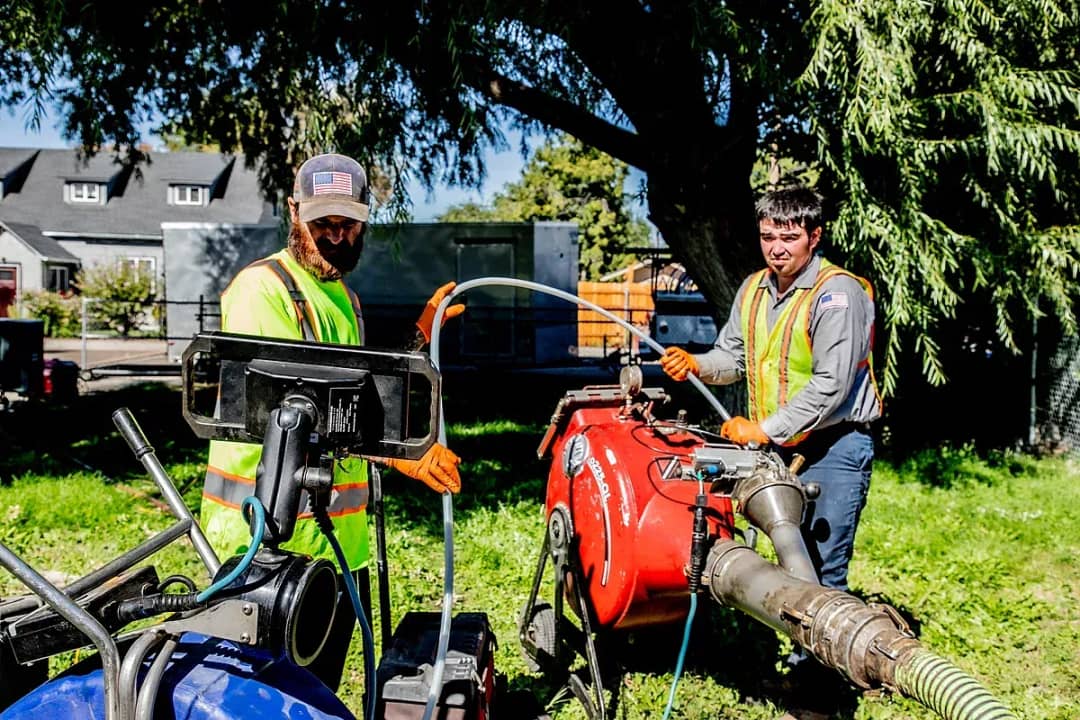
4. The pass itself, with the head chosen for what's on the wall — a flushing head for root hair and ordinary buildup, never a descaling head on anything but confirmed cast iron.
5. A closing camera pass, so you're looking at the same footage we are instead of taking our word for what changed.
What actually determines the price of a Weiser jetting job?
There's no set number for this, because a scaled cast iron main and a root-choked clay joint are different jobs even when the symptom on the surface looks identical. What moves the price is the pipe material and how far the corrosion or root growth extends, the total run length, how many joints or how much wall length needs attention, and whether an accessible cleanout already exists or has to be located first. We look at the line, hand you one flat number in writing, and that price holds even if the pass runs long — that time is ours to absorb, not an added line on the invoice. The on-site estimate is free, and if the camera shows a single soft clog with no scale or root history behind it, a drain cleaning in Weiser cable pass at $59 is the honest, cheaper call instead.
If a Weiser line has backed up more than once and you don't know whether the pipe under the house is iron or clay, that's exactly what the camera is for — guessing at the material before it runs risks bringing the wrong equipment to a job that needed the other one. Our Weiser hub lists the rest of what we do in town, tree root intrusion covers the symptom side of this, and the hydro jetting overview has every city we run. Call (208) 366-5771 for a free on-site camera inspection.