Call (208) 366-5771 and we'll come look at the line.
Nampa's downtown blocks share a plumbing history
On the afternoon of July 3, 1909, a firecracker went off inside a wooden cigar store and took more than sixty businesses with it — the whole block bounded by 12th and 13th Avenues and 1st and Front Streets. Nampa rebuilt in brick over the decade that followed, and that 1909-to-1920 rebuild is essentially the downtown commercial core standing today, with the 1903 Oregon Short Line depot at the edge of it.
That history has a practical consequence for anybody running a kitchen down there. A century-old commercial block was plumbed for a very different tenant mix than the restaurants, bakeries and coffee shops occupying it now. Under-slab drainage in those buildings is often original or nearly so, sized before commercial dish machines and high-volume fryers existed, and it has been passing fats, oils and grease from a rotating cast of food-service tenants for decades. That is why downtown Nampa grease lines behave differently from a residential kitchen line in a subdivision off Franklin Road.
Why jetting is the only tool that actually works on grease
Warm grease goes down a drain as a liquid. Twenty feet along the line, cooled to pipe temperature, it comes out of suspension and plates onto the wall. It keeps doing that, layer over layer, until the bore is a fraction of its original diameter — and the deposit is soft, sticky and continuous, not a discrete plug sitting in one place.
That's the whole reason a cable underperforms here. An auger head spins through the center of a grease-lined pipe and opens a channel, water starts moving again, and the call feels solved. Nothing came off the wall. Within weeks the channel closes back to where it was. A jetting nozzle works the opposite way: it fires water rearward at the pipe wall around the full circumference and washes the deposit off in the direction of flow, then flushes it out. You're restoring diameter, not punching a hole.
For a straightforward one-time blockage close to a fixture, a cable is still the right and cheaper tool — that's drain cleaning in Nampa. Jetting is for a line whose wall is coated.
How often a Nampa line should actually be jetted
This is the question worth asking, and the answer isn't the same for every building.
- Food service with fryers or a high-volume dish machine — grease lines commonly need attention on a recurring interval measured in months rather than years. The right number for your building comes from what the camera shows on the second visit, not from a rule of thumb.
- Food service without fryers — coffee, bakery, deli — typically stretches considerably longer, but "longer" is still an interval, not never.
- Multi-tenant and rental housing — heavier per-fixture use and a lot of turnover. The main line is where problems concentrate, and a periodic camera check is usually cheaper than the alternative.
- Single-family homes on modern PVC — most never need scheduled jetting at all. They need it once, reactively, when something specific has built up.
- Older homes near the downtown core — worth camera-checking before assuming either way, since the original lateral material varies block to block.
The honest version: we'd rather set you on the longest interval your line can actually tolerate than sell you a visit you don't need. The way to find that number is to look at the pipe after the first cleaning and again at the next one.
Nampa water is 100% groundwater, and that changes what's on the pipe wall
Unlike Boise, which blends river water into its supply, the City of Nampa draws its entire drinking water supply from wells — fourteen of them, pulling from the western Snake River Plain aquifer and feeding several hundred miles of distribution pipe. The city's own water quality reporting puts hardness anywhere from negligible up to roughly seven grains per gallon depending on which well is serving your zone.
On the drain side, mineral matters because of what it does in combination with grease. Dissolved calcium coming out of solution leaves a microscopically rough film on the inside of a warm drain line, and rough is the operative word — a slick pipe sheds grease reasonably well, a mineral-filmed pipe gives it a surface to grab. Scale and grease compound each other. Clearing only the grease and leaving the scale means the next layer forms faster than the last one did, which is a specific and common reason a line seems to go bad more quickly each time.
The other Nampa problem: irrigation silt and ag debris
South and west of town toward Lake Lowell and the Deer Flat canal system, and out on the acreages on Nampa's rural edge, the debris we pull out of lines looks nothing like a downtown grease job. Fine sediment, sand and silt work into drain lines and settle in any low spot, and unlike grease it doesn't coat — it accumulates on the invert, the bottom of the pipe. Cable augers ride right over it.
Properties out this way are also more likely to be on septic rather than city sewer, which changes the whole conversation. Jetting a lateral that terminates in a septic tank is fine, but flushing a large volume of solids into a tank has consequences for the tank, so we handle those calls differently and will tell you so up front. If that's your situation, septic services in Nampa is the more relevant page.
What a jetting visit looks like, start to finish
1. We ask about history first. When did it start, has it been cleared before, how many fixtures are affected. That narrows the diagnosis before anyone touches a tool.
2. Camera down the line. We're identifying pipe material, confirming the line is sound enough to jet, and locating exactly where the buildup sits. See sewer camera inspection in Nampa if you want that on its own.
3. A price in writing. One flat number, approved by you, before the jetter runs.
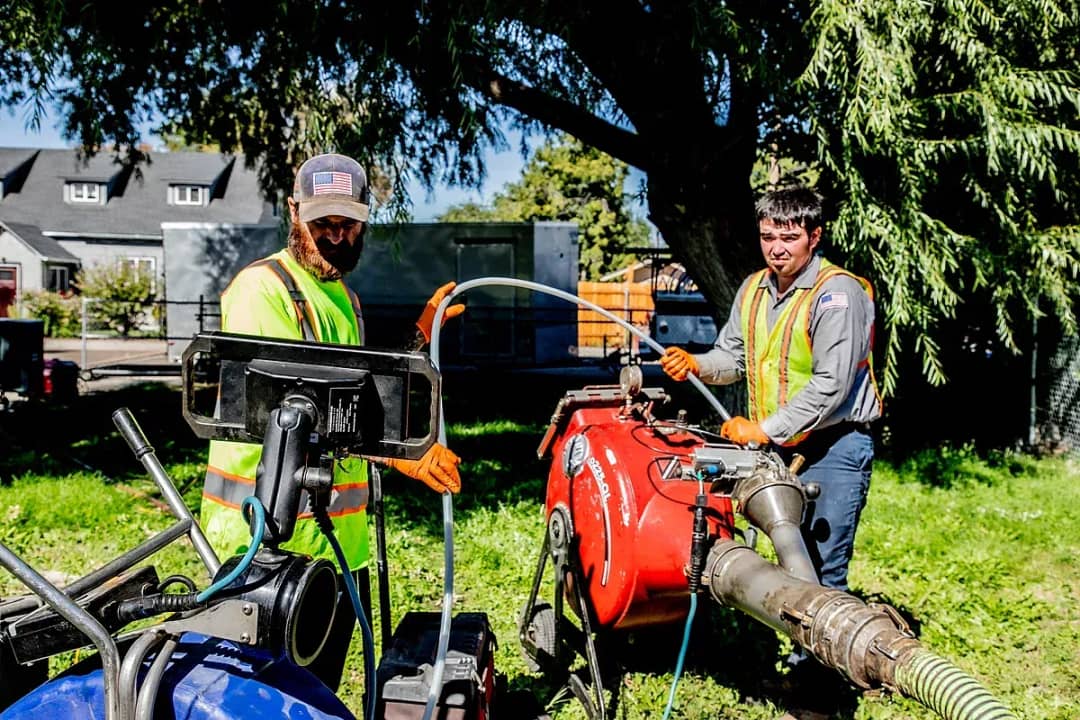
4. The jetting pass. Nozzle chosen for the deposit — a penetrating head to open a grease plug, a flushing head to bring the debris back out.
5. Camera again. Same line, same footage, cleaned. You see it, not just hear about it.
Most residential calls are done in roughly two hours on site. A commercial kitchen line with heavy accumulation, a long run, or a cleanout that has to be located can take a half day. We'll tell you which one you're looking at after the first camera pass, not after the invoice.
What hydro jetting costs in Nampa
We won't quote a range, because a range does customers a disservice — everybody reads the bottom of it and feels misled when their job lands anywhere else. What we'll do instead is tell you exactly what moves the number: the length of the run, the pipe material and condition, how much is actually on the wall, whether one pass will do it, whether an accessible cleanout already exists, and whether it's a residential branch or a commercial main carrying a kitchen's full load.
Those variables are why the camera goes first. Once we've seen the line, you get one exact flat price in writing before any work begins, and that price holds — it isn't an hourly meter, and if the job runs long that's on us. The look is what makes an honest number possible, and we'd rather give you a real one than a guess with a wide enough spread to always be technically true.
Ready to schedule?
If a Nampa line has backed up more than once, the pipe wall is the reason. Call (208) 366-5771 and we'll get eyes on it.
Frequently asked questions
How often should a Nampa restaurant have its grease line jetted?
It depends on volume and equipment far more than on square footage. Kitchens running fryers and a high-volume dish machine typically need a recurring interval measured in months; lower-grease operations go considerably longer. We set the interval from what the camera shows on your specific line rather than applying a default schedule.
Why did my drain back up again a few weeks after it was snaked?
Because a cable opens a channel through a grease deposit without removing it from the pipe wall. Flow returns, the underlying coating is still there, and the channel closes again. That pattern — cleared, fine for a few weeks, backed up again — is the clearest indicator a line needs jetting rather than another cable pass.
Is hydro jetting safe if my Nampa property is on a septic system?
The jetting itself is fine, but where the debris ends up matters. Pushing a large volume of solids into a septic tank isn't ideal for the tank, so we plan those jobs differently and talk it through before starting. Properties toward Lake Lowell and out on the acreages are the ones this comes up on most.
Can jetting clear sand and silt out of a line?
Yes, and it's the right tool for it. Silt settles on the bottom of the pipe rather than coating the walls, so an auger head tends to pass over it entirely. A flushing nozzle moves the sediment back toward the cleanout and out of the line.
Do I need to be there for the camera inspection?
You don't have to be, but most people want to be — it's your line on the screen, and seeing the buildup before and the bare pipe after is the whole point of doing it that way. We'll walk you through what you're looking at in plain language.
Will jetting fix a line that's cracked or collapsed?
No, and we'll say so. Cleaning a structurally failed pipe doesn't restore it. If the camera shows a break, an offset joint or a section holding water, the conversation shifts to sewer line repair in Nampa or a trenchless option instead.
See everything we do in Nampa, ID, and for an active backup right now, clogged drain repair in Nampa.
Looking for hydro jetting in another part of the Treasure Valley? See every city we cover on the main Hydro Jetting page.