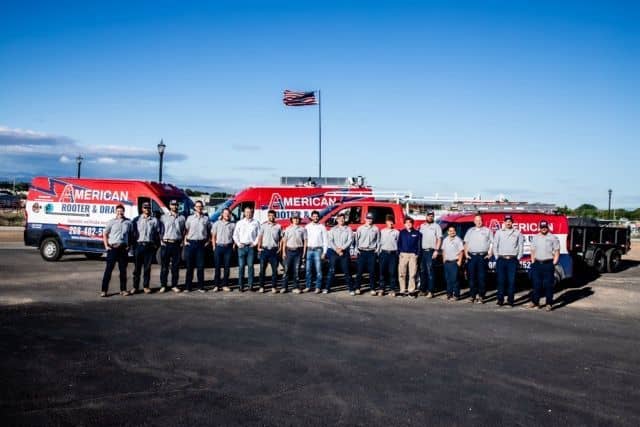

American Electrical Services installs home EV chargers at Nampa addresses across all three of the city's ZIP codes — 83651, 83686 and 83687 — from the older grid downtown out to the newer subdivisions south of the interstate. We are the electrical side of American Rooter & Drain, established in Caldwell, Idaho in 1945 and serving the greater Treasure Valley since 1945, and the electrical division holds Idaho Electrical Contractor License LIC# 3671445 in its own right. Call (208) 782-8268 for a free on-site estimate.
What happens when an electrician comes out to look at my Nampa house?
There is a fixed order to the visit, and it is worth knowing, because the order is what keeps the price honest. Nothing gets quoted until all of it is done.
First, where the car actually sits. Not where you think the charger should go — where the car parks, which side the charge port is on, whether you back in, and whether a second EV is coming. Cable length and mounting position get chosen around that, and moving a charger to the other side of a garage later is a second job with a second price.
Second, the panel gets opened. We read the main breaker rating, count the usable spaces, read the panel's own label to see which breakers it is listed to accept, and look at how the circuits are arranged. If it has been a while since anyone looked at your panel, that same visit is a good time to schedule a full electrical safety inspection. A panel that looks full at a glance is not always full in practice, and a panel that looks fine can turn out to be a brand nobody should add a car circuit to.
Third, the arithmetic. This is the part you cannot do from a photo and the part a phone quote skips entirely. We total what the house is already wired to run and measure it against the size of your service. What is left over is the space a car charger has to fit inside.
Fourth, the path. We walk the route the wire has to take, because distance matters far less than what is in the way. An open attic or an accessible crawlspace makes a long run routine; a finished garage ceiling or a slab you would have to go under turns a short run into real work.
Fifth, the service entrance. Where power comes into the house, and the condition of the meter base. If the size of the service itself has to change rather than just the panel, Idaho Power owns the meter and the wires feeding your house, and their scheduling becomes part of your timeline. That is the most common reason an EV project runs longer than the homeowner expected, and we would rather say so at the estimate than after you have committed.
Then you get a number in writing — a flat rate for the whole job, before anything is opened up, not an hourly rate that can climb while somebody is in your attic.
We quote the timeline in the same breath, because it depends on which version of the job you have. A charger on a garage wall near a panel with room to spare is one appointment. A long run across the house, a trenched driveway or a detached shop is usually still one appointment, just a longer one, with the underground utility locate scheduled ahead of it. A charger that needs panel or service work first is two phases, two permits, two separate power shutoffs.
Will my panel take a car charger, or do I need a bigger service?
This is the question sitting behind every quote, and it has two halves people tend to collapse into one.
Is there a slot for the breaker? A car charger breaker is double-width, so it needs two adjacent positions. Sometimes the answer is a clean yes. Sometimes a couple of existing circuits can legitimately be consolidated onto a listed tandem breaker to free a slot — but only where the panel's own label permits tandems in that position, and many do not. Sometimes there is nowhere to put it, and a small sub-panel becomes the cheaper answer rather than the bigger one.
Is there capacity left in the service? Older houses near downtown Nampa — the ones on the tight railroad-era grid the city grew up around, with the deep front porches — were wired long before anyone imagined a circuit dedicated to a car. Plenty are still on 100-amp service, some on less. Houses in the newer south Nampa subdivisions generally arrived with 200-amp service, but the builder often filled that panel, and now a car charger is competing with a heat pump, a hot tub and a shop circuit the original plan never accounted for.
There are also panels nobody should hang a car circuit on, and you should know the names, because they are still in service in this city: Federal Pacific Stab-Lok, Zinsco and Challenger. The objection is not brand snobbery. Breakers in these panels have a documented history of failing to trip, and vehicle charging is exactly the wrong load to put behind a breaker you cannot trust, because it draws hard for hours while the house is asleep. If yours is one of these, the conversation moves to panel upgrades in Nampa before it moves to chargers.
Two related things surface on the same look. Homes wired when aluminum branch circuits were common need those connections handled with correctly rated devices rather than reused, and any time a panel is worked on, grounding and bonding at the service has to be brought current. Neither is an upsell.
Three honest outcomes, and we say plainly which one you got:
- Nothing else has to change. The charger circuit goes in on the panel you already have.
- A managed circuit makes it work. A charger that can be turned down, or a load-management device that pauses charging when the rest of the house is pulling hard, can put a large circuit on a service that could not otherwise carry it. That is a recognized engineered solution, not a dodge, it costs a fraction of changing the service, and it is invisible in daily life — the car charges overnight while the range, the dryer and the air conditioning sit idle.
- The service is the limit. It genuinely cannot carry the load, or the panel is one of the brands above. Then we price the panel work as its own line, so you can see what the charger costs and what the panel costs, separately.
Can my Idaho Power bill save me from a service upgrade?
Frequently, yes, and most homeowners have never been told this. There are two legitimate ways to work out whether an existing house has capacity left.
The first adds up every appliance's nameplate rating as though the house might run all of them flat out at once. It is the conservative method, it is what most quotes get built on, and in an older Nampa house with an electric range, an electric dryer and an electric water heater it very often produces the answer "you need a service upgrade."
The second is permitted for existing homes and uses what the house has actually drawn. Your utility keeps a record of your maximum demand over the past year, and because nobody in the real world runs the range, the dryer, the water heater and the air conditioning at full output in the same minute, measured demand usually sits well below the nameplate total. A house that fails on paper often passes comfortably on the record.
So before you accept a service upgrade quote from anybody, ask whether the calculation was run against your actual usage history. We do that as part of the estimate, and it is the most common way we talk a Nampa homeowner out of work they did not need. Sometimes the answer still comes back that the service is the limit — but then you are upgrading because the numbers said so.
Who pulls the permit, and does the city have to inspect it?
Homeowners tend to assume this runs through the city building counter the way a deck or a fence might. Electrical work in Idaho is handled through the state electrical program rather than the city, and we confirm the authority having jurisdiction for your address when we pull the permit. Either way it is our job, not yours: we pull it, we schedule the inspection, and the job is not finished until it passes.
What the inspector looks at explains a lot of what we do that could otherwise seem fussy:
- Wire size against breaker size. The conductor has to be rated for the breaker protecting it, over the whole run, with distance accounted for.
- A breaker listed for that panel. You cannot put any brand of breaker into any brand of panel. The panel's label states what is permitted, and mixing is both a failed inspection and a genuine hazard.
- Conduit and fittings. Properly supported, and anything outdoors or underground rated for wet conditions — not indoor parts used outside because they were on the truck.
- Bonding and grounding. The most commonly failed item on an older service, and the one homeowners never see.
- Working clearance at the panel. There has to be clear space in front of it — roughly 30 inches wide, 36 inches deep and six and a half feet high. In Nampa garages this is the sleeper: the panel is behind the chest freezer, a shelf of paint cans, or the second refrigerator. Easier to move before the visit than after.
- A labeled circuit, so the next person who opens that panel door knows what the new breaker feeds.
Permitted work matters afterward too: it documents the circuit for a future buyer and keeps the installation on the right side of your homeowners insurance if there is ever a claim involving the garage.
Why does the breaker trip when the car is plugged in?
Almost always one of five things, and they are worth separating, because the fixes are not the same.
You are on a general-purpose outlet. A garage outlet that also feeds a freezer, a shop vacuum and a second refrigerator was never designed for one appliance drawing hard for hours every night. Add the freezer compressor kicking in at two in the morning and the breaker does what it is designed to do.
There is an extension cord in the picture. There should not be. A charging cable is not a light-duty load, and an extension cord under it is a heat problem waiting to happen.
The circuit was sized to the charger instead of above it. Vehicle charging counts as a continuous load, so the circuit and breaker have to be rated higher than what the charger actually pulls — a 32-amp charger belongs on a 40-amp circuit, a 40-amp charger on a 50-amp circuit, a 48-amp charger on a 60-amp circuit. It is the classic error on an install done by somebody who read the number on the box and assumed it was also the breaker number.
Ground-fault protection is doing its job — or being oversensitive. Certain vehicle, charger and breaker combinations produce nuisance trips. That is diagnosable, and the answer is never to remove the protection.
A termination is loose and heating up. Take this one seriously. A warm plug end, a discolored outlet face, a faint burning smell, or a breaker that trips only overnight while the car charges are all reasons to stop using the circuit and call for electrical repair in Nampa before anything else.
My car does not park in the garage — can you still do it?
Yes. What changes is the build, not whether it is possible.
Carport or exterior wall. Everything gets weather-rated: an outdoor enclosure, the correct conduit and fittings, and a properly sealed penetration where the wire passes through the wall. The charger may be rated for outdoor mounting, but the installation around it still has to survive Idaho winters and Idaho sun, and mounting height matters more outdoors because nothing else is protecting the cable.
Driveway pedestal or a detached shop. This is the version that gets trenched, and there is a Nampa-specific warning attached. Calling 811 gets the public utilities marked — power, gas, communications — and we always do it. What 811 does not mark is private underground line, and yards in this valley are full of it. Much of Nampa is watered from district irrigation, and those pressurized laterals run through back yards at shallow depth with no record and no locate service behind them. Add sprinkler laterals and the gas line somebody once ran out to a fire pit, and you have three things that will never show up in paint on the grass. We probe and hand-dig where the risk is real rather than trusting a machine over unmarked ground.
For a detached shop, the better answer is often not one long circuit but a small sub-panel at the building. It costs more up front and leaves you with a shop that can run a compressor and a welder instead of only a car.
How fast will my car actually charge once the charger is in?
Here is the thing that surprises people most, and it is worth knowing before you buy a bigger unit than you need. The box on the wall is essentially a smart, safe switch. The equipment that converts household power into something the battery can accept lives inside the car, and every vehicle has a ceiling built into it. If your car will only take a certain rate, feeding it a larger circuit changes nothing — the car simply will not draw more. We have talked homeowners out of the bigger charger and the bigger breaker on exactly this basis.
What does change everything is moving off an ordinary household outlet onto a proper 240-volt circuit. That is a difference in kind rather than degree: the car is full every morning regardless of what yesterday looked like. Tell us the year and model of the vehicle at the estimate and we will size the circuit to what the car can genuinely use, with headroom for the car after this one.
What is an EV charger install going to cost at my house?
We do not quote electrical work sight unseen and we do not publish a price range, because a range would mislead you more than it would help. The variables are specific, and nearly all of them are behind a wall:
- Whether the panel has capacity, has a free position, has both, or has neither
- The route from panel to charger and what is in the way — open attic, tight crawlspace, finished ceiling, stucco, concrete
- Whether the run is indoors, outdoors or underground, and how far
- Whether the charger is wired in permanently or plugs into a 240-volt outlet, and the breaker type that follows
- Whether a sub-panel, a load-management device, or a service change is part of the work
- Whether you are supplying the charger or we are
The estimate is free and it happens at your house. You get a flat rate in writing before any work begins, and the only thing that changes an approved number is additional scope you approve first. Here is why we will not quote a price over the phone.
What else is worth checking while an electrician is at the house?
The panel is already open, so it is a cheap moment to settle a question you have been ignoring — a garage with one bare bulb and no usable outlets, or exterior outlets that quit after a storm. Work we fold into the same visit where it makes sense: panel upgrades in Nampa, electrical repair in Nampa, lighting installation in Nampa and generator installation in Nampa. Everything we do in this city is on the Nampa services page, and the wider detail is on the main home EV charger installation page.
Who is coming to my house, and how do I get them out here?
A licensed electrician, working under Idaho Electrical Contractor License LIC# 3671445. For the fuller picture of what our licensed electricians handle beyond EV chargers, that page covers the rest of what we do inside a Nampa panel. We are based at 1005 Commercial Way, Caldwell, ID 83605, a short drive from most Nampa addresses — which is why we are in this city constantly rather than occasionally.
Nampa is not a market we visit. American Rooter & Drain has 4,255 jobs booked at Nampa addresses in our system, and the electrical side alone accounts for 41 of them, spread across all three Nampa ZIP codes — 17 in 83686, 13 in 83651 and 11 in 83687. Twenty-six of those electrical jobs were estimate visits, which is the part worth reading twice: we look at a lot of Nampa panels, and looking is free.
Call (208) 782-8268 or request service online and we will book that on-site estimate. Three things make the visit faster and more accurate: a photo of your panel with the door open so the main breaker rating and the label are readable, the year and model of the vehicle, and a clear space in front of the panel before we arrive — if the chest freezer is parked there, it has to move anyway.