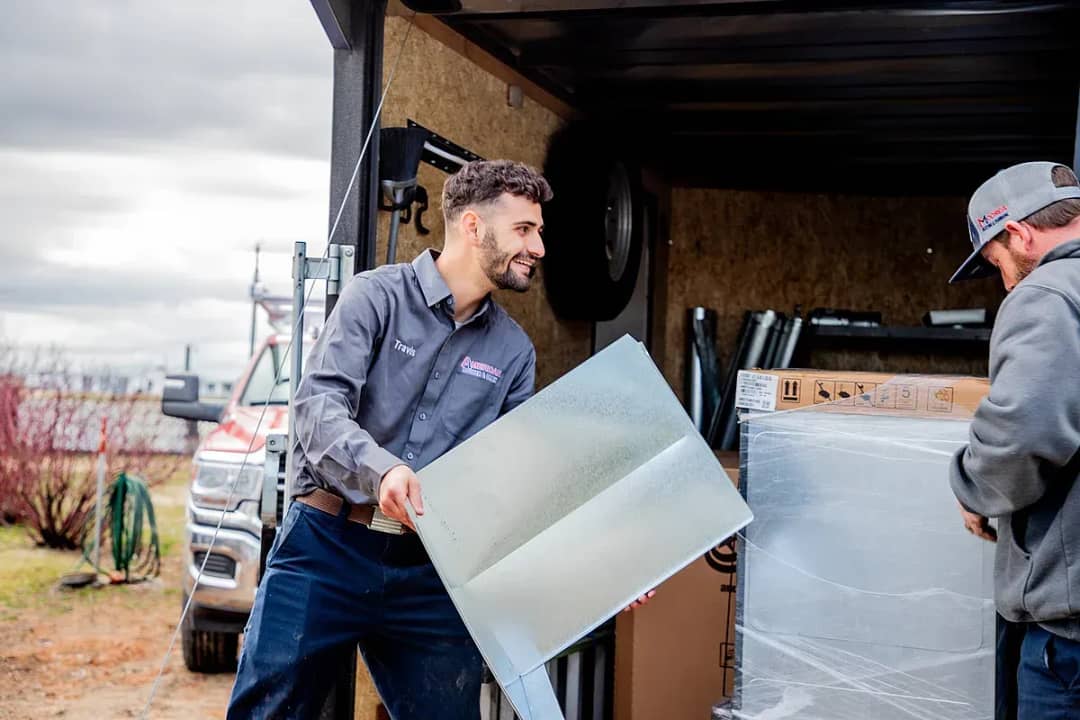



American Electrical Services puts home car chargers in Meridian garages, on exterior walls, out on driveway pedestals and in detached shops. We are the electrical side of American Rooter & Drain, running out of the Caldwell shop under Idaho Electrical Contractor License LIC# 3671445. Across all of our trades, American Rooter & Drain has run 1,825 jobs at 884 different Meridian addresses, and 36 of those jobs were electrical calls — 20 in the 83646 ZIP on the north end, 16 in 83642 covering the older core and the south side. Those two halves of town produce genuinely different conversations about car chargers, and a good part of this page is about telling them apart.
The electrical line is (208) 782-8268, and the estimate is free and done at the house.
I just bought an EV — how fast can I be charging at home?
The install itself is short when nothing is in the way. A dedicated 240-volt circuit gets run from the panel to wherever the charger is going, a double-width breaker lands in the panel, the unit gets mounted and commissioned, and before anyone leaves we plug the car in and watch it draw at the amperage it is supposed to draw. In a Meridian house where the panel is on the garage wall and the charger is going eight feet away on that same wall, that is one visit and you are charging that evening.
What stretches it out is never the charger. It is one of four things:
- The panel has no free position. A charger breaker needs two adjacent slots. Builder panels in the newer subdivisions off Ten Mile, Black Cat and Linder are often full already — the heat pump, the air handler, the range, the dryer and a shop circuit all got there first.
- The service itself is maxed out. A different problem with a different fix, and the next section is about telling those two apart.
- The wire has a long or awkward way to travel. Crossing to the far side of the house, going over a finished ceiling, or getting out to a shop across the back lot.
- Something has to be dug. Anything underground waits on 811 marking the buried utility lines first, and that lead time belongs to the marking service, not to us.
Where a panel or service change has to happen first, the project splits into phases: the work that makes room comes first, with its own permit and its own power shutoff, and the charger circuit goes in afterward. If the size of your service is changing rather than just the panel box, Idaho Power has to be in the loop, because the meter and the wires coming to your house are theirs and not ours. Utility scheduling is outside our control, and it is the most common reason a homeowner's mental timeline and the real one drift apart. You hear which phase you are in at the estimate.
Will my Meridian panel take a car charger?
This is the question the whole quote hangs on, and it is why nobody honest will price your install over the phone. It is really two questions people run together.
Is there physical room in the box? Stand in front of the panel with the cover off and you can see it. A charger breaker is double width, so it needs two spaces stacked next to each other. A panel that looks stuffed sometimes still has a usable pair, and a panel with visible blanks sometimes does not, depending on how the breakers are arranged.
Is there electrical capacity left in the service? That is arithmetic, and it cannot be eyeballed. An electrician adds up the load the house is already wired to carry — the square footage allowance, the general lighting and receptacle load, the fixed appliances, the range, the dryer, the water heater if it is electric, and whichever is larger of the heating or the cooling equipment — following the method in the National Electrical Code. That total gets measured against the size of your service, and whatever is left over is the space a charger has to fit inside.
Look at the number stamped on your main breaker. It will read 100, 125, 150 or 200, and that figure is the ceiling on the entire house. The two Meridian ZIPs hand us different starting points. In 83646, where the subdivisions north of Ustick went up over the last couple of decades, capacity is usually the easier half and physical space is the fight — the builder wired to code for the house as designed, then the homeowner added a hot tub, a shop sub-panel and a second refrigerator. In 83642, around the original townsite east of Meridian Road and out along the older county roads, we run into smaller services and occasionally a panel brand nobody will add a breaker to any more, which turns a charger conversation into a panel upgrade conversation.
One code rule catches almost everyone who priced this out online before calling. A car charging overnight is a continuous load — it pulls hard for hours without stopping — so the circuit has to be sized larger than the charger's own rating rather than equal to it. A 32-amp charger sits on a 40-amp breaker. A 40-amp charger sits on a 50-amp breaker. A 48-amp charger, about as quick as home charging gets, needs a 60-amp breaker. Whatever number is printed on the charger is not the number that goes in your panel.
That rule can work in your favour, too. Modern chargers generally let their maximum output be set at commissioning, and dialling a 48-amp unit back to 32 amps is often the difference between fitting your existing panel and not. For a car parked from six in the evening until seven the next morning, the slower setting fills it just the same. You would never notice; your panel would.
If the arithmetic still comes up short, there is a middle path before anyone starts talking about a new service. The Code recognises energy management: a charger, or a separate control device, that automatically backs the charging circuit down when the rest of the house is drawing heavily. That is an engineered, inspectable solution rather than a dodge, and on a Meridian house with a heat pump it is frequently cheaper than replacing the service. Sometimes the answer is simpler still — a sub-panel, or reorganising what is already in the box. We run the calculation at your house and show you how it came out.
Where does the charger go if I park in the driveway or a detached shop?
The charger is the simple part. The path the wire takes is what separates two jobs that sounded identical on the phone.
Attached garage, charger near the panel. The best case, and common in Meridian's three-car garages where the panel sits on an interior wall. Short run, surface conduit or straight through the framing, and nothing along the way needs a weather rating.
Attached garage, panel on the opposite side of the house. Now the route matters more than the raw footage. A walkable attic or an open crawlspace keeps it routine; a finished bonus room over the garage — common in the newer Meridian floor plans — means working around a ceiling somebody has already painted. Long runs also need heavier wire so the charger still sees full voltage at the far end — a materials cost, not a labour one.
Exterior wall or a carport. Everything outdoors gets built for weather: an outdoor-rated enclosure, the right conduit and fittings for wet conditions, and a properly sealed penetration where the cable passes through the wall. A charger may be rated to hang outside, but the wiring around it still has to survive an Idaho January and a July afternoon on a west-facing wall.
Driveway pedestal, detached garage, or a shop out back. This is the version that gets trenched: conduit buried at the required depth, wire rated for wet locations, and 811 out first. Treasure Valley ground can turn to hardpan a foot down, and a trench across an established lawn or a stamped-concrete driveway is a restoration question as much as an electrical one. On the acreage south of town and toward the Kuna line, where detached shops are the norm, we price two options side by side: one long circuit out to the charger, or a small sub-panel at the building. The sub-panel costs more up front and leaves you with a shop that runs a welder and a compressor, not only a car.
Tell the electrician where the car actually parks, which side the charge port is on, and whether a second EV is coming. Cable length and mounting position are chosen around those three answers, and moving a charger afterward is a second job.
Should the charger plug into an outlet, or be wired straight in?
Both are proper installs. They fail in different ways, and once you know the trade-off the choice is yours.
Plugged in. We install a 240-volt receptacle — the pattern is called a NEMA 14-50 — and your charger plugs into it. Swapping units later is a plug swap rather than a service call, which suits anyone expecting to change cars or chargers. Two things to know first. A plug-in unit is capped at 40 amps of continuous draw on a 50-amp circuit, so it cannot reach the fastest home charging speed. And a 240-volt receptacle in a dwelling requires ground-fault protection, which means a GFCI breaker. Spend the extra on an industrial-grade receptacle while you are at it; the bargain ones are a well-known heat problem under something that pulls hard every night.
Wired in permanently. The charger connects directly to the circuit, with no plug in between. This is the route to the full 48 amps, it removes the receptacle as a failure point, and it looks tidier on the wall. Depending on the unit, no separate GFCI breaker may be needed, because some chargers carry that protection internally — we check the listing for your model rather than assuming. The trade is that replacing the charger later means booking an electrician instead of unplugging one thing and plugging in another.
Rule of thumb: outdoors, or wanting the quickest charge, points to wiring it in; wanting flexibility points to the receptacle.
Who issues the permit for an EV charger in Meridian?
Not the City of Meridian — which surprises people, because for a fence or a deck you would be filling in a city form.
A new dedicated 240-volt circuit is permitted electrical work in Idaho, and both the permit and the inspection come from the state — the Idaho Division of Occupational and Professional Licenses, under the Idaho Electrical Board — rather than from your city or from Ada County. When your job needs one, we pull it and we schedule the inspection as part of the work. You are not filing anything.
A permit means somebody with no stake in the job puts eyes on it afterward, and it is the record a future buyer's home inspector goes looking for. Several charger manufacturers also make licensed, permitted installation a condition of the equipment warranty — worth reading your unit's terms before deciding who does this.
Does my HOA get a say in where the charger goes?
Often, yes, and it is worth finding out before we quote rather than after.
A large share of Meridian's housing sits inside subdivisions with an active homeowners association, and the two things that draw attention are anything mounted where the street can see it and anything that disturbs common ground. A charger inside the garage is nearly always a non-issue. A charger on the front-facing exterior wall, a pedestal at the head of a shared driveway, or a trench that clips a landscape easement can all need approval first, and approvals run on the association's meeting calendar rather than on ours.
You handle the association; ask at the estimate and we will put the mounting location, the enclosure type and the trench route in writing so you have something to submit.
What will it cost to put a charger in my garage?
We do not quote electrical work without seeing it, and we do not publish a price range, because a range invites you to plan around a figure that may have nothing to do with your house. Two Meridian homes a mile apart can be double each other on this job for reasons entirely behind the drywall.
What actually moves the number:
- Whether the panel has a free double slot, spare capacity, both, or neither
- How far the wire has to travel and — more importantly — what it travels through: attic, crawlspace, finished ceiling, exterior wall, or trench
- Whether the run is indoors, outdoors or buried, since each changes the wire, the conduit and the fittings
- Whether the charger plugs in or is wired in, and which breaker type that requires
- Whether a sub-panel, an energy-management device or a service change enters the picture
- Who is supplying the charger, you or us
The estimate is free and it happens at the house. You get a flat rate in writing before work starts — not an hourly rate, so the figure cannot creep upward while somebody is on their stomach in your attic. The only thing that changes an approved price is additional scope you approve first. Here is the longer explanation of why we will not quote a price over the phone.
My car came with a cord — why isn't that enough?
That cord was designed to get you home, not to be your charging plan. On an ordinary 120-volt outlet, an EV gains range slowly enough that a normal Meridian commute — out to downtown Boise and back, or a run over to Nampa and around — can outpace what the car recovers overnight. And the circuit behind a garage outlet was never designed to feed one appliance drawing hard for six or eight hours a night; it usually shares that circuit with the freezer, the door opener and the shop vac. If your arrangement involves an extension cord, that is a call to make today.
Worth having an electrician out if any of these describe you: an EV has arrived or is on order; you are charging from a standard outlet and losing ground; the breaker feeding your setup has started tripping; a previous charger went in without a permit; or the panel is warm, buzzing, or smells like hot plastic.
Do you work in my part of Meridian?
Yes — both ZIPs, the subdivisions off Chinden, Ustick, Cherry Lane, Overland and Victory, the older streets around the original townsite, and the acreage past Ten Mile and Black Cat. Meridian takes its name from the Boise Meridian, the north–south survey line the state's land grid is measured from, and that grid is why so much of the city sits on square-mile blocks with long straight driveways running back off the section roads. Those driveways are exactly the ones that turn a charger install into a trenching job, which is why we ask about the approach before we ask about the car.
Same work in the neighbouring towns: Boise, Eagle, Kuna, Star, Garden City, Hidden Springs, Nampa and Middleton, with the area overview on the home EV charger installation page.
Other electrical work at Meridian addresses: panel upgrades in Meridian when the arithmetic says the service is the limit, electrical repair in Meridian for a breaker that will not stay set or a dead garage circuit, generator installation in Meridian, and lighting installation in Meridian. Everything we do in town, plumbing included, is on the Meridian services page.
How do I get someone out to look at it?
Call (208) 782-8268 or request service online, and we will book a free on-site estimate. An electrician opens the panel, walks the route the wire would take, confirms where you want the charger and where the car actually parks, runs the load calculation, and leaves you with a flat written price and a plain description of which version of this job your house is — one visit, one longer visit, or two phases.
American Electrical Services is the electrical division of American Rooter & Drain — same family company, same Caldwell shop at 1005 Commercial Way, its own license and its own phone line. American Rooter & Drain was established in Caldwell, Idaho in 1945 and has served the greater Treasure Valley since 1945. The electrical side holds Idaho Electrical Contractor License LIC# 3671445 in its own right, and every job is run by a licensed electrician, permitted where a permit is required, and priced in writing before anyone opens a wall.