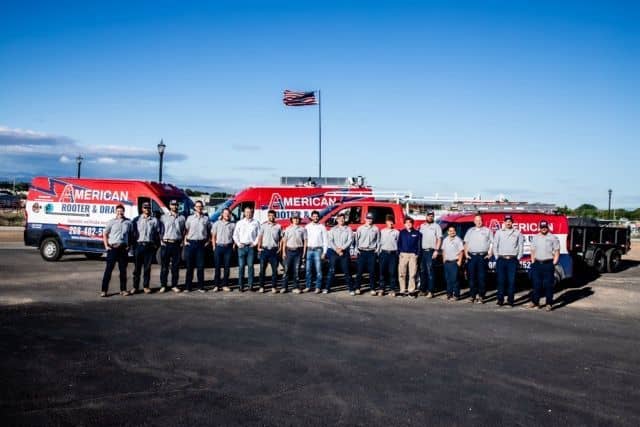

American Electrical Services installs home Level 2 chargers across Kuna's single ZIP code, 83634 — the older blocks around Main Street, the subdivisions off Ten Mile and Kuna-Meridian Road, and the acreage south toward Swan Falls Road and Kuna-Mora. We are the electrical division of American Rooter & Drain, established in Caldwell, Idaho in 1945 and serving the greater Treasure Valley since 1945, and the electrical side holds Idaho electrical contractor licence LIC# 3671445 in its own name. The estimate is free, it happens at your house, and the number you get is a flat price in writing. Every visit is handled by a licensed electrician, not a subcontractor, from that first walkthrough to the final inspection. Call (208) 782-8268.
My commute is Kuna to Boise and back — will the garage outlet keep up?
Probably not, and the arithmetic is worth seeing rather than taking on trust.
The cable that came in the trunk plugs into an ordinary household outlet. At 120 volts drawing 12 amps, that outlet hands the car about 1.4 kilowatts. A Level 2 circuit runs at 240 volts, and a 40-amp charger on a dedicated 50-amp circuit delivers 9.6 kilowatts into the same parked hours. Nothing about the car changes — the wall is the whole difference.
For a household running errands inside town, the trunk cable is genuinely fine and we will tell you so. The problem is the Kuna pattern: up Ten Mile or Meridian Road to the interstate, into Boise or across to the Meridian corridor, home again, five days running. That takes range out of the battery faster than a 120-volt outlet puts it back, so you start Monday full and finish Thursday hunting a public charger. A Level 2 circuit resets the car every night whether you drove twenty miles or eighty.
There is a second reason the trunk cable ages badly. That garage outlet is rarely a circuit of its own — it shares with the freezer, the shop vacuum and whatever is behind the workbench, and a car pulling steadily for eight hours is not the load it was drawn for.
My house is only a few years old. Why would the panel still be a problem?
Because the number stamped on the main breaker and the space actually available inside the panel are two different things, and homeowners in Kuna's newer subdivisions get caught by that gap.
A 200-amp service sounds like plenty. But the builder filled the panel to a plan that never contemplated a car — air conditioning, furnace, two kitchen counter circuits, dishwasher, disposal, microwave, laundry, dryer, water heater, bathrooms, garage and exterior receptacles, lighting. By the time the keys changed hands, the slots were gone.
A car charger breaker is double-width. It does not need one free slot, it needs two adjacent free positions, which is stricter than it sounds. So the panel gets read carefully: what the main breaker is rated at, and what the panel's own label permits — every panel carries a sticker listing which breakers it accepts and which positions will take a half-width tandem. Freeing two adjacent positions by consolidating small circuits onto a listed tandem is often the cheapest fix on the whole job.
Whether the service has capacity left is a larger question than whether the panel has slots, and two lawful methods answer it. The first totals every appliance's nameplate rating as though the house could run all of it flat out at once — conservative, quick, and in a house with electric heat it can return "you need a bigger service" for one that does not. The second is permitted for existing homes and uses your actual recorded demand, the highest the house has genuinely pulled over the past year, plus 125 percent of the charger's continuous load. Since nobody runs the dryer, the range and the air conditioning in the same minute, a house that fails on paper can pass comfortably on the record. We run it that way before anybody quotes a service upgrade.
Houses in the original townsite grid near Main Street sit at the other end of the problem. Those services were sized for a different century of appliances, some are still at 100 amps or less, and a few are panels nobody should hang a nightly high-draw circuit on. If yours is one, the honest conversation starts at panel upgrades in Kuna and only then moves to chargers.
We are on a well and a septic system. Does that change anything?
Yes — more than any other single factor on Kuna's acreage properties, and it is the part a city-only electrician underweights.
A submersible well pump sits on a 240-volt two-pole breaker and cycles on demand: somebody starts a shower, the pressure tank drops, the pump starts. Starting current on a submersible is far higher than its running current, so it lands on the service as a short heavy spike at an unpredictable moment. A septic effluent or lift pump adds a second motor on a float or a timer, running to its own schedule with no regard for what the car is doing.
Two consequences follow. The load calculation has to count both honestly — one that treats an acreage property like a subdivision house on city water gives an answer that is wrong in the direction that hurts. And if a load-management device is the answer to a tight service, its configuration matters enormously here: the charger sheds, the well never does. Losing charge overnight is an inconvenience. Losing water pressure because a car was charging is not something we will design in.
I park in a shop at the end of the driveway. Can you get power out there?
Yes, and on Kuna acreage this is a common shape of job. Two ways to build it, and they are not equivalent. One long dedicated circuit from the house panel to the shop wall is simplest and cheapest, and gives you exactly one thing: a car charger. A small sub-panel at the shop, fed once from the house, costs more the day it goes in and leaves you a building that can run a compressor, a welder, lighting and the car. If the shop is going to be a shop, that is the better money.
Distance is the first thing we measure, because it drives everything downstream. Our own price book is built in run-length tiers — up to 25 feet, up to 75 feet, up to 150 feet — in either 12/3 or 6/3 with ground, and a heavy circuit over a long run gets its conductor upsized to hold voltage drop inside acceptable limits. Two houses on the same road can be very different jobs because one parks fifteen feet from the panel and the other a hundred and thirty.
Then there is the trench, where Kuna properties carry hazards a city lot does not. Calling 811 gets the public utilities marked — power, gas, communications — and we always do it. 811 does not mark private underground lines, and on an acreage those are the ones that ruin the week:
- The septic tank, its lids and the drain field laterals. A trench across a drain field is not an electrical problem, it is a septic replacement. If nobody knows where the field runs, we locate it first — a septic inspection in Kuna is a far cheaper afternoon than the alternative.
- The pressurised irrigation line from the district: shallow, unrecorded, everywhere in this part of the valley.
- Buried propane to a shop heater, plus well head conduit and the pump's own feed, which rarely follow the route anyone remembers.
Where the risk is real we probe and hand-dig rather than trust a machine over unmarked ground. Buried PVC conduit on a residential branch circuit needs 18 inches of cover, more under a driveway — trench depth is a code dimension.
What charger should I buy, and does it need an outlet?
Start with your car, not the charger. Every EV has an onboard charger with a maximum it will accept, and no wall unit beats that ceiling. If your car tops out at 32 amps, a 48-amp charger on a 60-amp circuit fills it at exactly the same rate as a 32-amp charger on a 40-amp circuit. You will have paid for copper you cannot use.
The sizing rule underneath all of it is not negotiable. Vehicle charging counts as a continuous load, so the circuit is rated at 125 percent of the charger's draw: a 32-amp charger belongs on a 40-amp circuit, a 40-amp charger on a 50-amp circuit, a 48-amp charger on a 60-amp circuit. Reading the number off the box and using it as the breaker size is the classic error on a rushed install, and it is why some cars trip a breaker at two in the morning.
Plugged in or wired in. A plug-in unit on a 240-volt receptacle is capped at 40 amps of continuous draw, so 9.6 kilowatts is its ceiling; the receptacle needs ground-fault protection, and an industrial-grade one is worth paying for, because the bargain versions are a documented heat problem under a nightly load. A hardwired unit reaches the full 48 amps for 11.5 kilowatts and deletes the receptacle as a failure point, at the cost of needing an electrician to swap the unit later. Outdoors, hardwiring into a weather-rated enclosure is the answer nearly every time.
One feature is genuinely worth having: adjustable output. A charger whose maximum can be set at commissioning lets a large unit live on a service that could not otherwise carry it, and dialling a 48-amp charger back to 32 amps is invisible to a car parked from ten at night until six. Buy the unit yourself or have us supply one — either works, but we need the spec sheet before the wall or the trench opens.
Does Kuna city hall handle the permit, or does the state?
Homeowners assume this crosses the same counter as a fence or a deck permit. Residential electrical work in Idaho is administered through the state electrical programme rather than the city building department, and we confirm the authority having jurisdiction for your address when we pull the paperwork. Either way it is our job, not yours: we pull the permit under our licence, we schedule the inspection, and the job is not finished until it passes. What the inspector looks at explains much of what could otherwise read as fussiness:
- Conductor rated for the breaker protecting it, across the whole run, with length accounted for.
- A breaker listed for that panel. Brands are not interchangeable; the label states what is permitted, and mixing is both a failed inspection and a genuine hazard.
- Wet-location fittings outdoors and underground, rather than indoor parts pressed into outdoor service because that is what was on the van.
- Cover depth on anything buried, measured rather than estimated, and bonding and grounding at the service — a routine failure point on an older Kuna house, and one homeowners never see.
- Clear working space in front of the panel, which in a Kuna garage is routinely occupied by a chest freezer or a shelf of paint. Easier to move before the appointment than during.
Permitted work keeps paying afterwards: it documents the circuit for a future buyer, keeps a home inspector from flagging your garage during a sale, and keeps the installation on the right side of your homeowners policy.
Why will nobody give me a price for this over the phone?
Because the charger is the cheap part, and everything that decides the price is invisible from a phone call. Anybody quoting a firm number sight-unseen is either padding it heavily to cover what they cannot see, or revising it once they are standing in your garage. The honest list of what moves it:
- How far the charger is from the panel, in feet of actual routed distance rather than straight-line optimism, and what is between the two. An open attic or accessible crawlspace makes a long run routine. A finished garage ceiling, a stucco exterior or a slab you would have to go under turns a short run into real work.
- Whether the panel has two adjacent positions free, or whether a tandem consolidation, a sub-panel or a panel change comes first — and separately, whether the service itself is the limit.
- Indoors, outdoors, or trenched, and the amperage you want — a 60-amp circuit and a 40-amp circuit are different conductor and a different breaker, and a trench that has to clear a drain field is not the same job as a bracket on a drywall garage wall.
- Whether the meter base or service entrance has to change. Idaho Power owns the meter and the conductors feeding your house, so if that moves, their calendar becomes part of your timeline — where an EV project gains weeks nobody planned for.
- Where the car actually parks — which side the charge port is on and whether you back in. That decides mounting position and cable length, and relocating a charger afterwards is a second job with a second price.
So we come out, look at all of it, and you get one flat price in writing before anything is opened up, rather than an hourly rate that climbs while somebody is in your attic. The visit costs you nothing.
Is this a one-day job, and what else is worth doing while you are here?
It depends which of three jobs you have, and we say which at the estimate rather than after. The panel has room and the car parks near it: one appointment — breaker, conductor, mount, terminate, commission, label, inspection to follow. A long run, an outdoor mount, or a trench to a shop: usually still one appointment, just a longer one, with the utility locate scheduled ahead of the dig. The panel or the service has to change first: two phases and two power shutoffs, and if the service itself changes size, Idaho Power has to pull and reset the meter on their schedule. That is the version that stretches.
While the panel is open, a few things are cheaper now than later. None are required for the charger to work:
- Whole-home surge protection in the panel. Once a charger, an inverter-driven heat pump and a house full of circuit boards share a bus, this stops being an accessory. The device we install is rated at 65kA.
- Garage and exterior lighting — plugging a car in at ten at night in January goes better when you can see the connector. See lighting installation in Kuna.
- A generator interlock, if outages on your stretch of road already have you thinking about it — see generator installation in Kuna.
One thing to watch afterwards: a car charger is among the hardest-working circuits in a house — high current, drawn steadily, for hours, while everyone is asleep — which makes it unforgiving of a loose termination. A warm faceplate, a discoloured outlet, a faint hot-plastic smell, or a breaker that trips only overnight are all reasons to stop using the circuit and call for electrical repair in Kuna.
Which parts of Kuna do you cover?
All of 83634 — the original townsite grid, the subdivisions off Ten Mile, Kuna-Meridian and Deer Flat, the properties along Cole Road and Hubbard, and the acreage toward Swan Falls Road and Kuna-Mora where the lots get large and the driveways long.
We are not strangers to these addresses. Across every trade we run, our dispatch records show 444 jobs booked to Kuna addresses, 391 of them completed, for 209 separate Kuna customers. Company-wide across the whole Treasure Valley, our Google reviews speak for themselves. American Electrical Services works out of American Rooter & Drain at 1005 Commercial Way, Caldwell, ID 83605, and holds LIC# 3671445.
We install home chargers in Meridian, Boise, Nampa and Star too, and the full service list for this address is at our Kuna page.
There is a certain symmetry to all this. The Snake River canyon south of town has been putting electricity on wires at Swan Falls since long before anyone in Kuna owned a car that needed charging. Getting 240 volts from your panel to your garage is not exotic work — it is just work that has to be done right, on the right conductor, behind the right breaker, with an inspector's signature on it.
What is the next step if I want a price?
Call (208) 782-8268 and ask for a free EV charger estimate at your Kuna address. A licensed electrician comes to the house, opens the panel, walks the route the wire has to take, asks where the car actually parks, and runs the load calculation properly. You get a flat price in writing before anything is opened up, and a straight answer about whether the panel is the limit, the service is the limit, or nothing at all has to change.
If your existing panel handles it fine, that is what we will tell you — and the trip still costs you nothing.