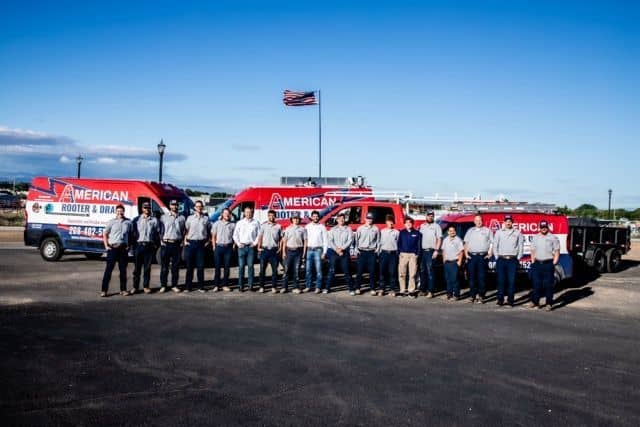
This page is about doing that on a Kuna lot. Written by American Electrical Services, the electrical division of American Rooter & Drain — established in Caldwell, Idaho in 1945 and working the greater Treasure Valley ever since. Idaho Electrical Contractor LIC# 3671445, electrical line (208) 782-8268, on-site estimate free.
We are in this town regularly. 444 jobs at Kuna addresses, across 209 households and 212 separate properties, sit in our dispatch records — oldest logged 29 October 2020, newest 26 August 2026, 133 inside the last twelve months. Those dispatch records begin in October 2020, when the current system went in — the company is a great deal older than the database. 86 of those households have had us back more than once, and 443 of the 444 are in the 83634 zip. The mix says what Kuna houses do to their owners: 136 drain, sewer and camera calls, 57 heating and cooling calls, 23 water heater calls, 5 septic calls. Electrical is the newest trade we added, and the Kuna column of that ledger is short enough that we will not wave a count at you — but the work is real: smoke and carbon monoxide alarms replaced through a whole house, whole-home surge protection, an arc-fault outlet traced and swapped, and one job wanting a cement silo motor, a water pump feed and two dedicated 120-volt circuits. That last one tells you where Kuna town stops and Kuna farm starts.
Worth remembering when the lights go: the oldest hydroelectric plant on the Snake River has been generating about twenty miles south of you at Swan Falls since 1901, and it has never once kept your kitchen lit. The problem is almost never generation. It is a pole, a transformer or a span of wire between there and your meter — and that gap is the one a generator fills.
Will I still have water when the power goes out?
This is the first question to settle, and the answer splits Kuna in half.
Inside the city on municipal water, an outage costs you pressure only if the system loses it, and taps generally keep running. Out on the acreage — south toward Kuna Butte and Swan Falls Road, east past Cloverdale, out along Kuna Mora — you are very likely on a private well, and the answer is worse. The pump down that casing is electric. When the power stops, the pressure tank gives you whatever it was holding and then you have nothing: no taps, no toilets, no hose for stock.
That fact usually decides the whole project, because a submersible pump does not draw its running current at start-up. It draws several times that while the motor breaks loose, and the generator has to survive the surge without stalling or sagging voltage on the rest of the house. Sized on the pump's nameplate running load alone, it will brown out your furnace every time the pressure switch closes. So we want horsepower, depth and control type before anything gets sized.
Septic is the same story one step downhill. A gravity system does not care about power. One with an effluent pump, a grinder or a lift station stops moving the moment the panel goes dark, and it gives no warning — it simply fills. If you are not certain which you have, we can tell you; that is the same crew that handles septic service in Kuna.
What actually stays on when it runs?
Two ways to do this, and the difference is money.
Essential circuits. A smaller transfer switch feeds a chosen list — furnace, well pump, refrigerator and freezer, a few outlets and lights, the garage door, the internet. Everything else stays dark until the utility returns. Cheaper machine, cheaper switch, and it demands you decide in advance what actually matters.
Whole house. A service-rated automatic transfer switch sits between meter and panel and carries the entire house. Nothing to choose, nothing to remember, and the outage becomes a flicker and a noise outside. Our standard is a 200-amp automatic transfer switch, with a 400-amp version for larger services.
Do not underestimate the essential list — written down honestly it grows fast in an Idaho winter. A gas furnace still needs power for its blower, igniter and board. So does the well, so does a chest freezer holding a quarter beef, and so does a CPAP or an oxygen concentrator. That last one is not negotiable.
Either way the switch is not optional: it is the only thing between your generator and a lineman on a downed conductor.
Can a smaller generator run my whole house?
Often, yes — and this is the part almost nobody knows going in.
The naive way to size a generator is to add up every load in the house and buy a machine bigger than the total. That math marches people straight to a liquid-cooled unit and a much larger bill. The better way is to recognise that your house never runs everything at the same instant, then enforce it with hardware.
Load shedding does exactly that. A load-shed transfer switch, or a smart module wired to a specific circuit, tells one big load to stand down while another runs. We install a 200-amp ATS with load shed built in, a 50-amp smart load module and a 100-amp smart shed module for the heavy stuff. In practice the air conditioning compressor drops out for the half minute the well pump spends refilling the pressure tank, then comes back. You never notice. The generator never sees both at once, and a 22 or 24 kW air-cooled machine covers a house a spreadsheet swore needed liquid cooling. On a Kuna property, shedding usually gets pointed at the air conditioner, the electric water heater, the well pump, and a shop or irrigation pump out back.
For reference: air-cooled units — the tall aluminum boxes that look like an oversized AC condenser — run 10/9, 14/14, 18/17, 22/19.5, 24/21 and 26/22.5 kW from Generac and 14/12 and 20/18 kW from Kohler, the paired figures being propane first and natural gas second. Past those they change character entirely — liquid-cooled, radiator and coolant loop, like a car engine — at 22/22, 27/25, 32/32 and 38/38 kW, plus 24/21 and 30/30 kW from Kohler. Two air conditioners, a heated shop or an irrigation pump is what usually pushes a house over that line.
Do I have gas out here, or does this have to be propane?
Inside Kuna proper, plenty of houses have an Intermountain Gas meter and the generator simply taps that supply: no tank, no delivery schedule, nothing to run out of in a long outage.
Out on acreage there is frequently no main at the road, and the answer is propane. Perfectly good fuel — but it changes three things. The unit makes slightly more power on propane than on natural gas, which is the higher of the two paired numbers. Your tank has to be sized and sited for a generator load on top of whatever else already burns propane at the house. And you now own a fuel you can exhaust, so the plan has to include who fills it and how fast they come.
Either fuel, the gas piping is its own trade and its own sizing calculation. An undersized run starves the engine under load and the unit shuts itself down — the most maddening failure of all, because the generator looks perfectly healthy afterward. Our plumbing side does that work; see gas line installation in Kuna.
Where is the thing going to sit in my yard?
Clearances are set by the manufacturer and by code, because the machine breathes air, throws heat and exhausts combustion products. It holds a distance off the wall, a distance from openable windows, doors and fresh-air intakes, and a clear zone all the way around for service. It cannot live under a deck or in an enclosed alcove. Then Kuna adds its own wrinkles.
Irrigation. Kuna grew up as a siding on the Oregon Short Line railroad and became the staging ground for the canal work that made this stretch of desert farmable. A century on, the ditch system still runs through and under a great many yards here. Before we trench a gas line or a conductor run out from the panel, we want to know where your lateral, headgate and buried irrigation main are. A pressurised line is easy to open with a trenching machine and expensive to explain afterward.
Wind and drift. Open ground on the south side of the valley moves snow. A unit set into a low spot that collects runoff, or drifts shut in January, is one you have to dig out before anybody can service it. When a site calls for it the machine goes up on a custom aluminum stand fabricated and anchored for that spot, instead of sitting flat on a composite pad or a poured slab.
Distance. The further the unit sits from your meter and panel, the longer the conductor and fuel runs — and where you want it and where it is cheapest are not always the same place.
Does my panel or meter need work first?
Sometimes, and finding out early is the difference between a smooth project and a bad surprise. A whole-house automatic transfer switch is service-rated equipment landing between the utility and your main panel, so it has to match your service size and your existing gear has to be fit to accept it. An old split-bus panel, or a meter can gone corroded or undersized, sometimes has to be solved first. We do that in the same visit rather than a second trip — a 200-amp meter pan swap, a 200-amp overhead service entrance, or a new load center with all new breakers, each priced alongside the install. See panel upgrades in Kuna; either way you hear about it at the estimate, not on install day.
What is the install actually like, start to finish?
1. The estimate. A licensed electrician walks the property, opens the panel, reads the well pump data plate, checks meter capacity and gas availability, and builds the load calculation with you. Free, and the output is a written flat price for a specific machine in a specific spot.
2. Ordering and permits. Unit and transfer switch ordered, and we pull the electrical permit under LIC# 3671445. Gas piping is generally permitted separately, and if your property sits outside the Kuna city limits the jurisdiction can differ from your neighbour's, mailing address notwithstanding. Nothing gets dug until equipment and permit are both in hand.
3. Site work. The base goes in — pad, slab or stand — then trenching for the conductor and fuel runs, around the irrigation you told us about.
4. Set day. The machine is placed and anchored, the fuel line lands and is pressure-tested, the transfer switch is mounted beside the panel.
5. The tie-in. The only stretch where your house is dark, because the switch has to go in between meter and panel with everything dead. A planned window inside one working day, not an outage lasting the length of the project.
6. Startup. The engine runs under real load, transfer and re-transfer get proved by killing the utility on purpose, the exercise schedule is set, and somebody walks you through the controller and manual override before the truck leaves.
7. Inspection. The inspector comes out to the finished work. Keep that paperwork: a permitted, inspected standby system is a documented improvement when you sell, and an undocumented one is a question mark a buyer's inspector will raise.
How many days it takes depends on the machine, the base, how far you sit from the panel and how quickly the inspection lands — which is why we tell you that on your property rather than guessing here.
I already have a generator. Can you replace it or fix it?
Both — a bigger share of the work than people expect, now that plenty of Treasure Valley units have real years on them.
Replacements. A swap is its own job at 14/14, 18/17, 22/19.5 and 24/21 kW, with variants for reusing a sound existing transfer switch versus replacing it, and for running new gas and electrical when the old routing will not serve the new machine. If the old pad or slab has to come out, that is priced in rather than sprung on you.
Repairs. The parts that actually fail, and that we stock: fuel regulators and air mixers, the stepper motor and choke solenoid, control boards and Evo controllers, oil pressure switches, diodes, valve cover gaskets, starters, belts and fuel solenoid coils on liquid-cooled units, transfer switch coils, smart transfer boards, load-shed boards, transfer fuses — and batteries. Batteries most of all: a dead battery is the single most common reason a generator that has faithfully exercised itself for years does not come on during the outage that mattered. If yours runs its exercise but sat silent through the last real outage, suspect the switch, the utility-sensing side or the battery before the engine.
Is a portable generator with an inlet box good enough?
Sometimes, and we would rather say so than sell you something you do not need. Done properly a portable is not a cord through a window — it is a permanently installed inlet box on the outside wall, a 30- or 50-amp circuit into a manual transfer panel or a panel interlock, and a machine you carry out and start yourself. We install that as defined work: inlet prep at 30 or 50 amps, or a permanently set 8 kW air-cooled unit for a lighter load. The trade is that somebody has to be home to start it in the weather with stored fuel to refill it, it usually will not start a well pump and an air conditioner, and it does nothing while you are away — precisely when a frozen pipe costs you the house. It also costs dramatically less, and for a well-insulated place in town whose worst case is a cold weekend that can be the right answer.
The wrong version — a portable back-fed through a dryer outlet on a double-male cord — kills people, because it energises the utility line in front of your house. If that is what you run, let us put an interlock or a real switch on it.
What is this going to cost at my house?
We will not print a number, and not a range either — on this job a range is a guess wearing a costume. Here is what actually moves the price:
- The machine. Air-cooled versus liquid-cooled is the largest fork, and load shedding can move you back across it.
- Transfer switch. Essential-circuit or whole-house, 200-amp or 400-amp, load-shed hardware or not.
- Distance. Feet of trench from the panel and from the fuel source to wherever the unit ends up.
- The base. Pad, poured slab or fabricated aluminum stand, plus removal of an old pad or slab on a replacement.
- Fuel. An existing gas meter with capacity to spare is one job. A propane run, or a meter that must be upsized, is another.
- Your electrical service. Whether the meter pan, service entrance or panel has to be brought up first.
- Site difficulty. We price standard, medium and difficult installs separately, because a tight side yard and a hand-dug trench is a different day than open ground.
- Coverage package. Where two quotes for the same kW differ, the gap is usually years of included maintenance and extended parts-and-labour coverage above the factory warranty, and whether surge protection is built in.
A licensed electrician comes out and looks, and you get one written flat price before anything is ordered.
How soon can someone come look at my house?
Call (208) 782-8268 and a licensed electrician comes out to your Kuna address at no charge and gives you a written flat price. Bring two things: your well pump's information if you are on a well, and an honest list of what has to stay on. Those two answers decide most of the project. Ask about maintenance while we are there — we carry service kits for air-cooled and liquid-cooled machines, a member tune-up, and a fast pre-storm check.
If the problem is smaller than a generator — a breaker that will not stay in, a dead circuit, a scorched receptacle — that is electrical repair in Kuna, a far shorter visit. Charging a car on backup power raises its own questions, on EV charger installation in Kuna. General equipment background sits on our whole house generator installation page, and the same crews run the neighbouring towns under the same licence: Meridian, Boise, Nampa and Star. Everything else is on the Kuna services page.
American Electrical Services · 1005 Commercial Way, Caldwell, ID 83605 · Idaho Electrical Contractor LIC# 3671445 · (208) 782-8268. American Rooter & Drain's main line is (208) 366-5771.