
A standby generator is the machine that makes none of that happen. It is anchored to a pad beside the house, wired into your panel through a switch that keeps the house on one power source at a time, and it burns the gas or propane already coming to the property. It starts itself whether you are home or away.
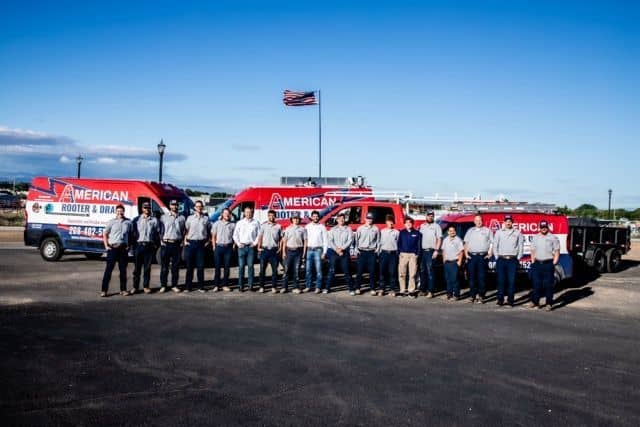
What follows is what that takes in Eagle in particular: these yards and what is buried under them, the wells north of the ridge, the low ground near the river. American Electrical Services is the electrical division of American Rooter & Drain, established in Caldwell, Idaho in 1945 and working the greater Treasure Valley since. Idaho Electrical Contractor LIC# 3671445, electrical line (208) 782-8268, on-site estimate free.
What actually happens in my house when the power goes out?
Worth walking through, because the order decides the machine size. The furnace goes first, and silently. People assume a gas furnace keeps running; it does not, because the blower motor, the igniter and the control board are all on 120 volts. In January that is the clock that matters — a house losing heat is a house with pipes at risk.
Then anything with a pump on it. Houses on the low ground near the Boise River and toward Eagle Island run sump pumps for a reason, and a sump pump with no power is a decoration. Houses on septic with an effluent pump or a grinder stop moving waste to the drain field, which arrives quietly as a problem on day two. Houses on a well have no water at all. Write that list down before an electrician comes out — it is the specification for the job.
What size generator will run my house in Eagle?
Not square footage. Starting loads, and the list you just made.
A motor draws far more current in the half second it starts than once it is turning, and a generator has to swallow those half seconds without stalling or browning out the house. On Eagle properties the number is set by the air conditioning compressor, a well pump if you have one, electric cooking and laundry, and a heat pump or electric water heater. Counting those means somebody standing at your open panel, which is why nobody can size this over the phone.
Before the count comes the decision the count serves. Three honest shapes: the whole panel, so nothing behaves differently and you forget the power is out; a named list of circuits — furnace blower, refrigerator, well pump, sump pump, some lights, a medical device; or the whole house taking turns, where a load management module briefly drops a big, patient appliance like the dryer or the water heater for the two minutes the air conditioner needs to start, then hands it straight back.
That third one is a sizing lever, not a gadget, and it is what quietly separates two quotes. Every package we write includes load management for one appliance where the house needs it, soft starts on the air conditioning compressors so the startup surge is flattened rather than absorbed, and a time delay where required. Ask a competing bid whether it carries any of that.
One more trap when spec sheets sit side by side: a standby unit has two power ratings, not one. The air-cooled Generac units we install read 10/9, 14/14, 18/17, 22/19.5, 24/21 and 26/22.5 kW; the Kohler air-cooled units read 14/12 and 20/18 kW. Those pairs are not typographical errors — one number is what the engine makes on propane, the other what it makes on natural gas, and only one applies at your address. Build the quote on the wrong half and the machine shows up too small for the house it was sold for. Above that range we install liquid-cooled Generac units at 22/22, 27/25, 32/32 and 38/38 kW and Kohler at 24/21 and 30/30 kW.
Will it keep my well and my irrigation pump going?
Yes, and on the north end of town it is usually first on the list. Eagle is two different jobs depending on which side of Beacon Light Road you live on. South and central, most houses are on city water and an outage is dark and annoying. North and up into the foothills, plenty of properties draw from a private well, and there an outage makes the house unusable by the second day. Lifting water up a casing from a dead stop is about the hardest work any motor on the place does, so the pump moves the machine size rather than sitting at the bottom of the list.
Tell the electrician what you know: roughly what horsepower the pump is, usually on the tag at the pressure tank or the well log; whether it is a submersible down the casing or a jet pump in a pit house, because they start differently; whether there is a booster pump or a cistern; and whether the septic is gravity or pumped, because an effluent pump belongs on the list beside the well.
Irrigation is the one we usually talk people out of. Plenty of Eagle lots water off a surface share with a pump in a pit, and that pump is a large starting load solving a problem that does not exist during an outage — the lawn survives a day without a set.
Can I just plug a generator into the house?
No. Not into a dryer outlet, not with a cord made up with a male plug on both ends, not "only for a couple of hours." That trick energizes your panel through a path nothing is switching and pushes generator power out onto the utility line. A lineman working to get your street back on can be killed by it, and when utility power returns while your machine is still tied on, the machine is destroyed.
Automatic. The switch feels the outage, cranks the engine, holds until voltage and frequency are right, throws the house over — then reverses the whole sequence and shuts the engine off once the utility is back. Nobody home, nobody notified. Our packages include a 200-amp OEM automatic transfer switch, with a 400-amp version for a 400-amp service.
Manual. You are home, you throw it, you start the engine. It costs less and it is an honest choice — the question is simply whether you expect to be home and awake for the outages that worry you.
A portable, connected properly. An installed 30- or 50-amp inlet with a manual transfer switch behind it, up to 50 feet of heavy-duty cord, and the panel labeled so anyone in the house knows which breakers the portable can carry. We install that prep as a job in its own right, and portable units around 8 kW.
Switches also fail on their own — the coil that throws the mechanism, the smart transfer board that decides when to throw it, the 10-amp fuses protecting the controller. A machine that runs its weekly exercise beautifully but refuses to pick the house up in a real outage is often a switch problem, not an engine problem. Say so on the phone; it changes what goes on the truck.
Natural gas or propane — which one works at my address?
Natural gas if the main already reaches the house, propane if it does not. In Eagle the street usually makes that decision for you, and it splits roughly where the subdivisions stop and the acreage starts.
Natural gas means no tank, no refills and no runtime limit — a standby unit will carry a week-long outage with nobody driving out to you. But something has to be settled first, and it is not the generator. A generator is a large gas appliance in its own right, and your meter was sized for heating, hot water and cooking — not for all of that plus an engine at full throttle. Checking that the meter and service can actually carry the unit happens during the on-site visit. Where they cannot, the upgrade is your gas provider’s work, done on their schedule, and it sits outside every one of our packages. Paying us more does not move their date, which is why we raise it at the estimate rather than on set day.
Propane is the answer wherever there is no main, which covers a good deal of ground north and west of town. It runs a standby machine perfectly well but changes one thing: runtime stops being unlimited and becomes a number of gallons. So — how big is the tank, who fills it, and is it topped up going into the season, because a tank at a quarter in November is not the same machine as a full one. Where the tank sits also has to agree with where the generator can legally sit. Then check which half of that paired kW rating your quote was built on.
Where is the generator going to sit in my yard?
Four things fight over that spot: clearance from windows, doors and vents; distance from the gas meter and the panel; what is buried in between; and, in many Eagle subdivisions, an architectural committee.
Distance is the one with a price attached. Our packages assume a short gas and electrical run, both on one side of the building. Cross 30 feet on either run, split them to opposite walls, or dig past 15 feet of trench, and the job moves up a tier; past 50 feet of run, or 30 feet of trench, it moves up again. That is not a penalty — it is conduit, pipe, pressure testing and hours in the ground.
What is in the ground is where Eagle gets its own personality. This town grew up as farm ground on the north bank of the Boise River, and the irrigation that made that ground worth farming still runs under the lawns: pressurized lines, old laterals and ditch crossings turn up where nothing on any map suggests them, along with the sprinkler mainline somebody's brother-in-law put in during the nineties. If you know where your mainline runs, say so at the estimate.
What the machine sits on depends on where it sits. Standard is a generator pad rated to 180 mph wind or a poured slab, but on the low ground toward the river and Eagle Island, where water stands in spring and snow drifts against the north side of everything, we fabricate a custom aluminum stand and anchor it on site to lift the unit out of the wet. If your subdivision has design review, start that paperwork early — it runs on its own calendar, separate from the permit.
Who pulls the permit, and what happens on the days you are here?
We pull it, and somebody who does not work for us signs the work off. A standby generator is permitted electrical work and the gas piping is permitted separately; both are included in every one of our packages, so you do not file anything and you do not meet an inspector alone. That sign-off is what your insurance carrier wants if the machine is ever part of a claim, and what a buyer's inspector looks for when you sell. While an electrician is already in the panel, it's also a reasonable time to book a full electrical safety inspection if the rest of the house's wiring hasn't been checked in years.
The rest runs in a set sequence, and the dates land in writing at the estimate. We will not print a number of days here, because the two things that actually stretch the calendar are not ours to control: the gas provider, if the meter has to change, and equipment availability.
1. The estimate visit. A licensed electrician opens your panel, finds the gas meter, walks the run, checks clearances and asks what you want still running. Fixed price in writing before anything is ordered. Free.
2. Permits, electrical and gas piping.
3. The gas provider, if the meter has to change — the one step that is not ours.
4. The base. Wind-rated pad, poured slab, or a fabricated aluminum stand anchored on site.
5. Set day. Machine placed and anchored, gas line run and pressure tested, electrical run, transfer switch set, load module in, soft starts on the compressors.
6. Startup and system testing. Not plugging it in — the unit is commissioned and the transfer proved by actually taking the utility away from it.
7. Inspection.
What does a standby generator cost in Eagle?
The machine is one line on the invoice and your property is the rest. That is why we do not publish generator prices and never quote a range. A range only sets you up to be disappointed by the real number, and anybody handing you one over the phone is guessing at your yard.
What moves it: how far the machine sits from the gas meter and the panel, and whether those are on the same side of the house; how much trenching, and what it crosses — turf, gravel, a driveway, tree roots, an irrigation mainline; what it sits on, and whether concrete has to be cut and replaced; and add-ons like whole-home surge protection, load management beyond one appliance, or a 400-amp transfer switch.
Two things sit outside our price entirely: a gas meter upgrade, if your provider has to do one, and panel work if the panel turns out to be the real constraint rather than the generator — its own project, covered on panel upgrades in Eagle.
There is also a difference between packages that never shows up in a price comparison. All of ours include a high-capacity battery, load management for one appliance where needed, soft starts, permitting, turn-key installation and system testing. Past that they part company — the entry package carries one year of maintenance and five years of extended manufacturer parts and labor warranty above the factory coverage, the top package three years, ten years and whole-home surge protection. That gap is where the difference between two numbers usually hides. The on-site estimate is free. More on why we won't quote a price over the phone.
What do I have to do to keep it running?
Oil and an oil filter, spark plugs with the gap set, an air filter, every electrical connection and gas fitting checked, and a battery that is watched rather than assumed — on a schedule driven by run hours and calendar time, whichever comes first. This is the half of ownership nobody sells you, and it is what decides whether the machine works in January.
- The exercise cycle. It runs itself briefly on a schedule to move oil, dry the windings and prove the battery. We set that schedule at startup and tell you what normal sounds like, so an abnormal cycle is obvious to you rather than to nobody.
- The first service is different. Break-in oil comes out early, and valve tolerances and torque specifications get checked while the machine is young.
- Full maintenance. Oil and filter, plugs gapped, air filter, all electrical connections, all gas fittings at the machine, battery checked, then run and verified. Our air-cooled kit covers units up to 28 kW; liquid-cooled machines take a different kit entirely.
- The battery. A generator that cannot crank is expensive yard art. Terminals oxidize outdoors and the charger keeping the battery topped up can fail quietly — corroded terminals get a new terminal kit, not a wire brush and optimism.
Can you fix or replace the generator I already have?
Yes — whether or not we installed it. If the pad, the gas line and the switch are all still good, a swap reuses them and hauling the old machine off is inside the package; if the switch has failed, a new 200-amp automatic transfer switch goes in on the same project. We also install customer-provided equipment as a defined package, so ask for it by name if a generator is already sitting in your garage.
On repairs we work air-cooled and liquid-cooled machines down to controllers, stators, rotors, brush assemblies, starters, voltage and fuel regulators, oil pressure switches, air mixers and radiators, and we stock parts for Generac and Kohler equipment. Call with the brand and the kilowatt figure off the data tag and we can usually tell you what you are dealing with before anybody drives out.
How soon can someone come out and look at my house?
Call (208) 782-8268 or book online, and a licensed electrician comes to your Eagle address at no charge. Bring your list of what you want still running, plus what you know about your well, your irrigation and your gas meter. You will have a fixed price in writing before anything is ordered.
We are not a call center routing your address to whoever answers. American Rooter & Drain trucks have run 444 jobs at Eagle addresses across plumbing, drains, septic, heating and air, and electrical — 217 separate service addresses, every one inside the 83616 ZIP.
Generator work also runs in Boise, Meridian and Star, with the full picture on the generator installation page. We also handle electrical repair in Eagle and EV charger installation in Eagle here, and every trade we run in this town is on the Eagle services page.
American Electrical Services · 1005 Commercial Way, Caldwell, ID 83605 · Idaho Electrical Contractor LIC# 3671445 · (208) 782-8268. American Rooter & Drain's plumbing line is (208) 366-5771.