

Am I on a septic system, or is my Payette house on city sewer?
Settle this before you spend a dollar. Most addresses inside Payette city limits are on city sewer, and a house on sewer has no tank to inspect. Septic out here is county work — the acreage toward Fruitland and New Plymouth, the river-bottom ground below where the Payette meets the Snake, and the lots on the bench where a sewer main was never going to reach.
If you are not certain which one you have: read your utility bill, because a sewer line item means you are connected and no sewer charge is a strong hint that you are not. Walk the ground between the house and the back of the lot — a round lid, a green plastic cap, or a rectangular dip the mower always finds is your tank. Watch the grass in spring, since a strip that greens up early and stays green into August is usually over the drain field. And pull your closing file, where a septic permit or a health district record will be waiting if the property was ever permitted. Two houses on the same road can land on opposite sides of that boundary, so verify rather than take a neighbor's word for it.
What happens during a septic inspection, in the order it happens?
The order is not arbitrary. Each step tells the next one what it needs to prove, and skipping one is how an inspection documents a tank while a drain field quietly fails twenty feet away.
1. Paperwork before shovels. Payette County septic permitting runs through Southwest District Health, and a permitted system usually has a site drawing on file showing where the tank and field went in. Ten minutes of records work saves an hour of hunting in the yard.
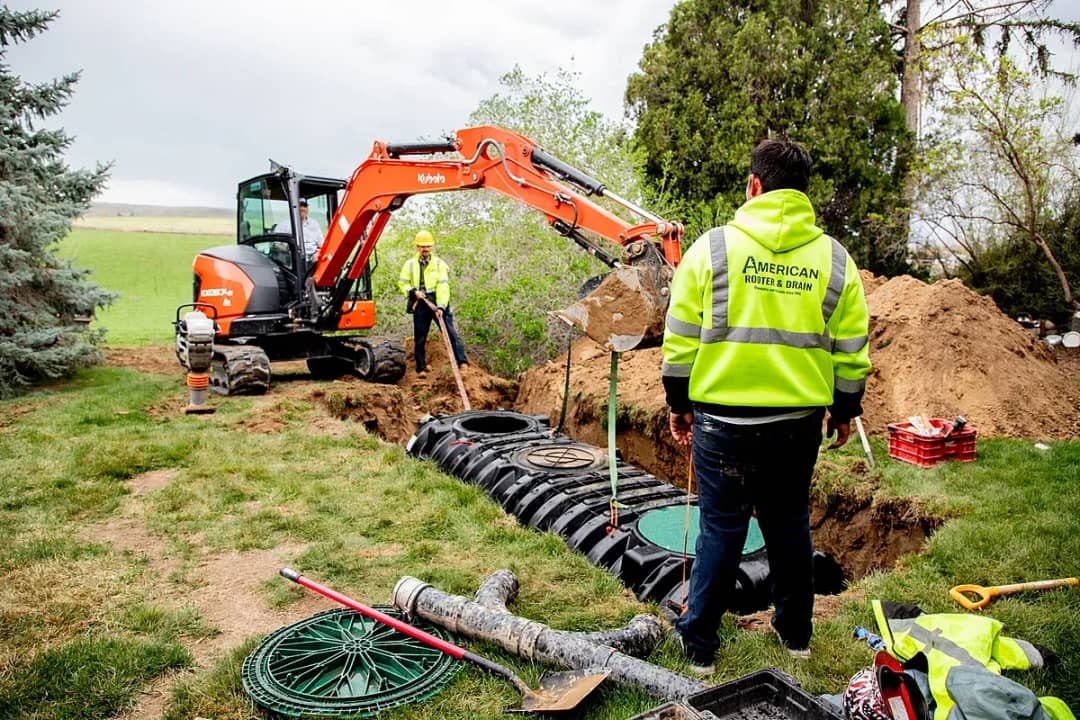
2. Locate the tank. If nobody knows where it is, we read where the main line leaves the house — generally below the lowest bathroom, running straight to the tank — and probe that wedge of ground. A soil probe leaves a pencil-width hole, not a trench.
3. Open every lid, not just the convenient one. A two-compartment tank inspected through one opening is half an inspection. The second compartment is where the outlet lives, and the outlet is where most of the bad news is.
4. Read the liquid level before anything moves. The most informative thirty seconds of the visit, and it gets its own section below.
5. Measure sludge and scum. Settled solids on the bottom, grease and light solids on top. Both measured in inches, both on the report. Those two numbers set your pumping interval better than any rule of thumb will.
6. Inspect the inlet and outlet baffles. The inlet baffle slows incoming flow so solids settle instead of churning; the outlet baffle holds the scum layer back so it cannot wash into the field. Cheap parts whose whole job is protecting an expensive one.
7. Pull and clean the effluent filter if the system has one. A filter caked shut mimics a full tank exactly — slow drains, gurgling, backups — and clearing it is a five-minute job that is easy to skip.
8. Check the tank structure. Cracks in the walls, root intrusion at a seam, a lid gone soft, a connection pulled loose by years of settling.
9. Find and open the distribution box where one exists. It splits flow between the field laterals, and a box settled out of level sends most of the water down one lateral and drowns it while the rest of the field sits dry and unused.
10. Walk the field. On foot, slowly, reading grass color and height, feeling for sponginess underfoot, checking for surfacing at the low end and the perimeter.
11. Write it down. A record of what was measured and what was found. That document is the entire point if a lender, an agent or the health district is going to read it.
How long it takes depends on things nobody can promise over the phone: whether the lid is findable, whether it sits at grade or under eight inches of sod, one compartment or two, and how much field there is to walk.
Why do you want the tank pumped before you inspect it?
Because you cannot grade a tank you cannot see the bottom of. Wall condition, the underside of the baffles, root intrusion at a seam — all guesswork through three feet of dark effluent. A tank measured full tells you how full it is. A tank pumped and then looked at tells you whether it is sound.
That is why the two jobs usually get booked together. Septic pumping is $395 for 1,000 gallons, and that price already includes a full tank inspection with a written condition report. If your reason for calling is "I want to know the condition of the tank," that is often the whole answer and the cheapest route to it. If the reason is a sale, a permit, or a field you suspect is failing, the inspection is broader work and the pump-out is one step inside it.
One caution specific to the river bottom: an emptied tank in saturated ground can become buoyant, which changes how the day is sequenced. We will say so before anything comes off the truck.
What does the liquid level in the tank tell you?
More than anything else on the visit, and reading it costs nothing. Three answers, each pointing somewhere different.
- Level sitting right at the bottom of the outlet. The tank is doing its job. Water in, water out, solids staying put.
- Level above the outlet. Water is not leaving at the rate it arrives. That is a drain field that has stopped accepting effluent, a blocked outlet, a crushed line, or a failed distribution box. Pumping this tank makes the house usable for a few days. It does not fix anything, and we will say so out loud rather than let you discover it next month.
- Level below the outlet. Water is escaping somewhere it should not — a cracked wall, a failed seam, a pulled inlet connection. A tank that leaks out also lets groundwater in during the wet season, and either direction is a structural finding.
An inspection that never records the liquid level skipped the diagnosis and went straight to the invoice.
What does a failing septic system actually look like?
Failure is rarely dramatic at the start. Roughly in the order it shows up:
- More than one fixture running slow at once. One slow sink is a clog in that fixture's own branch. Kitchen, hall bath and laundry dragging together is the main line or the tank.
- Gurgling after a flush, or when the washing machine dumps. That is air pushed back up the line because water cannot get away fast enough downstream. A toilet that flushes fine in the morning and poorly at night is the same story: daily volume stacking up faster than the system passes it along.
- Odor outdoors near the tank or the field, or a sulfur note near an indoor floor drain. Gas has found a path it should not have.
- Turf over the field greener, taller and spongy underfoot days after the last water. Effluent is surfacing instead of soaking in — and out here that hides inside irrigation season, which is why it goes unnoticed until late summer.
- A wet ring around the tank lid in a week with no rain, or a tank that refills to the outlet within days of being emptied. That second one is not a tank problem at all.
Any single item is worth a call. Odor plus wet ground together means the field is involved and the clock is running.
What goes wrong on Payette County ground in particular?
This end of the valley has two septic environments and they fail in opposite directions.
On the river bottom, below the Payette-Snake confluence and out through the irrigated ground toward Fruitland, the water table is shallow and moves with the season. Runoff and canal water lift groundwater close to the surface on ground that was bone dry in September. A field sitting in saturated soil has nowhere to send effluent, so a system that behaved all winter starts backing up in spring for reasons that have nothing to do with the tank. That is also why the season changes what an inspection reads: the same field assessed in March and in October can give two different pictures, and a good report says which one you got.
Up on the bench, the problem is underneath rather than above. Hardpan and tight clay at depth change how much water the ground will take, and a field sized generously on paper can still saturate if the layer beneath it never lets go of anything.
Two things specific to county property here get overlooked on both:
- Canal and lateral easements. A drain field cannot sit inside one, and on a narrow lot that can force an awkward layout onto otherwise good soil. Worth pulling up before you plan anything.
- Separation from a private wellhead. Most county property around Payette is on its own well. That separation is not negotiable, and on an older system installed before anyone was checking, it is not always there.
Who approves septic paperwork in Payette County?
Southwest District Health, which also covers Canyon, Gem, Owyhee, Washington and Adams counties. It is not Central District Health, which handles Ada County and most Boise-side work.
Carry that distinction into every conversation about this. A contractor who normally files on the Boise side is learning this district on your schedule, and much of what gets written about septic in the Treasure Valley is written against a different agency and different dirt than yours.
If your property is across the river in Oregon — and around Payette that comes up on real calls — it runs through an entirely different agency with different rules. Say so on the first call so the right process starts.
We are selling the house. What will the buyer's lender ask for?
Usually a documented, eyes-on assessment a third party can rely on: tank condition, baffles, liquid level, drain field behavior, and a clear statement of anything found. Not a receipt for a pump-out. A receipt proves a truck came; it does not say the system works.
Timing is where deals get hurt. Septic surfaces late — the contingency is already running, the report finds something, and a repair that needs a permit is now standing between two families and a moving date. Have the system looked at before the listing goes up and you have options. Wait until the contingency clock is running and you have none.
Buying, the reverse applies. Ask for the report and the pumping history in writing before your contingency expires, and treat a property with no records as a reason to inspect rather than a reason to assume.
What does a septic inspection cost in Payette?
We do not publish a range, and that is deliberate rather than evasive. A range invites you to plan around the low end and then feel misled, and the honest answer is that this is not the same work from one property to the next. What moves it:
- Whether the tank lid is at grade or buried, and how deep
- One compartment or two, and whether both lids can be found
- Whether a distribution box exists, and whether it can be located
- How much drain field there is to walk, and whether a pump-out is part of the visit
- Whether the report is for you or has to satisfy a lender or the health district
- Whether records exist, or the system has to be reconstructed from what is in the ground
The on-site estimate is free. We look at the actual property rather than a satellite image, tell you which of those apply, and put your number in writing before anything is scheduled.
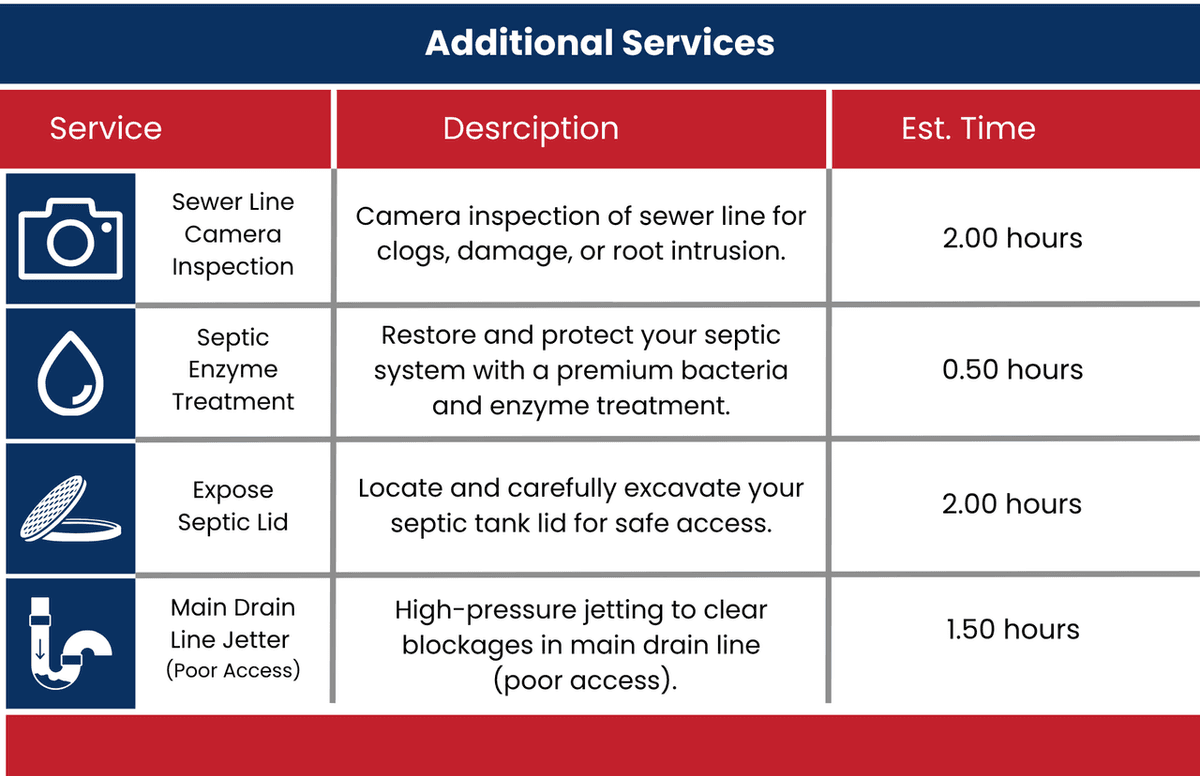
What we can price flat today: septic pumping, $395 for 1,000 gallons, tank inspection and written condition report included. And if what brought you here is a slow drain inside the house rather than anything in the yard, our $59 drain clean may be the entire conversation. On a septic property mechanical cleaning is the right tool anyway — caustic drain opener sterilizes the bacteria your tank runs on, and a bottle of it is a genuinely bad idea out here.
Does an inspection always turn into a big repair bill?
No, and our own records are why we can say that plainly. Sixty customers have had a completed septic diagnostic on our books. Twenty later booked further septic or drain field work with us. The other forty did not — the system was looked at, measured, written up and left alone.
Sometimes the answer is a filter that needed cleaning. Sometimes the tank is in better shape than the owner feared. Sometimes it is genuinely bad news, and finding it in March beats finding it in the middle of a closing. All three are useful and only one is a bill.
When there is real work, it gets named plainly and priced separately once we have seen it — septic repair in Payette if a component failed, drain field services in Payette if the field has stopped accepting water, septic tank installation in Payette if the system is finished. We never quote drain field work over the phone. Nobody has ever seen a drain field over the phone.
How soon can someone come out?
Across our completed septic diagnostic visits company-wide, comparing the date the job was booked against the date the work finished, 17 of 28 were done on the same calendar day, 24 of 28 within a day and 26 of 28 within a week. That is our record, not a promise about your particular Tuesday — routes fill, and a truck already committed in Weiser is not turning around for Payette that afternoon.
Two things help: call in the morning rather than late in the afternoon, and describe what you are actually seeing. "The yard is soggy and it smells" and "we are under contract and the contingency ends Friday" get scheduled differently.
Why does everybody call about septic in August?
Because that is when the ground stops hiding it. Of the 68 completed septic diagnostics on our books, 17 landed in August — the biggest month of the year, more than double any month from September through January. Late irrigation season is when a marginal drain field runs out of room, when a wet spot stays wet after the water is shut off, and when odor carries in the heat.
The demand is real and growing: 3 completed septic diagnostics in 2023, 10 in 2024, 13 in 2025, and 42 through early September of 2026. The takeaway is boring and correct. If you already suspect something, August is the worst month to be first noticing it, because that is when everyone else is noticing something too.
Do you actually work in Payette, or did you find it on a map?
We work here. Our Payette job record runs to 2,818 jobs, 2,519 completed, for 792 different customers, across 71 separate calendar months — including 364 camera inspections and 31 main line clogs in town.
The septic side is smaller and we will not inflate it: 21 septic jobs in Payette, all in 83661, including 6 completed septic system installations. Across the corridor we run — Weiser 31, Payette 21, Ontario 15, Nyssa 10, New Plymouth 9, Parma 7, Fruitland 5 — that is 98 septic jobs on this end of the valley, and Payette is second-busiest on the list. A town we service on a route, not one we advertise into.
Who do I call?
Related: septic pumping in Payette, septic service in Payette, septic inspection in Fruitland and Weiser, and the septic pumping cost guide. If the trouble is in the pipe rather than the tank: sewer camera inspection in Payette or drain cleaning in Payette. Everything else we do in town: the Payette plumber page.