

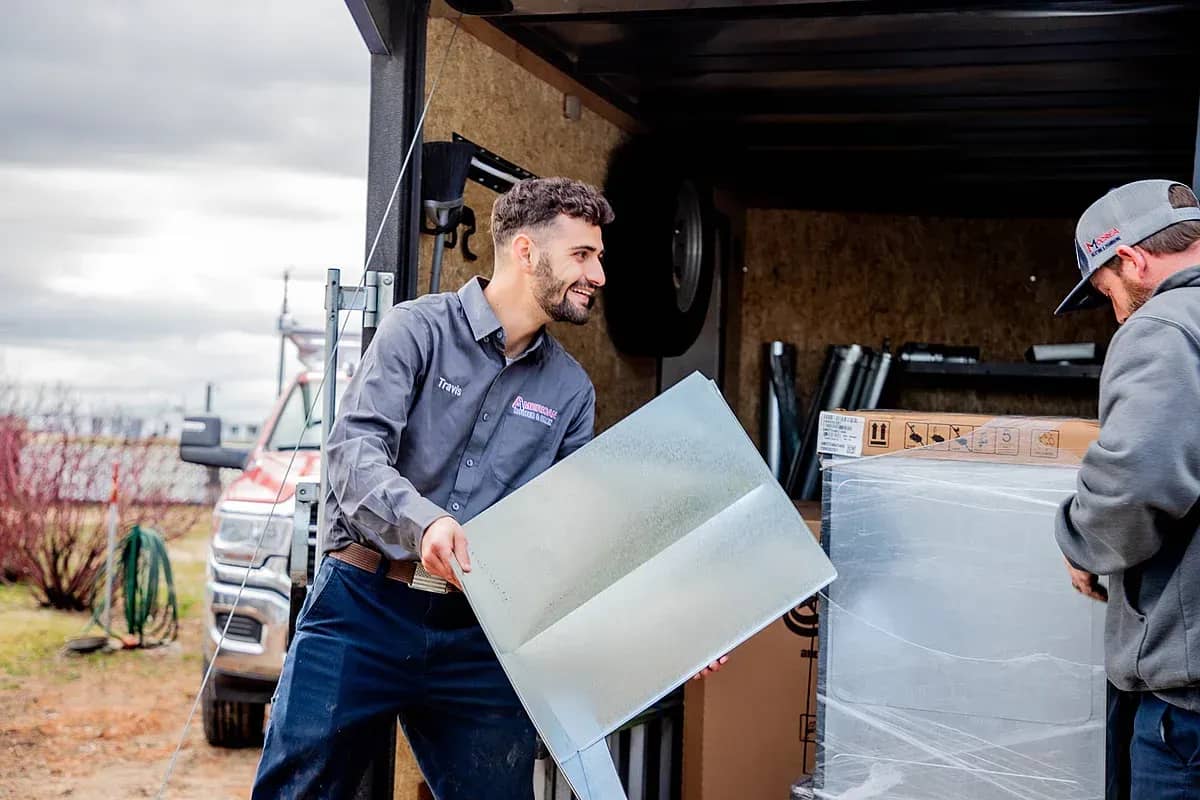
That machine is a permanently installed engine on a pad beside the house, wired in through a switch that never lets the house touch two power sources at once. It burns the gas or propane already coming to the property, starts itself whether anybody is home or not, and shuts down when the utility comes back.
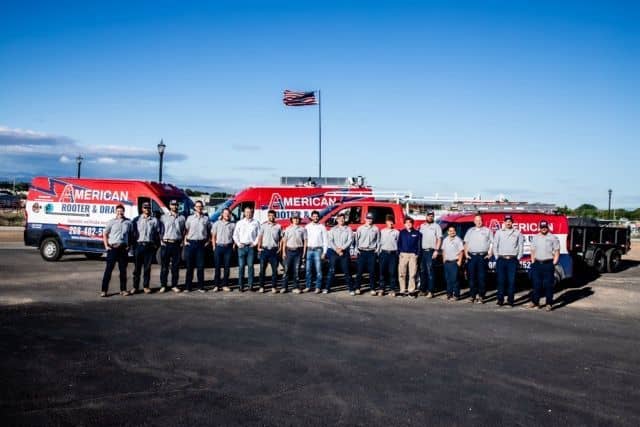
This is American Electrical Services, the electrical division of American Rooter & Drain — established in Caldwell, Idaho in 1945 and working the greater Treasure Valley ever since. The electrical trucks leave from 1005 Commercial Way, Suite A. Idaho Electrical Contractor LIC# 3671445, electrical line (208) 782-8268. The estimate is free and happens in your yard, because nobody can size one of these over the phone.
How big does the generator have to be for my house?
Not square footage, whatever the display at the home center implies. Starting loads — plus one decision only you can make.
A motor pulls far more current in the half second it starts than once it is turning, and the generator has to swallow those half seconds without stumbling. On Caldwell properties the loads that set the number are the air conditioning compressor, a well pump, an electric range or dryer, and a heat pump or electric water heater. Counting them means somebody at your open panel, which is why the estimate is a visit.
Before the count comes the shape of the system, which moves the price more than the badge on the housing does:
- The whole panel. Nothing behaves differently and you forget the power is off. Biggest machine of the three, and on some houses it drags panel work along with it.
- A named list. Furnace blower, refrigerator, well pump, some lights and outlets, a medical device. Smaller engine, smaller pad, and you live with a plan instead of forgetting.
- The whole house, taking turns. A load management module briefly drops a big, patient appliance — the dryer, the electric water heater — for the two minutes the air conditioner needs to start, then hands the power straight back.
That third one is a sizing lever, not a gadget, and it is where two quotes quietly stop being comparable. Every package we write includes load management for one appliance where the house needs it, soft starts on the air conditioning compressors so the startup surge is flattened rather than absorbed, and a time delay where required. Ask a competing bid whether any of that is inside its number.
One more trap when spec sheets sit side by side: a standby unit carries two power ratings, not one. Read 22/19.5 kW or 24/21 kW and neither figure is a typographical error — one is what the engine makes on propane, the other on natural gas, and only one half applies at your address.
We are on a well outside of town. Does that change anything?
It changes the whole list, and it is the first thing we ask when a Caldwell address is county ground. Inside the city you are on Caldwell water: an outage is dark and irritating, but the taps run. Get past the edge — southwest toward Sunnyslope, west along Homedale Road toward Wilder and Marsing, north over the river toward Purple Sage, out the Notus and Parma direction — and the house is on a private well. There an outage is no water at all. Not low pressure: none, the moment the pressure tank empties, because the pump is electric and nothing else lifts water up that casing. Add a septic system that pumps effluent uphill to a drain field, and that stops too.
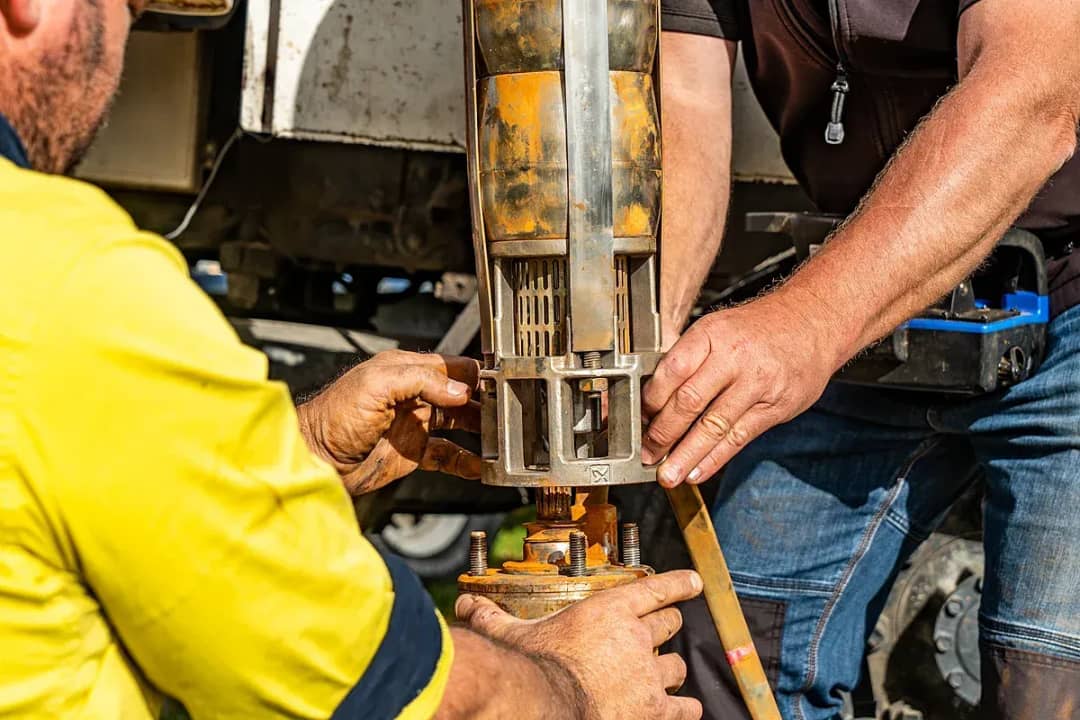
That is ground we already work: our records carry 6 well pump jobs and 33 septic jobs at Caldwell addresses, and the electricians are the same outfit under the same roof as the plumbers. A submersible starting under a full column of water is one of the heaviest loads on a property, so bring what you know — roughly what horsepower the pump is, usually on the tag at the pressure tank; whether it is a submersible or a jet pump, because they start differently; and whether the septic runs on gravity or on a pump.
The load nearly everybody forgets is the furnace. We have run 124 furnace jobs at Caldwell addresses, and every one of those furnaces is useless without house power — a gas furnace still needs electricity for the blower, the igniter and the control board. A January outage here is a heating problem before it is a lighting problem.
What does it burn, and how long can it run on its own?
Natural gas if the main already reaches the house, propane if it does not. In Caldwell the street settles that, and the line falls roughly where the subdivisions stop and the farm ground starts.
Natural gas means no tank, no deliveries and no runtime ceiling — a standby unit will carry a week-long outage with nobody driving out to you. One thing has to be settled first, and it is not the generator. A standby generator is a large gas appliance, and your meter was sized for heating, hot water and cooking — not all of that plus an engine at full throttle. Whether the meter can feed the unit is part of the on-site assessment. Where it cannot, the upgrade is your gas provider's work, on their calendar, and outside every one of our packages. Paying us more does not move their date, which is why we raise it at the estimate rather than on set day.
Propane is the answer wherever there is no main, which covers a good deal of ground west and south of town. It changes one thing: runtime stops being unlimited and becomes a number of gallons. So the questions change. How big is the tank and who fills it. Is it topped up going into the season, because a tank at a quarter in November is not the same machine as a full one. And does the spot the tank sits in agree with the spot the generator can sit in.
How much room does it take, and where is it going to sit?
Four things fight over that spot: clearance from windows, doors and vents; distance to the gas meter and the panel; what is buried in between; and what the ground is doing. Distance is the one with a price attached — our packages assume a short run with the gas and the electrical on the same side of the building, and once either run passes 30 feet, or the two land on opposite walls, the job steps up a tier. The base is a pad rated to 180 mph wind or a poured slab, except on low ground and lots that hold water in the spring, where we fabricate an aluminum stand and anchor it on site.
Settle noise early too. What you hear most is not an outage but the weekly exercise cycle, and we set that schedule with you at startup so it lands mid-week, not at seven on a Sunday. On the tighter older lots near downtown, which wall it goes on is worth deciding deliberately.
What if my breaker box is old — does that stop the whole thing?
Sometimes the panel is the real project and the generator is the smaller half of it. Caldwell produces that answer more than the newer valley suburbs do, because it has more old houses — the town was platted in the 1880s when the railroad came through, and the blocks nearest the original grid hold houses far older than the subdivisions out toward Ustick.
What the electrician reads when the cover comes off: the service size, because a 100-amp and a 200-amp service are different projects once a transfer switch lands in the middle of them; where that switch goes, at the panel or out at the meter; free breaker spaces and the condition of the bus; grounding and bonding, since the generator becomes a second source of power for the house; and whether a heat pump, hot tub or EV charger is coming, because that belongs in the decision now rather than twice.
If the panel is the constraint, it is its own project with its own permit and price, and we say so at the estimate — that work lives on our panel upgrades page for Caldwell. A panel that was tripping breakers before anybody mentioned a generator is an electrical repair in Caldwell job first. If you just want an overall read on the panel's condition before deciding anything, an electrical safety inspection is the lower-commitment first step.
One thing to fix today regardless: if your outage plan is a cord with a male plug on both ends pushed into a dryer outlet, retire it. It energizes your panel through a path nothing is switching, pushes power back onto the utility line where a lineman told the street is dead can be killed by it, and destroys your machine when utility power returns. The safe version is an installed 30- or 50-amp inlet with a manual transfer switch behind it. Our packages include a 200-amp OEM automatic transfer switch, with a 400-amp version for a 400-amp service.
Does this need a permit in Caldwell, and who checks the work?
Yes — normally two permits rather than one: the electrical work, and the gas piping out to the machine. Both sit inside our installation packages. We file them and book the inspection, and the person who signs the work off does not work for us — that signature is what a buyer's inspector looks for when you sell.
Which counter each permit crosses depends on your address. The City of Caldwell runs its building permitting through Development Services at 205 South 6th Avenue on an online portal, while electrical permitting and inspection for residential work in this part of Canyon County runs through the State of Idaho's electrical program. A Caldwell mailing address also does not automatically mean a house inside the city limits — 83605 and 83607 both reach out into county ground, and we settle which side of that line you are on at the estimate, not on install day.
Then there is the approval nobody expects, and Caldwell is the town that wrote the case law on it. Most of the canals, laterals and drains threaded through and under this city belong to the Pioneer Irrigation District, whose office is here, and its easements are property rights rather than lines on an old map. Idaho Code section 42-1209 stands behind that, and the Idaho Supreme Court confirmed in Pioneer Irrigation District v. City of Caldwell that the district may require removal of an encroachment placed in its easement without written permission. A generator install means a gas line and an electrical run trenched across your yard, so where that trench goes has to be answered before anybody orders a machine. That network reaches so many ordinary back lots because the water came first and never left: Indian Creek runs straight through the middle of downtown, buried under concrete from the early 1950s until it was uncovered a block at a time starting in 2003, and the irrigation that made this ground worth farming is still where it was put.
Before any trench opens we file a locate request with Digline, Idaho's 811 service, with the state's two-business-day notice built into the schedule. The gap worth understanding: 811 gets the utilities' lines marked, not yours. The gas line somebody ran out to the shop, the sprinkler mainline, the septic line and drain field are not member facilities and will not be marked. Those we find by asking you, and by digging carefully wherever the answer is a shrug.
What is the order of events from the first phone call?
A fixed sequence, with the dates in writing at the estimate. We will not print a number of days here, because the two things that stretch the calendar are not ours to control: the gas provider, if the meter has to change, and equipment.
1. The estimate visit. A licensed electrician opens your panel, finds the gas meter, measures the run, walks the trench route and asks what you want still running. Fixed price in writing before anything is ordered. Free.
2. Permits and locates, filed by us, with the Digline notice window built into the schedule.
3. The gas provider, if the meter has to change — the one step that is not ours.
4. The base. Wind-rated pad, poured slab, or a fabricated aluminum stand anchored on site.
5. Set day. Machine placed and anchored, gas line run and pressure tested, electrical pulled, transfer switch landed, load module in, soft starts fitted.
6. Startup and system testing. Not plugging it in — the transfer is proved by actually taking the utility away from it, with you there while the exercise schedule is set.
7. Inspection.
Replacing a machine you already have is shorter, because most of the site work is done: if the pad, gas line and switch are sound, a swap reuses all three and hauling the old unit away is inside the package. We also install customer-provided equipment, and repair air-cooled and liquid-cooled machines whether or not we installed them, with parts stocked for Generac and Kohler.
After that the machine wants oil and a filter, plugs gapped, an air filter and a watched battery, on a schedule set by run hours and calendar time. Two things fail far more often than the engine: the battery, whose terminals oxidize outdoors and whose charger can die quietly, and the transfer switch — its coil, its control board, or the small fuses protecting it. A machine that runs its weekly exercise beautifully and then will not pick the house up in a real outage is usually a switch, not an engine. Say that on the phone; it changes what goes on the truck.
Why won't anybody give me a price over the phone?
Because the machine is one line on the invoice and your property is all the rest of it. We do not publish generator prices and we will not quote a range. A range only sets you up to be disappointed by the real number, and anybody handing you one over the phone is guessing at a yard he has never seen. Longer version: why we won't quote a price.
What actually moves the figure on a Caldwell lot:
- How far the machine sits from the gas meter and the panel, and whether those two are on the same side of the house.
- How much trenching, and what it crosses — turf, gravel, a driveway, tree roots, a sprinkler mainline, or an easement that forces a longer route than the straight line you pictured.
- What it sits on, and whether concrete has to be cut and replaced to make room.
- Add-ons — surge protection, load management beyond the one appliance, a 400-amp transfer switch.
Two things sit outside our price entirely: a gas meter upgrade if your provider has to perform one, and panel work if the panel is the constraint rather than the generator.
Packages also differ in ways a price comparison never shows. Every one of ours includes a high-capacity battery, load management for one appliance where needed, soft starts, permitting, turn-key installation and system testing; past that they part company on years of maintenance and of extended parts and labor coverage above the factory warranty. The on-site estimate is free.
Is your shop actually in Caldwell?
It is, and this is the town the company started in. American Rooter & Drain was established in Caldwell, Idaho in 1945, and the building the electrical trucks leave from is 1005 Commercial Way, Suite A — the same shop the plumbing, septic and heating trucks roll out of.
We are not a call center routing your address to whoever answers. Across every trade we run, our dispatch records carry 4,165 jobs booked, 3,746 of them completed at Caldwell addresses, over 1,495 separate service properties; on the electrical side, 39 jobs at Caldwell addresses, 16 of them free estimate visits — a licensed electrician looking at a panel, not a salesman with a tablet. The Caldwell location's Google profile carries a 4.8-star average across 1,680 reviews.
Call (208) 782-8268 and ask for the next estimate opening. Bring your list of what you want still running, plus whatever you know about the well, the gas meter and where the irrigation runs.
Standby work runs next door in every direction — Nampa, Middleton, Parma and Homedale each have their own page, with the full picture on the whole house generator installation page. The same visit can cover a panel upgrade, an EV charger or an electrical repair in Caldwell; the plumbing side handles well pump repair and septic work in Caldwell; and every trade we run here is on our Caldwell page.
American Electrical Services · 1005 Commercial Way, Suite A, Caldwell, ID 83605 · Idaho Electrical Contractor LIC# 3671445 · (208) 782-8268. American Rooter & Drain's plumbing line is (208) 366-5771.