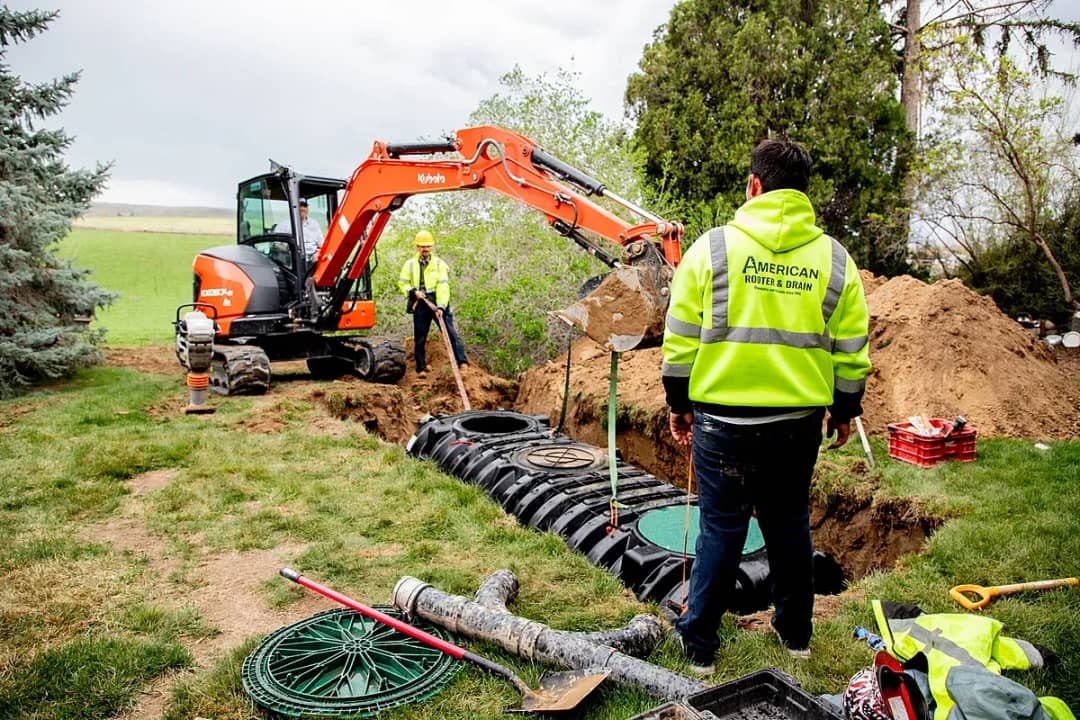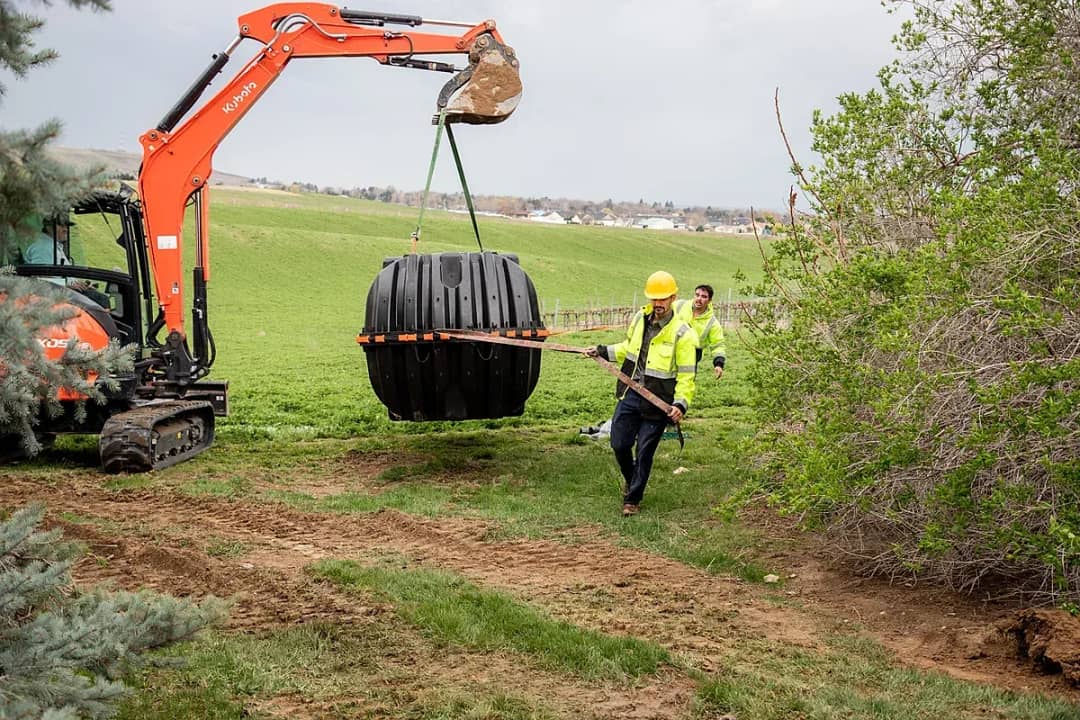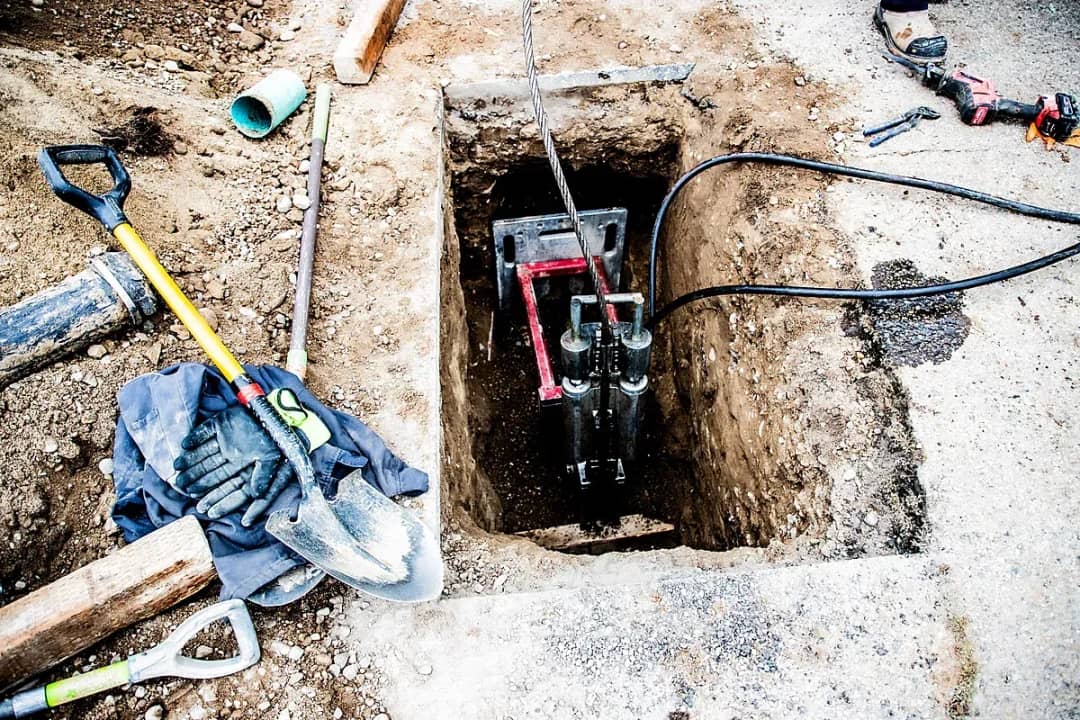

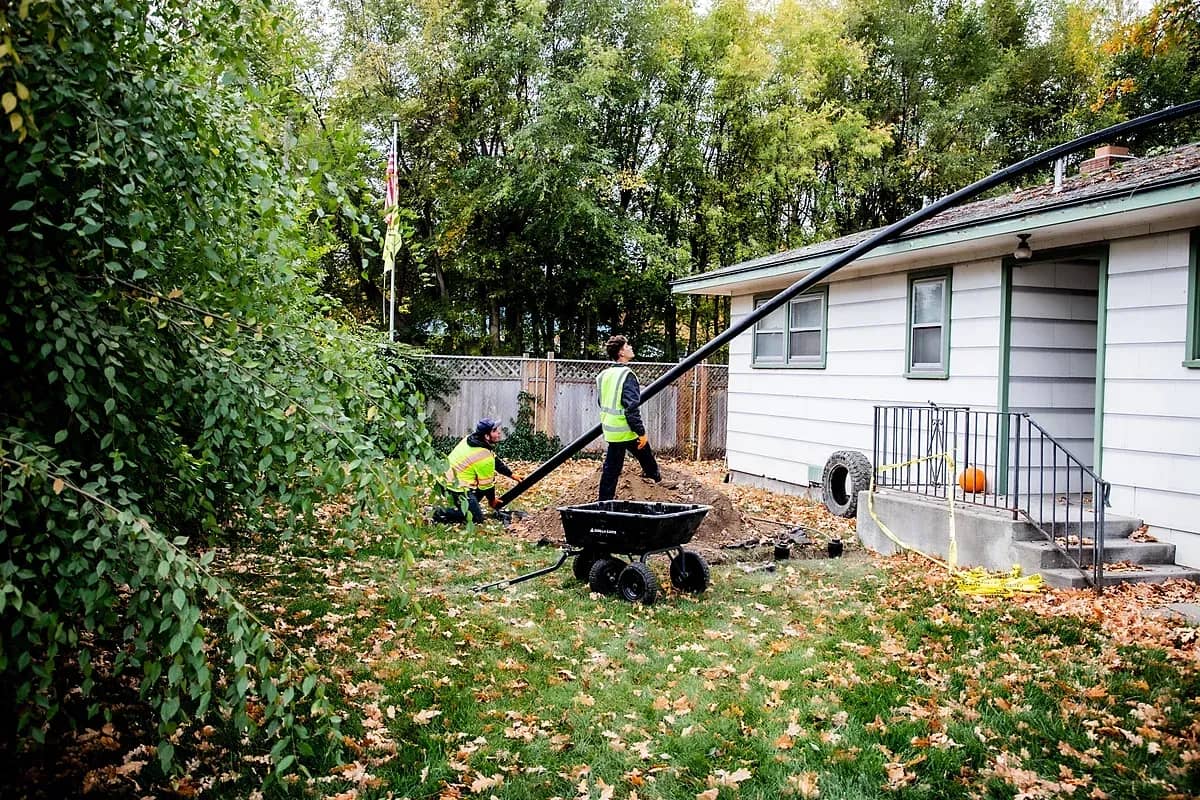
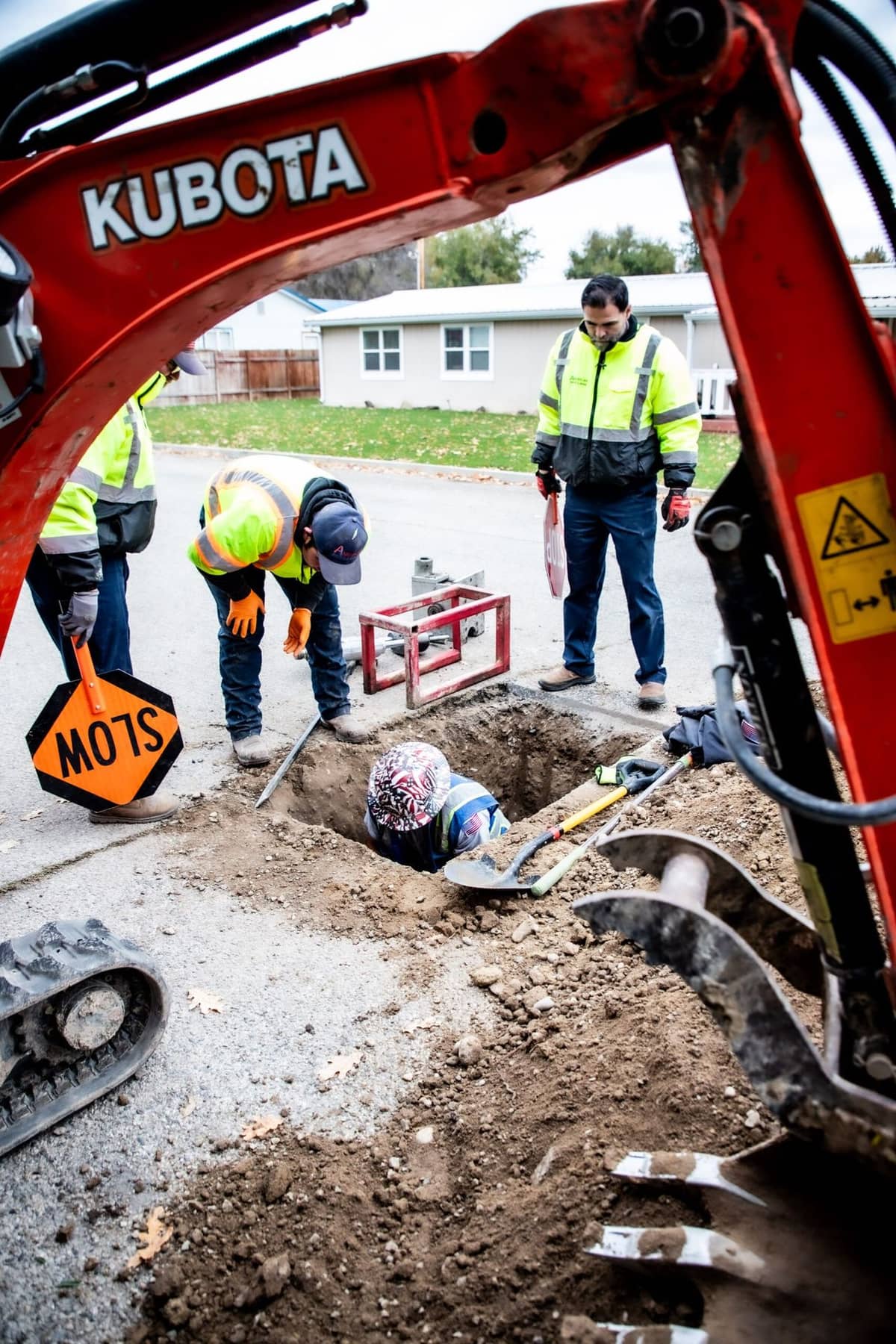
American Septic finds the field, tells you whether the field is what failed, repairs what can be saved, and builds a replacement when the soil under the trenches is finished. We are the septic side of American Rooter & Drain, established in Caldwell, Idaho in 1945 and serving the greater Treasure Valley since. Our trucks have run 5,434 jobs at Boise addresses across 2,441 different properties.
Is my Boise house even on a septic system?
Start here, because a fair number of people calling about a soggy yard turn out to be on city sewer. Most addresses inside city limits drain to the municipal system. Septic survives where the mains never reached: unincorporated county pockets surrounded by city, older acreage annexed around but never connected, foothills lots, and larger parcels at the edges.
Three checks, none of which need a truck:
- Your monthly City of Boise utility bill. A sewer charge means you are connected. No sewer line item and you are almost certainly on your own system.
- Hardware in the yard. A tank has a lid, usually two, often buried a few inches down and often paved over or planted on top of. A 4-inch capped pipe standing out of the lawn is an inspection port for the field.
- The as-built. Septic permits are filed with the health district, and a drawing of the tank and laterals turns a two-hour hunt into a ten-minute walk.
If the bill says sewer and the yard is still wet, the cause is something else — a broken lateral, a leaking water service, an irrigation line — and a sewer camera inspection in Boise answers it faster than digging will.
Where in Boise are the septic systems?
Scattered, which is what makes them easy to forget. Our septic-specific calls at Boise addresses land in seven zip codes — 83702, 83704, 83705, 83706, 83709, 83714 and 83716 — across 17 separate properties. There is no septic neighborhood here, just leftovers everywhere.
The largest share, eight of those calls, sits in 83709 in southwest Boise, where county islands and older half-acre and acre lots still run their own systems. Northwest, 83714 climbs toward Hidden Springs, which has its own drain field service page. Southeast, 83716 runs up the Boise River corridor toward Lucky Peak where soil gets thin over rock in a hurry.
Those settings fail differently. A southwest lot near the canals has a shallow water table that rises under the field every irrigation season. A foothills lot may have only a couple of feet of usable soil before the profile turns to decomposed granite or basalt, so the field was built shallow and wide with less margin. That is why a technician asks which part of town you are in first.
What does a failing drain field look like from the back porch?
Read the yard before anyone reads the tank. In July half the neighborhood has green grass because half the neighborhood is watering, so a green patch alone proves nothing. Shape and persistence give it away.
- A stripe, not a blob. Grass over a lateral pushing water upward grows taller and darker than the turf beside it, in a straight line, because the pipe underneath is straight. Two or three parallel stripes is the whole field. One rectangle at the near end is usually the distribution box, which is a much smaller repair.
- Green that outlasts the watering. Skip a cycle. The patch that stays lush while everything else fades is being fed from below.
- Odor outside with nothing wrong inside. Effluent smells. A cut irrigation line and a wet dog run do not.
- An alarm. On a system with a pump chamber and a buzzer, an alarm means water is not leaving on schedule. Silencing it empties nothing.
If water is standing on top of the ground, be clear about what it is. It has cleared the tank but not the earth, and the earth is where treatment actually happens. Rope it off from kids, dogs and stock, and resist the urge to dig in for a better look.
Is it the drain field, or is it the line under my lawn?
From inside the house these look identical, and guessing wrong is expensive both ways. At Boise addresses we have run 791 clogged drain calls, 417 camera inspections, 65 main line clogs and 18 sewer smell calls, and plenty began with somebody sure their septic had died.
A blockage between the house and the tank behaves like any other main line clog. One fixture goes first, usually the lowest in the house, and the trouble stays indoors. A cable or a jetter opens it and it stays open. Our $59 drain clean covers a lot of these.
A drain field problem announces itself in the yard, and the plumbing is the last thing to notice. Ground goes soft, the stripe shows up, there is an odor out at the field and none in the bathroom. Then the tell that settles it: once the tank is emptied, the drains slow again within days rather than months. Water level drops and stays down, and the tank was what flooded it. Water level comes back up with an empty tank behind it, and the field itself has quit accepting water.
Which is why the first move on nearly every one of these calls is a pump-out. Septic pumping in Boise is $395 for 1,000 gallons — both the treatment and the cheapest test for which half of the system you are about to buy.
Why does my yard only go soft in the summer?
Southwest and south Boise sit in canal country. When irrigation season opens and water moves through the ditches and across the flood-irrigated ground around you, the shallow water table comes up with it. The drain field has not changed. What changed is the unsaturated soil under the trenches — the layer that does the absorbing — which has filled in from below. Come fall the canals shut down, the table drops, the field works again, and the owner writes it off as a wet spring.
It was not. A field that surfaces every July and behaves every January is running with no margin left. Catch it there and the cheap options are still open: pumping on a real schedule, getting the softener discharge out of the septic, pulling roof and sump water away from the field. Wait two or three more seasons and the same yard will be wet in February, and by then the conversation is about replacement.
What actually wears a drain field out?
What makes a drain field work is also what kills it. Along the walls of every trench, where effluent touches undisturbed earth, a thin dark biological skin forms. It is meant to be there. It handles much of the treatment and holds the water back on purpose so the ground beneath has time to do its job. The field dies when that skin grows faster than it can eat itself away. Every cause below runs through that one mechanism:
- A tank nobody pumped. Let the sludge climb to the outlet and grease and solids wash into the laterals, feeding that skin directly. The one item here you can prevent for free.
- More water than the design allows. A field is sized by gallons per day, not gallons ever. A softener regenerating into the septic, a sump or downspout plumbed into the sanitary line, a toilet running quietly upstairs.
- Air shut out of the soil, or compaction. A slab, a parking pad, sheet plastic, fabric under bark — seal the surface and the soil goes anaerobic, so the skin stops digesting and only thickens. A truck across it once on wet ground does the same, and compacted soil does not spring back.
- Roots. Anything with a serious root system near a lateral finds the water and goes in through the perforations.
- Broken hardware. Crushed pipe, a lateral that lost grade, a tipped distribution box — worth hunting for, because these are repairs rather than replacements.
Is there room for a new field on a lot this size?
On an acre past the city, usually. On a quarter-acre county island surrounded by Boise, this is the whole question, answered before anything is designed.
A replacement field is not a part you swap out. It needs earth that has never taken effluent, that sits above the seasonal water table, and that holds every setback. The old footprint does not simply come back into service — that ground is what failed. Newer systems were permitted with a replacement area held in reserve for exactly this day; on older Boise lots that reserve is often under the shop, the pool, the second driveway or a row of forty-year-old trees.
Separations do the rest. Distance to a private well is the largest and least negotiable, and on a small lot the circle it draws can eliminate the usable ground in one stroke. Property lines, canal easements, the foundation and the buried water service all have to clear too. Gravity only works if the new field lies lower than the tank outlet; where it does not, the design gains a lift station, and with it power, parts and upkeep for the life of the system.
One outcome worth naming on a tight lot: if a sewer main is already in the street and the connection is available to you, that comparison belongs on the table alongside a replacement. A lot that cannot hold a compliant field should not have one forced onto it.
What happens on the first visit?
- We locate the system. Tank, lids, the pipe leaving it, and where the laterals actually run. Bring the as-built if you have it; nothing else you hand us saves as much time.
- We open the tank and read it. Sludge depth, scum layer, liquid level against the outlet, condition of the baffles. A liquid level standing above the outlet is the field backing water up into the tank.
- We look at the field, matching the shape of the wet area against the actual layout and checking how far saturated soil extends past the trench walls.
- We put a camera where we can. Down the outlet line, and into the laterals if there is an access point — which turns up flattened pipe, root balls, and pipe that was never laid on grade.
- We ask about the house. Occupancy changes, a new softener, an added bathroom, whether the sump or gutters were ever tied in.
- We pump, then rest it, and somebody comes back to see where the water sits with the household load off the field.
You get what we found in writing, and if the answer is a repair you get that price before anyone starts.
Can it be fixed without replacing the whole field?
Often enough to be worth checking before you commit replacement money. The list below runs cheapest first.
- Pump and rest. Treatment and diagnostic in one visit.
- Clean the laterals one branch at a time. Our cleaning is priced per branch for a reason: one blocked lateral with three healthy ones beside it is not a dead field. We have jetted a leach field behind a pump-out on an Eagle property.
- Level or reset the distribution box. That buried junction, the D-box, shares flow among the laterals. Settle it or crack it and a single branch swallows the whole household while its neighbors stay bone dry. Standing on the grass you cannot tell that from total failure; two feet down it is a small fix. We did one in Ontario.
- Repair the pipe running from tank to field. Its own component, its own price line, and now and then the entire fault.
- Fix the source. Softener discharge, a downspout, a sump, a flapper valve. Sometimes the only work needed.
The signs that a field is genuinely spent: the level will not fall even after the tank is emptied and rested, wet ground shows over the entire footprint rather than one lateral, and each attempted fix lasts weeks where it used to last years. That is a soil failure, and no jetter cleans soil. A spent field does not condemn a healthy tank, though — putting in a new field and leaving the old tank in place is routine.
Who has to approve a new drain field in Boise?
Central District Health, which covers Ada County along with Boise, Elmore and Valley counties, permits subsurface sewage disposal here. That office decides how much absorption area your property needs and which design your soil qualifies for.
The sequence runs: soil evaluation, design, permit issued, excavation, inspection while the trenches are still open, then backfill. Test holes get opened to log the soil profile where the new field would go — a real job type on our books, dug in Weiser, Caldwell, Nampa, Homedale and Mountain Home. The design follows what those holes show, not the other way around.
Two consequences. Nobody can honestly promise you an installation date before the permit is issued. And file the inspection sign-off and the as-built where you will find them again, because the next buyer's inspector asks for both. Selling? Having the field's condition written down on its own is a leach field inspection, and it pairs with a septic inspection in Boise.
How long will my yard be torn up?
A repair is usually a single visit. A full replacement is a multi-day project, and the digging is rarely what sets the calendar. What does: the permit review sitting in front of the work; how wet the ground is on the day, because digging trench in sodden earth polishes the walls and a polished wall glazes over the very surface meant to absorb; and whatever has to be taken out and put back — driveway, fence line, sprinkler mains, landscaping.
Before a bucket moves we pace the layout with you and paint it out, so nobody is surprised by the footprint on the morning of. Topsoil is skimmed and piled apart from the subsoil coming out of the trenches; mixing the two is why some yards look wrong for years afterward. Plan on the trench lines sinking a little through the first winter, and on the grass above a new field taking more than one season to knit back together.
Then keep it alive the boring way: nothing heavier than a mower crosses it, grass over it and nothing else, and the tank pumped on schedule.
What does drain field work cost in Boise?
No honest figure belongs on this page, and the reason is worth knowing: the biggest single input is decided by somebody outside this company. How much absorption area your soil obliges you to build is the health district’s call, and that ruling swings the total further than anything we control.
The rest of the swing: which design your ground qualifies for; gravity or a pump; the distance between tank and new field; whether any of the failed area is salvageable; what gets torn out and put back; and whether the pipe out of the tank is still good, which is priced on its own.
Two things do not move. A fee is charged up front, and it is not refundable, because it pays for assembling your file and carrying the permit through the health district — that work gets done whether the ruling lands easy or hard. And the on-site estimate costs nothing, with a written price before anyone starts. The valley-wide picture sits on what a new septic system costs in Idaho. The single flat number touching nearly every call like this is the $395 pump-out.
When can you get somebody out here?
Fast, most days. Of the completed jobs at Boise addresses where we hold both the booking and the completion on record, 1,169 out of 1,575 finished on the same calendar day the call came in, and 1,419 finished within one day. Drain field diagnosis usually starts with a pump-out, and that part is very often a same-day visit.
Call (208) 782-8269 and tell whoever answers which part of Boise you are in, what the yard is doing, and when the tank was last pumped — those three answers decide what goes on the truck.
If the field can be saved, you are looking at septic repair in Boise or plain drain field service — a much better day. If the soil really is spent, you will know that too, with a written price in hand before any machine rolls onto the grass. The full technical walkthrough is on our drain field repair and replacement page.
The drain fields we have replaced sit where the sewer never went: Eagle and Meridian on this side of the valley, then Caldwell, Wilder, Weiser, Payette, Fruitland and Mountain Home, plus Ontario and Nyssa across the Oregon line. Nearby town pages: Eagle, Meridian, Garden City, Kuna and Star. For work with nothing to do with septic, the Boise services page has the rest.