Nothing you can do at the shower drain will fix this, and plunging, snaking or pouring a chemical down it will make the mess worse. The shower is only where the problem showed up. The blockage is somewhere farther along, in the pipe that carries everything out of the house.
What to do right now
1. Stop all water use. No toilet flushes, no washing machine, no dishwasher, no showers, no running taps. Every gallon you send down has nowhere to go and comes up at the lowest opening, which is the one already overflowing.
2. Keep children and pets out of the bathroom. Sewage contains bacteria, viruses and other germs, according to a state health department. Do not touch it with bare hands, wear rubber gloves for anything it has touched, and wash your hands right after.
3. Do not use a drain chemical or a plunger on it. A chemical cannot reach a blockage that is farther down the pipe. It would only sit in a tub of sewage that someone has to clean up.
4. If water is spreading toward outlets or appliances, switch off power to that area at the panel from a dry spot.
5. Open a window if the smell is strong, and wash your hands well after any contact.
Why is water backing up in my bathtub when I flush the toilet?
Because the tub and the toilet empty into the same pipe, and that pipe is blocked below both of them. When you flush, the water has nowhere to go but back up the line and out of the lowest opening it can find. A bathtub or basement shower is usually lower than the toilet, so it is the first to show it. The tub is not the problem. Stop using water and call, because each flush pushes more water into a line that cannot take it.
Why the shower is the first place it shows
All the drains in a house empty into one main line that runs out to the city sewer or to a septic tank. When that main line is blocked, wastewater backs up the pipe like water in a bathtub. It rises until it finds an opening, and the opening it finds first is the lowest one. That is often a basement shower, a tub on the ground floor or a floor drain, because those sit closest to the main.
So a shower that fills with dirty water when the toilet is flushed, or when the washing machine empties, is telling you something specific. Water from other fixtures is reaching the same blockage and being pushed back up through the shower. It does not mean the shower is the problem.
How to tell a main line from a single fixture
You can answer this in a couple of minutes without any tools.
- Is it only this shower? If the toilets, sinks and washer all drain normally and only one shower is slow, that is a branch line problem, covered in how to unclog a shower drain.
- Does it happen when something else drains? If the shower fills when a toilet is flushed or the washer runs, the fixtures share a blocked line.
- Are two or more fixtures slow or gurgling together? That points to a shared line and not to one fixture.
- Is the lowest drain in the house the one that backs up? A blocked main pushes water out of the lowest opening first, so a basement drain or ground-floor tub backing up while upstairs fixtures still drain is a main line sign.
If you answer yes to any of the last three, treat it as a main line. The color of what comes up is not a reliable test, so do not wait to see whether it looks dark.
Why is my shower drain gurgling even though nothing is blocked?
A gurgle from a drain you are not using usually means air is being pushed or pulled through its trap by water moving somewhere else. Two causes are common: a vent that is not letting air in, or a main line that is partly blocked and pushing air back up as other fixtures drain. A single gurgle once in a while is a vent question. A gurgle together with a slow drain, a toilet that bubbles or any sewage smell is a main line warning, and the next flush or load of laundry can turn it into a backup.
What you can safely check
Keep this short and safe. You are gathering information for the phone call, not trying to clear the line.
- Look for the cleanout. It is a capped pipe, usually three or four inches wide, outside near the foundation, in the basement or in the crawlspace. Look at it, but leave the cap on. If sewage is already seeping around it or standing at it, that tells us the blockage is downstream of the cleanout, so mention it when you call.
- Ask a neighbour. If the houses on your street are slow or flooded, the blockage may be in the city's pipe in the street and not yours. Tell us when you call. A Connecticut health department notes that heavy rain, flooding and thaws can overload sewers, and that blockages in sewer systems can also cause backups.
- Think about the septic tank. If your home is on septic and it has been years since the tank was pumped, a full tank can back up into the house in just this way. The EPA lists sewage backing up into the home's drains as a common sign of septic trouble. A septic pump-out is what that case calls for, and our septic page explains the signs.
- Note when it started. If it began just after heavy rain, or after a lot of laundry, say so. If you rent an apartment or townhouse, tell your landlord or property manager as well, because the blocked line may be shared.
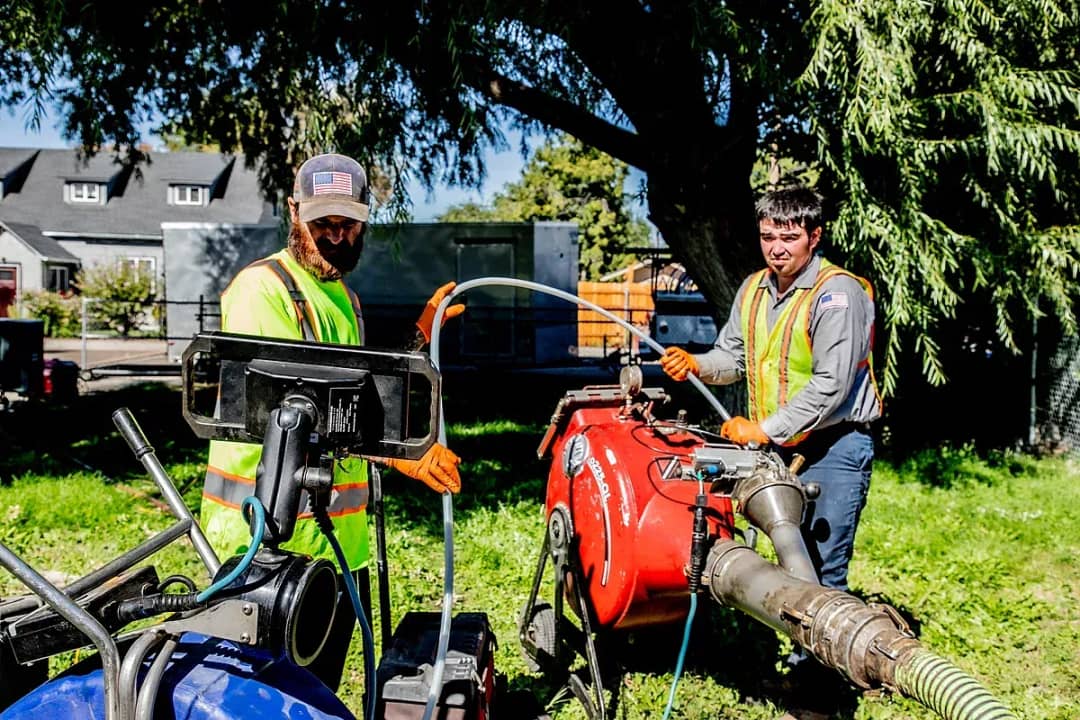
That is all. Do not climb into a crawlspace to hunt for the blockage and do not try to open a cleanout and feed a cable into it. Do not rent a sewer machine either. The maker's own operator manual for one drum-type machine warns that hands can be caught in the moving parts of the drum and guide tube with serious injury, and says never to grasp the rotating cable with a rag or loose glove because it can wrap around the cable. That is the wrong tool in untrained hands.
What is usually behind it
A main line stops for reasons that a shower snake will never touch:
- Tree roots that have worked into a joint in older clay pipe and packed it solid.
- Wipes, grease and scale that stick together and catch on a rough spot.
- A pipe that has sagged, shifted or collapsed, leaving a low spot where solids settle.
- A full septic tank or failed drain field, if you are not on city sewer.
Telling these apart takes a look at the pipe, and the right fix depends on which one it is. A blockage that is only grease clears differently from roots, and neither is a repair if the pipe has failed. For the full list of causes and repair options, see sewer line backing up.
What about cleaning up after sewage backs up?
Public health agencies treat this as a contamination job and not a mop-up. The Connecticut health department advises protective eyewear, gloves and boots, avoiding direct contact with sewage, washing your hands after, and discarding porous items such as carpet, cardboard and upholstered furniture that sewage soaked. It lists hiring a professional cleanup company as the sensible choice when sewage has stayed indoors for more than 24 hours in a finished living space or when the job is too large to do yourself. Cleanup is separate from clearing the blockage, so get the line cleared first or the backup will repeat.
How do I stop sewer gas from coming up the shower drain?
If the gas is coming up because the trap has dried out, running water in the shower for a minute refills it, and the page on a smelly shower drain covers that and the vent causes. If the smell comes with sewage or a slow drain, the cause is the main line and the fix is clearing it, not anything poured down the drain.
When should I stop and call a plumber?
Now. This is the one question on the site where the answer is not "try this first." Call us and keep the water off if:
See emergency plumbing for after-hours calls, and sewer line backing up for what a backup involves. This is not a branch-line job. Call (208) 366-5771.
What it costs
What moves the number: how far out the blockage sits, whether there is a usable cleanout or we pull a toilet, pipe material and depth, whether the line runs under a driveway or landscaping, and whether the fix is a cleaning, a spot repair, or a replacement. None of that is visible from a phone call.
Could a full septic tank cause sewage in the shower?
Yes. The EPA lists sewage backing up into the home's drains as a common sign of septic trouble, and a tank overdue for pumping is one cause.
Is sewage in the house dangerous?
Yes, it can be. A state health department says sewage contains bacteria, viruses and other germs, so keep children and pets away and never touch it with bare hands.
Why is my bathtub filling with water when I flush the toilet?
The tub and toilet drain into the same blocked pipe, so the flush has nowhere to go and rises at the lowest opening. Stop using water and call.
Why does my shower gurgle when nothing else is running?
Air is moving through the trap because of a vent problem or a partly blocked line. If it comes with a slow drain, bubbling in a toilet or a sewage smell, treat it as a main line warning.
Where we work
American Rooter & Drain was established in Caldwell, Idaho in 1945 and has worked the greater Treasure Valley since 1945. We clear main line backups in Boise, Nampa, Caldwell, Meridian, Kuna, Eagle, Star, Middleton, Garden City, Emmett and the rest of the valley, plus Ontario, Nyssa and Vale in Oregon. See what we do in Boise, Nampa, Caldwell and Meridian. Call (208) 366-5771, days, nights, weekends and holidays.