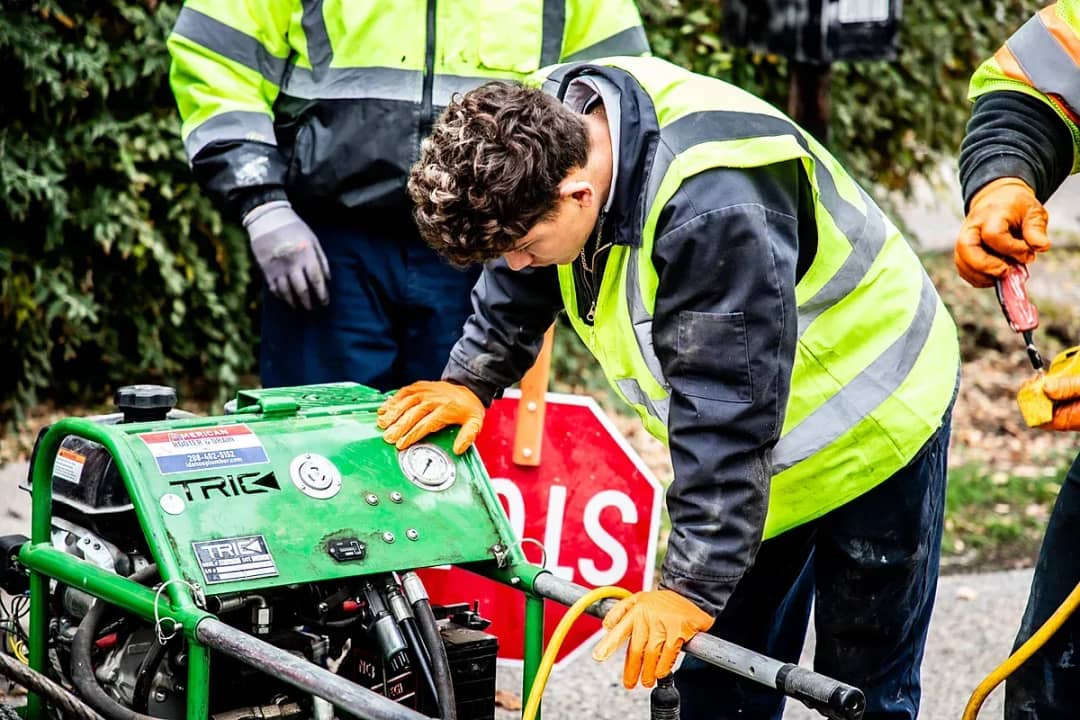
We run these calls out of the shop at 1005 Commercial Way in Caldwell. American Rooter & Drain has served the greater Treasure Valley since 1945. Call (208) 366-5771 and we will put a camera in the line before anyone talks about digging.
What's actually under a Marsing lot built before 1970?
Clay, more often than not, and clay laid by hand decades ago the same way it was laid everywhere else in the valley at the time — short sections joined bell-to-spigot, sealed with mortar or a packed jointing compound, no gasket to absorb any movement in the ground around it. That seal was built to hold a fixed shape. It was never built to flex, and the ground under a lot this close to the Snake River gives it plenty of reason to.
Because Marsing grew lot by lot instead of subdivision by subdivision, the age of the house tells you less than it would somewhere else. A newer-looking home built on a lot split off an old farm parcel in the 1980s can still carry a clay lateral run decades before that, tied into a main that predates the house sitting on top of it. The only way to know what's actually down there is to look, which is the first thing a camera does regardless of what year the county thinks the house was built.
Why does silty river-bottom ground work a joint loose faster than firmer soil?
The soil along this stretch of the Snake is fine, silty material laid down over centuries of the river spreading out and slowing down — good for growing onions and mint, which is a large part of why this ground got farmed in the first place, and mediocre at holding a rigid clay joint in one position. Silt behaves differently from sand or gravel: it holds water instead of shedding it, swells when it's wet and shrinks when it dries, and does both on a tighter cycle than denser clay-loam soil elsewhere in the valley. A pipe joint sitting in ground that's expanding and contracting around it every irrigation season doesn't get to settle into one fixed position the way it would in firmer ground. It gets worked, a little at a time, for as long as the cycle keeps repeating — and on a lot that's been irrigated every summer for seventy years, that's a lot of cycles.
Once a joint opens even slightly under that kind of pressure, the same silty soil that caused the problem starts making it worse. Fine particles migrate into the gap on the inside, and moisture that would otherwise drain away instead lingers right at the point of failure, softening the ground around it further and giving roots looking for water an easy way in.
Why does a working garden change what a trench actually costs you?
Plenty of Marsing lots still have what their original owners planted: a fruit tree or two, a grape row, a vegetable garden laid out in furrows that have been worked in the same spot for longer than most nearby fences have stood. None of that is landscaping in the sense a newer subdivision means it — it's cultivated ground, hand-shaped over years, and a trench cut straight through it doesn't just disturb dirt. It cuts through irrigation furrows built up over seasons, takes out a fruit tree's root system if the path runs anywhere near it, and leaves the soil compacted and mixed in a way that changes how it drains and how well anything grows there for at least a season or two afterward, sometimes longer.
That's the cost a homeowner on one of these lots is actually weighing, and it's a real one even before you get to the price of the dig itself. Pipe bursting sidesteps most of it by using two access points instead of a continuous cut — the pull follows the buried pipe's existing path below where the garden's actual root zone sits, and the two pits get placed to miss a fruit tree or a garden bed wherever the layout allows it.
Is the drain actually fixed, or did the cable just buy you a few weeks?
There's a pattern worth naming for anyone who's had a Marsing line cabled more than once: each time, the interval before it backs up again gets a little shorter. That's not coincidence and it's not new debris finding its way in every few months. A cable clears a path through whatever's blocking the pipe without changing the pipe itself, so if the actual cause is a joint that's stepped out of alignment in loose silty ground, the channel that gets reopened is narrower than the one before it — the joint hasn't un-shifted, it's just had material pushed through it again.
Drain cleaning in Marsing is the right and cheaper answer when a camera shows the pipe itself is still round and sound. It stops being the answer once the camera shows the joint has actually moved, because at that point the next cable pass is buying weeks, not a fix.
What if it's buildup, not a broken joint?
A weeping joint that hasn't actually separated yet still shows up on camera as roots or debris rather than a structural gap, and treating that like a bursting job would mean replacing a pipe that's still doing its work. Hydro jetting in Marsing is the tool for a line that's dirty rather than broken — it strips a coated wall back to bare pipe without touching a joint that's still holding. For a single, isolated clog near a fixture, the honest fix costs less than either one: a flat $59 cable pass clears it and you're done. Which of the three you actually need comes down to what the footage shows, not a guess made from the symptom alone.
How do you get a new line into ground that won't hold a shape?
Nothing about this method involves digging the old pipe out. A steel expander shaped like a blunt cone gets drawn through the existing clay line by a winch cable anchored at the far pit, and as it travels the length of the run, it splits the old pipe outward into the soil around it rather than removing it — the fragments stay exactly where they land. What follows immediately behind the expander is the replacement: one continuous length of HDPE pipe, heat-fused seamless before it ever goes into the trench, so there isn't a single bell-and-spigot joint left anywhere in the new run for silty ground to work loose the way it worked the old one loose. Once the expander reaches the far pit, the crew ties the new line back into the house on one end and the main or septic connection on the other, then runs the camera through the finished pipe before either pit closes up.
Why isn't a cured-in-place liner the fix once a joint has actually shifted?
A liner works by pushing a resin-saturated tube into the existing pipe and curing it against the host pipe's own interior wall, which only works if that host pipe is still round enough to hold the tube's shape while the resin sets. A clay joint that's already begun separating in loose silty ground rarely holds that shape reliably — there's a step or a gap right where the joint has opened, and a liner asked to bridge that step either won't seat evenly or won't hold once it does. Once a camera shows real separation rather than ordinary buildup, bursting is the more dependable call specifically because it replaces the compromised section outright instead of asking a liner to bond to a pipe that's already out of shape.
Does a septic-served Marsing property change anything here?
Marsing acreage lots outside city sewer run to a private septic system instead, and the lateral between the house and the tank fails the same way and for the same reason as one running to a city main — same clay, same bell-and-spigot joints, same silty ground working them loose. Bursting that house-to-tank run works identically regardless of what's downstream of it. The one thing worth checking while the camera's already in the ground is the tank itself, especially on a lot old enough that the tank predates any current septic permitting record — that's a conversation for septic services in Marsing, not something to guess about separately later.
When isn't bursting the right tool here?
A joint that's already shifted most of the way closed leaves too little bore for an expander to widen safely in one pass. Older farm lots sometimes have a hand-dug well, an old cistern, or a buried irrigation line crossing near the sewer's path that nobody has a record of, and if a pit location turns one up mid-dig, that changes the plan on the spot. And a lateral running shallow under a driveway or an outbuilding slab doesn't leave enough room above it for the old pipe to fracture outward without disturbing whatever's sitting on top. None of that is common on a Marsing lot, but any of it is reason enough to look at trenchless sewer repair in Marsing as a different option, or in the rare case even that doesn't fit, a short dig limited to just the section that actually needs it.
What happens once the crew is actually on site?
1. History first — when the backups started, whether the line's been cabled before, and how long that held.
2. Camera down the line — reading the pipe material, finding the offset joint, and mapping exactly where it sits along the run.
3. A flat price in writing, based on what the camera actually found, before anyone digs.
4. Access pits opened at the two points that keep the pull short while staying clear of a garden bed or fruit tree wherever the lot allows it.
5. The pull itself — fused HDPE following the expander as the old clay fractures outward into the soil.
6. Reconnection at both ends, then a final camera pass so you see the finished line rather than take our word for it.
7. Backfill closes just the two pits — the rest of the yard was never opened.
What actually moves the price on a job like this?
There's no flat number for this, because the real cost drivers differ from one acreage lot to the next: how deep the original line runs, how far it travels from the house to the main or the septic tank, how many access pits the path genuinely needs, whether a usable cleanout already exists, and whether it's a residential branch or a full building sewer. Silty ground that needs extra shoring at the pits, or a path that has to work around an established garden or a fruit tree, adds time the same way rockier ground does elsewhere in the valley — the crew prices what your specific lot needs rather than what a typical one might.
If a line on your property has backed up more than once at the same fixture, or a patch of ground along its path stays soft longer than the rest of the yard after watering, get a camera in before guessing at a fix. See everything we do around Marsing at our Marsing hub, check tree roots in a sewer line if that's the symptom you're actually seeing, or browse every city we serve on the pipe bursting overview. Call (208) 366-5771 for a free on-site camera inspection.