
Why does grade matter more here than in a flat subdivision?
A sewer line on level ground only has to stay round and clear to function. A line running down a real slope also has to hold a consistent fall the entire way, because a section that settles even slightly out of that planned grade creates a low spot that collects water and solids regardless of how clean the rest of the pipe is. Hidden Springs lots were cut and filled to create buildable pads on hillside terrain, and every foot of that fill soil settles at its own rate as it compacts over years — which means the ground supporting a graded lateral isn't uniform the way flat, undisturbed native soil would be. A joint sitting exactly where two different settlement rates meet is under stress that a joint on flat ground never sees.
Even newer PVC settles here — why does that happen?
Gasketed PVC doesn't corrode and doesn't grow the internal buildup that ages out an old cast iron line, so it's tempting to assume a newer Hidden Springs home is immune to this problem. It isn't, because PVC's failure mode on a slope isn't material decay — it's the ground moving underneath it. Compacted fill continues consolidating for years after construction, and it rarely consolidates at exactly the same rate along the whole run. A gasketed joint is built to tolerate a small amount of that movement, but a joint sitting at a transition between two zones of fill that are settling at different speeds can be pulled or pushed out of the alignment it needs to keep water moving downhill instead of pooling. The pipe itself stays sound. Its grade doesn't.
What's actually engineered into this hillside, and why does a trench threaten it?
Hidden Springs was designed with real erosion control and stormwater drainage built into the site — swales, subsurface drains, and graded surfaces that route water off the slope in specific, deliberate paths rather than letting it run wherever gravity happens to take it. A trench cut down the slope to reach a failed sewer joint crosses those systems, and disturbing a subsurface drain or an engineered swale without rebuilding it correctly doesn't just leave a cosmetic scar — it can redirect water onto a different part of the same lot, or a neighboring one, in a way that shows up as a new problem months later with no obvious connection to the sewer repair that caused it. That is the real cost of a full-length trench here, and it's a cost that has nothing to do with the sewer line itself.
How does pipe bursting avoid disturbing the slope?
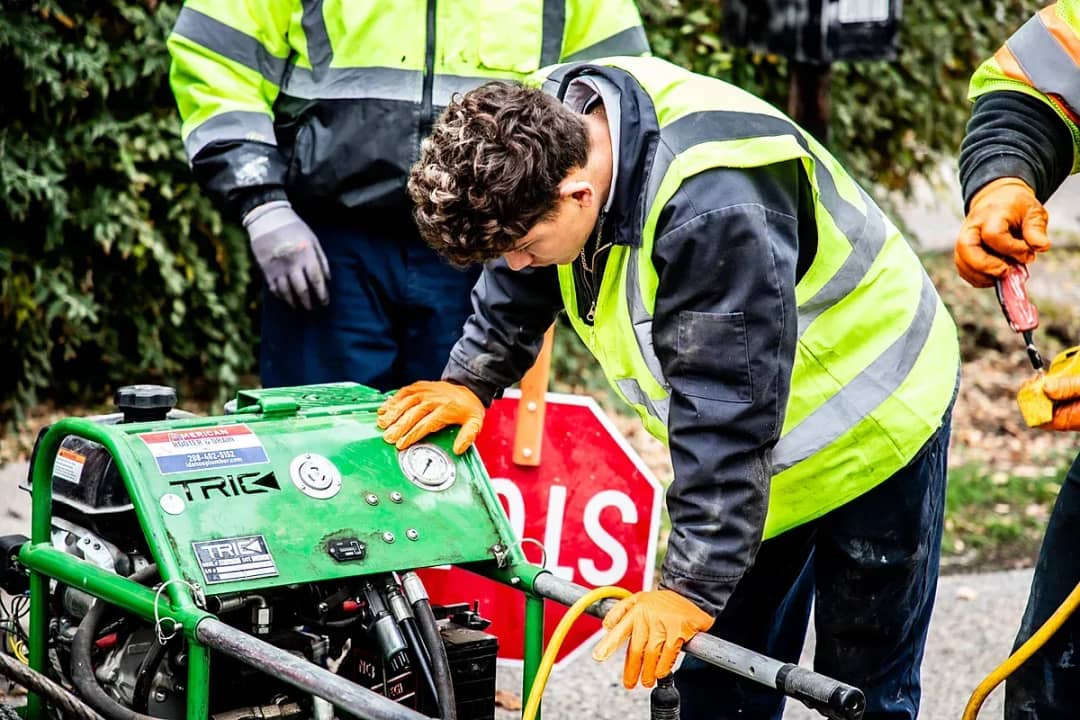
Rather than opening the slope end to end, the crew sets an access pit upslope and another downslope, both sited to stay clear of the engineered drainage running through the rest of the lot, and pulls a cable the full distance between them through the existing line. What matters most on a graded lot is what happens to that cable's path as it travels: the crew controls the pull rate to set a corrected, consistent slope through the new section rather than simply following whatever the old line's settled alignment happened to be, correcting the grade break instead of just replacing the pipe that sits in it. The expander riding the front of the cable splits the old pipe apart into the surrounding fill as it advances, and the fused HDPE section trailing it takes up residence at the newly corrected fall. A run with no joints in it also has no seam for the next round of uneven fill settlement to find, which is the reason this fix tends to outlast a patch made at the one joint that already failed.
What does the camera actually need to read on a graded line?
Beyond material and condition, a camera pass on a sloped Hidden Springs lot has one more job: confirming exactly where along the run the grade breaks down. That's not always the same point as where the water first backs up, because a low spot can sit uphill of where debris finally piles high enough to slow a fixture. Mapping the true low point is what lets the crew plan pit placement on either side of the actual problem instead of a placement based on where the cleanout happens to already be.
Does a repeat backup mean the slope moved again, or something new happened?
On flat ground, yes — clear it once and it stays clear unless something new gets flushed down the line. On a graded lot, a low spot changes that math entirely, because a cable pass restores flow without touching the actual dip that's collecting water and solids underneath it. Every fixture upstream keeps sending the same low point the same load it always has, the sag fills back in at whatever rate the household uses water, and the household experiences that as the drain "going slow again" on a schedule that has more to do with how the low spot refills than with anything new going wrong. A Hidden Springs line that clears and slows on a repeating interval is telling you the grade broke, not that the clearing failed.
Is every low spot on a graded line the same kind of problem?
No, and the distinction is a measurement rather than a judgment call. A shallow sag — a section that's dropped out of grade by a small amount — often still scours itself well enough on most flushes and can be managed on an interval, jetted or cleared periodically while the settlement is monitored at each visit. A deep sag holds standing water permanently, drops solids on every single use, and refills right after cleaning no matter how thoroughly the wall gets washed, because gravity isn't going to reconsider on its own. Which one a given lot has is read directly off the camera, comparing how much of the pipe's diameter is actually holding water against how much would be expected on a properly graded run — and that reading is what decides between a maintenance plan and a full replacement.
What if the crew has to open the slope anyway?
A handful of situations call for something other than a straightforward two-pit burst. A grade break severe enough that the low spot has effectively become a trap rather than a shallow dip may need the section re-graded rather than just replaced in place, which is a job for trenchless sewer repair in Hidden Springs using a different approach, or occasionally a short, targeted excavation instead of pulling through the same failed alignment. If that becomes the plan, restoring the erosion control and drainage the excavation crosses is part of the job, not an afterthought — the goal is to leave the hillside doing what it was engineered to do, not just to leave the sewer line working.
What if the camera shows debris instead of a real grade failure?
Then bursting drops off the table entirely, and the camera is what makes that call rather than a guess from the truck. Roots or ordinary buildup sitting in a line that's still holding its designed grade is a hydro jetting in Hidden Springs job, or for a simple soft clog, a straightforward drain cleaning in Hidden Springs at a flat $59. Disturbing an engineered slope only makes sense when the pipe itself is actually the problem, and the footage is what settles whether it is.
What order does a Hidden Springs repair actually happen in?
1. Questions before anything else — when the slowdown started, which fixtures it hits, whether the line's been cabled before.
2. Camera down the line, mapping exactly where the grade breaks and how severe the resulting low spot is. On its own, this is our sewer camera inspection in Hidden Springs.
3. A flat price in writing, based on what the camera found and where the pits need to sit relative to existing drainage, before any digging starts.
4. Two access pits, placed to stay clear of engineered swales and subsurface drains wherever the slope allows.
5. The pull itself — HDPE fused pipe threaded in behind the bursting head at a corrected, consistent grade, the old pipe fractured outward and left in the fill.
6. Reconnection at both ends, then a final camera pass to confirm the corrected slope before backfilling.
7. Restoring the surface — backfill at the two pits, with any disturbed erosion control or drainage put back the way the site was engineered to work.
We run these calls out of the shop at 1005 Commercial Way in Caldwell. American Rooter & Drain has served the greater Treasure Valley since 1945.
What can turn a planned half-day into a longer one on this hillside?
Three things, mostly. A pit that happens to land at the seam between two zones of fill settling at different rates needs more careful shoring than one on more uniform ground, and there's no way to know that until the pit is actually open. Pinpointing a subsurface drain precisely enough to route around it can eat more of the schedule than the excavation itself, particularly on lots where what's actually buried has drifted from what the original site plans show. And a grade break bad enough to call for re-grading a section rather than a straight pull through the existing alignment turns a standard two-pit visit into a planned, longer one — planned being the operative word, since we'd rather build that into the estimate up front than discover it with a pit already open. Whatever the reason, the written price holds; time spent working through any of this is ours to carry, not yours.
What actually determines the price on a Hidden Springs job?
There's no flat rate for this, because the real cost drivers are specific to a graded lot: how deep the line runs, how much elevation change it crosses, how many pits the path needs to stay clear of engineered drainage, whether an existing cleanout is usable, and whether any erosion control has to be carefully restored rather than simply backfilled over. We price the job from what the camera and a site walk actually show, hand you one number in writing, and the on-site estimate is free.
If a Hidden Springs line keeps backing up at the same fixture, or a patch of the slope stays wetter than the ground around it, get the camera in before assuming a fix. See everything we do around the community at our Hidden Springs hub, or browse every city we cover on the pipe bursting overview. Call (208) 366-5771 for a free on-site camera inspection.