We run these calls out of the shop at 1005 Commercial Way in Caldwell. American Rooter & Drain has served the greater Treasure Valley since 1945. Call (208) 366-5771 and we'll get a camera into the line before anyone opens a trench in this ground.
Why does a trench here take longer than the estimate first suggested?
Sandy, loose soil doesn't hold a vertical cut the way denser ground does. Left open, the sidewalls of a trench slump back toward the bottom, which means more shoring, more time spent keeping the excavation safe to work in, and often more soil hauled off site than the pipe's own footprint would suggest. Depth makes it worse — the deeper the cut, the more pressure the loose walls put on whatever is bracing them, and a lateral running any real distance from house to main can mean a trench that has to stay open and stable for the length of an entire workday. None of that is about the crew's speed. It's about ground that behaves differently than the ground three miles away toward the bench.
What is that same looseness doing to the pipe that's already underground?
The original clay laterals under Fruitland's older lots were joined bell-to-spigot, sealed with mortar or a packed compound that was built to hold one fixed position for the life of the pipe. Loose confluence soil doesn't hold still the way denser soil does — it compresses and shifts more with every wet season, every irrigation cycle nearby, every freeze-thaw swing — and a joint sitting in ground that moves that much eventually gets nudged out of true alignment. It rarely happens all at once. A joint typically creeps a fraction of an inch at a time over years before the two pipe sections are far enough out of line to actually matter.
What does an offset joint actually do once it's happened?
An offset joint isn't just a gap — it's a step. Where two pipe sections used to sit flush, one edge now sits slightly proud of the other, and that small ledge is exactly where paper, wipes, and solids catch instead of continuing on with the flow. Debris builds against that shelf a little at a time, the effective bore narrows right at that one point, and the line starts backing up at a schedule instead of once. A camera reading the run can usually spot the transition instantly — round pipe, then a visible step where the joint has walked out of alignment, sometimes with a curtain of fine soil visible sifting in through the gap.
Is this the same clog coming back, or a new one every time?
Think of it as a shelf rather than a clog and the pattern makes more sense. A cable head doesn't know the difference between debris sitting loose in a round pipe and debris caught against a step where two sections have offset — it punches through either one and calls the job done. Against loose debris that's a real fix. Against the shelf at an offset joint, it's temporary: the step is still there the moment the crew leaves, and everything that goes down the line afterward has the same ledge to catch against that the last load did. A Fruitland fixture that's gone slow, cleared, and slow again within a matter of weeks hasn't seen three separate problems. It's seen one joint doing the same thing three times, and each pass tends to buy a little less time than the one before it, since the shelf itself never gets any shallower.
How does pipe bursting sidestep the sand problem entirely?
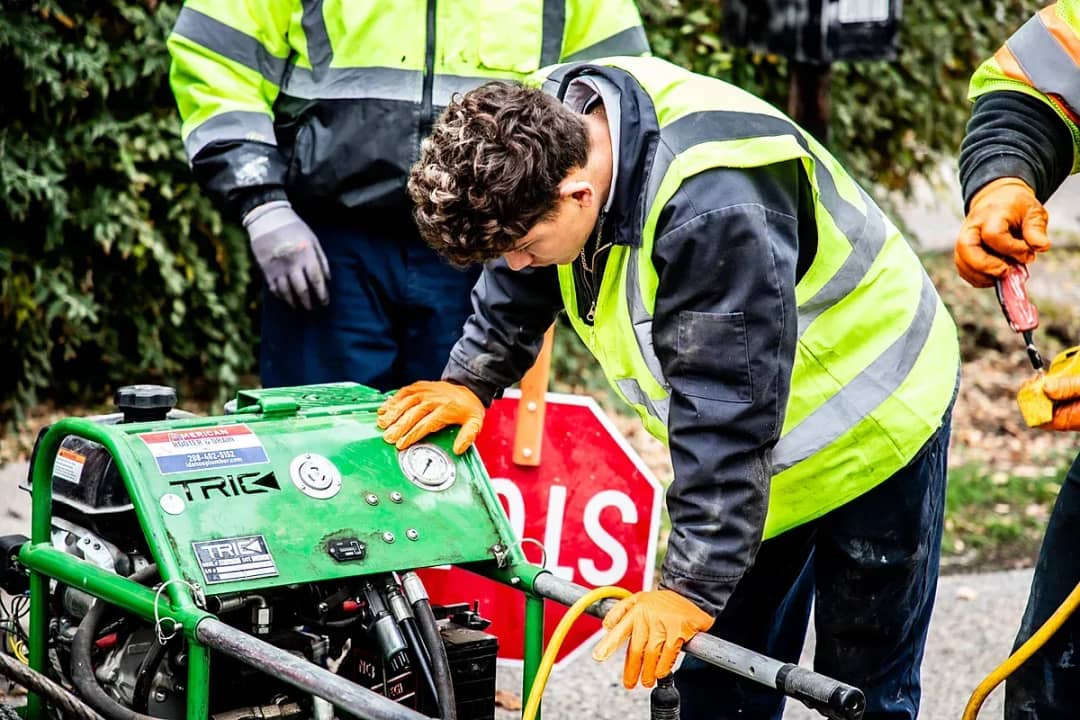
Two pits do the work a full trench would otherwise need — one near the house, one near the connection point — each small enough to shore properly without turning into the kind of long, unstable excavation loose confluence soil punishes. A winch strung between them draws a coned expander through the existing clay at a steady pace, and the pipe doesn't come out ahead of it; it splits apart under the load and is shoved sideways into the soil the expander is passing through, staying buried rather than getting hauled to the surface. The replacement pipe is already threaded onto the back of that expander before the pull starts — a single length of HDPE, heat-fused seam to seam beforehand so there's no joint anywhere in it — and it simply occupies the space the old clay used to fill. What's left when the pull finishes is a line with zero bell-and-spigot connections along its entire length, which matters specifically here: there's nothing left in the ground for this soil's ordinary shifting to find and reopen the way it found the original joints.
What's actually different about working the pits in sandy ground?
The pits themselves need more attention here than they would in denser soil. A winch needs something solid to pull against, and loose backfill at the edge of a pit doesn't give it one, so the crew typically shores and anchors each pit more deliberately before the pull starts. The pit walls get the same slumping tendency as a full trench would, just over a much smaller footprint and for a much shorter window of time, which is the whole point of choosing two contained holes over one long cut in ground like this.
Does the river's seasonal level change any of this?
Some. Ground this close to where the Payette meets the Snake sits over a water table that rises and falls with the rivers themselves, higher in spring runoff and lower by late summer, and loose sandy soil transmits that change faster than denser ground does. A pit dug in late spring can hit noticeably wetter soil at the same depth than the identical pit dug in September, which affects how much the sidewalls want to slump and how much shoring the crew plans for going in. It doesn't change whether bursting is the right fix — that's a question about the pipe, not the season — but it's part of why we look at ground conditions on the day of the visit rather than quoting sight unseen from an address alone.
What pushes a Fruitland pit job past a single afternoon?
Three things account for most of it. Soil that's wetter than usual at pit depth simply won't hold its shape the way a dry-season pit does, and shoring it properly takes real time rather than being something to rush past. A joint further gone than the first camera pass from one direction could confirm sometimes only shows its full extent once the crew is already in the ground, at which point a third, smaller access point mid-run becomes the honest fix rather than forcing the two original pits to reach further than they can. And a house-side tie-in modified at some point in the past — a swapped diameter, a patch from an earlier service call nobody mentioned when booking — takes real time to reconnect cleanly rather than dropping straight into a standard clay-to-HDPE transition. Whichever of these shows up, the number in writing doesn't move; extra time spent working around what the ground or the old plumbing turns out to be is absorbed on our side of the invoice, not added to yours.
What if the camera finds roots or buildup instead of an offset joint?
Then the honest recommendation changes, on the spot, on the same footage. A joint that's cracked but hasn't actually stepped out of alignment, with roots or ordinary debris sitting in an otherwise round pipe, points to hydro jetting in Fruitland instead, or for a simple soft clog near a fixture, a straightforward drain cleaning in Fruitland at a flat $59. The same pass that would confirm an offset joint is just as capable of confirming there isn't one, so there's never a reason to guess before it runs.
What does a Fruitland visit actually look like, step by step?
1. We start by asking, not digging — when the slow drainage began, whether the line's ever been cabled, and how long that held.
2. Camera down the line — reading the material, finding the offset joint if there is one, and measuring exactly how far along the run it sits. Run by itself, that step is a sewer camera inspection in Fruitland.
3. A written figure, built from what the footage actually showed, handed over before a shovel moves.
4. Two access pits, shored for this soil, opened at the points that keep the pull as short as the lot allows.
5. The pull itself — HDPE fused pipe threaded in behind the bursting head, the old clay fractured outward and left in the ground.
6. Reconnection at the house and the main, then a final camera pass to confirm the new line before backfilling.
7. Backfill at the two pits only — not the length of the yard.
Does a property near the confluence on septic have a different version of this problem?
Plenty of Fruitland's older lots never connected to city sewer at all and run to a septic tank instead, which shortens the run in question without changing anything about how it fails — the pipe from house to tank is the same clay, joined the same bell-and-spigot way, sitting in the identical loose confluence ground doing the identical shifting. A burst on that shorter lateral looks exactly like the version described above, just over less distance. What's worth a second look while everyone's already out there is the tank itself, if it dates to the same era as the house; that's a separate conversation, and septic services in Fruitland is where it lives.
What actually determines the price on a Fruitland job?
There's no flat rate for this, because the real cost drivers vary by lot: how deep the original line was laid, how far it runs, how many pits the path needs once soil condition is accounted for, whether a usable cleanout already exists, and whether we're replacing a residential branch or a full building sewer. Sandy, loose ground affects the labor more than the materials — it's why the pits get more shoring attention here than they would on firmer ground three miles inland. The number comes out of the footage and a walk of the lot, it goes on paper before anything starts, and the visit that produces it costs you nothing.
If a Fruitland line has backed up more than once at the same fixture, or a strip of yard along its path stays soft or unusually green after watering, get the camera in before guessing at a fix. See everything we do around Fruitland at our Fruitland hub, check tree roots in sewer line if that's the visible symptom, or browse every city we cover on the pipe bursting overview. Call (208) 366-5771 for a free on-site camera inspection.