We run these calls out of the shop at 1005 Commercial Way in Caldwell. American Rooter & Drain has served the greater Treasure Valley since 1945. Call (208) 366-5771 and we'll get a camera into the line before anyone talks about digging near the canal.
Why is a seasonal on/off canal harder on a pipe than steady moisture?
Ground that stays consistently damp settles into something close to a stable state and mostly stops moving. Ground next to a canal that runs six or seven months and then goes dry does the opposite: it saturates and swells as the canal fills each spring, then dries and contracts through the fall and winter once the water is shut off, and it repeats that full cycle every single year rather than settling into anything permanent. A clay pipe joint sealed with mortar — never designed to flex — sits through that swing and shrink cycle every spring and fall for decades. Eventually the seal cracks, and once it does, the joint stops holding a fixed connection and starts holding a gap.
What happens at that gap once the canal season starts again?
Once a joint has cracked, the spring wet-up does more than just add moisture — it is the point in the year when the ground around the pipe is actively swelling the most and pushing hardest against whatever seal is left. Saturated soil right at the joint has a path of least resistance into the pipe rather than staying put, and it takes that path every spring the canal runs. Roots looking for a dependable water source find the same opening, and a joint that offsets even slightly becomes a shelf where solids catch instead of continuing through. None of this reverses when the canal goes dry in the fall — the gap that opened during one wet season is still there through the dry months, waiting for the next one to make it worse.
Does winter add anything to the spring problem?
It compounds it. Once the canal goes dry in the fall, the ground around an already-stressed joint keeps contracting as it dries further into winter, and in a cold enough stretch the soil right at pipe depth can freeze and contract again on top of that. So the joint isn't just absorbing one seasonal swing a year — it's absorbing a fall dry-down, a winter freeze, and a spring wet-up in sequence, each pulling on the seal a little differently before the cycle starts over.
Why does a cleared line here fail again on almost the same schedule?
A blockage that's truly gone doesn't reappear on its own. If a Wilder line near the canal was cabled clean and it's backing up again at the same fixture within a matter of months, the honest explanation is a joint that keeps refilling on the same annual cycle that opened it, not coincidence. A camera settles the question by showing whether the material at the stoppage is loose debris sitting in an otherwise round, intact pipe, or whether the pipe has stepped out of alignment at a joint. The first is a drain cleaning in Wilder call, or hydro jetting in Wilder if the pipe is sound but coated. The second means another cable pass buys a few months on a line that's coming back regardless of how many times it's cleared.
Does the time of year affect when we'd actually dig, if it came to that?
It can. A full trench near an active canal during the running season means working closer to elevated soil moisture and a higher water table than the same dig would face in the dry months, which typically means more shoring and more time spent managing water in the cut rather than working on the pipe. It is one more reason pipe bursting, which limits the ground that has to stay open to two small pits rather than a continuous trench, is worth considering regardless of which part of the year the failure shows up in.
How does pipe bursting handle ground that swings between wet and dry?
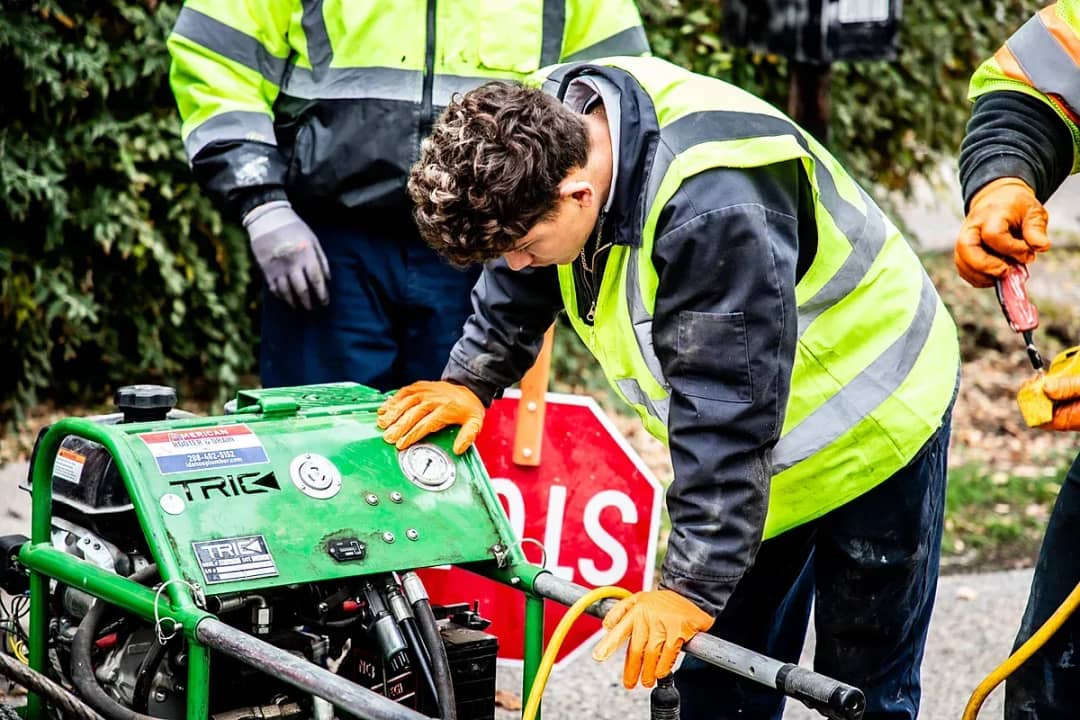
The method doesn't care which state the ground is in on the day of the pull the way an open trench does, because it only opens two contained points rather than a continuous cut across canal-adjacent soil. A coned steel tool, drawn forward on a cable between the two pits, splits the old clay apart and forces it outward into the surrounding ground as it travels, and a new length of HDPE follows immediately behind it, joined by heat fusion into a single run with no seams anywhere in it. That seamless run is the actual fix for Wilder's specific problem: there is no bell-and-spigot joint anywhere in the new line for next spring's canal wet-up, or the one after it, to work against.
What if the property is on septic instead of a sewer main?
Not every Wilder lot near the canal ties into a sewer main — plenty run their own septic tank instead, on a lateral that's shorter but built no differently: same clay, same mortared bell-and-spigot connection, same ground swelling and shrinking with the canal season on either side of it. Whatever this page says about the mechanism failing applies just as directly to that shorter run. The one thing worth flagging separately is the tank itself; if it's original to the property's farm-era construction, septic services in Wilder covers that side of things once the sewer lateral question is settled.
Does canal maintenance ever affect a nearby sewer lateral?
Irrigation districts periodically clean and maintain the ditches that run through Wilder's older lots, and that work can change what's actually above a lateral running near the easement — a ditch bank regraded or built up over the years does not always match what the original installer assumed when the pipe went in. A lateral laid at a normal depth relative to the ground when it was installed can end up shallower or deeper relative to the current bank profile than old records would suggest, which is one more reason the camera and a site walk happen before pit locations get finalized.
What if the lateral actually crosses under the canal easement itself?
That changes the job. Work within an irrigation district's easement typically means coordinating with the district before anything gets disturbed, regardless of which method is used to fix the line. It doesn't rule out bursting, but it does mean the timeline isn't purely up to us, and we'll tell you that up front rather than promise a schedule we don't control.
When is bursting not the right fix near the canal?
A joint that has offset far enough to close most of the bore can be beyond what the splitting tool should be asked to widen safely in one pull. A lateral sitting unusually shallow, close enough to the canal easement itself that ground disturbance is a real concern, may call for a different trenchless approach entirely rather than a standard pull. And a section that has settled into an actual sag rather than simply developing a stressed joint needs to be dug and regraded, since bursting replaces a pipe on its existing alignment and cannot correct a low spot by itself. Any of those points toward trenchless sewer repair in Wilder using a different method, or in rare cases a short, targeted excavation.
What determines what a Wilder bursting job actually costs?
Every canal-adjacent lateral is a different length, depth, and degree of ground saturation depending on the time of year, so pricing comes from the camera and a site walk rather than a flat rate: how far the run goes from the house to the main or the septic tie-in, how many access points it needs, whether a usable cleanout already exists, and how much shoring the ground condition requires that day. We hand you one flat price in writing before anything is dug, and the on-site estimate is free.
How the crew handles a canal-side job, in order
1. We start with the history — when the backups started, whether they track with the canal's running season, whether the line's been cabled before.
2. The camera goes down to confirm the material, find the offset joint, and see how far root or soil intrusion has traveled.
3. One firm number in writing before anything is dug.
4. The two pits are opened and shored to match the ground's current moisture level.
5. The pull itself — new HDPE trailing the splitting tool, the old clay left broken in the soil.
6. Reconnection happens at the house side and the main or septic tie-in, then a follow-up camera pass confirms the fix.
7. Backfill happens at the two pits — not a trench along the canal-side property line.
If a line on a Wilder lot near the canal has backed up more than once, or backs up on roughly the same schedule every spring, get the camera in before guessing at a fix. See everything we do around Wilder at our Wilder hub, check recurring drain backups if that's the pattern you're seeing, or browse every city we serve on the pipe bursting overview. Call (208) 366-5771 for a free on-site camera inspection.