We run these calls out of the shop at 1005 Commercial Way in Caldwell. American Rooter & Drain has served the greater Treasure Valley since 1945. Call (208) 366-5771 and we will get a camera into the line before anyone talks about digging.
Is the pipe under my house cast iron or clay?
A camera answers this within the first few feet, and the two look nothing alike once the lens is inside. Cast iron shows a rough, dark interior wall, often narrowed by a ridge of corrosion running along the bottom and sides where standing water sits between uses. Clay shows a smoother buff or reddish wall broken at regular intervals by a bell joint — the flared socket where one length of pipe was fitted into the next and sealed with mortar or a packed compound. Emmett's gravelly, river-valley soil drains well and doesn't carry much fine sediment against a buried pipe wall, which is part of why a failure out here tends to be a genuine material problem rather than ordinary debris that just needs clearing.
How does a cast iron line actually fail?
Cast iron corrodes from the inside, the same way an old water pipe does, and the corrosion doesn't build evenly. It forms into nodules and ridges — tuberculation, if you want the technical word — concentrated wherever water sits longest between uses, usually along the bottom third of the pipe and heaviest near any low point in the run. Over decades that buildup narrows what was originally a four-inch or six-inch working bore down to something closer to a garden hose, and the narrowing is gradual enough that a household usually doesn't notice until flow drops below whatever a full load of laundry running at the same time as a shower actually needs. The corrosion itself rarely opens a hole straight through the wall until it's very far along; the failure that actually shows up at the fixtures is the narrowing, not a leak.
How does a clay joint fail instead?
Clay doesn't corrode and it doesn't narrow gradually along its length. It fails at the joint. The bell-and-spigot connection between two sections was sealed with mortar or a packed oakum-and-cement compound built to hold one fixed position, not to flex, and once the surrounding soil shifts even slightly over the years, that rigid seal is the first thing to crack. A cracked seal does two things at once: it lets fine soil migrate into the pipe from outside, and it opens a gap that root hair from any nearby tree or shrub can find from the other direction. Either one narrows the bore at a single point rather than along the whole run, which is a different shape of problem than the even corrosion inside a cast iron line — and it changes how far a repair actually has to reach.
Why does it matter which one you actually have?
Because the two failures point at different jobs. Even corrosion along a long cast iron run usually means the whole run has to come out — patching one section leaves the rest of the pipe corroding at the same rate, so a spot repair just buys a few years before the next call from the same address. A single failed clay joint, caught before it has opened into a full offset, can sometimes be addressed at that one joint; once soil has been migrating in for years, though, the practical answer is usually still a full replacement of the run, because a joint that failed once in that ground is a preview of the next one over. The camera is what tells us which situation is actually in front of us before anyone commits to a plan, and it also tells us whether the existing pipe is sound enough to pull a new line through — a cast iron line corroded to paper-thin in spots, or a clay run with several open joints, can change how the bursting head gets staged.
If the same drain backs up again, does that mean something new broke?
Worth asking before anything else, because the answer changes what a repeat visit actually means. An obstruction genuinely cleared out of a pipe stays cleared — it doesn't grow back on its own. If an Emmett line was cabled clean and it's running slow again at the same fixture within a few months, the pipe's own shape is putting the problem back, not some new blockage forming independently. That's exactly the pattern a narrowed cast iron bore or an offset clay joint produces: a cable pass punches a channel through whatever is sitting there, flow returns for a while, and the channel closes again because nothing about the pipe's actual shape changed. Repeated cleared-then-recurring calls at one address is the clearest signal that clearing was never the real fix.
How does pipe bursting actually put a new line in the ground?
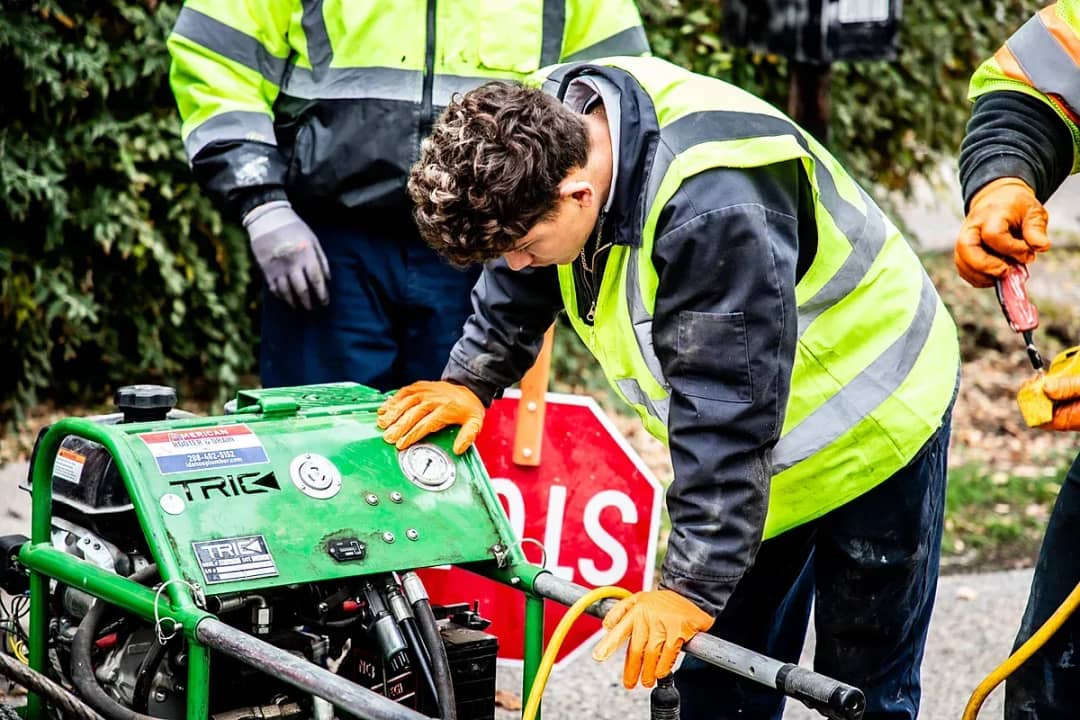
A steel bursting head — a coned expander sized to the new pipe — gets winched through the old line from one access pit to another. As it travels, it fractures the old pipe outward into the surrounding soil rather than pulling it out of the ground; the corroded cast iron or the cracked clay stays exactly where it is, broken apart around the new line instead of hauled out of a trench. Trailing directly behind the bursting head is a length of HDPE pipe heat-fused into one continuous run before it ever goes into the ground, so the finished line carries no joints along its entire length — nothing for river-valley soil to work against the way it worked against the original clay bells, and nothing for corrosion to build up inside the way it built inside the old cast iron. Once the pull reaches the second pit, the crew reconnects the new line to the house on one end and to the main or septic tie-in on the other, then runs the camera through it once more before anything gets backfilled.
When is bursting not the right call in Emmett?
A handful of situations point somewhere else. Cast iron corroded thin enough in spots that the wall can't safely take the outward force of the burst is one — the footage goes to trenchless sewer repair in Emmett instead, where a different method fits pipe that fragile. A clay joint that's cracked but hasn't stepped out of alignment, holding roots or plain debris rather than an actual offset, doesn't need replacing at all — it's a hydro jetting in Emmett call, or for a simple soft clog near a fixture, a flat-$59 drain cleaning in Emmett. Sorting which of these you actually have is the entire reason the camera runs before anyone quotes a pull.
What makes an Emmett job run longer than the estimate expected?
A few specific things push a job past its planned time, and they're worth naming instead of treated as a surprise afterward. Gravelly river-valley soil holds a winch anchor well, but a pit that hits a larger buried cobble partway down sometimes has to be widened or shifted a foot or two to get around it. A cast iron line that was previously patched with a mismatched fitting — a rubber coupling, a section of a different diameter spliced in at some point — can take longer to reconnect cleanly than a straightforward transition to the new HDPE. And a clay run with more than one failed joint sometimes means the second joint has migrated further than the first camera pass from one direction could see, which occasionally means opening a third, smaller access point mid-run rather than assuming the two planned pits will reach every failure. None of that changes the flat price once it's written; if the job runs long for reasons like these, that time is ours to absorb, not an added line item.
What happens once the crew is on site, in order?
1. History first — when the slowdown started, whether the line has been cabled before, which fixtures back up and how often.
2. Camera down the line — this is where we read the material, find where a cast iron bore has narrowed or a clay joint has opened, and measure exactly how far along the run it sits. On its own, this is our sewer camera inspection in Emmett.
3. A flat price in writing, based on what the camera actually found, before any digging starts.
4. Two access pits opened at the points that keep the pull as short as the lot allows.
5. The pull itself — HDPE fused pipe threaded in behind the bursting head, the old pipe fractured outward and left in the soil around the new line.
6. Reconnection at the house and at the main or septic tie-in, then a final camera pass through the finished line.
7. Backfill at the two pits — not a trench the length of the yard.
What actually moves the price on an Emmett job?
There's no flat rate for this, because the honest variables genuinely differ from one lot to the next: how deep the original line runs, how far it is from the house to the main or a septic tank, whether an existing cleanout is usable or one has to be established, how many access pits the path needs, and whether we're replacing a residential branch or a full building sewer. Which material is actually in the ground changes it too — a corroded cast iron run and a clay run with several open joints are not the same amount of pipe to fracture and pull through. We price the job from what the camera and a site walk actually show, hand you one number in writing, and if the work runs long for a reason we should have caught, that time is ours to absorb rather than yours to pay for.
If an Emmett drain keeps backing up at the same fixture, or flow through the house has been gradually getting weaker in a way nobody can quite date, get the camera in before guessing at which material — or which fix — you're actually dealing with. If the property sits outside city sewer, septic services in Emmett covers the tank side of the same question. See everything we do around town at our Emmett hub, or browse every city we cover on the pipe bursting overview. Call (208) 366-5771 for a free on-site camera inspection.