
American Rooter & Drain has run 350 jobs at Emmett addresses — 154 separate properties, all inside the 83617 zip. 139 of those calls were drains and sewer lines rather than tanks, so we spend a lot of time here looking at what happens downstream of a septic system once it stops keeping up.
What are the first signs my septic system is going bad?
Septic trouble announces itself in a specific order, and that order tells you a lot before anyone opens a lid.
It starts at the lowest fixture. A basement floor drain, a downstairs shower, the ground-floor toilet — whichever sits lowest slows first, because that is where backing-up effluent reaches first. One slow fixture upstairs with everything else fine is a local clog. The whole house slowing together means the trouble is downstream: the line, the tank, or the field.
Then you hear it. Gurgling in a toilet when the washing machine drains, a glug from a tub when a nearby sink empties. Air is being forced back through the trap because the water it should be displacing has nowhere to go. That noise is the most reliable early signal there is, and the one people ignore longest.
Then you smell it and see it outside. A sewage odor on a still evening, strongest between the house and the field, means effluent is surfacing or a lid has lost its seal. Sewer gas inside is a different animal — usually a dry trap. Outdoors, look for spongy ground or standing water over the field after a dry stretch. Here is the Emmett wrinkle: on an irrigated lawn the whole yard is already lush from May onward, so the greener-stripe tell that works elsewhere is hard to read here. Walk it barefoot instead — soft ground where the rest of the lawn is firm says more than color does.
And the one nobody expects: toilets flushing fine while an alarm panel has been beeping for a week. On a system with a pump chamber or an aerobic unit, that alarm means the chamber is filling faster than it empties — usually a day or two of normal use before it backs up.
Why can't anybody find my septic tank?
Because on a lot of older properties around Emmett, nobody ever wrote it down. Systems installed before clean digital records may have no as-built on file, and where a permit does exist the sketch can amount to a hand-drawn arrow and the words "approx. 40 ft from house." Yards move, too: grade gets built up around a foundation, a landscaper adds four inches of topsoil, somebody extends a driveway, a shed lands on skids over exactly the wrong six square feet. A lid that sat at grade when the house was built ends up a foot down, or under something you cannot move.
How a tank actually gets found, in order:
1. Start at the house, not the yard. Find where the main sewer line leaves the foundation. Tanks are almost always in a straight run off that exit point.
2. Probe the line of travel. A steel soil probe pushed in on a grid along that run eventually hits concrete or the corner of a lid. On soft irrigated ground that goes fast; on sun-baked August ground it is a workout.
3. If probing fails, send a camera. A sewer camera with a transmitting sonde in the head goes down the line from a cleanout. A locator on the surface picks the sonde up, marks the tank inlet within about a foot, and reads depth at the same time.
4. Read the property. Old farmsteads sometimes have two tanks — an original abandoned in place when the house was re-plumbed, and a newer one elsewhere. Finding a tank is not the same as finding the tank.
Once it is found we mark it, and that is the moment to talk about risers so nobody hunts again.
What actually happens on a septic visit, step by step?
The sequence is the same whether it is a routine pump-out or a system that has already failed, because you cannot diagnose what you cannot see. It starts with a walk of the property — where the tank and field are, where the truck can park, how far the hose has to run, since hose distance from the drive to the access is one of the real variables in what a job takes.
We uncover and open the access. Both lids on a two-compartment tank, because the outlet compartment holds the useful information. A riser at grade takes seconds; a lid under a decade of dirt takes real digging.
We look before we pump. The liquid level tells a story by itself. Above the outlet pipe means effluent is not leaving — that points at the field, the outlet line, or a plugged filter, not a full tank. Below the outlet means the tank is leaking, its own problem. Resting right at the outlet invert is normal. That observation, made before anything is disturbed, redirects a lot of calls away from the repair the homeowner assumed they needed.
We pump it out completely — both compartments, solids and liquid, not just the clear layer off the top. A partial pump-out is a common shortcut and close to worthless, since the sludge on the bottom is the entire reason for the visit.
We wash down and inspect the interior. With the tank empty we can read walls, corners, the inlet tee and the outlet baffle — cracking, spalling concrete, roots through a joint, a broken baffle, any sign the tank has shifted. An effluent filter in the outlet tee comes out and gets cleaned; a plugged one presents exactly like a failed field — slow drains, backups, high liquid level — and it is a five-minute fix that gets mistaken for a five-figure problem.
We run water and watch the outlet. Effluent leaving cleanly and disappearing into the field is what health looks like; water that comes straight back is the field talking. Then you get the findings out loud and in writing, with a flat-rate number for anything past the standard service before we touch it.
Does irrigation season really change how my drainfield works?
Yes — around Emmett, more than most people believe. A drainfield does not work by draining. It trickles effluent into unsaturated soil, where oxygen and soil bacteria finish treating it before it reaches groundwater. That requires dry, air-filled soil beneath the trenches. Take the dry soil away and the mechanism stops — not because a pipe broke, but because there is nowhere left to put the water. Now put that on the Emmett valley floor. The Black Canyon Dam upstream and the irrigation ditches that fan out from it turn this valley green every summer, and the same water that grows the orchards lifts shallow groundwater underneath them. Flood-irrigated pasture, canal seepage and a neighbor's turnout all push the water table up from spring through fall, so a field with dry soil under it in February can sit in saturated ground in July.
Two things follow. A system that "was fine last winter" can genuinely fail in June with nothing about it having changed — seasonal failure is a real diagnosis, not an excuse. And if you can choose the timing, have a drainfield evaluated while irrigation is running, because one looked at on frozen ground will flatter itself.
Why does the drainfield fail when the tank looks fine?
Because they fail for different reasons, and the field usually fails because of something that happened in the tank years earlier.
At the bottom and sides of every trench, a thin black layer called the biomat forms where effluent meets soil. It belongs there — it is part of the treatment. Trouble starts when it thickens enough to seal.
Solids carryover. A tank that is never pumped loses the room it needs to settle solids. Once the sludge layer reaches the outlet, suspended solids leave with the effluent — and a drainfield is not a filter, it is an absorption surface. Solids that plug the trench bottoms do not come back out. This is the most common reason a field dies young, and it is why a routine pump-out is really drainfield maintenance in disguise.
Hydraulic overload. A running toilet flapper adds hundreds of gallons a day, silently, for months. A water softener regenerating on a hard-water schedule sends its brine cycle through the same system. Three loads of laundry back to back push more water through than the trenches can process. None of that breaks anything — it just never lets the field drain down and dry out between doses, which is the part that keeps it alive.
Roots and compaction. Cottonwoods, willows and poplars along the Payette bottoms will find a trench and follow it, and so will the arborvitae planted for privacy the year after the system went in. Meanwhile a truck, camper or tractor parked on the field — or a livestock pen over it — squeezes out the air the system depends on, and that injury stays invisible until the day the field stops absorbing.
Several of those causes are reversible if you catch them. None are reversible once the trenches have sealed.
How often should the tank actually be pumped?
The guidance you will see everywhere is every three to five years for a typical household, and it is a reasonable place to start. But it averages situations that do not resemble each other. The interval that fits your property depends on tank size against household size — a 1,000-gallon tank serving two people is on a very different schedule than the same tank serving six — plus whether the tank is single-compartment or two, how hard the garbage disposal works, total water volume through the house, and whether an effluent filter is protecting the field.
The real answer is a measurement, not a calendar. With the lid off, sludge depth on the bottom and the scum layer floating on top can both be measured directly. The trade threshold is simple: pump when sludge occupies roughly a third of the tank's liquid depth, or when the scum layer works down near the bottom of the outlet baffle, because past that point solids start leaving with the effluent. Measure once and you know your property's real interval instead of somebody's national average.
If you just bought the place and have no idea when it was last done, do not calculate — pump it, look inside, and start the clock from a known state.
What does septic work cost in Emmett?
A septic tank pump-out is $395 for 1,000 gallons, quoted in writing before anything starts — getting to the access, opening it, evacuating the tank, and inspecting its condition with the findings written down. One truck, one access point, tank fully emptied.
Past that, we do not price septic repairs over the phone, and you should be skeptical of anyone who does. The variables that move the number are only visible on site:
- Tank capacity. Anything larger than 1,000 gallons takes more time and more truck capacity.
- Lid depth. A riser at grade versus a lid under a foot of soil is a different job with a shovel in it.
- Whether the tank has to be located first, and how close the truck can get to it once it is found.
- What is actually failing. A cracked baffle, a broken lid, a plugged filter, a collapsed line to the distribution box and a saturated drainfield are five different jobs sharing one symptom.
- Whether the health district has to be involved. A tank replacement or a new absorption field is a permitted project; a lid or a set of risers generally is not.
So we come out, we look, and you get a written flat-rate number for the work your system actually needs — with the on-site estimate itself free. Straightforward repairs are usually a single visit. A full drainfield replacement is a multi-day project whose schedule follows the design the health district approves.
What does the health district want to see in Gem County?
Septic — formally, subsurface sewage disposal — is permitted at the health district level in Idaho, not by the city. Emmett and the rest of Gem County fall under Southwest District Health, working from the state rules at IDAPA 58.01.03. Routine service is not a permit matter: pumping a tank, cleaning an effluent filter, replacing a broken lid or adding risers to grade are maintenance, not construction. New systems, tank replacements and new or replacement absorption fields are, and those need a permit and a site evaluation before anything gets dug. Our new septic system cost guide for Idaho covers what tends to drive that number once a site evaluation confirms a full replacement is needed.
A site evaluation is a soil investigation, not paperwork. A test pit gets dug so the profile can be read — texture, structure, and depth to any restrictive layer or to seasonal high groundwater. That reading decides whether a conventional gravity field is allowed at all, how large it must be, or whether the site calls for an alternative design such as pressure distribution or a mound. Setbacks come out of the same design work: distances from wells, from the Payette River and its side channels, from canals and irrigation ditches, from property lines and from the foundation are all set by the district, and around Emmett the ditch network makes those a live constraint rather than a formality.
Keep the permits and as-builts that come out of any of it — they are exactly what a future buyer's lender and inspector will ask for.
What can I do to keep the system healthy for the next twenty years?
Almost none of the prevention costs money. Keep these out of the drains: wipes of every kind, including the ones sold as flushable — they do not break down and they sit behind most of the pump and filter trouble we see; grease and cooking oil; coffee grounds; cat litter; paper towels; dental floss; paint, solvents and pesticides; unused medication. Bleach in ordinary amounts is fine; dumping a jug of it is not, because the tank is a live biological process. And skip the additives — nothing poured into a toilet substitutes for pumping, and the harsher products strip the biomat and drive solids into the field.
Watch the water, not just the waste. Fix running toilets the week you notice them, spread laundry across the week instead of stacking it on a Saturday, and use the disposal sparingly or not at all. Outside, keep vehicles, campers, equipment and livestock pens off the drainfield, keep deep-rooted trees away from it, and point downspouts and irrigation heads somewhere else — clean water is still load.
Then make the next service easier. Risers to grade turn a shovel job into a lift-the-lid job, permanently. Add an effluent filter if the outlet tee lacks one, mark the lid, and write the date down every time the tank gets pumped.
How soon can someone come out?
Call (208) 366-5771. Same-day scheduling is available when the calendar allows, and Emmett is a regular run for us out of the Caldwell shop.
A few things help when you call: the address, what you are seeing and when it started, whether it is one fixture or the whole house, roughly when the tank was last pumped, and whether the system has a pump or an alarm panel.
If sewage is actively backing up into a tub, a shower or a floor drain right now, stop using water in the house — no laundry, no dishwasher, minimal flushing. Every gallon you send down while you wait makes the cleanup bigger.
What else can you handle while you're out here?
A fair amount of what looks like a septic problem is a line problem, and the two get sorted on one visit:
- Septic tank pumping in Emmett — the $395 pump-out on its own
- Septic inspection in Emmett — the documented evaluation a sale or a permit needs
- Septic repair in Emmett — baffles, lids, distribution boxes, tank-to-field lines
- Drain field services in Emmett — evaluation, repair and replacement
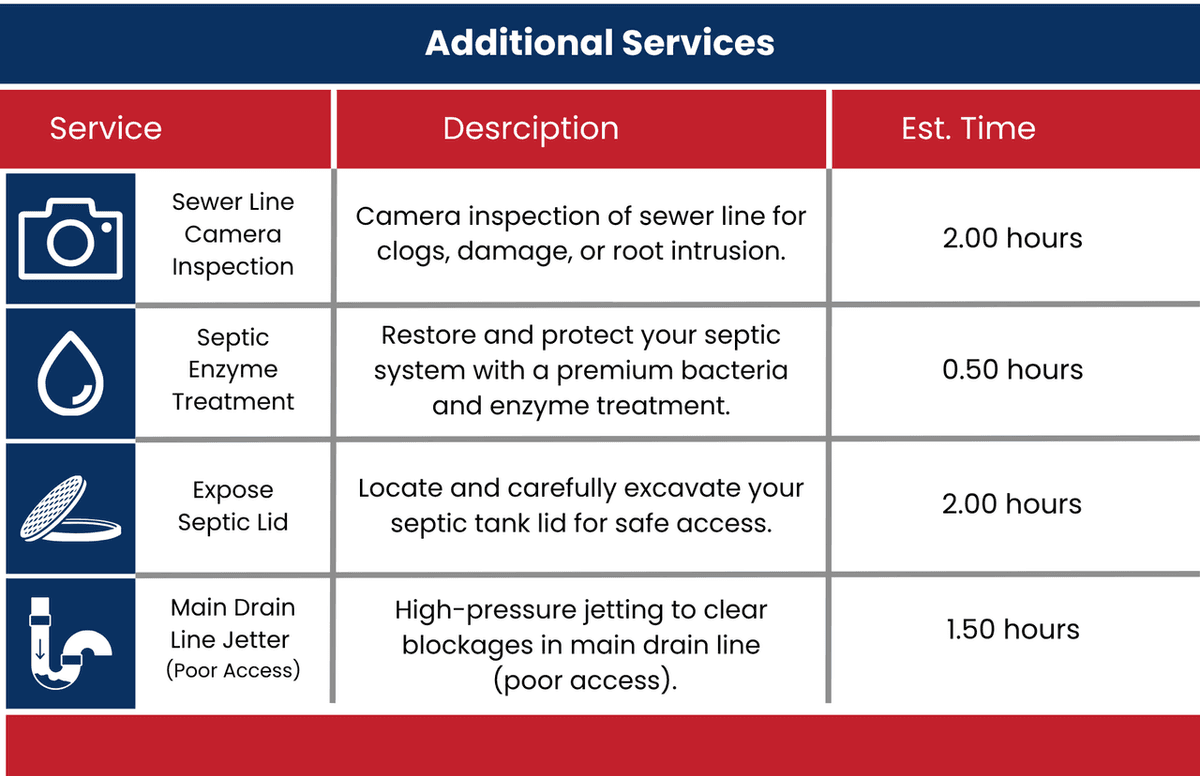
- Sewer camera inspection in Emmett — the tool that locates a tank also finds a break in the line
- Drain cleaning in Emmett — the $59 drain clean, when the trouble is a line and not the tank
- Hydro jetting in Emmett — grease, scale and root-clogged lines
- Plumbing repair in Emmett — everything on the house side of the wall
Or see everything we do in Emmett, ID.
American Rooter & Drain was established in Caldwell, Idaho in 1945 and has served the greater Treasure Valley since 1945. Licensed and insured, dispatched from 1005 Commercial Way, Caldwell, ID 83605. Call (208) 366-5771 and we will tell you what your Emmett system needs, with the number in writing before anything starts.