We run these calls out of the shop at 1005 Commercial Way in Caldwell. American Rooter & Drain has served the greater Treasure Valley since 1945. Call (208) 366-5771 and we'll get a camera into the line before anyone talks about digging.
Why does a wet-dry cycle matter more than just 'wet soil'?
Constantly saturated ground and ground that cycles between wet and dry are not the same problem for a buried pipe, and the cycling is actually the harder one on a joint. Soil that stays wet all the time settles into a stable, saturated state and mostly stops moving. Silty ground near irrigated farmland does something less stable: it swells as irrigation water moves through it, then contracts again as it drains and dries between waterings, and it repeats that expansion and contraction on whatever schedule the surrounding fields are watered on. A rigid clay pipe joint, sealed with mortar that was never designed to flex, is asked to tolerate that swelling and shrinking around it for decades. Mortar does not flex. Eventually it cracks, and once it does, the joint is no longer holding a fixed seal — it is holding a gap that gets slightly wider with every cycle that follows.
What actually gets into the line once a joint opens?
Two things, usually together but not for the same reason. Fine, silty soil migrates into the pipe through the cracked seal because the ground right around an open joint has nowhere else to go when it is saturated and under any hydraulic pressure at all — it works its way toward the lowest-pressure path available, which is the inside of the pipe. Roots arrive independently, drawn by the same moisture that is causing the joint to fail in the first place; irrigated farmland and irrigated yards both keep root systems well-watered and searching for more, and a cracked joint is a reliable source. Once both are present, the offset joint acts as a shelf that neither one clears on its own, catching whatever solids pass by and narrowing the opening a little further each season.
Why does clearing the line only hold for a few months at a time?
Count how many times a line has actually been cabled and a pattern usually falls out of it. Once is unremarkable — debris happens, a cable clears it, life goes on. Twice inside a single growing season, at the same fixture, is the number worth paying attention to, because a joint refilling on the irrigation calendar does it reliably rather than randomly: wet the ground, the gap works a little material in, dry the ground, nothing changes until the next watering does the same thing again. A camera separates the two situations by looking rather than counting — loose debris in a pipe that's still round and true is one answer, worth a drain cleaning in Nyssa and nothing more; a joint that's visibly stepped out of alignment is the other, and no amount of additional cabling changes what happens at that joint next season.
Why does saturated ground make trenching slower and riskier here?
An open trench needs stable sidewalls to stay safely open while a crew works in it, and ground that is already wet from a nearby irrigation cycle does not hold that shape well. Saturated silt is heavier, less cohesive, and more prone to caving into the cut than the same soil dry, which usually means more shoring to keep a trench safe and more time spent managing water in the excavation itself rather than working on the pipe. None of that has anything to do with what is actually wrong with the line — it is a separate cost the ground itself adds to any full-length dig, on top of whatever the pipe needs.
How does pipe bursting work around irrigated ground instead of through it?
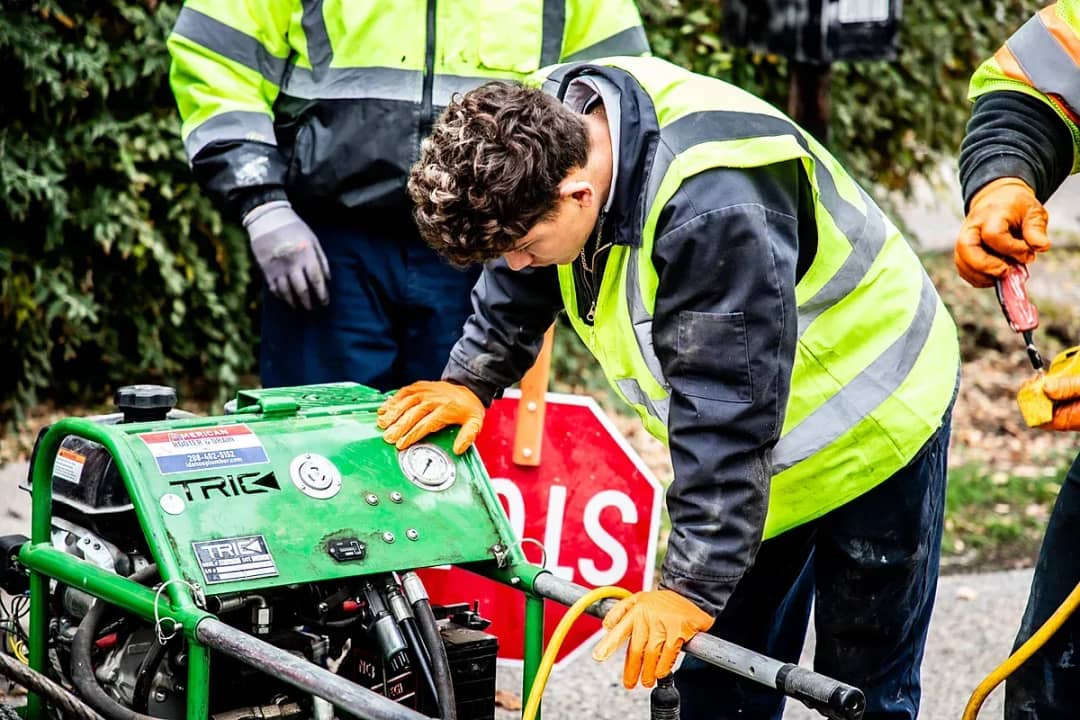
Bursting replaces the line from two access pits rather than a continuous open cut, which limits how much of that saturated, unstable soil has to be held open at once and for how long. A steel splitting cone, hauled through the old clay line on a cable run between the two pits, breaks the pipe apart as it goes and forces the fragments out into the surrounding ground rather than requiring anyone to excavate the old line out. Directly behind the cone comes a fresh length of HDPE, thermally welded into a single seamless run before it's ever set into the ground. That detail carries real weight on this ground specifically: there is no bell-and-spigot joint anywhere in the new line for the next irrigation cycle's swelling and shrinking to find and work against.
Does timing around the irrigation season change anything?
It can affect how the ground behaves during the pull itself. Ground that is actively saturated during peak irrigation season is heavier and less stable at the access pits than the same ground in the shoulder season, which is one more reason the camera and site walk happen before a price is set rather than after — we are looking at the actual soil condition on the day of the job, not assuming what it will be from the calendar alone.
When is bursting not the right fix in Nyssa?
Three situations take bursting off the table even when the diagnosis is a genuine joint failure. Root growth established through several joints at once, rather than concentrated at a single failure point, is more line than one pull should try to solve — that calls for trenchless sewer repair in Nyssa addressing the affected section on its own terms. A lateral running unusually close to the surface under a driveway or outbuilding may not carry enough soil cover to safely absorb the ground displacement a splitting pull causes. And an offset so severe the bore has essentially closed can ask more of the expander than it should be asked to do in one pass. Any of the three is worth knowing about from the footage before a crew shows up planning on a standard two-pit job.
Does a property on private septic near the fields have a different version of this?
A fair number of Nyssa's residential and acreage lots sit outside city sewer entirely and run to a private septic system instead, and the joint mechanics are identical on a shorter run — the lateral between the house and the tank is still clay, still bell-and-spigot, still sitting in ground that swells and shrinks on the same irrigation schedule as everything around it. Bursting that house-to-tank lateral works the same way regardless of what's downstream of it. If the tank itself is the part you're actually unsure about, septic services in Nyssa is the more relevant page, and it's worth a look while the camera and crew are already on site rather than as a separate call later.
What actually stretches a Nyssa job past its planned window?
Timing with the watering schedule is most of the answer. Ground still saturated from a recent turn of the pivot needs noticeably more shoring at the pits than the same ground a week or two into a drier stretch, because wet silt gives up its shape under a shovel far more readily than the same soil dry. A joint that's migrated further than one camera pass from a single direction could actually confirm sometimes only reveals its full extent once a pit is open, which can mean adding a third, smaller access point mid-run rather than betting the two planned pits reach every bit of root and silt intrusion. A house-side tie-in carrying an old mismatched repair — a different diameter, a patch from a service call nobody remembers — also takes longer to reconnect properly than a clean clay-to-HDPE transition does. None of that moves the number already in writing. It's time we plan for and absorb, not time billed back to the property owner.
What if the camera shows debris instead of a broken joint?
Then replacement is not what you should be buying, and we will tell you that with the footage on the screen. Root hair inside a joint that has not actually offset, or ordinary debris sitting in an otherwise sound pipe, is a job for hydro jetting in Nyssa or a straightforward cable pass — our drain cleaning service is a flat $59 — not for replacing a section of pipe that has not actually failed.
How much does pipe bursting cost near irrigated ground?
We won't quote this over the phone, and the reason is specific to this ground: two lots on the same street can need meaningfully different amounts of shoring depending on which one was watered more recently, on top of the usual variables of run length, depth, and whether a usable cleanout already exists. Seeing the actual soil on the actual day is what turns those variables into one honest number instead of a guess wide enough to always be technically right. That number is delivered in writing before anything is dug, it holds regardless of how the job goes once it starts, and getting to it costs nothing.
How a Nyssa bursting job actually runs, in order
1. Talking through the pattern first — how many times it's happened, whether it lines up with a watering cycle, which fixtures are involved.
2. Running the camera to identify the material, pinpoint the joint, and gauge how far silt and root have traveled from it.
3. Writing the number down before touching a shovel.
4. Opening and shoring the two pits for whatever the soil is doing that specific day.
5. Pulling the fused HDPE section through behind the expander, old clay fractured and left in place.
6. Reconnecting both ends and confirming the result with the camera one more time.
7. Filling in the two pits and leaving the rest of the lot exactly as it was.
A yard that stays wetter than the rest of the lot well past when an irrigation cycle should explain it, on top of a fixture that's slowed more than once, is worth a camera before it's worth a guess. Our Nyssa hub covers everything else we do in town, recurring drain backups is the page if that pattern is what brought you here, and the pipe bursting overview lists every city in the coverage area. Call (208) 366-5771 and we'll get a camera into the line before anyone talks about digging.