
We work Middleton out of the shop at 1005 Commercial Way in Caldwell. American Rooter & Drain has served the greater Treasure Valley since 1945. Call (208) 366-5771 — a camera goes down the line before any quote gets written.
What kind of sewer line came with an older Middleton farmhouse?
Clay pipe from this era went into the ground in short runs, each section's spigot end seated into the next section's bell and packed tight with mortar or oakum — a seal meant to stay put, never to move. Decades of settling around it eventually cracks that seal, and the joint opens just enough for soil to migrate in and for the mature trees planted along the original fence lines to find the same gap from outside. Orchard trees and windbreak plantings on a lot like this are often as old as the house, with root systems that have had just as long to find every opening the pipe has ever developed.
What's actually happening under a newer Middleton build on sandy loam?
A newer rural-residential lot on the edge of town runs modern PVC, and PVC doesn't fail at a joint the way clay does — it's smooth, it doesn't corrode, and there's no mortar seal for anything to crack. What it sits in is sandy loam that was graded and compacted during construction, and that soil keeps settling under its own weight for years after the crew leaves. Loam settles differently than the denser fill dirt used in some subdivisions closer to Boise or Meridian — it drains faster and consolidates more unevenly along a run, which can leave one section of an otherwise sound pipe sitting lower than the sections on either side of it.
Does the calendar affect the two kinds of Middleton lots differently?
Yes, and differently for each. An older farmhouse lot's frost depth is the bigger factor — a shallow clay lateral that's already thinned by root pressure is more likely to finally separate when the ground freezes hard in the depths of winter, which is part of why farmhouse-side calls tend to bunch up in that season rather than spread evenly through the year. A newer rural-residential lot answers to the irrigation season instead, since sandy loam fill soil compacts faster when it's cycling wet and dry every year than it would sitting at a constant moisture level, which is part of why a settling problem on that side of town tends to show up gradually over several irrigation seasons rather than all at once.
Is the end result the same problem, even though the cause isn't?
Close to it. Either way, you end up with a spot in the line that no longer moves water and solids the way the rest of the pipe does — an open joint on the farmhouse side collecting roots and debris, or a settled low spot on the newer side holding a pocket of standing water between uses. Both show up the same way at the fixture: a backup that comes back at the same drain on a shortening interval, no matter how many times it's cleared.
What does the camera actually need to tell you before anything gets recommended?
Three things, regardless of which kind of lot it is: what the pipe is made of, whether it's still sound enough to work with, and exactly where along the run the trouble starts and stops. On the farmhouse side, that means confirming whether a joint has cracked and opened or just has roots resting against it without an actual gap. On the newer side, it means measuring how deep a low spot actually is and whether it's holding enough water to matter or just enough to look concerning on the screen. Sewer camera inspection in Middleton is that pass on its own if you want it without committing to anything else yet.
Why does a trench cost an older farmhouse lot more than the invoice shows?
Because the invoice only prices the digging. A trench the full length of a farmhouse lateral goes through whatever's sitting on top of it, and on a lot like this that's often a windbreak's worth of established trees, a fence line that's been in place for decades, or an outbuilding whose footing sits closer to the original pipe path than anyone planned for. None of that comes back the way it was in the same season, if it comes back at all, and none of it shows up as a line item until it's already been dug through.
Why would a newer rural-residential lot also want to avoid a trench?
For a different reason. Sandy loam doesn't hold an open trench wall the way denser ground does — it's more prone to sloughing in, which means more shoring, more time, and more soil to manage on a lot that may still have fresh landscaping the owner put in themselves within the last year or two. A long open trench on ground like that is slower and messier than the same trench in heavier soil, even before accounting for anything the owner would rather not have torn up.
How does the pull actually replace the pipe on either kind of lot?
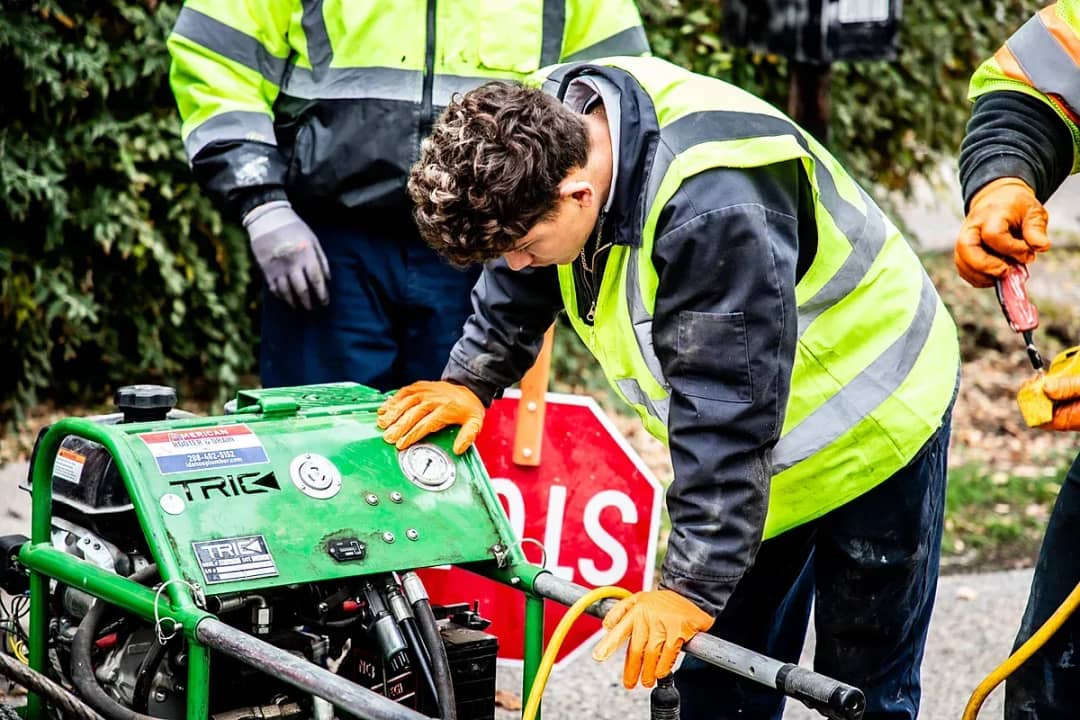
The mechanics don't change based on which kind of lot it's on. An expander head is pulled through the existing pipe on a cable strung between two access pits, breaking the old clay into pieces or pushing a settled section of PVC aside as it goes, and none of that material gets hauled back out — it stays exactly where it lands, packed into the surrounding soil. Trailing right behind it is a single run of polyethylene pipe, welded end to end into one unbroken length before it ever reaches the trench, following a straight path between the two pits rather than whatever route the old line had settled into. Both ends get tied back in once the pull is done, and the camera confirms the result before either pit closes.
When is bursting not the right tool on a Middleton property?
A joint offset badly enough to have closed most of the bore, which is sometimes more than a single expander pass can safely open back up; a lateral running under a driveway or slab with too little cover for the ground movement bursting causes; or a settled section so long and so deep that a straight pull between reasonably spaced pits can't correct it — any of those point toward trenchless sewer repair in Middleton using a different method, or in rare cases a shorter, targeted excavation instead of a full trench. A pipe that's merely coated or carrying a root mat, with no real structural failure behind it, doesn't need replacing at all — that's squarely a job for hydro jetting in Middleton or a plain drain cleaning in Middleton, and the camera footage is what makes that call instead of a guess.
How does the actual appointment unfold?
1. We start with the property's history — when it began, whether it's been cleared before, and what's changed on the lot since the line went in.
2. The camera goes down the line to confirm material and measure exactly where the trouble starts and stops.
3. A written price before anyone breaks ground.
4. Two pits, sited to steer around trees, outbuildings, or fresh landscaping depending on which kind of lot it is.
5. The pull itself, replacing or bridging the affected section in one continuous run.
6. Reconnection at both ends and a last camera pass before the pits close.
Does well water on a rural Middleton lot affect anything?
Some of the newer rural-residential lots and older farmhouses alike draw from a private well rather than city water, and well water hardness varies parcel to parcel depending on the aquifer it draws from. That has more bearing on scale inside fixtures and water heaters than on the sewer side, but it's worth mentioning if the same property is also dealing with mineral buildup elsewhere, since it points to groundwater chemistry rather than the sewer line itself.
Does it matter whether the property is inside city limits or out in the county?
It changes who signs off on the work, not how the pull itself gets done. A lot inside Middleton's city limits ties into a municipal main and follows the city's own permitting process for the connection point. A property out in the surrounding unincorporated county — more common among the older farmhouse parcels — connects to a county-permitted line or runs its own septic system instead, and the paperwork follows whichever jurisdiction actually owns the ground the connection sits in. Either way, the mechanics of the bursting pull itself don't change; only who has to approve the tie-in does.
What if a Middleton property doesn't have a working cleanout?
An old farmhouse lot is as likely to be missing a cleanout entirely as a newer build is to have one buried under fresh landscaping that went in without much thought for what the builder already put underneath it. Either way, adding or exposing one is scoped and priced as part of the same visit that produces the bursting quote, not tacked on once the pits are already open.
What comes back afterward, and what doesn't?
Reseeding the two pits handles most of what gets disturbed, on either kind of lot. Where it doesn't is anything genuinely mature standing in the way of equipment access — an orchard tree's root flare on an old farmhouse parcel, or landscaping a newer owner only just finished putting in — and that's a conversation we have on the walk-through, before the pits get placed, not after.
What determines the price on either kind of Middleton lot?
Whichever kind of Middleton property it is, run length and depth are part of the number, and so is the specific scope — putting in an entirely new run to replace failed clay and mortar is more involved than bridging one settled length of otherwise sound PVC. How many access points the path needs to clear trees or outbuildings adds to that, along with whether a working cleanout already exists. That number gets built from what the footage and a walk of the specific lot actually show, set down in writing before any ground gets broken, and reaching it costs nothing. Once it's written it doesn't move — a pit relocated around a root, or extra time on an old cast-iron tie-in, is ours to absorb.
Whether it's an old farmhouse that can't get ahead of its own roots or a new build backing up at the same spot no matter how recently it was cleared, the camera settles which problem you actually have before any work gets scheduled. Reach us at (208) 366-5771, browse our Middleton hub for everything else we do nearby, or see every other city on the pipe bursting overview.