Most pages about sewer cameras average those two halves together into something that describes neither one. This one will not. Which half of Middleton your house sits in decides what we expect to find, how we get access, and what we are going to tell you to do about it.
The old core: clay, cast iron, and eighty years of roots
Middleton is one of the oldest settlements in this part of Canyon County, and the streets around the old downtown have the tree canopy to show for it. Cottonwoods, silver maples, elms and honey locusts went in along ditch banks and parking strips generations ago. Those trees are the best thing about those blocks and the worst thing about the pipe underneath them.
Roots do not attack pipe. They follow moisture and oxygen, and a vitrified clay lateral offers both: bell-and-spigot joints originally packed with oakum and mortar, a joint every two to three feet, and eighty-odd years of ground movement to open a few of them by a hair. A hair is plenty. A trace of vapor escaping at a joint pulls a feeder root, the feeder root thickens and levers the joint wider, and by the time it is your problem it is a mat across the pipe catching paper. That is the entire mechanism, and it is why root intrusion in a sewer line is an old-core Middleton problem far more than a subdivision problem.
Inside those same houses the stack and the under-slab runs are frequently cast iron. Cast iron does not rot uniformly. It rots from the bottom, where waste sits. On camera that reads as a channel: the top half of the pipe still looks like pipe, and the bottom half is scaled into a rough trough that catches everything going past. A few postwar additions here have Orangeburg, the bituminized fiber pipe of that era, which does not crack so much as go oval and eventually pancake.
The reason to camera an old-core line is not curiosity. It is to stop paying for the wrong fix. If roots are established at one joint twenty-two feet out and the rest of the clay is sound, that is a spot repair plus a maintenance cut every few years, and that is a perfectly sensible way to live. If we count roots at six joints out of nine and find the clay offset at two of them, then cabling that line every spring is not maintenance, it is a payment plan on a pipe you are going to replace anyway. You cannot tell those two situations apart from the top of a floor drain. You can tell them apart in about twenty minutes of video.
The subdivisions: PVC that fails in an entirely different direction
Out in the newer neighborhoods roots are close to a non-issue. Solvent-welded PVC has no joints to weep, and when a root does get in it comes through a specific defect such as a cracked fitting or a cold glue joint, which the camera pins to the foot.
What we find on that side of town instead:
- Settlement bellies. These subdivisions went in on ground that was farmed and flood-irrigated for a century, threaded with laterals and ditches that got filled during development. Trench backfill over that kind of ground keeps consolidating for years. The pipe follows it down and a low spot forms that holds water permanently. Solids settle out of that standing water, which is the real reason a young house develops backups that keep coming back after every cleaning.
- Construction leftovers. Thinset, grout, drywall mud, mortar and driveway sand that went down open stub-outs during the build and then set up hard inside the pipe.
- Wipes and grease. Not a Middleton specialty by any means, but a belly plus wipes is a guaranteed annual service call, and the belly is the half nobody diagnoses.
- Bore strikes. Irrigation, fiber and gas crews all bore, and occasionally a bore clips a lateral. The camera is the only thing that settles who hit what, where, and at what depth.
If your house is under five years old there is a second reason to look. Coverage on plumbing systems under a builder warranty typically runs a couple of years from closing, and a video with a footage counter and a locate mark on the lawn is what turns my drain seems slow into a scheduled repair somebody else pays for.
The seam between the two, which is its own category
Middleton's most interesting laterals are on the properties that started on septic and later tied into a sewer main. What you get is a hybrid: original clay or cast iron from the house out to some point in the yard, then newer PVC from there to the street, spliced with a shielded coupling.
That splice is a hinge. Two pipe materials with very different stiffness, sitting in a trench that was dug and refilled decades apart, do not settle at the same rate. On camera it shows up as an offset or an ovaled shoulder at exactly the depth where old meets new, and it is a spot repair rather than a full replacement if you catch it before the joint separates.
The abandoned tank is the other half of that story. Old septic tanks in this town were not always pumped, crushed and filled when service changed over. Sometimes the original line still tees toward one, and that dead leg holds sewage and vents gas back toward the house. If you are chasing a sewer smell inside the house that nobody can locate, an abandoned septic connection is a genuine candidate on this side of town, and it is one a camera answers in a single visit.
Getting a camera into a Middleton line
Access is honestly different on the two sides of town, so it is worth saying out loud. Newer houses almost always have a two-way cleanout at the foundation, usually buried under sod or bark by now. We will find it and tell you where it is. Plenty of old-core houses have no exterior cleanout at all, which means we get in through a pulled toilet or a roof vent, and we say that up front rather than adding it to the bill afterward.
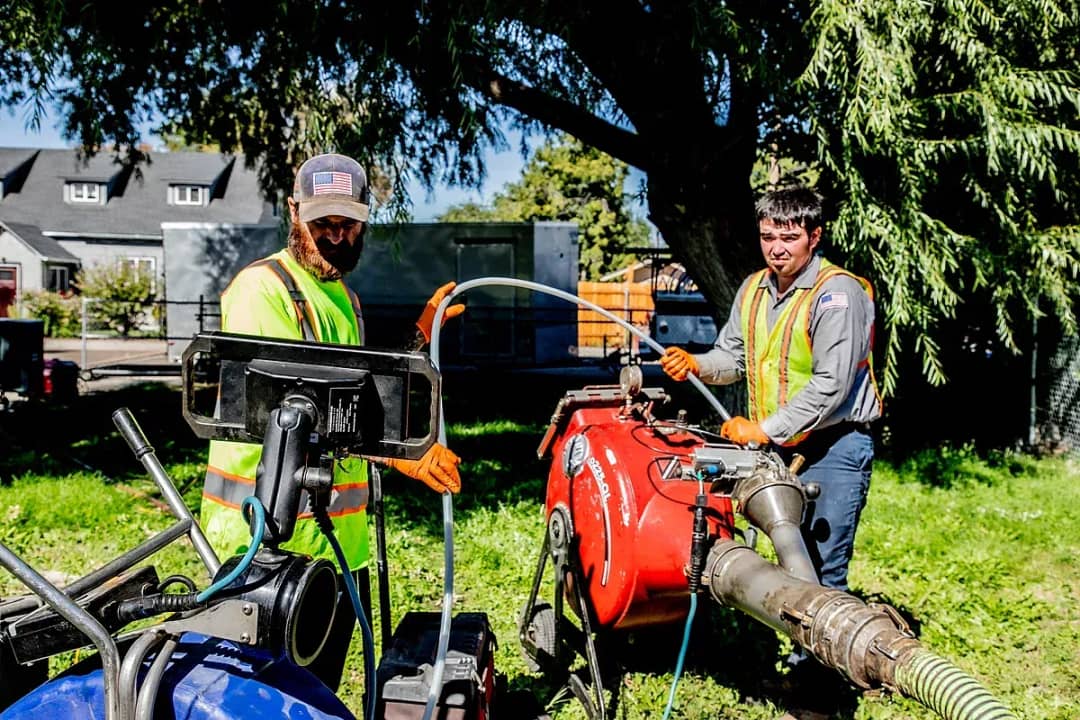
From there the job runs the same everywhere. A self-leveling color camera goes the full length of the run with footage counted, water goes in the line so that standing water reveals itself instead of hiding, and a sonde locate lets us paint the line's path and depth on the ground. You get the footage and the marks. On an older lot where the yard is also hiding a galvanized water service, it is worth knowing we do water leak detection on the same trip so nobody digs the same yard twice.
If the line is too packed to see past, we clear it and then film it. That means cabling, or hydro jetting in Middleton when the obstruction is grease, scale or hardened construction debris that a cable will only punch a hole through. Our $59 drain cleaning special covers a standard cleanout-accessible drain.
What we tell you afterward
Three grades, in plain words. Sound, leave it alone. A defect worth watching, with a re-check on a schedule. Or a defect that needs repair now, with the footage mark and the depth to prove it. We do not sell a repair off a symptom, and we do not sell a replacement when the video shows one bad joint.
Buying or selling here makes that judgment worth real money. On the old side, a pre-purchase camera inspection tells you whether you are inheriting eighty-year-old clay under a row of mature cottonwoods, which a standard home inspection will not tell you, because home inspectors do not put cameras in sewer lines. On the new side, buyers skip the inspection because the house looks new, and that is exactly the moment when a settlement belly is still somebody else's financial problem instead of yours.
What it costs
No ranges here. The variables that actually set the price on a Middleton camera inspection are how far the run is from the house to the main, whether there is a usable cleanout or we have to open the line another way, whether the line needs clearing before a lens can see anything, and whether you want the path located and marked when we are done. Old-core lots and deep subdivision setbacks are not the same run and should not carry the same number. We give you the flat price before we start, and coming out to look costs you nothing.
Call and we will find out what is actually down there
American Rooter & Drain has served the greater Treasure Valley since 1945, from the shop at 1005 Commercial Way in Caldwell where the company was established. That is a straight shot down Highway 44 from Middleton, so this is a town our trucks are in constantly rather than one we visit.
Call (208) 366-5771 to get a camera in your line, whichever half of Middleton you live in.
More about the service itself: sewer camera inspection. Everything we handle locally: our Middleton service page. If the line is already overflowing, do not wait on a camera, start with a sewer line backing up.