
We run these calls out of the shop at 1005 Commercial Way in Caldwell. American Rooter & Drain has served the greater Treasure Valley since 1945. Call (208) 366-5771 and we will get a camera into the line before anyone talks about digging.
Why does the ground under an older Parma lot keep moving?
Denser clay-loam ground grips a buried pipe and mostly leaves it alone. Confluence soil does the opposite. It is loose enough that water moves through it easily, which means the soil around a lateral compresses and rebounds with every wet-dry cycle instead of settling once and holding still. The nearby irrigation network runs its canals roughly April through October, and the shallow water table close to the river responds to that seasonal swing — rising every spring, dropping back every fall. A rigid clay pipe sitting in soil that is doing that every year for half a century does not stay in the same position it was laid in, and a joint is the one place in the whole run built to move even a little. Ask it to move every year for fifty years and eventually it moves too far.
What is actually failing inside the joint?
The original clay laterals under Parma's farmhouse-era lots were joined bell-to-spigot — the narrow end of one section fitted into the flared end of the next, sealed with mortar or a packed oakum-and-cement joint compound, no gasket. That seal was never meant to flex; it was meant to hold a fixed position. When the soil around it keeps shifting, the mortar seal is the first thing to crack, and once it does, two things happen at the same joint: soil can migrate into the pipe through the gap, and roots looking for moisture can find the same gap from outside. Neither of those is instant. A joint typically weeps and shifts for years before it opens far enough to actually offset the two pipe sections, and an offset joint is where flow catches solids, where roots have room to mat, and where the line eventually backs up on a schedule instead of once.
Is this the same backup coming back, or a new one?
That question matters more than it sounds like it should. An obstruction that is genuinely removed stays removed — if a Parma line was cabled clean and it is running slow again at the same fixture within a matter of months, the honest read is that the pipe's shape put the problem back, not that something grew back overnight. A camera reading two things settles it: whether the material at the stoppage point is loose debris sitting in an otherwise round pipe, or whether the pipe itself has stepped out of alignment at a joint. The first is a drain cleaning in Parma call. The second is a structural problem, and running a cable through it again just buys another few months before the same fixture backs up again.
Why not just cut a trench across the yard?
Because on the lots this problem shows up on, a trench is the expensive part of the job in ways that have nothing to do with labor cost. Parma's established lots tend to carry decades of landscaping that isn't easy to reproduce — a garden bed that's been worked since the property was a working farm, an outbuilding whose foundation sits close to the original lateral path, fencerows and mature trees planted long before anyone thought about where the sewer line ran underneath them. A trench the full length of that run tears through all of it, and some of what it disturbs — an established tree's root structure, a foundation's undisturbed footing — doesn't come back the way it was. Pipe bursting exists for exactly this situation: it replaces the pipe using an entry pit and an exit pit rather than a continuous open cut, so the disturbance is two contained holes instead of a scar the length of the yard.
Does Parma's older downtown carry the same problem?
Parma grew up around the site of the original Fort Boise, the Hudson's Bay Company trading post built near the Boise-Snake confluence in the 1830s, long before the current town was platted around the rail line. The historic blocks near that site are the oldest part of town, and they were plumbed on the same timeline and with the same material as the farmhouse lots around them — original clay, joined the same way, sitting in the same confluence soil. A building near that older core is not automatically a harder job, but it is a reason to assume clay and an aging joint rather than modern PVC until the camera says otherwise, and it is worth knowing if you own one of those properties and are trying to guess what is under your slab.
Does a Parma property on septic have a different version of this problem?
Farmhouse-era lots around Parma that sit outside city sewer run to a private septic system instead, and the joint-separation problem is the same mechanism on a shorter run — the lateral between the house and the tank is still clay, still bell-and-spigot, still sitting in the same confluence soil. The difference is what is on the other end. Bursting the house-to-tank lateral works the same way regardless of what is downstream, but if the tank itself is also original to the farmhouse era, that is worth a look while the camera is already in the ground rather than as a separate call later. See septic services in Parma if the tank side is the part you are actually worried about.
How does pipe bursting actually replace the line?
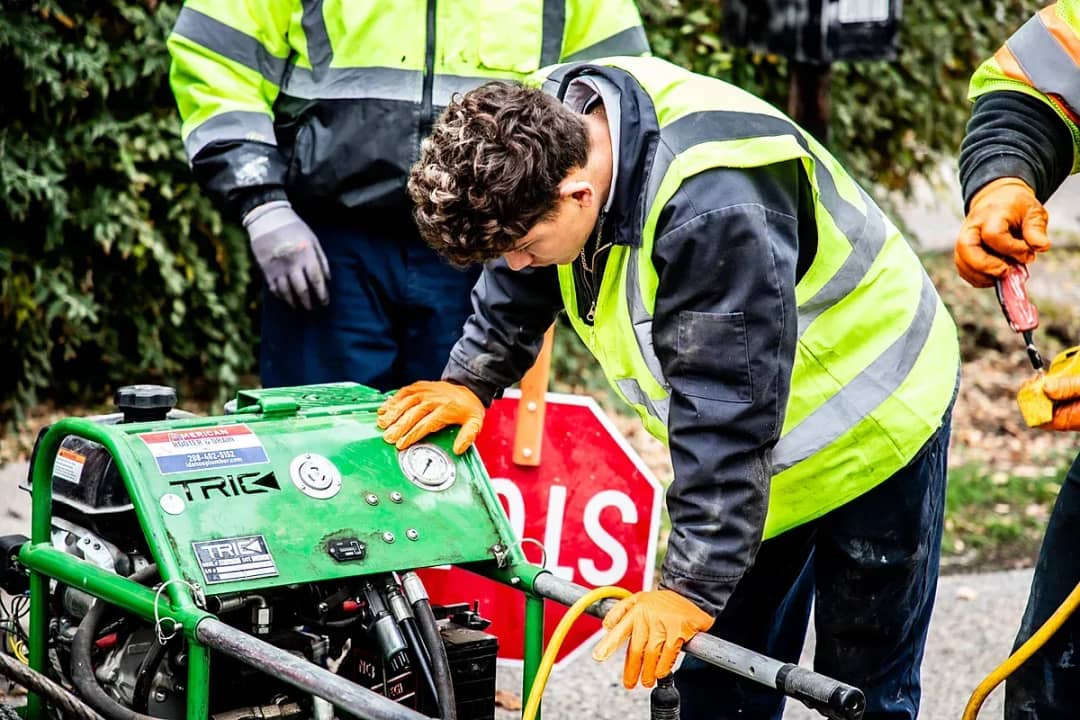
The mechanics are straightforward even though the result looks like nothing happened above ground. A bursting head — a coned steel expander — gets pulled through the old clay pipe by a cable winched from one pit to the other. As it travels, it fractures the clay outward into the surrounding soil; the old pipe does not get dug out, it gets broken apart and left in place around the new line. Trailing directly behind the bursting head is a new length of HDPE pipe, heat-fused into a single jointless run before it ever goes into the ground, so the replacement line has none of the bell-and-spigot connections that failed in the first place. Once the pull is complete, the crew reinstates the connection at each end — to the house side and to the main or the septic tie-in — and runs the camera one more time to confirm the new line is running true before anything gets backfilled.
What if the camera shows buildup instead of a break?
Then bursting is the wrong purchase, and we will say so with the footage in front of you. Roots inside a joint that has not offset yet, or ordinary debris sitting in an otherwise sound pipe, is a job for hydro jetting in Parma or a straightforward drain cleaning in Parma — our cable-clearing service is a flat $59 — not for replacing a section of pipe that is not actually broken. The camera is what tells the two situations apart, and it is the same camera pass either way, so there is no reason to guess before it runs.
When is bursting not the right answer either?
A handful of situations call for something other than bursting. A joint that has offset so far it is closed most of the bore can be past what an expander can safely widen in one pass. A line with a sharp bend built into the original layout — routed around an old foundation or a mature tree that was already there when the lateral was laid — can be tighter than a bursting head can pull through without risking the new pipe's path. And a lateral sitting only a foot or so under a slab or a driveway may not have enough cover for the ground movement bursting causes as the old pipe fractures outward. Any of those points the job toward trenchless sewer repair in Parma using a different method, or in the rare case where neither trenchless option applies, a short, targeted excavation instead of a full-length trench. We would rather tell you that from the camera footage than discover it partway through a pull.
What slows this down on an older farm lot?
A few specific things push a job past its planned time, and they are worth naming rather than treated as a mystery afterward. Sandy, loose soil needs more shoring and anchoring at the pits than denser ground does, because the winch needs something solid to pull against and loose backfill does not give it one. A tie-in at the house that was itself replaced at some point in cast iron or a mismatched fitting can take longer to reconnect cleanly than a straightforward clay-to-HDPE transition. And an offset joint that has migrated further than the camera could see from one direction alone sometimes means opening a third, smaller access point mid-run rather than assuming the two planned pits will reach it. None of that changes the flat price once it is written — if the job runs long for reasons like these, that time is ours to absorb, not an added line item.
What happens once the crew is on site, in order?
1. History first. When the backups started, whether the line has been cabled before and how long that held, which fixtures are affected.
2. Camera down the line. This is where we read the pipe material, find the offset joint, and map exactly how far along the run it sits — on its own, this is our sewer camera inspection in Parma.
3. One number, on paper, tied to what the camera found and agreed before excavation begins.
4. Entry and exit pits opened at the two points that keep the pull as short as possible while staying clear of anything worth protecting on the lot.
5. The pull itself — fused HDPE pulled through behind the bursting head, the old clay fractured outward and left in the soil.
6. Reconnection at both ends, then a final camera pass through the new line so you see the result rather than take our word for it.
7. Backfill at the two pits only — not the length of the yard.
What actually moves the price on a Parma bursting job?
There is no flat rate for this, because the honest cost drivers vary from one confluence lot to the next: how deep the original line was laid, how far it runs from the house to the main or the septic tank, how many pits the path actually needs, whether there is already a usable cleanout or one has to be established, and whether we are replacing a residential branch or a full building sewer. Soil condition matters too — sandy, silty ground pulls differently than denser soil, and that affects how the crew stages the pit locations. What you get is one written figure, built from the footage and a look at the property, handed over before you have committed to any of it.
If a Parma line has backed up more than once at the same fixture, or a patch of yard along its path stays wet longer than the rest of the lawn after a watering cycle, get the camera in before guessing at a fix. See everything we do around Parma at our Parma hub, check tree root intrusion if that is the visible symptom, or browse every city we serve on the pipe bursting overview. Call (208) 366-5771 for a free on-site camera inspection.