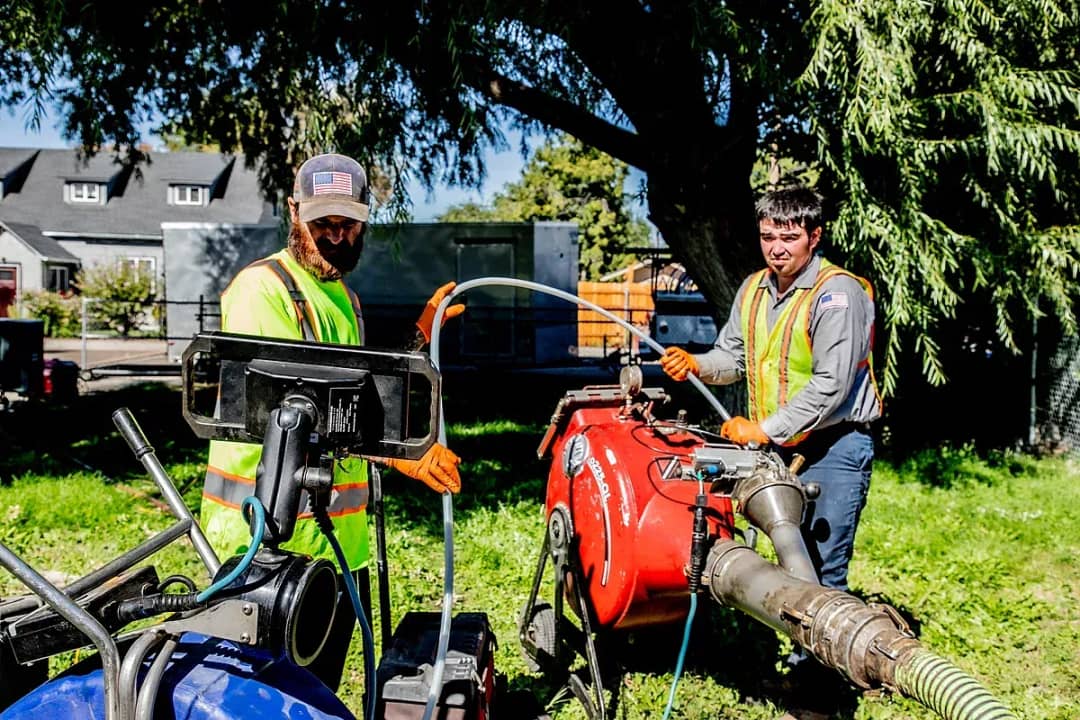
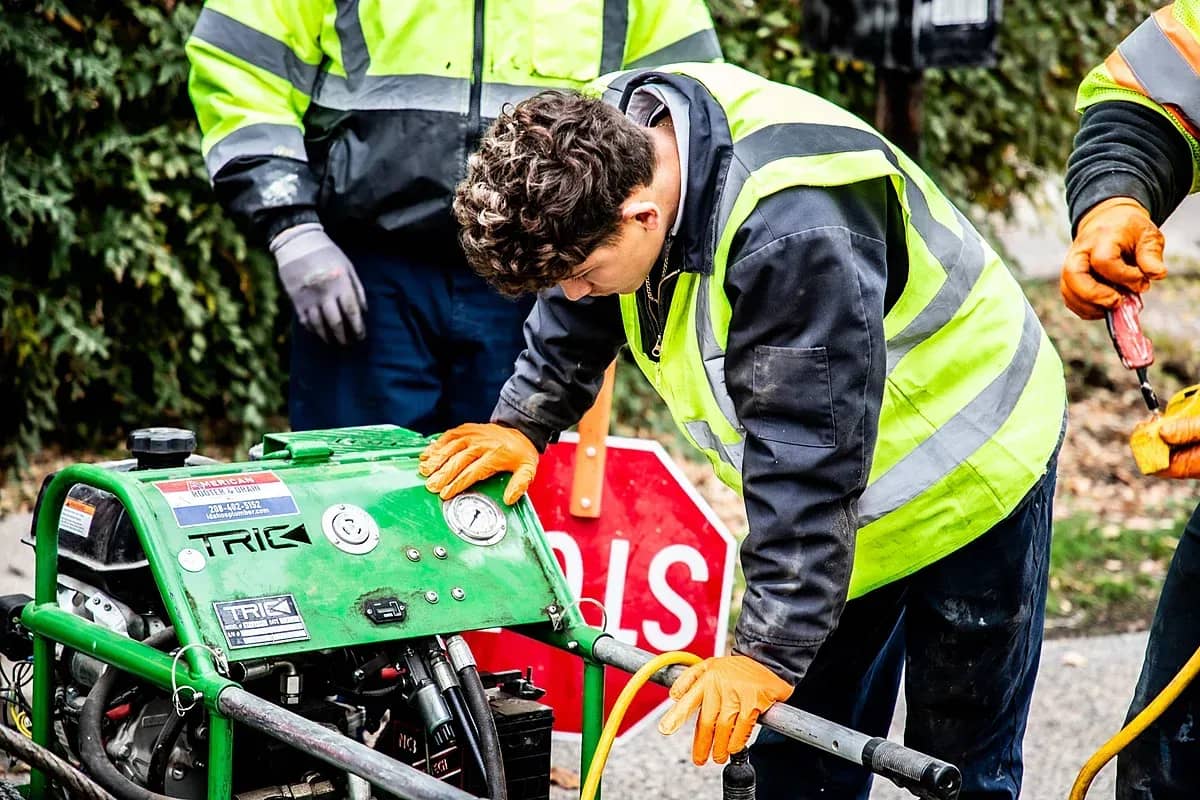
That is why we treat the camera and the locator as one tool rather than two. The camera tells us what the defect is. The locator tells us where we are standing when we are over it, and how far down. Run one without the other and you are still guessing about the only part of the job that costs real money, which is where to open the ground. American Rooter & Drain has worked the greater Treasure Valley since 1945, and Parma is a short run west of our Caldwell shop.
Finding the line is half the job
The camera head carries a transmitting sonde. With the head parked at the defect, we walk a receiver across the yard until the signal peaks, mark the spot, and read the depth off the locator. Then we walk the whole run and paint the path, so you can see your sewer line laid out on the grass instead of imagining where it might go.
The practical difference is not subtle. A located defect is a six- to eight-foot trench that lands on the problem. An unlocated one is an exploratory dig down a hundred-plus feet of run, and every foot of that is time, spoil piles, and a lawn, driveway, or pasture fence you have to put back afterward. On a long rural lateral, that gap is most of the cost of the job, and it is entirely avoidable.
Locating also keeps you from tearing up something else on the way down. Call 811 and get Digline out before any excavation, but understand what that locate does and does not cover. One-call marks utility-owned facilities: gas, power, telecom, the water main in the right of way. It does not mark private lines, and on a Parma property there is a great deal of private line underground. Your sewer lateral, the irrigation mainline, the feed out to a yard hydrant, the buried wire to the shop and the well pump, none of that is on anyone's map. A private locate is how you find it, and it is the same locator we are already carrying.
What is actually in the ground under Parma
On pre-1970 property we expect one of four materials, and each has a signature on camera.
Clay tile, laid in short sections with mortared joints. The barrel is often sound. The joints are the weakness, and there is a joint every two or three feet, which is a lot of doors for roots to try. On screen you usually see the roots first and the offset behind them.
Orangeburg, which is bituminized fiber pipe, essentially tar-impregnated wood pulp. It was common in postwar construction and stayed in use into the early seventies. It does not crack the way clay does, it deforms. The camera shows a round pipe gradually going oval, then blistering and delaminating inward until the bore closes off. Once Orangeburg starts to go it does not stop, and no amount of cleaning changes that.
Cast iron, typically under the house and out toward the property line. It fails by scaling, a rough rusted buildup that narrows the bore and grabs everything passing through, usually with a worn channel along the bottom.
Early thin-wall plastic from the seventies and eighties. Better than the other three, but the joints pull apart when a long trench settles and it crushes under load.
Knowing which one is in your yard changes the recommendation completely. Clay with roots at three joints can be cut and maintained on a schedule. Orangeburg going oval is a replacement conversation from the first minute of footage.
Long lines fail in the middle, not at the house
A short suburban lateral is thirty or forty feet. A Parma farmhouse lateral is frequently three or four times that, and the extra length changes the physics of how it fails.
At the standard quarter-inch-per-foot fall, a 120-foot run drops about two and a half feet between the house and the connection. Every joint along that run is an opportunity for the trench beneath it to settle, and settlement out in the middle of a long line produces a belly, a low section that holds standing water permanently. In a short lateral a half-inch dip is nothing. In the middle of a long run the same settlement can hold water across twenty feet of pipe, and standing water is exactly where solids drop out and build. That is the line that backs up every few months, gets cabled, runs beautifully for eight weeks, and does it again. The cable is not failing. It is clearing a symptom of a defect that is still sitting there holding water.
Then there is what drives over the top of it. Farmyard laterals cross driveways, two-tracks, and field accesses, and take loaded trucks and tractors over them at harvest. Clay and Orangeburg were never rated for that kind of point load. Some of the worst crushed pipe we pull out of the ground in this area is precisely where a vehicle turns.
If your drains gurgle, a floor drain burps when the washing machine dumps, or you catch sewer gas in the utility room, those are long-line symptoms and they are worth taking seriously. Our page on sewer smell in the house walks through what causes it. If instead one fixture keeps draining slow while everything else in the house runs fine, the problem is probably local to that fixture, not the lateral, and clogged toilet is the better starting point.
When there is no cleanout
A fair number of older Parma houses have no accessible cleanout at all, or had one that vanished under forty years of lawn, a flower bed, a deck, or a concrete pad. That is a real obstacle rather than a detail, because access decides how much of the line the inspection can actually see.
Options, best to worst. Best case, we locate the buried cleanout, which is usually findable, and open it back up so it can be used again from here on. Next best, we pull a toilet and enter at the closet flange, which gives a clean straight shot down the main run. Least useful is going down the roof vent. It sounds clever and mostly is not: vent geometry is tight, the camera fights every turn, and you often cannot reach the section that actually matters.
If the property has no cleanout, we will usually recommend installing a two-way cleanout near where the line leaves the house. It is a modest one-time job, and on a long rural lateral it makes every future cleaning, inspection, and jetting on that property faster and less invasive for as long as you own the place.
Septic tanks, and where the camera stops
A lot of Parma-area property is on septic, and there is a hard limit to what a camera does for you there. We run the line from the house out to the tank inlet and inspect that pipe. Past the inlet baffle a camera is the wrong instrument, because you are looking at liquid rather than at pipe.
A tank gets evaluated differently: liquid level relative to the outlet, sludge and scum depth, baffle condition, and whether effluent is standing where it has no business standing. If the tank has not been pumped in years, that is the first move regardless of what the lateral looks like, because a tank sitting at capacity backs up into perfectly good pipe and makes the pipe look guilty. Our 1,000-gallon pump-out is $395.
This is where the two halves matter most. A house on a long lateral running to a tank has two independent systems that can fail and only one symptom to tell you which. Camera the lateral, inspect the tank, and you stop paying to fix the half that was never broken.
What changes the price of an inspection
There is no honest fixed number for a line nobody has seen yet, so here is what moves it on a Parma property. Access, first: an existing open cleanout is the easy case, and locating a buried one or pulling a toilet is more work. Run length, and whether the lateral crosses a driveway, an irrigation ditch, or a field access. Whether the pipe has to be cleared before a camera can pass through it. Whether you want the run located and marked on the surface, which out here is usually the part most worth paying for. And whether we are looking at one line or at a house plus a shop, a second dwelling, or a rental sharing the same parcel.
The on-site estimate is free and the price is flat and stated before we start. If the footage shows a repair is needed, you see the defect on the screen before anyone quotes the work, and nothing gets excavated without your say-so.
One related note. If the wet spot in the yard is clean water rather than sewage, you are dealing with a pressurized line, not a gravity sewer, and the locating method is completely different. That work starts at water leak detection instead.
Book a camera inspection in Parma
Call American Rooter & Drain at (208) 366-5771. The shop is at 1005 Commercial Way in Caldwell, established in Caldwell, Idaho in 1945, and Parma is twenty minutes west of the door.
See everything we do in Parma, the full service overview on the main sewer camera inspection page, or the town we work out of every day, sewer camera inspection in Caldwell.