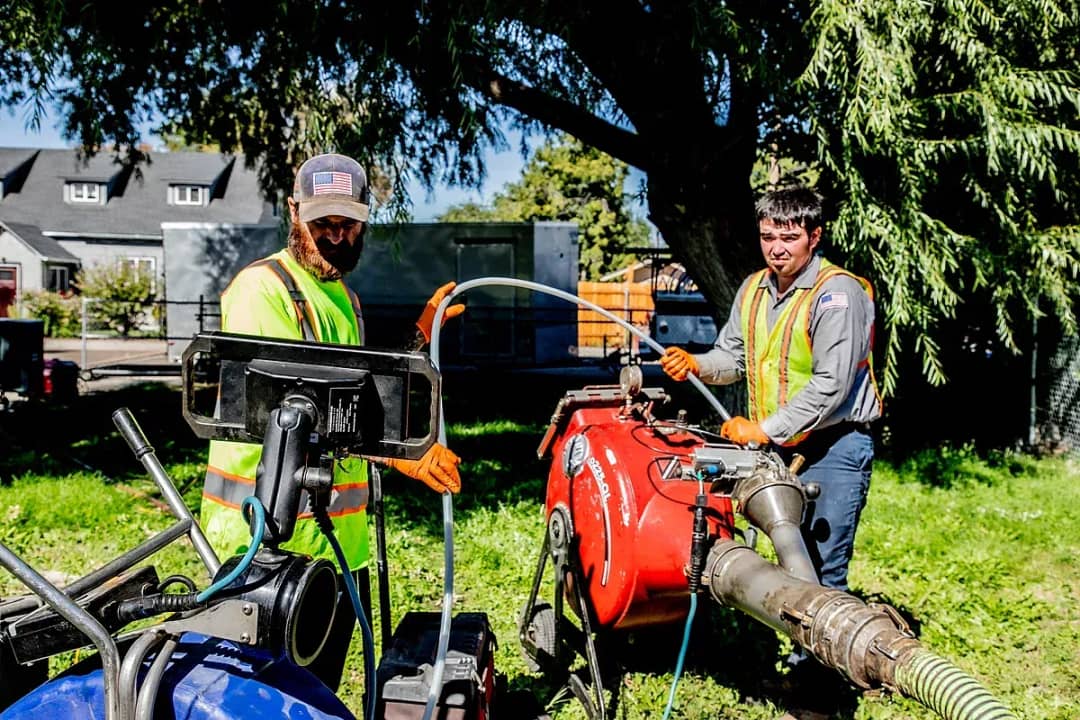
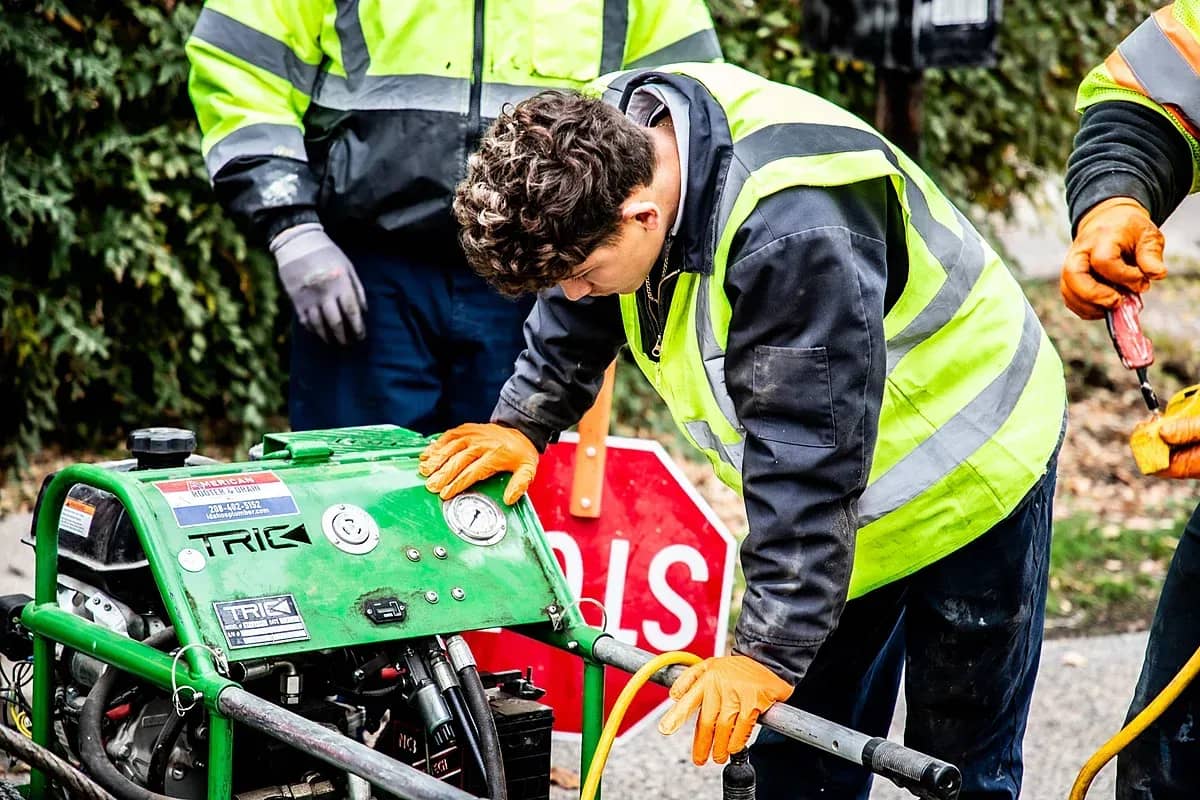
American Rooter & Drain runs a self-leveling color camera with a transmitting sonde in the head, so we are not just handing you a picture of the damage. We walk the yard with the locator and paint the spot on the grass with a depth written next to it. That mark is what keeps a repair from turning into an exploratory dig across a lawn. Call (208) 366-5771 and we will tell you what the visit involves before you commit to anything.
Long runs change what an inspection in Nyssa actually has to cover
In a newer subdivision the lateral from house to main is thirty or forty feet and there is not much room for surprises. On the older deep lots here the run is frequently well past a hundred feet, and on the farmsteads out toward the county roads the run to a septic tank is longer than that. Length matters for three concrete reasons.
First, joints. Clay pipe came in short sections, so a long run is simply a long string of joints, and every joint is a candidate for roots and for offset. Second, slope. Over a hundred feet of pipe laid in ground that has been irrigated for decades, a settled low spot two-thirds of the way out is common, and a belly does not announce itself until it has collected enough solids to matter. Third, and this is the one that costs people money: most drain cables that get run at a house are not long enough to reach the far end of a Nyssa lateral. A snake that stopped at seventy-five feet and came back clean tells you nothing whatsoever about what is happening at a hundred and ten. We have camera reels that go the full distance, and we push to the main or to the tank, not to the end of somebody's cable.
Irrigation season shows up in the footage
This is farm ground with water on it. Canal season saturates the soil from spring into fall, then the ground dries out and shrinks for the back half of the year, and pipe joints get worked open and closed twice a year for as long as they have been in the ground. That cycle is the reason so many laterals here fail at the joints rather than in the middle of a stick of pipe.
The second half of it is silt. Project water carries fine sand and silt, and yards that get flood irrigated put a lot of that into the ground around a pipe that has open joints. Where the line has settled into a low spot, the silt drops out and builds up a bar, the way it does in a slow stretch of river. What the homeowner experiences is a line that behaves perfectly in February and starts backing up in July, then partially clears itself over the winter. If that seasonal pattern sounds like your house, the page on drains that keep backing up on a schedule is worth reading, because that signature is one of the most common things we put a camera on in this town. A sand and silt bar in a bellied section is also one of the few sewer problems that hydro jetting genuinely resolves, which is a much better outcome than a replacement, and the camera is what separates the two.
Windbreak poplars, ditch-bank cottonwoods, and one open joint
Rows of Lombardy poplar along property lines, cottonwoods on the ditch banks, and old elms and locusts on the parking strips are not decoration around here, they are infrastructure, and their roots behave accordingly. By late summer the coolest, wettest thing anywhere in that soil column is the inside of your sewer lateral, and a root will travel a surprising distance sideways to get to a joint that weeps.
What we are looking for on screen is the difference between two situations that feel identical from inside the house. One is a fine root hair intrusion at a single joint, which gets cut, treated, and re-inspected in a year, and the pipe carries on. The other is an established mat that has already pushed the joint out of alignment, where cutting it is a subscription rather than a fix because the pipe is no longer round at that point. Homeowners are told the first story and sold the second all the time. The footage settles it in about a minute. If you already know roots are your issue, see tree roots in a sewer line for how we handle each of those cases.
Getting a truck to Nyssa, and the state-line question
People assume the state line complicates scheduling. It does not, and there is a specific reason. Malheur County runs on Mountain Time, the same clock as our shop at 1005 Commercial Way in Caldwell, so when we give you an eight o'clock arrival window that is eight o'clock on your kitchen clock as well. No conversion, no missed morning, no argument about who was an hour off.
The drive is I-84 west to Ontario and then south on Oregon 201 down the river, or across at the Parma bridge on the highway when that route is moving better. It is roughly three quarters of an hour with a loaded truck. We are set up to work both sides of the line, and the camera, the locator, the cable machine and the jetter all ride out together on the same truck. That matters more than it sounds: if the line is packed badly enough that the lens cannot see past the blockage, we clear it and camera it on the same visit instead of booking you a second trip across the river a week later.
When there is no cleanout to work from
A lot of houses in the older part of town never got an exterior two-way cleanout installed, because nobody was thinking about camera access when the line went in. That leaves three ways in: pull a toilet and go through the closet flange, run down through a roof vent, or use an accessible stack in a basement or crawlspace if the house has one. Each has tradeoffs, and we tell you which one we intend to use and what it involves before we start rather than after. Pulling a water closet means a reset and a new wax ring, and that is a small job, but it should not be a surprise on the invoice.
If we are already in there and the footage shows you will be looking at this line again, adding a proper cleanout is usually the cheapest thing on the list and it makes every future visit shorter. We will say so if it applies and leave it alone if it does not.
Houses outside the city limits
Past the city boundary, out toward Adrian and the Owyhee ground, homes are on a tank and drainfield instead of a main, and a camera inspection there is a different job with a different endpoint. We run the lens from the house to the tank inlet, check that the line is actually reaching the tank and at what grade, and look at the condition of the inlet baffle while we are there. A backed-up house on a septic system is frequently not a sewer line problem at all, it is a tank that is overdue, and the honest answer costs less: we pump a 1,000-gallon tank for $395 and you are done. If it is one slow fixture rather than the whole house, the $59 drain cleaning special usually covers it.
There is also the case where the wet spot in the yard turns out to be pressurized water rather than sewage. With irrigation lines, stock waterers, hose bibs and long buried service runs on rural property here, that happens often enough to mention. That is an outdoor water line leak, and it takes a different tool to pinpoint.
What it costs to find out
We quote a flat price for the inspection before the camera goes in the pipe, and we get to that number on site rather than over the phone, because the honest variables are things we have to look at. How long is the run. Is there a usable cleanout or do we have to make access. Does the line need to be cleared before the lens can see anything. Is this house-to-main or house-to-tank. Two houses three blocks apart in Nyssa can be different answers on all four of those, which is exactly why we do not throw numbers at people sight unseen. The estimate visit is free, the price you are given is the price, and if the footage shows a repair is warranted, that scope gets quoted the same way with the video in front of you.
Set up an inspection
Call (208) 366-5771, or if you are standing outside watching it come up out of the cleanout right now, read what to do when a sewer line is backing up first and then call. American Rooter & Drain has worked the greater Treasure Valley since 1945 and we are licensed on both sides of the river.
Everything else we handle in town is listed on the Nyssa service page, and if you are comparing towns, the parent sewer camera inspection page covers the rest of the valley.